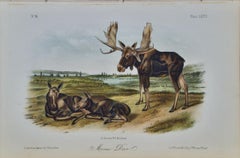
Moose Landscape Prints
to
3
Overall Width
to
Overall Height
to
2
2
1
3
3
22
6,817
3,352
2,606
2,330
1,833
1,663
1,504
1,373
1,217
1,044
1,025
989
867
848
830
718
579
527
520
2
2
1
1
3
Art Subject: Moose
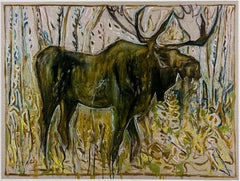
Billy Childish - Moose
Located in London, GB
Moose, 2020
Archival print on heavy matt stock
30.5 x 38 cm
Edition of 200
signed and numbered by the artist
Billy Childish is a prolific British artist, musician, and writer known...
Category
2010s Contemporary Figurative Prints
Materials
Archival Pigment
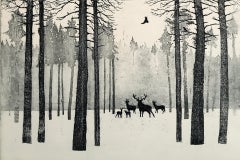
Tim Southall, Deer in Winter, Contemporary Etching, Animal Print, Affordable Art
By Tim Southall
Located in Deddington, GB
Tim Southall
Deer in Winter
Limited Edition Etching
Edition of 75
Image Size: H 20cm x W 30cm
Sheet Size: H 35cm x W 42cm x D 0.1cm
Sold Unframed
(Please note that in situ images are...
Category
21st Century and Contemporary Contemporary Landscape Prints
Materials
Paper, Etching

Tim Southall, Deer in Winter, Contemporary Etching, Animal Print, Affordable Art
By Tim Southall
Located in Deddington, GB
Tim Southall
Deer in Winter
Limited Edition Etching
Edition of 75
Image Size: H 20cm x W 30cm
Sheet Size: H 35cm x W 42cm x D 0.1cm
Sold Unframed
(Please note that in situ images are...
Category
21st Century and Contemporary Naturalistic Landscape Prints
Materials
Paper, Etching
Related Items
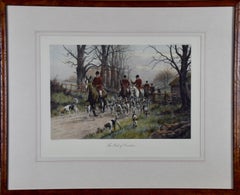
Engraving of a British Fox Hunting Scene "The Pink Of Condition"
Located in Alamo, CA
The engraving "The Pink Of Condition" by George Wright was published in London in 1909. It depicts the beginning of a British fox hunting scene. The ...
Category
Early 1900s Naturalistic Landscape Prints
Materials
Engraving

$1,075
H 23.63 in W 28.75 in D 0.88 in
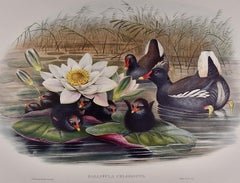
A Family of Moorhens & Lilly Pad: A 19th C. Hand-colored Lithograph by Gould
Located in Alamo, CA
This is an original 19th century hand-colored folio-sized lithograph entitled "Gallinula Chloropus" (Moorhen) by John Gould, published in his "Birds of Great Britain", published in London between 1862 and 1873. The print, which was drawn by Gould and Henry Richter and lithographed by Walter & Cohn, depicts a family of Moorhens, including two adults and six babies in a beautiful landscape. The adults are in the water and the babies are lying on the leaves a flowering lilly pad.
This striking Gould hand-colored moorhen family lithograph is augmented with gum-arabic paint. The sheet measures 14.88" high and 21.75" wide. It is in excellent condition, other than a spot in the upper portion of the right margin and two small spots at the edge of the lower margin on the left. The original descriptive text pages from Gould's 19th century publication are included.
There are several other unframed Gould hummingbird lithographs available on our 1stdibs and InCollect storefronts. Two or more of these striking lithographs would make an attractive display grouping. A discount is available for purchase of a set depending on the number. These additional Gould hummingbirds may be viewed by typing Timeless Intaglio...
Category
Mid-19th Century Naturalistic Animal Prints
Materials
Lithograph
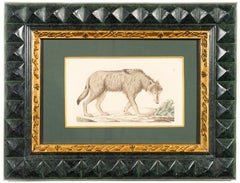
A Wolf, Hand-Colored Print From The Early 1800s by Johan Wilhelm Palmstruch
Located in Stockholm, SE
Johan Wilhelm Palmstruch (1770-1811) Sweden
Title: A Wolf
hand-coloured print
early 1800s
print dimensions approx 4.33 x 7.08 inches (11 x 18 cm)
frame 11.81 x 15.74 inches (30 ...
Category
Early 19th Century Naturalistic Animal Prints
Materials
Etching
$1,018
H 11.82 in W 15.75 in
Italian Summer, Framed Etching by Michael Chapman
By Michael James Chaplin
Located in Brecon, Powys
Etching from the studio of this acclaimed British Watercolorist.
Good condition. Image 15.5" x 11.5"
English artist Michael Chaplin is a Member of the Royal Watercolor Society, pa...
Category
1990s Realist Landscape Prints
Materials
Etching
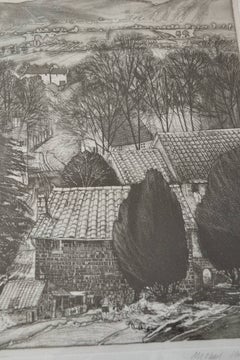
Meadow-Limited Edition Etching, Signed by Artist
By Russa Graeme
Located in Chesterfield, MI
Limited Edition Etching (125/200). Signed by Artist. Measures 32.75 x 25.5 inches and is unframed. The piece is in Fair/Distressed Condition-discoloration/yellowing primarily in the ...
Category
Late 20th Century Landscape Prints
Materials
Etching
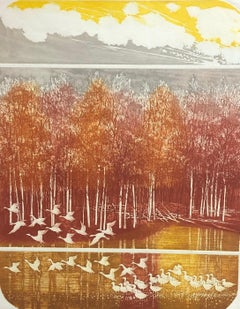
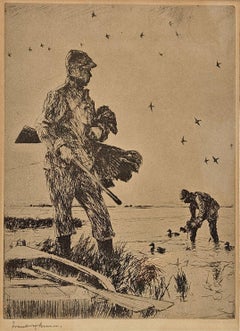
"Winter Wildfowling" Frank Weston Benson, Hunting Scene, Outdoors, Marshes
Located in New York, NY
Frank Weston Benson
Winter Wildfowling, 1927
Signed lower left
Etching on paper
Image 8 1/2 x 7 inches
Born in Salem, Massachusetts, a descendant of a long line of sea captains, Benson first studied art at Boston’s Museum School where he became editor of the student magazine. In 1883, Benson enrolled at the Académie Julian in Paris where artists such as Bouguereau, Lefebvre, Constant, Doucet and Boulanger taught students from all over Europe and America. It was Boulanger who gave Benson his highest commendation. “Young man,” he said, “Your career is in your hands . . . you will do very well.” Benson’s parents gave him a present of one thousand dollars a twenty-first birthday and told him to return home when it ran out. The money lasted long enough to provide Benson with two years of schooling in Paris, a summer at the seaside village of Concarneau in Brittany and travel in England.
Upon returning to America, Benson opened a studio on Salem’s Chestnut Street and began painting portraits of family and friends. An oil of his wife, Ellen Perry Peirson, dressed in her wedding gown is representative of this period. It demonstrates not only the academic techniques he learned at the Academie Julian but also his own growing emphasis on the effects of light. And yet, despite all the technical mastery displayed in the work, the painting exudes the warmth that existed between model and artist. More than a likeness, it is a study in serenity. Perhaps it was of a work such as this that Benson was thinking when he said, “The more a painter knows about his subject, the more he studies and understands it, the more the true nature of it is perceived by whoever looks at it, even though it is extremely subtle and not easy to see or understand. A painter must search deeply into the aspects of a subject, must know and understand it thoroughly before he can represent it well.”
Following a brief stint as an instructor at the Portland, Maine, Society of Art, Benson was appointed as instructor of antique drawing at the Museum School in Boston in the spring of l889. Benson’s long association with the school was particularly fruitful. Under the leadership of Edmund Tarbell and Benson the Museum School became a national and internationally recognized institution. The students won numerous prizes, enrollment tripled, a new school building was erected and visiting delegations from other schools sought the secret of their success. Benson cherished his role as teacher and was held in high esteem by his students, many of whom called him “Cher Maitre.” Reminiscing about his long career with the school Benson once said, “I may have taught many students, but it was I who learned the most.”
In 1890, Benson won the Hallgarten Prize at the National Academy in New York. It was the first of a long series of awards, that earning for him the sobriquet “America’s Most Medalled Painter.” In the early years of his career, Benson’s studio works were mostly portraits or paintings of figures set in richly appointed interiors. Young women in white stretch their hands out towards the glow of an unseen fire; girls converse on an antique settee in a room full of objets d’arts; his first daughter, Eleanor, poses with her cat. Works of this sort, together with a steady influx of portrait commissions, earned Benson both renown and financial rewards, yet it was in his outdoor works that gave Benson his greatest pleasure.
In the latter half of the 1890s, Benson summered in Newcastle, on New Hampshire’s short stretch of seacoast. It was here, in 1899, that Benson made his first foray into impressionism with Children in the Woods and The Sisters, the latter a sun-dappled study of his two youngest daughters, Sylvia and Elisabeth.
This painting was one of the first works that Benson hung at an exhibition with nine friends. The resignation of these ten illustrious artists rocked the American art establishment but, the catalogue for their first exhibition was titled, simply, “Ten American Painters.” When, in 1898, the three Bostonians and seven New Yorkers began to exhibit their best work in exquisitely arranged small shows, the group (dubbed by newspapers, “The Ten” ) quickly became known as the American Impressionists, a bow to the style of their French predecessors. The Ten’s annual shows soon became an eagerly awaited part of the annual exhibition calendar and were always well reviewed. Held annually in New York City, the group’s yearly exhibitions usually traveled to Boston and were occasionally seen in other cities. Benson’s association with other members of the group such as Childe Hassam, Thomas Dewing, William Merrit Chase and J. Alden Weir, only reinforced his growing emphasis on the tenets of Impressionism. As he later said to his daughter Eleanor, “I follow the light, where it comes from, where it goes.”
The principles of Impressionism began to dominate Benson’s work by 1901, the year that the Bensons first summered on the island of North Haven in Maine’s Penobscot Bay. His summer home “Wooster Farm,” which they rented and finally bought in 1906, became the setting for some of Benson’s best known work and there, it seemed, he found endless inspiration. Benson’s sparkling plein-air paintings of his children–Eleanor, George, Elisabeth and Sylvia–capture the very essence of summer and have been widely reproduced: In The Hilltop, George and Eleanor watch the sailboat races from the headland near their house.
As a boy, Benson dreamed of being an ornithological illustrator. In mid-life, he returned to the wildfowl and sporting subjects that had remained his lifelong passion. Using etching and lithography, watercolor, oil and wash, Benson portrayed the birds observed since childhood and captured scenes of his hunting and fishing expeditions.
Together with his two brothers-in-law, Benson bought a small hunting retreat on a hill overlooking Cape Cod’s Nauset Marsh. Here, in the late 1890s, he began experimenting with black and white wash drawings. These paintings became so popular that Benson was not able to keep up with the demand. He turned to an art publishing company to have several made into it intaglio prints; twelve wash drawings are known to have been reproduced in this manner. At least two of them were given as gifts to associate members of the Boston Guild of artists, of which Benson was a founding member.
Benson was also an avid fisherman and his salmon fishing expeditions to Canada’s Gaspé Peninsula where one of the high points of his summer. There, in 1921, he began the first in a series of watercolors that would eventually over 500 works.
Benson’s watercolors conveyed the joy and beauty of a sportsman’s life whether in a painting of a hunter setting out decoys, a flock of ducks coming in for a landing or a grouse flushed from cover. The critics favorably compared Benson’s watercolors to those of Homer. “The love of the almost primitive wilderness which appears in many of Homer’s landscapes and the swift, sure touch with which he suggests rather than describes–these also characterize Benson’s work,” one critic wrote. “The solitude of the northern woods is very much like Homer’s.”
Like the wash drawings before them, Benson’s watercolors proved...
Category
1920s Academic Animal Prints
Materials
Paper, Etching
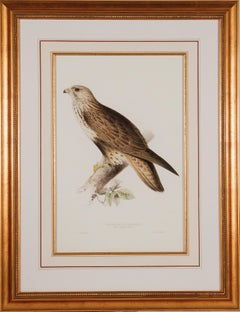
Rough-legged Buzzard: 19th C. Hand-colored Lithograph by J. Gould & Edward Lear
By Edward Lear
Located in Alamo, CA
This is an original 19th century hand-colored folio-sized lithograph entitled "Archibuteo Lagopus" (Rough-Legged Buzzard) by John Gould and Edward Lear, from Gould's "Birds of Great Britain", published in London between 1862 and 1873. The print depicts an adult Rough-Legged Buzzard perched on a branch of a tree looking to the left.
This beautiful framed Gould hand-colored lithograph is presented in a gold-colored wood frame and cream-colored French mat, embellished by a gold-colored fillet. The frame measures 33" high, 25.5" wide and 1.25" thick. It is in excellent condition
There are several other unframed Gould bird lithographs available on our 1stdibs and InCollect storefronts. Two or more of these striking lithographs would make an attractive display grouping. A discount is available for purchase of a set depending on the number. These additional Gould hummingbirds may be viewed by typing Timeless Intaglio in the 1stdibs or InCollect search field to be taken to our storefront.
John Gould (1804-1881]) was an English ornithologist and artist. He, like his American contemporary John James Audubon, published a number of books on birds in the mid 19th century, illustrated by hand-colored lithographs. His wife and fellow artist, Elizabeth Gould, and several other artists including Edward Lear and Henry Constantine Richter produced lithographs for his various publications. He has been considered the father of bird study in Australia and the Gould League in Australia is named after him. Charles Darwin referenced Gould’s work in his book, "On the Origin of Species" and Gould named a bird after Darwin; "Darwin's finches".
Gould began his career in London as a taxidermist, but in 1827 became the first curator and conservator at the museum of the Zoological Society of London. In this position naturalists brought him collections of birds from all over the world. He began creating drawings and eventually hand-colored lithographs with his wife and Edward Lear, which were the basis for his first publications. Darwin brought him specimens from the Galapagos Islands, including 12 species of finches which had never been described. In 1838, Gould and his wife travelled to Australia and their work led to the seven volume publication of “The Birds of Australia”. Gould had a fascination for hummingbirds and collected specimens of 320 varieties before ever seeing a live hummingbird on a trip to the United States in 1857. He eventually published “A Monograph of the Trochilidae, or Family of Humming-birds". Other large publications include: "The Birds of Europe"," A Monograph of the Ramphastidae, or Family of Toucans”, “A Synopsis of the Birds of Australia, and the Adjacent Islands”, “A Monograph of the Odontophorinae, or Partridges of America”, “The Birds of Asia”, “The Birds of Great Britain” and "The Birds of New Guinea and the Adjacent Papuan Islands, including many new species recently discovered in Australia".
John Gould (1804-1881) was a British ornithologist and illustrator who is best known for his monumental work, "The Birds of Europe," published between 1832 and 1837. Gould was born in Lyme Regis, Dorset, England, and began working as a taxidermist and natural history dealer in London in the 1820s. In 1827, Gould was appointed the first curator and preserver of birds at the Zoological Society of London, where he began to build his collection of specimens and began to study the birds of the world. He published his first monograph, "A Century of Birds from the Himalaya Mountains," in 1831, which included 80 plates of Himalayan birds. Gould continued to publish numerous volumes on the birds of the world throughout his life, including "The Birds of Australia" (1840-1848) and "The Birds of Great Britain" (1862-1873). His works were highly regarded for their accuracy and detail, and he was one of the most prominent ornithologists of his time.
In addition to his work as an ornithologist, Gould was also a successful businessman, and he used his profits to fund expeditions and to support the scientific community. He was elected a Fellow of the Royal Society in 1843, and he was awarded the Royal Medal...
Category
Mid-19th Century Naturalistic Animal Prints
Materials
Lithograph
$2,575
H 33 in W 25.5 in D 1.25 in
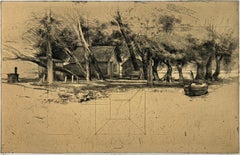
Lakeshore, landscape by lake, by Trevor Southey
Located in Palm Springs, CA
Signed, titled and numbered by the artist from an edition of 60. Nostalgic scene of a lakeshore cabin with boat.
Trevor Southey was born in Rhodesia, Africa (now Zimbabwe) in 1940....
Category
1980s Contemporary Landscape Prints
Materials
Etching, Aquatint
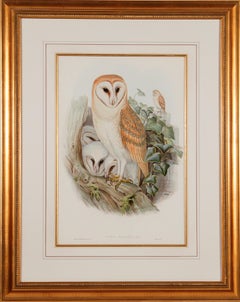
Barn Owl Family: A Framed Original 19th C. Hand-colored Lithograph by Gould
Located in Alamo, CA
This is a framed original 19th century hand-colored folio-sized lithograph entitled “Strix Flammea” (Barn Owl) by John Gould, from his "Birds of Great Britain", published in London between 1862 and 1873. The print depicts an adult Barn Owl perched on a log its three baby owls to the left. Another adult owl in the background on the right, presumably a male, watches over his family. There are leaves on the right contributing to this pleasant landscape composition.
This striking framed Gould...
Category
Mid-19th Century Naturalistic Animal Prints
Materials
Lithograph
$3,775
H 32 in W 25.5 in D 1.5 in
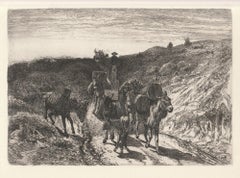
A Burro Train, New Mexico
By Peter Moran
Located in Middletown, NY
Etching with aquatint on heavy laid paper, 7 x 9 1/4 inches (172 x 233 mm), full margins. Signed in the plate, lower right image area. Minor corner loss, top right, and a 1/4 inch ed...
Category
Late 19th Century American Realist Animal Prints
Materials
Laid Paper, Etching
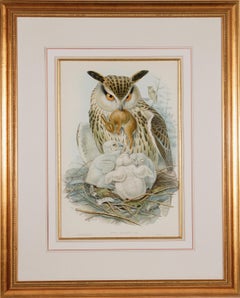
Eagle or Horned Owl: A Framed Original 19th C. Hand-colored Lithograph by Gould
Located in Alamo, CA
This is a framed original 19th century hand-colored folio-sized lithograph entitled “Bubo Maximus" (Great Horned or Eagle Owl) by John Gould, from the supplement to his "Birds of Great Britain", published in London between 1862 and 1873. The print depicts an adult Eagle Owl about to feed her brood of babies who are in the their nest. A another adult (possibly the male) is seen in the distant background in the upper right.
This striking framed Gould...
Category
Mid-19th Century Naturalistic Animal Prints
Materials
Lithograph
$3,775
H 35 in W 28.25 in D 1.25 in
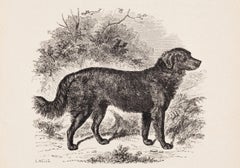
Retriever Crossed with a Setter
Located in Columbia, MO
Retriever Crossed with a Setter
1887
Etching
3 x 5
Category
Late 19th Century Naturalistic Animal Prints
Materials
Etching
Previously Available Items
"Moose Deer", an Original 19th C. Audubon Hand-colored Quadruped Lithograph
Located in Alamo, CA
This is an original John James Audubon hand-colored royal octavo lithograph entitled "Moose Deer, Male", No. 16, Plate 76 from Audubon's "Quadrupeds of North America". It was drawn on stone by William Hitchcock, printed and colored by J. T. Bowen and published in 1849-1854. It depicts a male moose standing on grass on the right with two female moose...
Category
Mid-19th Century Naturalistic Animal Prints
Materials
Lithograph