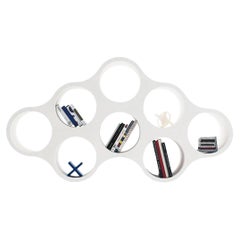
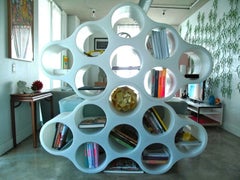
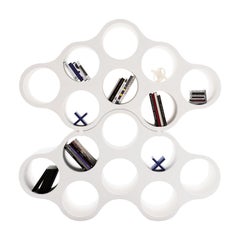
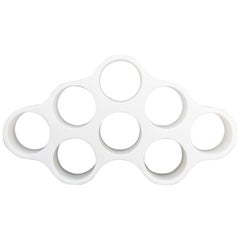
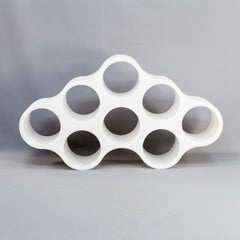
Bouroullec Cloud For Sale on 1stDibs
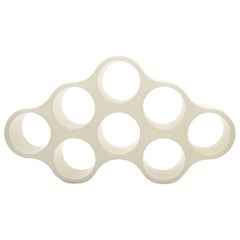
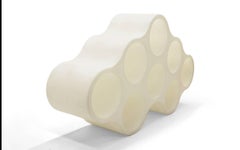
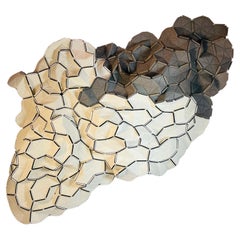
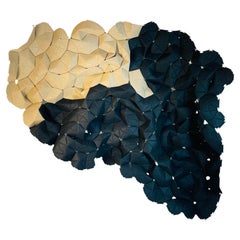
Choose from an assortment of styles, material and more with respect to the bouroullec cloud you’re looking for at 1stDibs. A bouroullec cloud — often made from
metal,
brass and
blown glass — can elevate any home. Each bouroullec cloud bearing
modern hallmarks is very popular. A well-made bouroullec cloud has long been a part of the offerings for many furniture designers and manufacturers, but those produced by
Marie & Alexandre and
Carla Baz are consistently popular.
How Much is a Bouroullec Cloud?
The average selling price for a bouroullec cloud at 1stDibs is $2,068, while they’re typically $1,408 on the low end and $8,147 for the highest priced.
Cappellini for sale on 1stDibs
In 1946, at the start of a postwar boom in Europe, Enrico Cappellini opened the doors to a small furniture studio in the Italian town of Carugo. But it wasn’t until his son joined the company nearly three decades later that Cappellini became a powerhouse fixture on the global design stage. Today Cappellini is one of the world’s foremost manufacturers of innovative chairs, tables and decorative objects.
Giulio Cappellini joined the family company in 1977 and, with his appointment, ushered in a stage of boundary-pushing modernism and prolific creativity at Cappellini. With a dual background in architecture and business management, Giulio was well equipped to steer the brand into both innovative design and economic growth in a rapidly globalizing economy.
The second-generation leader’s first major success came in 1981, with the launch of Sistemi, a modular, hyperfunctional storage system that would come to symbolize the chic functionality of Cappellini. That was quickly followed by a collaboration with renowned Japanese designer Shiro Kuramata for the Progetti Compiuti collection, a line that brought unexpected playfulness to the simple framework of a black-and-white cabinet and remains an iconic collectible today.
That first collaboration opened the doors to a prolific output of partnerships, with Cappellini tapping such star designers as Jasper Morrison, Marcel Wanders, Tom Dixon, Ronan and Erwan Bouroullec and Nendo for collections over the ensuing decades that spanned a range of materials and styles. Speaking to this range, Marc Newson’s plumply curvaceous 1988 Embryo chair, Jasper Morrison’s slightly arachnoid 1987 Thinking Man’s chair and Tom Dixon’s sculptural 1991 S-chair — each quite stylistically unique — remain some of the company’s most recognizable pieces, with the latter in the permanent collection of the Museum of Modern Art.
Cappellini, now headquartered in Milan, continues to partner with guest designers across furniture, storage and lighting solutions, though many of its 1970s and ’80s designs remain its most coveted today.
Find vintage Cappellini furniture on 1stDibs.
A Close Look at Modern Furniture
The late 19th and early 20th centuries saw sweeping social change and major scientific advances — both of which contributed to a new aesthetic: modernism. Rejecting the rigidity of Victorian artistic conventions, modernists sought a new means of expression. References to the natural world and ornate classical embellishments gave way to the sleek simplicity of the Machine Age. Architect Philip Johnson characterized the hallmarks of modernism as “machine-like simplicity, smoothness or surface [and] avoidance of ornament.”
Early practitioners of modernist design include the De Stijl (“The Style”) group, founded in the Netherlands in 1917, and the Bauhaus School, founded two years later in Germany.
Followers of both groups produced sleek, spare designs — many of which became icons of daily life in the 20th century. The modernists rejected both natural and historical references and relied primarily on industrial materials such as metal, glass, plywood, and, later, plastics. While Bauhaus principals Marcel Breuer and Ludwig Mies van der Rohe created furniture from mass-produced, chrome-plated steel, American visionaries like Charles and Ray Eames worked in materials as novel as molded plywood and fiberglass. Today, Breuer’s Wassily chair, Mies van der Rohe’s Barcelona chair — crafted with his romantic partner, designer Lilly Reich — and the Eames lounge chair are emblems of progressive design and vintage originals are prized cornerstones of collections.
It’s difficult to overstate the influence that modernism continues to wield over designers and architects — and equally difficult to overstate how revolutionary it was when it first appeared a century ago. But because modernist furniture designs are so simple, they can blend in seamlessly with just about any type of décor. Don’t overlook them.
Finding the Right Case Pieces And Storage Cabinets for You
Of all the vintage storage cabinets and antique case pieces that have become popular in modern interiors over the years, dressers, credenzas and cabinets have long been home staples, perfect for routine storage or protection of personal items.
In the mid-19th century, cabinetmakers would mimic styles originating in the Louis XIV, Louis XV and Louis XVI eras for their dressers, bookshelves and other structures, and, later, simpler, streamlined wood designs allowed these “case pieces” or “case goods” — any furnishing that is unupholstered and has some semblance of a storage component — to blend into the background of any interior.
Mid-century modern furniture enthusiasts will cite the tall modular wall units crafted in teak and other sought-after woods of the era by the likes of George Nelson, Poul Cadovius and Finn Juhl. For these highly customizable furnishings, designers of the day delivered an alternative to big, heavy bookcases by considering the use of space — and, in particular, walls — in new and innovative ways. Mid-century modern credenzas, which, long and low, evolved from tables that were built as early as the 14th century in Italy, typically have no legs or very short legs and have grown in popularity as an alluring storage option over time.
Although the name immediately invokes images of clothing, dressers were initially created in Europe for a much different purpose. This furnishing was initially a flat-surfaced, low-profile side table equipped with a few drawers — a common fixture used to dress and prepare meats in English kitchens throughout the Tudor period. The drawers served as perfect utensil storage. It wasn’t until the design made its way to North America that it became enlarged and equipped with enough space to hold clothing and cosmetics. The very history of case pieces is a testament to their versatility and well-earned place in any room.
In the spirit of positioning your case goods center stage, decluttering can now be design-minded.
A contemporary case piece with open shelving and painted wood details can prove functional as a storage unit as easily as it can a room divider. Alternatively, apothecary cabinets are charming case goods similar in size to early dressers or commodes but with uniquely sized shelving and (often numerous) drawers.
Whether you’re seeking a playful sideboard that features colored glass and metal details, an antique Italian hand-carved storage cabinet or a glass-door vitrine to store and show off your collectibles, there are options for you on 1stDibs.