In Vienna’s Neubau district, a beautiful Biedermeier townhouse has been home to the Werkstätte Carl Auböck for more than 100 years. Inside the workshop, where production continues to this day, countless objects line the shelves, walls, tabletops and desktops.
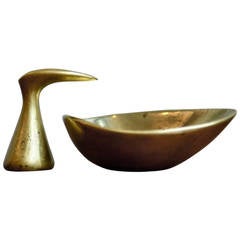
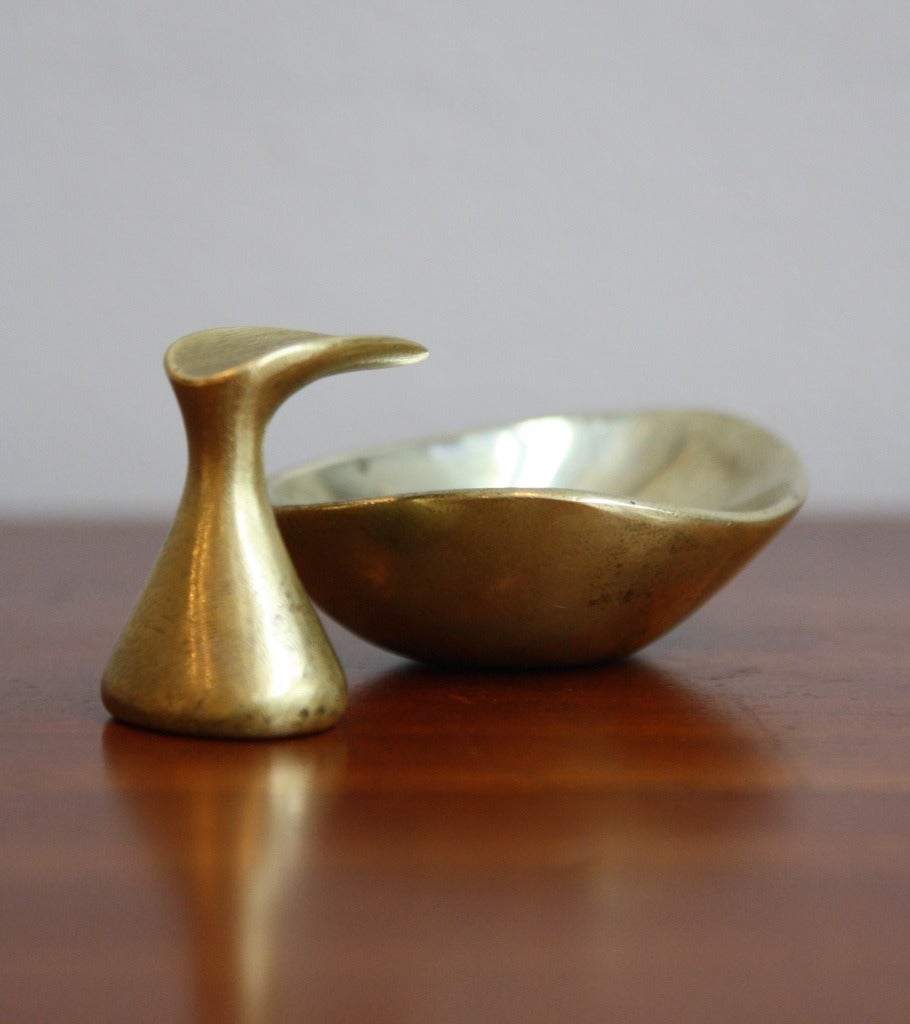
The Viennese artist and designer Carl Auböck II was one of the quirkiest and most delightful and collectible of modern designers. A rather odd duck in the world of decorative arts, he was a peculiar talent whose specialties included smaller desk accessories and tabletop pieces such as corkscrews, paperweights, letter openers, bookends and bottle stoppers. He rendered these pieces in a combination of metal — most often brass — and such elemental materials as leather, knobby wood and animal horn, creating forms that could be almost Surrealist, from hands and feet to keys, birds and amoebae.
As a boy, Auböck was precocious and artistic. He studied drawing and at the same time trained in the workshop of his father, Karl Heinrich Auböck, a popular maker of traditional bronze figurines and collectibles. In 1919, Carl II went to Germany to study at the Bauhaus, where he was a pupil of the progressive artist and theorist Johannes Itten. While the Bauhaus is most associated with the rigidly ordered, functionalist architecture of its directors Walter Gropius and Ludwig Mies van der Rohe, the school was in reality a liberal, spirited place — a crucible for imaginative, playful and avant-garde art and design. It was this spirit that imbued Carl II’s work from the time he left in 1921.
In 1922 or ’23, Carl Auböck II returned to Vienna to help care for his ailing father, and he took over the business. He created the Werkstätte Carl Auböck and a legacy that earned his objects cult status among collectors. The business was passed on to his descendants, who run the atelier that is still in operation today. Today, objects designed by Carl II make up 90 percent of Werkstätte Carl Auböck’s production, joined by the creations of architect and designer Carl IV, his grandson.
Vintage Auböck designs have a special character, a patina that only emphasizes how much the pieces have been loved and used. Carl Aubock II’s small furniture items — leather- or caned-sling magazine racks; free-edge wooden side tables with tubular bronze legs; wicker serving trolleys with turned beechwood wheels — are elegant and purposeful. His bijoux desktop objects, library tools, ashtrays and barware pieces evince a kind of mirthful practicality. They seem to ask: “If you need a corkscrew, or a paperweight, or a candlestick, why not make it fun as well as functional?” And indeed, why not?
Find a collection of vintage Werkstätte Carl Auböck mirrors, seating, tables, decorative objects and other furniture on 1stDibs.
The late 19th and early 20th centuries saw sweeping social change and major scientific advances — both of which contributed to a new aesthetic: modernism. Rejecting the rigidity of Victorian artistic conventions, modernists sought a new means of expression. References to the natural world and ornate classical embellishments gave way to the sleek simplicity of the Machine Age. Architect Philip Johnson characterized the hallmarks of modernism as “machine-like simplicity, smoothness or surface [and] avoidance of ornament.”
Early practitioners of modernist design include the De Stijl (“The Style”) group, founded in the Netherlands in 1917, and the Bauhaus School, founded two years later in Germany.
Followers of both groups produced sleek, spare designs — many of which became icons of daily life in the 20th century. The modernists rejected both natural and historical references and relied primarily on industrial materials such as metal, glass, plywood, and, later, plastics. While Bauhaus principals Marcel Breuer and Ludwig Mies van der Rohe created furniture from mass-produced, chrome-plated steel, American visionaries like Charles and Ray Eames worked in materials as novel as molded plywood and fiberglass. Today, Breuer’s Wassily chair, Mies van der Rohe’s Barcelona chair — crafted with his romantic partner, designer Lilly Reich — and the Eames lounge chair are emblems of progressive design and vintage originals are prized cornerstones of collections.
It’s difficult to overstate the influence that modernism continues to wield over designers and architects — and equally difficult to overstate how revolutionary it was when it first appeared a century ago. But because modernist furniture designs are so simple, they can blend in seamlessly with just about any type of décor. Don’t overlook them.
Antique, new and vintage tobacco accessories are not typically works of art, but, even if you’ve kicked the habit, an ornate mid-century modern ashtray, bronze cigar cutter or Art Deco cigarette case — collector’s items, all — will prove to be a unique accent piece for your bar cart, coffee table or mantel.
Cigar connoisseurs know the value of a good cigar box or humidor. Humidors safely store cigars at the right temperature so they don’t retain moisture and deteriorate in quality. Depending on the size and type of cigar, a cigar cutter is also an important accessory for the consummate cigar smoker. There are guillotine cutters, cigar scissors, V-cutters and punch cutters. These tools are useful, but, as part of a 19th-century upgrade for your contemporary desk, antique tobacco accessories are also a fun way to integrate personal expression into your workday. A sleek vintage cigarette case or lighter can introduce some pizzazz to the shelves of your home library or any other surface where you display your collectibles.
While ashtrays might not immediately strike you as interesting and provocative objects that deserve to be part of your decor, these accessories have taken on all manner of forms and styles over the years. Old glass ashtrays, which are quite popular and easily found in free-form, organic shapes, can be a purely decorative final touch when styling a coffee table. Visionary designers such as Isamu Noguchi — one of the most prolific and protean creative forces of the 20th century — popularized the idea of tobacco accessories as art with projects such as his decorative ashtrays.
Discover an extensive collection of antique, new and vintage tobacco accessories for your home today on 1stDibs.