By Adolf Dehn
Located in Fairlawn, OH
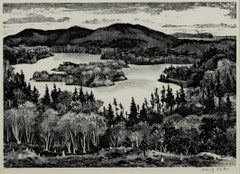
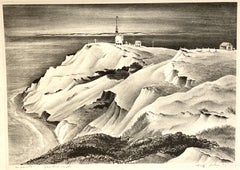
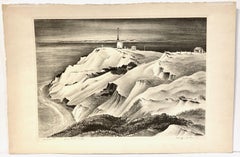
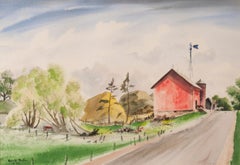
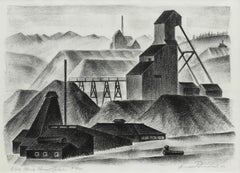
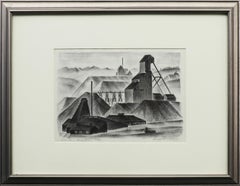
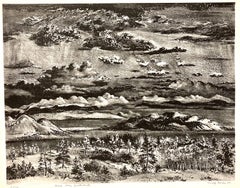
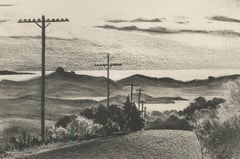
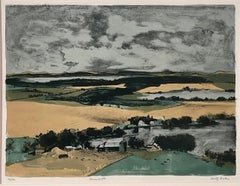
Horses Leaving the Barn
Watercolor on paper, 1940
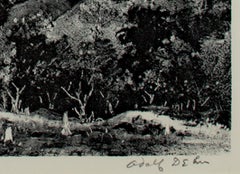
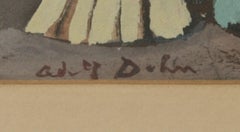
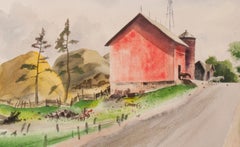
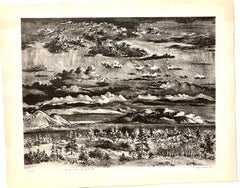
Signed and dated lower left corner (see photo)
Condition: Excellent
Image: 14 1/2 x 21”
Frame: 25” x 31”
Provenance; Associated American Artists, New York (see photo of label)
Mamdouha and Elmer Holmes Bobst
Displayed in an original wormy chestnut frame with OP3 Acrylic. Most probably from the AAA Dehn watercolor exhibition of 1940. Vintage original framing chosen by the artist.
Note: Elmer Holmes Bobst (1884–1978) was an American businessman and philanthropist who worked in the pharmaceutical industry. His wife, Mamdouha, was also well known philanthropist.
Bobst was born in Lititz, Pennsylvania. He aspired to become a doctor, but instead, he taught himself pharmacology. After his wife Ethel composed his interview letter, he became manager and treasurer of the Hoffman-LaRoche Chemical Works by 1920. When Bobst retired from the company in 1944, he was one of the nation's highest paid corporate executives. In 1945 he took charge of the ailing William Warner Company (later Warner–Lambert) and he remained board chairman until his retirement.
Bobst had close connections to President Dwight Eisenhower, but was also a close friend of President Richard Nixon.
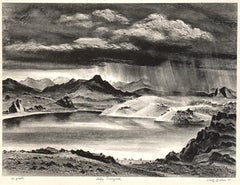
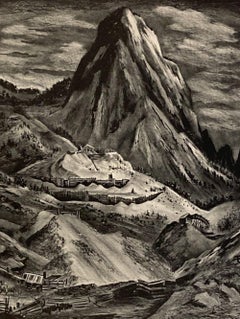
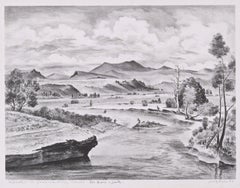
Note: In 1940, the year of this watercolor, Dehn and Elizabeth Timmerman visited Waterville, MN on their way to Colorado Sprint, Colorado where Dehn was to teach lithography and watercolor. This watercolor is obviously a view of the area around Waterville.
Adolf Dehn, American Watercolorist and Printmaker, 1895-1968
Adolf Dehn was an artist who achieved extraordinary artistic heights, but in a very particular artistic sphere—not so much in oil painting as in watercolor and lithography. Long recognized as a master by serious print collectors, he is gradually gaining recognition as a notable and influential figure in the overall history of American art.
In the 19th century, with the invention of the rotary press, which made possible enormous print runs, and the development of the popular, mass-market magazines, newspaper and magazine illustration developed into an artistic realm of its own, often surprisingly divorced from the world of museums and art exhibitions, and today remains surprisingly overlooked by most art historians. Dehn in many regards was an outgrowth of this world, although in an unusual way, since as a young man he produced most of his illustrative work not for popular magazines, such as The Saturday Evening Post, but rather for radical journals, such as The Masses or The Liberator, or artistic “little magazines” such as The Dial. This background established the foundation of his outlook, and led later to his unique and distinctive contribution to American graphic art.
If there’s a distinctive quality to his work, it was his skill in introducing unusual tonal and textural effects into his work, particularly in printmaking but also in watercolor. Jackson Pollock seems to have been one of many notable artists who were influenced by his techniques.
Early Years, 1895-1922
For an artist largely remembered for scenes of Vienna and Paris, Adolf Dehn’s background was a surprising one. Born in Waterville, Minnesota, on November 22, 1895, Dehn was the descendent of farmers who had emigrated from Germany and homesteaded in the region, initially in a one-room log cabin with a dirt floor. Adolf’s father, Arthur Clark Dehn, was a hunter and trapper who took pride that he had no boss but himself, and who had little use for art. Indeed, during Adolf’s boyhood the walls of his bedroom and the space under his bed were filled with the pelts of mink, muskrats and skunks that his father had killed, skinned and stretched on drying boards. It was Adolf’s mother, Emilie Haas Dehn, a faithful member of the German Lutheran Evangelical Church, who encouraged his interest in art, which became apparent early in childhood. Both parents were ardent socialists, and supporters of Eugene Debs...
Category
1940s American Realist Adolf Dehn Art