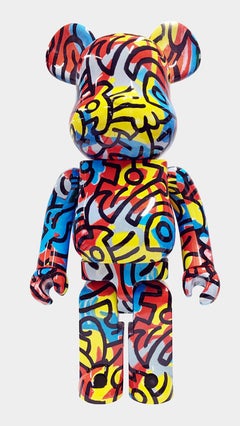
(after) Keith Haring Abstract Sculptures

American, 1958-1990
Keith Allen Haring was an American artist whose pop art emerged from the New York City graffiti subculture of the 1980s.
to
1
Overall Width
to
Overall Height
to
1
1
1
1
1
1
1
71
216
119
84
77
1
Artist: (after) Keith Haring
Related Items
"Portalito", Abstract Patterns, Geometric Abstraction, Woodcut Monoprint

"Portalito", Abstract Patterns, Geometric Abstraction, Woodcut Monoprint

Located in Philadelphia, PA

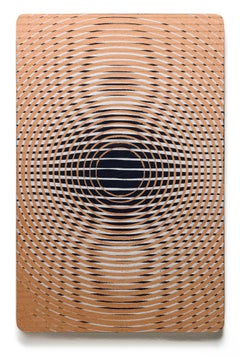
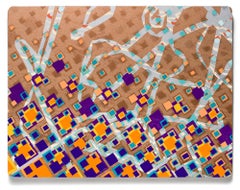
This piece titled "Portalito" is an original piece by Alexis Nutini and is made from a woodcut monoprint mounted on panel. This piece measures 7.25"h x 9.5"w. Born in Mexico City, ...

Category

21st Century and Contemporary Contemporary (after) Keith Haring Abstract Sculptures

Materials

Panel, Monoprint, Woodcut

The Gates (c), from the Project for Central Park

The Gates (c), from the Project for Central Park

By Christo and Jeanne-Claude

Located in New York, NY

This offset lithograph in colors from the Project for Central Park, New York City, was created by the artist in 2004. One of 300 hand-signed by the artist in pencil from an unnumbere...

Category

21st Century and Contemporary Contemporary (after) Keith Haring Abstract Sculptures

Materials

Lithograph

The Gates (e), Project for Central Park

The Gates (e), Project for Central Park

By Christo and Jeanne-Claude

Located in New York, NY

This offset lithograph in colors on wove paper from the Project for Central Park, New York City, was created by the artist in 2005. One of 300 hand-signed (in pencil) prints from an ...

Category

21st Century and Contemporary Contemporary (after) Keith Haring Abstract Sculptures

Materials

Lithograph

Jenny Holzer, Inflammatory Essays: Shriek When the Pain Hits...

Jenny Holzer, Inflammatory Essays: Shriek When the Pain Hits...

By Jenny Holzer

Located in Hamburg, DE

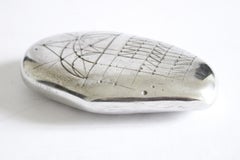
Jenny Holzer (American, b. 1950) Inflammatory Essays: Shriek When the Pain Hits During Interrogation, 1996 Multiple: Pewter multiple with engraved text Dimensions: 6.6 × 5 × 1.1 cm (...

Category

20th Century Contemporary (after) Keith Haring Abstract Sculptures

Materials

Metal

The Bather Italy 1981 Roberto Nanut Bronze Nude Sculpture La Bagnante

The Bather Italy 1981 Roberto Nanut Bronze Nude Sculpture La Bagnante

Located in Brescia, IT

This is an engaging multiple artwork by the Italian artist Robert Nanut, a talented artist of 1980’. This is a multiple of numbered edition of 1.000 pieces. This artwork was made in 1980 but it can be considered new cause remained since now stored and packed in the Editor warehouse. The bronze sculpture is completed by the certificate of authenticity, there is the number assigned to the piece and the original signature of the author. Roberto Nanut...

Category

1980s Abstract (after) Keith Haring Abstract Sculptures

Materials

Bronze

Takashi Murakami, Gargantua on Your Palm - Limited Edition Plate, Pop Art

Takashi Murakami, Gargantua on Your Palm - Limited Edition Plate, Pop Art

By Takashi Murakami

Located in Hamburg, DE

Takashi Murakami (Japanese, b. 1962) Gargantua on Your Palm, 2022 Medium: Porcelain plate (fine bone china) Dimensions: 10 1/2 in diameter 26.7 cm diameter Edition of 250: Printed s...

Category

21st Century and Contemporary Contemporary (after) Keith Haring Abstract Sculptures

Materials

Porcelain

Rosenthal Plate, Limited Edition Abstract Ceramic Plate by Otto Piene

Rosenthal Plate, Limited Edition Abstract Ceramic Plate by Otto Piene

By Otto Piene

Located in Long Island City, NY

Decorative Rosenthal ceramic plate produced in collaboration with artists Otto Piene from 1973. A modern design in Piene's abstract modernist style. Porcelain plate with box and sign...

Category

1970s Modern (after) Keith Haring Abstract Sculptures

Materials

Ceramic

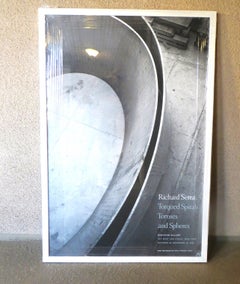
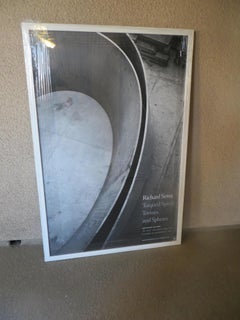
Richard Serra, Torqued Spirals Toruses and Spheres, Gagosian Gallery

Richard Serra, Torqued Spirals Toruses and Spheres, Gagosian Gallery

By Richard Serra

Located in Pasadena, CA

Richard Serra, Torqued Spirals Toruses and Spheres Poster, Hal. New York: Exhibition : Gagosian Gallery, October 18th - December 15th 2001. Size is framed. Richard Serra was an A...

Category

20th Century Abstract (after) Keith Haring Abstract Sculptures

Materials

Paper, Black and White

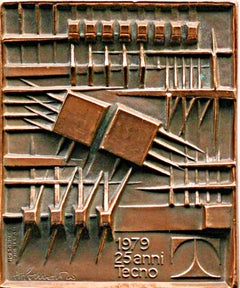
Medaglia 25 Anni Tecno Limited Edition bronze medallion plaque famous sculptor

Medaglia 25 Anni Tecno Limited Edition bronze medallion plaque famous sculptor

By Arnaldo Pomodoro

Located in New York, NY

ARNALDO POMODORO Medaglia 25 Anni Tecno (Two Sided Bronze Medallion), 1979 Bronze (incised signature) 2 1/2 × 2 × 7/10 inches Edition 196/1600 Unframed This beautiful two sided limit...

Category

1970s Abstract Geometric (after) Keith Haring Abstract Sculptures

Materials

Bronze

Organic Abstract Cast Paper Sculpture Relief Painting Suzanne Anker

Organic Abstract Cast Paper Sculpture Relief Painting Suzanne Anker

By Suzanne Anker

Located in Surfside, FL

"Cocoon (1990)" by Suzanne Anker Suzanne Anker (born August 6, 1946) is an American visual artist and theorist. Considered a pioneer in Bio Art. She has been working at the relationship of art and the biological sciences for more than twenty five years. Her practice investigates the ways in which nature is being altered in the 21st century. Concerned with genetics, climate change, species extinction and toxic degradation, she calls attention to the beauty of life and the "necessity for enlightened thinking about nature’s 'tangled bank'.” Anker frequently works with "pre-defined and found materials"botanical specimens, medical museum artifacts, laboratory apparatus, microscopic images and geological specimens. Suzanne Anker was born in Brooklyn, New York on August 6, 1946. She earned a B.A. in Art from Brooklyn College of the City of New York and an M.F.A. from the University of Colorado in Boulder (1976). She also completed independent Studies with Ad Reinhardt (1966-1967) and studied at the Brooklyn Museum Art School (1968). She lives with the artist Frank Gillette in Manhattan and East Hampton, NY. During the mid 70s to the mid 80s, Anker worked almost exclusively on sculptural handmade paper reliefs. She started papermaking in 1974 on the basis of reading Dard Hunter's and Claire Romano's books. In 1975 she worked with Garner Tullis at the Institute of Experimental Printmaking in Santa Cruz, California. The paper reliefs produced at his institute were exhibited at the Martha Jackson Gallery in New York City in 1976.[ The same year, she participated in the North American Hand Papermaking exhibition organized by Richard Minsky at the Center for Book Arts in New York City. From a background as a printmaker, Anker initially worked with cast paper, made in latex molds. Subsequently, she incorporated limestone and fossils in her experiment with combinations of paper and stone. For her 1979 solo exhibition at the Walker Art Center, Anker installed large limestone planks that extended from the interior to the exterior of the gallery. The same year, she presented an installation of limestone and its residual chalk dust at P.S. 1’s "A Great Big Drawing Show" curated by Alanna Heiss with artists Vito Acconci, Alice Aycock, Frank Gillette, Sol LeWitt, Robert Morris, Bruce Nauman, Dennis Oppenheim, Richard Serra, and others. Suzanne Anker is considered "one of the pioneers in the broader field of art, science, and technology", particularly in the burgeoning field of Bio Art. In 1994, Suzanne Anker curated Gene Culture: Molecular Metaphor in Visual Art – one of the first art exhibitions on the subject of art and genetics – at Fordham University’s Lincoln Center Campus in New York. The exhibition investigated "the ways in which genetic imaging operates as aesthetic signs". From 2004 to 2006, Suzanne Anker hosted twenty episodes of the Bio-Blurb Show, a 30-minute-long internet radio program originally broadcast on WPS1 Art Radio, in collaboration with MoMA. The show focused on the intersection of art and the biological sciences, and the ethical and aesthetic dimensions therein. It is currently archived on Alanna Heiss’ Clocktower Productions. In 2006, Anker co-curated the exhibition Neuroculture: Visual Art and the Brain, at the Westport Arts Center with Giovanni Frazzetto. The exhibition presented an investigation of aspects of the human brain, and its attendant representations. Suzanne Anker is the Chair of the School of Visual Arts (SVA)'s BFA Fine Arts Department in New York City (2005-present). She previously chaired the SVA BFA Art History Department (2000-2005). In 2011, Anker founded the SVA Bio Art Lab, the first Bio Art laboratory in a Fine Arts Department in the United States. The SVA Bio Art Lab is located in Chelsea, New York City and has been conceived as a place where "scientific tools and techniques become methodologies in art practice". Anker has participated in lectures and symposia in prominent institutions around the world, including Harvard University, Boston; University of Cambridge, Cambridge, UK; Yale University, New Haven; Art-Sci UCLA, Los Angeles; Maryland Institute College of Art (MICA), Baltimore; Rensselaer Polytechnic Institute, New York; Museum of Arts and Design, New York; Nanyang Technological University, Singapore; London School of Economics, London; European Molecular Biology Laboratory- EMBL, Monterotondo, Italy; Max Planck Institute of Molecular Cell Biology and Genetics, Dresden; Leiden University, NL; Hamburger Bahnhof, Berlin; Dundee Contemporary Arts, Dundee; Courtauld Institute of Art, London; Banff Art Center, Alberta; The National Academies of Sciences, Engineering, and Medicine, Washington, D.C.; Berlin-Brandenburg Academy of Sciences and Humanities, Berlin;[ University of Amsterdam, NL; New York Academy of Sciences, Institute for the Humanities, New York University; DLD, Munich. Selected artworks Gene Pool Anker’s interests in the natural world extended her investigation into the microscopic domain of chromosomes and genes. Appropriating scientific images, she created Gene Pool in 1991, a body of work that includes suspended pigment on large vellum sheets and expansive sculptural arrays employing metallic fibers of stainless steel, copper, aluminum and bronze. Other works that reflect scientific representations of chromosomes include Chromosome Chart of Suzanne Anker –a presentation of her own DNA sequence as a self-portrait– and Cellular Script, in which she displays chromosome patterns as a kind of calligraphy. Biota (2011) is a sculptural installation by Suzanne Anker composed of porcelain sculptures and silver-leaf figurines. The porcelain objects are fabricated by immersing natural sea sponges into a mixture of kaolin, feldspar, and quartz. "The organic material of the sponge burns away in the process, leaving behind only the perfect replica of nature". Exhibitions Selected one-person exhibitions "The Biosphere Blues Mending an Unhinged Earth", O'NewWall, Seoul, Korea (2017). “Culturing Life”, Sam Francis Gallery...

Category

1990s (after) Keith Haring Abstract Sculptures

Materials

Mixed Media

"I HOPE..." 2021, lamp by Chiharu Shiota, Design, Contemporary Art, Japanese Art

"I HOPE..." 2021, lamp by Chiharu Shiota, Design, Contemporary Art, Japanese Art

By Chiharu Shiota

Located in Zug, CH

Chiharu Shiota "I HOPE..." 2021 stainless steel, heat-resistant satin glass, transparent Din A5 sheets Edition of 100 + 20 APs 120 x 120 cm 28 x printed artworks by the artist 65 x...

Category

2010s Abstract Geometric (after) Keith Haring Abstract Sculptures

Materials

Photogravure, Paper

Ernest Trova, Falling Man, Limited Edition 1969 PACE Gallery silkscreen poster

Ernest Trova, Falling Man, Limited Edition 1969 PACE Gallery silkscreen poster

By Ernest Tino Trova

Located in New York, NY

Ernest Tino Trova Limited Edition of 2000 Silkscreen on heavy art paper Unframed This exclusive poster, created by renowned American artist Ernest Trova as an edition for Pace Columbus, is a testament to his profound influence in contemporary art and his longstanding association with Pace Gallery...

Category

1960s Abstract (after) Keith Haring Abstract Sculptures

Materials

Lithograph, Offset

Previously Available Items
Keith Haring Bearbrick 1000% (Haring DesignerCon BE@RBRICK)

Keith Haring Bearbrick 1000% (Haring DesignerCon BE@RBRICK)

By (after) Keith Haring

Located in NEW YORK, NY

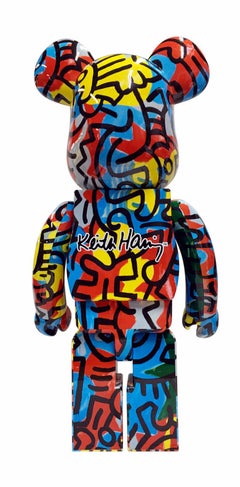
Keith Haring Bearbrick Vinyl Figure 1000% A nicely sized (27 inch), highly collectible Bearbrick Keith Haring statue piece, trademarked & licensed by t...

Category

21st Century and Contemporary Pop Art (after) Keith Haring Abstract Sculptures

Materials

Resin, Vinyl

(after) Keith Haring abstract sculptures for sale on 1stDibs.

Find a wide variety of authentic (after) Keith Haring abstract sculptures available for sale on 1stDibs. You can also browse by medium to find art by (after) Keith Haring in organic material, paint, resin and more. Much of the original work by this artist or collective was created during the 21st century and contemporary and is mostly associated with the abstract style. Not every interior allows for large (after) Keith Haring abstract sculptures, so small editions measuring 5 inches across are available. (after) Keith Haring abstract sculptures prices can differ depending upon medium, time period and other attributes. On 1stDibs, the price for these items starts at $420 and tops out at $420, while the average work can sell for $420.
Questions About (after) Keith Haring Abstract Sculptures
  • 1stDibs ExpertMarch 22, 2022
    Keith Haring is originally from Kutztown, Pennsylvania, although he was born in the nearby city of Reading, Pennsylvania, on May 4, 1958. In 1978, Haring moved to New York City. He continued to live there until he died on February 16, 1990. Find a selection of Keith Haring art on 1stDibs.
  • 1stDibs ExpertMarch 22, 2022
    Keith Haring was a modern American artist and activist. He began as a street artist creating graffiti-inspired works throughout New York City’s subway system and would later produce public murals in cities all over the world. Haring’s paintings, prints and murals address the universal themes of death, love and sex, as well as contemporary issues he experienced personally, like the crack-cocaine and AIDS epidemics. In 1986, Haring opened a Pop Shop in Manhattan’s Soho neighborhood to sell merchandise bearing his bold, cartoon-inspired designs. On 1stDibs, find a variety of Keith Haring art.
  • 1stDibs ExpertMarch 22, 2022
    To pronounce Keith Haring, say "Keeth HEH-ring." Keith Haring was born on May 4, 1958, in Reading, Pennsylvania, and grew up in nearby Kutztown, Pennsylvania. You'll find a range of Keith Haring art on 1stDibs.
  • 1stDibs ExpertMarch 22, 2022
    Keith Haring is famous for producing bold cartoon-style art. You may see his work printed on everything from home décor to coffee mugs to fashion accessories. He gained notoriety for street art in his early days as an artist. Later, Haring’s revered paintings, prints and murals would address the universal themes of death, love and sex, as well as contemporary issues he experienced personally, like the crack-cocaine and AIDS epidemics. On 1stDibs, find a collection of Keith Haring art.
  • 1stDibs ExpertMarch 22, 2022
    In his early days as an artist, Keith Haring worked primarily in New York City, where he created murals on walls and unused advertising boards along Manhattan’s subway system. Once his work gained popularity, he traveled to produce work in Australia, Europe and elsewhere. You'll find a collection of Keith Haring art on 1stDibs.
  • 1stDibs ExpertMarch 25, 2024
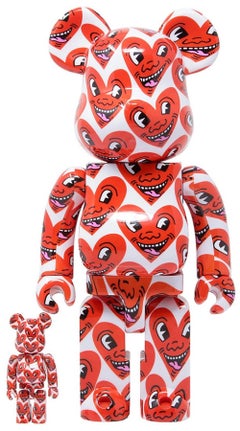
    Keith Haring's art was about a variety of subjects. His paintings, prints and murals addressed themes of death, love and sex, as well as contemporary issues, like drug use and the AIDS epidemic. His work derives much of its impact from the powerful contrast between these serious subjects and the joyful, vibrant pictographic language he used to express them. Haring’s enduring work is full of dancing figures, babies, barking dogs, hearts and rhythmic lines, as well as references to pop culture. On 1stDibs, explore a collection of Keith Haring art.
  • 1stDibs ExpertMarch 22, 2022
    The Keith Haring Foundation is a philanthropic organization founded by the artist Keith Haring in 1989. Its mission is to provide funding for nonprofit organizations who offer services and programs for children or conduct research or educational initiatives related to AIDS.
  • 1stDibs ExpertMarch 22, 2022
    For most of his life, Keith Haring lived in New York City and died there on February 16, 1990. He grew up in Kutztown, Pennsylvania, and briefly attended an art school in Pittsburgh, Pennsylvania. After he arrived in New York in 1978, he turned the city into a gallery space, creating murals in public areas like subway stations. On 1stDibs, shop a collection of Keith Haring art.
  • 1stDibs ExpertMarch 22, 2022
    Keith Haring is important primarily because his innovative work, which began as street art on the New York City subway, became widely known during the 1980s and influenced other artists working at the time. Haring was also an activist — his late-career prints and murals addressed contemporary issues he experienced personally, like the crack-cocaine and AIDS epidemics. Haring helped elevate graffiti art and was one of the first artists to begin placing his designs on merchandise sold to the general public through his Pop Shop in New York City. Shop a collection of Keith Haring art on 1stDibs.
  • 1stDibs ExpertMarch 22, 2022
    Keith Haring drew most of his inspiration from graffiti artists and got his start painting subway stations and other locations around New York City. In addition, artists such as Pierre Alechinsky, William Burroughs, Jean Dubuffet, Brion Gysin and Robert Henri influenced his work. On 1stDibs, shop a collection of Keith Haring art.
  • 1stDibs ExpertAugust 8, 2024
    Keith Haring was known for his work as an artist. He began experimenting with his bold, graphic lines and cartoon-inspired figures on the walls of New York City subway stations in the early 1980s. He called these underground places his “laboratory” to develop a radical new aesthetic based on the ideology of creating truly democratic public art. Haring used paintings, prints and murals to address the universal themes of death, love and sex, as well as contemporary issues he experienced personally, like the crack-cocaine and AIDS epidemics. These works derive much of their impact from the powerful contrast between these serious subjects and the joyful, vibrant pictographic language he used to express them, full of dancing figures, babies, barking dogs, hearts and rhythmic lines, as well as references to pop culture. To make his art even more accessible, in 1986, Haring opened the Pop Shop in Soho. In a foreshadowing of today’s intermingling of art and fashion, the shop sold merchandise and novelty items featuring his imagery. Find a collection of Keith Haring art on 1stDibs.
  • 1stDibs ExpertFebruary 1, 2024
    Some facts about Keith Haring include that he began his career by creating street art in New York subway stations, which he referred to as his "laboratory." In 1986, Haring opened the Pop Shop in Manhattan’s Soho neighborhood and began selling merchandise and novelty items featuring imagery by himself and contemporaries like Kenny Scharf and Jean-Michel Basquiat. Also, the world's largest jigsaw puzzle features Haring's artwork and consists of 32,000 pieces. After his death, his estate formed the Keith Haring Foundation to raise awareness about AIDS and fund research into the autoimmune disease. On 1stDibs, explore a wide range of Keith Haring art.
  • 1stDibs ExpertMarch 22, 2022
    Keith Haring was born on May 4, 1958, in Reading, Pennsylvania. After growing up in Kutztown, Pennsylvania, and briefly attending art school in Pittsburgh, Pennsylvania, he moved to New York City, where he made a name for himself creating street art on the subway system. Haring gained an even larger audience in the years that followed, producing public murals that were often commissioned and making art that was frequently informed by political and cultural issues. On 1stDibs, find a selection of Keith Haring art.
  • 1stDibs ExpertMarch 22, 2022
    For his earlier works of art, Keith Haring found inspiration in graffiti and applied paint or chalk to advertising boards spread across New York City that had not yet been used. Much of Haring’s street art was created in subway stations. As his work became more widely known, Haring was frequently commissioned for public murals and would often paint in oils and acrylics on canvas. He also produced merchandise bearing some of his most famous designs. Shop a selection of Keith Haring art on 1stDibs.
  • 1stDibs ExpertApril 5, 2022
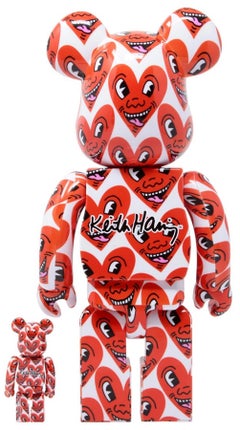
    There are a few tell-tale signs you can look for to determine whether your Keith Haring is real or fake. Authentic Keith Haring artwork features a continuous, unbroken line, a subtle signature, barking dogs and crying babies. There are often fakes and the story of them being a gift to an old boyfriend is often an invalid provenance. Shop a collection of authentic Keith Haring artwork from some of the world’s top art dealers on 1stDibs.
  • 1stDibs ExpertAugust 20, 2024
    How much a Keith Haring painting is worth depends on its history, age, size and other factors. In 2017, his 1982 Untitled sold for more than $6.5 million at an auction in New York. Many of Haring’s paintings, prints and murals address the universal themes of death, love and sex, as well as contemporary issues like the crack cocaine and AIDS epidemics. They derive much of their impact from the powerful contrast between these serious subjects and the joyful, vibrant pictographic language he used to express them, full of dancing figures, babies, barking dogs, hearts and rhythmic lines, as well as references to pop culture. If you have a Haring piece, a certified appraiser or experienced art dealer can give you an idea of how much it may be worth. On 1stDibs, shop a range of Keith Haring art.
  • 1stDibs ExpertApril 5, 2022
    The Keith Haring Foundation owns international copyright to artwork created by Keith Haring. In 1989, Haring himself established the foundation to ensure that his philanthropic legacy would continue. The Keith Haring Foundation today makes grants to charitable activities in accordance with Haring’s wishes. Shop a selection of Keith Haring pieces from some of the world’s top art dealers on 1stDibs.
  • 1stDibs ExpertMarch 22, 2022
    You can buy Keith Haring art from a variety of sources. One option is to go through an auction house or reputable art dealer. Some trusted online platforms also sell pieces by Keith Haring. You'll find a collection of expertly vetted Keith Haring art on 1stDibs.
  • 1stDibs ExpertFebruary 27, 2024
    The Keith Haring Foundation owns the Keith Haring estate. In 1989, the American artist set up the foundation to guarantee that his philanthropic efforts would continue after his death. Under the foundation's structure, The Keith Haring Studio is the owner of the copyrights to all of Haring's works. Find an assortment of Keith Haring art on 1stDibs.
  • 1stDibs ExpertApril 11, 2024
    Keith Haring worked in a variety of mediums. The legendary Pennsylvania-born artist experimented with painting, sculpture, printmaking, performance, video, murals and more. In 2023, a series of digital drawings Haring made on a personal computer during the late 1980s went to auction. No canvas was off limits, either, as he painted on wood, vast tarps and sheets of metal. Haring was always experimenting, even in his early days as an artist.

    When Haring arrived in New York City, he was drawn to subway graffiti and other street art, and was soon drawing with chalk on the black sheets of paper that were affixed to subway panels when there wasn’t a poster advertisement to populate the space.

    To make his art even more accessible, in 1986, Haring opened the Pop Shop in Soho. In a foreshadowing of today’s intermingling of art and fashion, the shop sold merchandise and novelty items featuring imagery by Haring and contemporaries like Kenny Scharf and Jean-Michel Basquiat

    Find original Keith Haring art on 1stDibs.