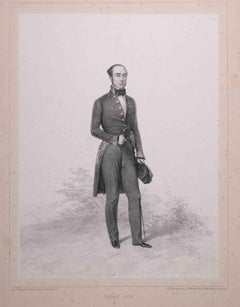
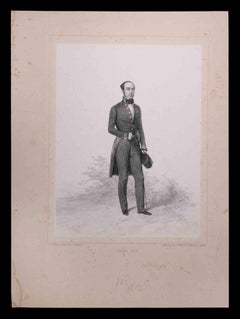
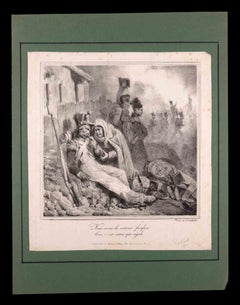
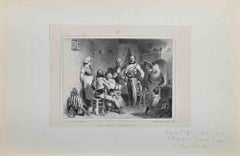
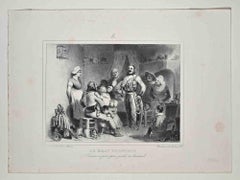
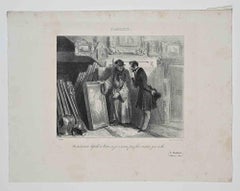
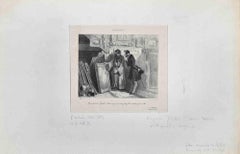
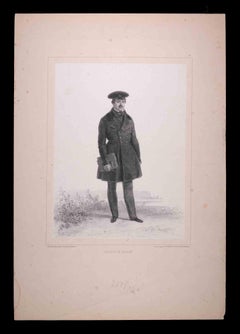
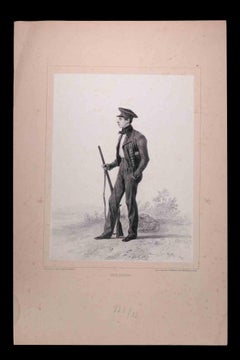
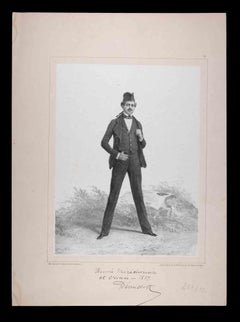
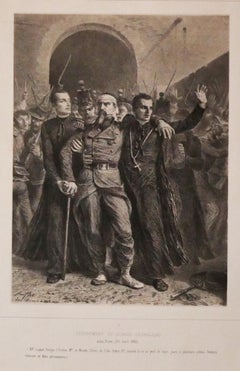
By Denis Auguste Marie Raffet
Located in Blackwater, GB
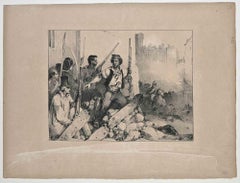
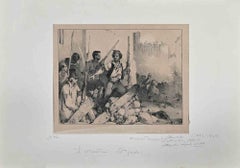
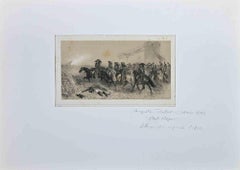
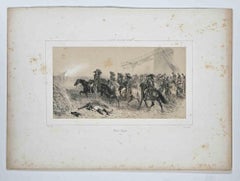
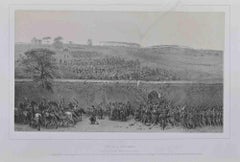
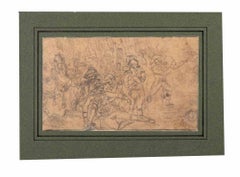
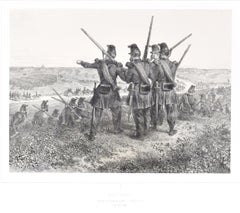
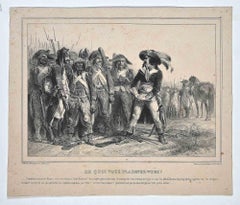
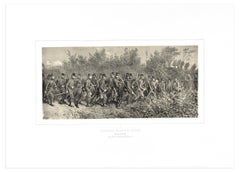
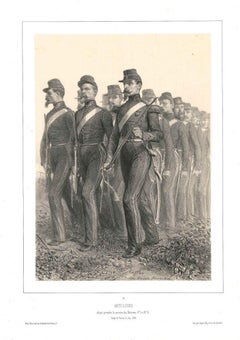
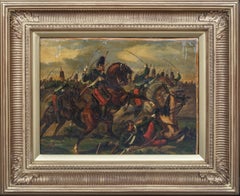
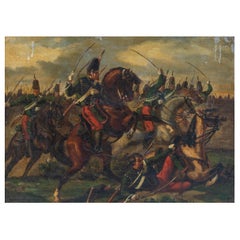
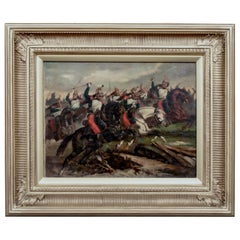
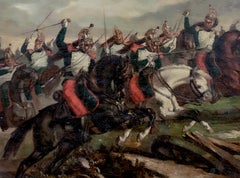
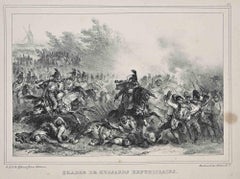
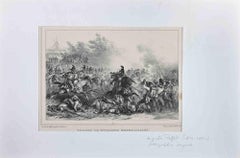
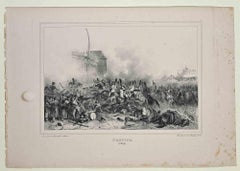
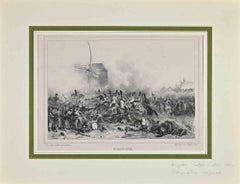
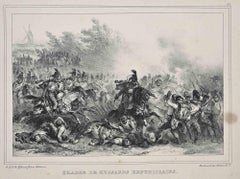
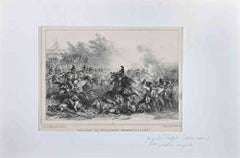
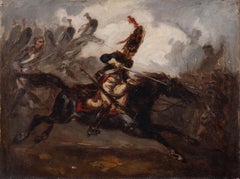
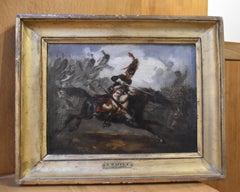
Charge Of the French Hussars At The Battle Of Waterloo 19th Century
by AUGUSTE RAFFET (1804-1860) similar to $15,000
19th Century French scene of Napoleons French Hussars charging at the Battle Of Waterloo, oil on canvas by Auguste Raffet. Excellent quality example of the famous battle painters work, signed and presented in a good gilt frame. Would be enhanced with a light clean.
Measurements: 18" x 16" framed approx
Artist Biography
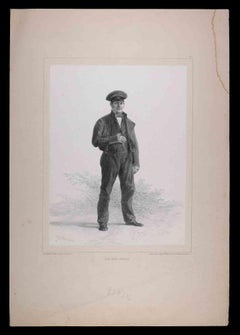
Auguste Raffet was nine years old when his father was killed in the Bois de Boulogne in 1813. As his mother lacked financial resources he was obliged to learn a trade at a young age and was apprenticed to a wood turner, but also attended a drawing school in the evenings. At the age of 18 he joined Cabanel's studio to work as a porcelain decorator; his workshop manager Rubau was impressed by the young artist's talent and advised him to take up painting. He then attended Suisse's studio where his fellow students included Théodore Leblanc, Juhel the Younger and Rudder. In 1824 Rudder arranged for Raffet to work with Charlet and gave him his first lessons in lithography. Raffetremained at Charlet's studio for five years and in 1829 became a pupil of Gros. While continuing to study lithography he also attended the École des Beaux-Arts where he worked towards taking part in the Prix de Rome. By the time he entered for the Prix in 1831 he had already published several collections of lithographs and some remarkable plates including: Long Live the Republic; Lutzen; Close Ranks; The Review; and his popular illustration My Emperor, It's the Most Cooked. The Grand Prix was in fact awarded to Frédéric Henri Schopin (no relation to the composer) and Raffet was so disappointed that he decided to abandon painting almost completely and to devote himself exclusively to drawing and lithography. A retrospective of his work was organised by the Grenoble museum and the Marmottan library in the town of Boulogne-Billancourt in 1999.
Up to 1830 Raffet had mainly been an imitator of Vernet, Charlet and Bellangé but he now began to develop a style of his own and to follow his own instincts. Raffet was in fact a great improviser: although he had never witnessed the Revolution, the campaigns under the Empire or the Algerian wars, he produced more convincing depictions of these events than those provided by many eye witnesses. From 1830 to 1837 he worked mainly on popular subjects, often executed with a touch of humour, such as: Representative of the People at the Army of the Rhine; Smoking Prohibited; Long Live the Emperor; Help the Vivandière; The Enemy Knows We Are There; and The Inspection. Some of his best works, true battle scenes, also date from this period: The Last Charge of the Red Banners; The Retreat of the Battalion; Capture of Fort Mulgrave; They Grunt; and The Night Review. Meanwhile, he also illustrated Museum of the Revolution; History of France by Abbé de Montgaillard; The Revolution; The Consulate and the Empire by Thiers; and History of Napoleon by Norvins. Although he did not witness the Algerian wars at first hand, they inspired some of his most important lithographs: The Capture of Constantine; The Flag of the 17th Light; and the famous Combat of Oued-Allez, which is perhaps his masterpiece.
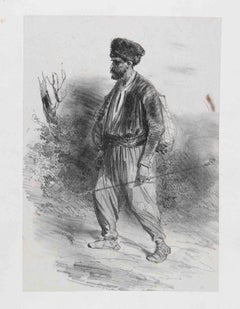
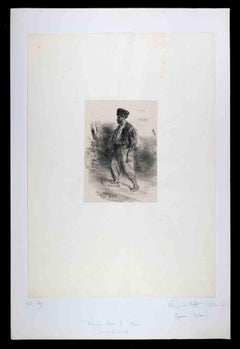
In 1837 Raffet travelled with Prince Anatole Demidoff, visiting Hungary, Moldavia, Wallachia, the Crimea, Smyrna and Constantinople. This trip marked the start of a third phase in Raffet's work: he became a keen observer and drew from life with perfect accuracy. When he returned to Paris he published the first plates of his Travels in the Crimea, which is not only of great artistic value but also provides a valuable ethnological source of reference. He followed the French army to Italy at the time of the siege of Rome and published a series of lithographs under this title which constitute a comprehensive study of the uniforms of the French army. He travelled constantly during the last 10 years of his life, always in the company of Demidoff, visiting Spain, London, Holland, Scotland, Austria and San Donato in Italy; he was still in San Donato at the end of 1859 during the war with Italy. He returned to Paris early in 1860 with plans to produce a series of lithographs that would draw a comparison between Napoleon Bonaparte's campaign of 1796 and that of Napoleon III in 1859. In order to gather the documentation he needed, Raffet left Paris for Italy on 7 February 1860; however, he caught a cold that developed into pneumonia, laying him low in Genoa, and he died in the city on 11 February 1860.
Raffet's battle drawings convey all the violence and passion of a real event witnessed at first hand, where the soldier is the main focus of a composition uncluttered by details unnecessary to the breadth of his vision. He was not fully appreciated by his contemporaries, many of whom viewed him simply as a skilled lithographer, nor by posterity which saw him as a battle illustrator - rather as if Raffet were to Baron Gros what the battles of Napoleon III were to those of Napoleon I.
Museum and Gallery Holdings
Bayonne (Mus. Bonnat): The Review (watercolour...
Category
19th Century Denis Auguste Marie Raffet Art