Edward Robert Hughes Art

to
2
1
1
Overall Width
to
Overall Height
to
2
2
2
2
11,124
2,854
2,494
1,436
2
Artist: Edward Robert Hughes
Portrait of Mildred - British Victorian art Pre-Raphaelite seated young girl

Portrait of Mildred - British Victorian art Pre-Raphaelite seated young girl

By Edward Robert Hughes

Located in Hagley, England

This captivating Victorian sanguine portrait drawing of a young girl is by Pre-Raphaelite British artist Edward Robert Hughes. The red chalk portrait dated 1885 is of Mildred, her name inscribed upper left. She is seated, hands in lap, her long hair flowing over her shoulders in typical Pre-Raphaelite manner. Great detail has gone into depicting the smocking on her dress and the artist has perfectly captured her sweet innocent nature. Signed and dated lower left. Provenance. Cambridge collection. Condition. Red chalk on paper, image size 22 inches by 18 inches and in good condition. Housed in a complimentary frame and glazed, 28 inches by 24 inches framed and in very good condition. Edward Robert Hughes - Not to be confused with Edward Hughes (1832 - 1908), who specialised in portrait painting. Edward Robert Hughes RWS (1851 – 1914) was an English painter who worked prominently in watercolours, but also produced a number of significant oil paintings. He was influenced by his uncle and eminent artist, Arthur Hughes who was associated with the Pre-Raphaelite Brotherhood, and worked closely with one of the Brotherhood's founders, William Holman Hunt. Having settled on his career choice, Edward Robert Hughes attended Heatherley's in London to prepare himself for the chance of auditioning for the Royal Academy School. Hughes became a student at the Royal Academy School in 1868. While Pre-Raphaelitism played an influential part in shaping Hughes work, Aestheticism is also seen in his paintings. E.R.Hughes is widely known for his works Midsummer Eve and Night With Her Train of Stars yet he built a career as a portrait painter to the upper classes. In addition to being an accomplished artist himself, E.R.Hughes was also a studio assistant to the elder artist and Pre-Raphaelite Brotherhood founding member William Holman Hunt when Hunt suffered from glaucoma. Two of the paintings that Hughes worked on with Hunt were The Light of the World, which is displayed in St Paul's Cathedral, and The Lady of Shalott, which is exhibited at the Wadsworth Atheneum. On his own he experimented with ambitious techniques and was a perfectionist; he did numerous studies for many of his paintings, some of which turned out to be good enough for exhibition. Hughes held several important offices within the artistic community over his lifetime such as becoming a member of the Art Workers Guild in 1888, and was on their committee from 1895 to 1897. He was elected to Associate Membership of The Royal Water Colour Society (ARWS) on 18 February 1891, and he chose as his diploma work for election to full membership a mystical piece (Oh, What's That in the Hollow?) inspired by a verse by Christina Rossetti entitled Amor Mundi. His painting A Witch was given by the Royal Watercolour Society to King Edward VII and Queen Alexandra to mark the coronation in 1902. In later years Hughes served as the Vice-President of the RWS before leaving in 1903. Throughout his career, E.R.Hughes exhibited his works in several galleries around London: Dudley Gallery, Grosvenor Gallery, New Gallery, The Royal Academy, and toward the end of his career he exhibited with The Royal Society of Painters in Water Colours (RWS). His works can be seen in public collections including Cartwright Hall, Bradford, Cambridge & County Folk Museum, Maidstone Museum & Art Gallery, Bruce Castle...
Category

19th Century Pre-Raphaelite Edward Robert Hughes Art

Materials

Chalk

Portrait of Elaine Blunt - British 19th century art Pre-Raphaelite chalk drawing

Portrait of Elaine Blunt - British 19th century art Pre-Raphaelite chalk drawing

By Edward Robert Hughes

Located in Hagley, England

This captivating Victorian sanguine chalk portrait drawing of a young girl is by Pre-Raphaelite British artist Edward Robert Hughes. Signed and dated 1896, Hughes depicts in great detail her sweet young face and beautiful dress which appears to almost glow with light. A full length portrait and a really lovely drawing epitomising childhood innocence. The portrait depicts Elaine Blunt and has an inscription from Edward Hughes verso. Signed and dated lower right. Provenance. Colchester estate. Sotheby Lot 283 29th June 1976 Chapman Bros Condition. Sanguine chalk on paper, 28 inches by 20 inches unframed and in good condition. Housed in a glazed oak frame, 37 inches by 29 inches framed and in good condition. Edward Robert Hughes - Not to be confused with Edward Hughes (1832 - 1908), who specialised in portrait painting. Edward Robert Hughes RWS (1851 – 1914) was an English painter who worked prominently in watercolours, but also produced a number of significant oil paintings. He was influenced by his uncle and eminent artist, Arthur Hughes who was associated with the Pre-Raphaelite Brotherhood, and worked closely with one of the Brotherhood's founders, William Holman Hunt. Having settled on his career choice, Edward Robert Hughes attended Heatherley's in London to prepare himself for the chance of auditioning for the Royal Academy School. Hughes became a student at the Royal Academy School in 1868. While Pre-Raphaelitism played an influential part in shaping Hughes work, Aestheticism is also seen in his paintings. E.R. Hughes is widely known for his works Midsummer Eve and Night With Her Train of Stars yet he built a career as a portrait painter to the upper classes. In addition to being an accomplished artist himself, E.R. Hughes was also a studio assistant to the elder artist and Pre-Raphaelite Brotherhood founding member William Holman Hunt when Hunt suffered from glaucoma. Two of the paintings that Hughes worked on with Hunt were The Light of the World, which is displayed in St Paul's Cathedral, and The Lady of Shalott, which is exhibited at the Wadsworth Atheneum. On his own he experimented with ambitious techniques and was a perfectionist; he did numerous studies for many of his paintings, some of which turned out to be good enough for exhibition. Hughes held several important offices within the artistic community over his lifetime such as becoming a member of the Art Workers Guild in 1888, and was on their committee from 1895 to 1897. He was elected to Associate Membership of The Royal Water Colour Society (ARWS) on 18 February 1891, and he chose as his diploma work for election to full membership a mystical piece (Oh, What's That in the Hollow?) inspired by a verse by Christina Rossetti entitled Amor Mundi. His painting A Witch was given by the Royal Watercolour Society to King Edward VII and Queen Alexandra to mark the coronation in 1902. In later years Hughes served as the Vice-President of the RWS before leaving in 1903. Throughout his career, E.R. Hughes exhibited his works in several galleries around London: Dudley Gallery, Grosvenor Gallery, New Gallery, The Royal Academy, and toward the end of his career he exhibited with The Royal Society of Painters in Water Colours (RWS). His works can be seen in public collections including Cartwright Hall, Bradford, Cambridge & County Folk Museum, Maidstone Museum & Art Gallery, Bruce Castle...

Category

19th Century Pre-Raphaelite Edward Robert Hughes Art

Materials

Chalk

Related Items
Half-length portrait of a Pharisee - In the shadow of betrayal -

Half-length portrait of a Pharisee - In the shadow of betrayal -

Located in Berlin, DE

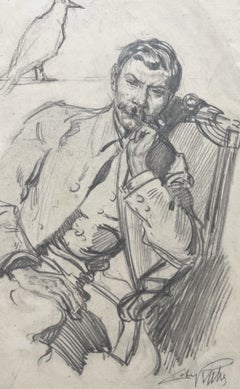
Hermann Prell (1854 Leipzig - 1922 Dresden-Loschwitz). Half-length portrait of a Pharisee, 1885. Sketch for the right-hand figure in the painting Judas Iscariot, 1886. Pencil drawing heightened with opaque white and black chalk on beige-grey wove paper (papier vélin), 34 x 27.8 cm (visible size), 52 x 45 cm (mount), signed, dated and inscribed "H. PRELL 1885 zu 'Judas'". Minor browning, collection stamp on the reverse. - In the shadow of betrayal - About the artwork This painting is the sketch for the head of the Pharisee offering the coins to Judas in one of Herrmann Prell's major works, the painting Betrayal of Judas, completed in 1886. The painting belongs to the Staatliche Kunstsammlungen Dresden and is illustrated in Adolf Rosenberg: Prell, Bielefeld and Leipzig 1901, p. 21 (Fig. 19). It is especially highlighted in Thieme-Becker (vol. 27, p. 376). Hermann Prell, Betrayal of Judas, 1886 The monumental head, which fills the picture and is distinguished by its ornamented robe, is almost a lost profile, which in the executed painting is justified by the Pharisee's turning towards Judas. Despite the fact that the sitter withdraws from the viewer by turning away, it was necessary to artistically elaborate the motivation for the purchase of one of Christ's disciples, which is why the drawing focuses on the expression of the face, while the 'accessories' are treated in a more summary manner. In characterising the face, Hermann Prell performs a balancing act: since the Pharisee, despite his destructive actions, is an actor in the history of salvation, the head must show a dignity appropriate to the event, but at the same time the physiognomy must also bear witness to the scheming attitude that led to the betrayal. To solve this dilemma, Prell draws on the traditional depictions of the heads of the apostles, shading the face to indicate the obdurate darkness of the spirit and moving the base of the nose slightly upwards while the mouth falls away, thus giving a physiognomic expression to the motivation of the action. The fatal drama of the betrayal is expressed in the monumentalisation of the head and in the thunderous white highlights that contrast with the darkness of the chalk. As a study, considered by the artist to be a work in itself, this drawing reveals the pictorial problems and brainstorming of monumental painting. About the artist In 1872 Prell, who was one of the most important exponents of monumental painting of his time, began studying painting with Theodor Grosse at the Dresden Academy of Art and continued with Carl Gussow at the Berlin Academy in 1876. Hans von Marées taught him in Rome in 1878. More influential on his work, however, were Arnold Böcklin and Max Klinger, with whom Prell had been friends since his student days and with whom he worked together on several occasions. Prell's first major work, which established his reputation as a monumental painter, were the frescoes in the banqueting hall of the Architektenhaus in Berlin in 1881/82, commissioned by the state and depicting the different periods of architecture. Prell then went to Italy for two years to study fresco painting. Other major commissions followed. These included monumental frescoes in the town halls of Worms (1884), Hildesheim (1882-92), Gdansk (1895) and Dresden, the staircase of the Silesian Museum of Fine Arts in Breslau (1893/94), the throne room of the German Embassy in Rome (1896-99) and the staircase of the Albertinum in Dresden (1900-1904). From 1886 Prell taught at the academy of arts in Berlin and in 1892 he was appointed professor at the academy of arts in Dresden. His students included Osmar Schindler and Hans Unger...

Category

1880s Realist Edward Robert Hughes Art

Materials

Chalk

Head of a Young Woman

Head of a Young Woman

Located in London, GB

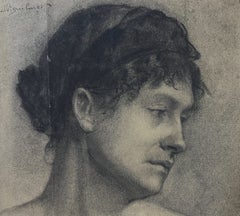
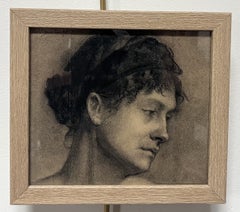
Karl Parsons English 1884 - 1934 Head of a Young Woman Graphite on paper Signed and dated '(19)07' lower left Image size: 6 1/4 x 8 1/2 inches (16 x 21.5 cm) Contemporary Pre-Raphaelite style frame One of Britain's leading stained glass designers during the early decades of the 20th century, Karl Parsons drew portraits invariably for pleasure rather than commissions, throughout his life, and it is in these that one sees most clearly the influence of some of the artists whom he most admired, notably Botticelli, Rossetti and Burne-Jones. Though harkening back to these illustrious forebears, both technically and compositionally, this portrait also epitomises the type of portraiture that was fashionable in British high society at the start of the 20th century. Karl Parson's technique here, with delicate shading and strong outlines, is certainly comparable to Gerald Leslie Brockhurst's graphic style. It is clear that Parsons took delight in demonstrating his skill at sculpting human forms through gentle shading. Karl Parsons was an English stained glass artist associated with the arts and craft movement. Parsons was born in Peckham in Surrey in 1884, the 12th child of Arthur William Parsons...

Category

Early 20th Century Pre-Raphaelite Edward Robert Hughes Art

Materials

Graphite

Anne Hyde, Duchess of York; King James II

Anne Hyde, Duchess of York; King James II

By Sir Peter Lely

Located in London, GB

After Sir Peter Lely 1618 - 1680 Anne Hyde, Duchess of York; King James II Pencil, ink and white chalk on paper, Image size: 10 x 8 inches (25.5 x 20.5 cm) Original frame This work,...

Category

17th Century Old Masters Edward Robert Hughes Art

Materials

Paper, Chalk, Ink, Pencil

Italian School, 17th century - Study for the Vision of Saint Anthony

Italian School, 17th century - Study for the Vision of Saint Anthony

Located in Paris, Île-de-France

Italian School, 17th century Study for the Vision of Saint Anthony Red chalk on paper 247 x 185 mm Unsigned Provenance Private collection, Paris Collection of Count Alessandro Mag...

Category

17th Century Old Masters Edward Robert Hughes Art

Materials

Chalk

Ellen, A Greek Model - PreRaphaelite chalk portrait drawing

Ellen, A Greek Model - PreRaphaelite chalk portrait drawing

Located in London, GB

FREDERIC JAMES SHIELDS, ARWS (1833-1911) Ellen, A Greek Model Signed and indistinctly inscribed with the name of the sitter on the reverse Chalks on blue/green tinted paper 37 by 28.5 cm., 14 ½ by 11 ¼ in. (frame size 63.5 by 54.5 cm., 25 by 21 ½ in.) Provenance: The Artist’s estate; Private collection. Shields was born in Hartlepool and brought up in extreme poverty with most of his family succumbing to TB. Employed by a commercial engraver he studied at evening classes in London and then in Manchester, where he settled in 1848. He was greatly impressed by the works of the Pre-Raphaelite Brotherhood, which he saw at the Manchester Art Treasures Exhibition in 1857. The quality of his illustrations for Defoe’s History of the Plague (1862) and Bunyan’s Pilgrim’s Progress...

Category

Late 19th Century Pre-Raphaelite Edward Robert Hughes Art

Materials

Chalk, Paper

Portrait Studies
Portrait Studies

Portrait Studies

By Edwin Longsden Long

Located in London, GB

Edwin Long 1829 - 1891 Portrait Studies Graphite on paper Image size: 4 x 8 inches (10 x 20.5 cm) Framed Edwin Longsden Long RA (1829-1891, British) wa...

Category

1850s Pre-Raphaelite Edward Robert Hughes Art

Materials

Graphite

Sibyl or bust-length woman, seen in profile to the left, wearing a turban

Sibyl or bust-length woman, seen in profile to the left, wearing a turban

By Giovanni Francesco Barbieri (Il Guercino)

Located in Paris, Île-de-France

Follower of Giovanni Francesco Barbieri, called Il Guercino (Cento 1591 – 1666 Bologna) Sibyl or bust-length woman, seen in profile to the left, wearing a turban Red chalk on paper,...

Category

18th Century Old Masters Edward Robert Hughes Art

Materials

Chalk

Portrait of a Young Man with Beret, 1896

Portrait of a Young Man with Beret, 1896

Located in Stockholm, SE

Karl Johan Holter (Norway, 1870–1960) Young Man with Beret, 1896 chalk and white heightening on paper, paper mounted on board approx. 58 × 39 cm (unframed) / 22.8 × 15.4 in signed ...

Category

1890s Symbolist Edward Robert Hughes Art

Materials

Chalk, Board, Laid Paper, Pencil

Style of Matisse Drawing

Style of Matisse Drawing

$550

H 10.5 in W 7 in

Style of Matisse Drawing

Located in San Francisco, CA

Very interesting portrait of a woman done in the style of Matisse. I believe most of it was done by chalk and just the red earrings are oil paint. Image itself measures 10 1/2 inches...

Category

20th Century Edward Robert Hughes Art

Materials

Chalk

Portrait of a Man’s Head

William EttyPortrait of a Man’s Head

$3,429

H 21.26 in W 16.93 in

Portrait of a Man’s Head

By William Etty

Located in London, GB

Charcoal and white chalk highlight on paper Label of J.M Maas Gallery (verso) 36cm × 28cm (54cm × 43cm framed) Etty, a student of Thomas Lawrence, R.A., was the first significant Br...

Category

19th Century English School Edward Robert Hughes Art

Materials

Paper, Chalk, Charcoal

Edward Robert Hughes art for sale on 1stDibs.

Find a wide variety of authentic Edward Robert Hughes art available for sale on 1stDibs. You can also browse by medium to find art by Edward Robert Hughes in chalk and more. Not every interior allows for large Edward Robert Hughes art, so small editions measuring 24 inches across are available. Edward Robert Hughes art prices can differ depending upon medium, time period and other attributes. On 1stDibs, the price for these items starts at $8,482 and tops out at $11,467, while the average work can sell for $9,974.