By Émile Eisman-Semenowsky
Located in Marlow, Buckinghamshire
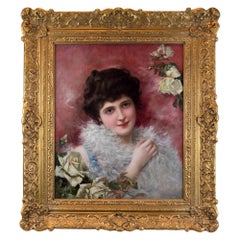
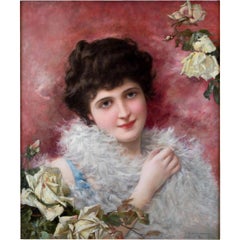
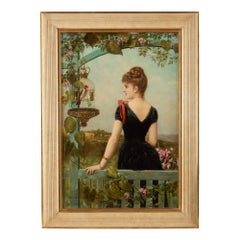
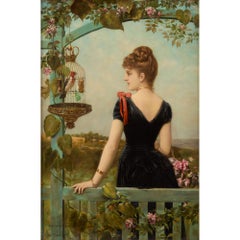
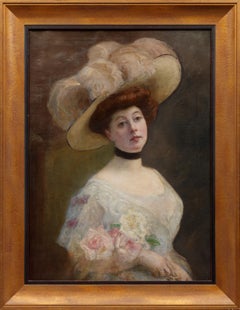
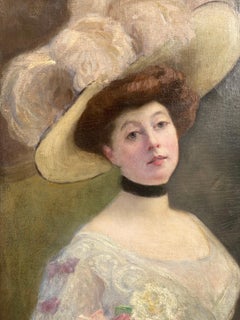
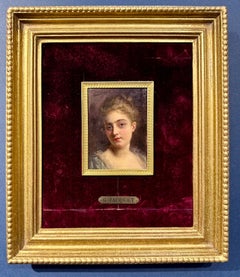
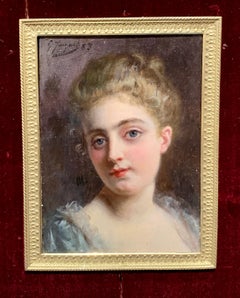
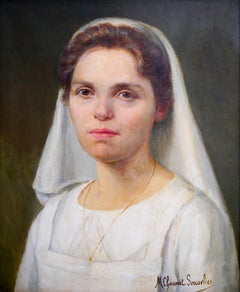
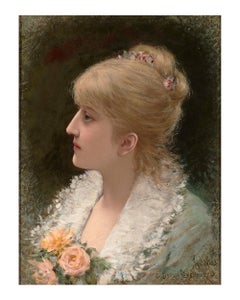
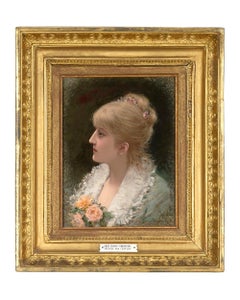
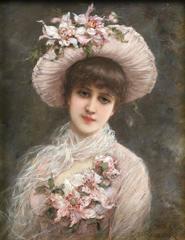
A wonderful oil on panel late 19th century portrait of a beautiful Parision girl. Highly detailed from the flowers in her hat to the translucent scarf around her neck. Signed and dated 1894 lower right.
Very little is known about the life of Emile Eisman-Semenowsky. He was born in eastern Poland but left his country fairly early on and arrived in Paris in the early 1880s. Here, he became the assistant of the Dutch painter Jan van Beers and established himself as a painter of young fashionable Parisian women, languid oriental odalisques, and reclining neoclassical beauties.
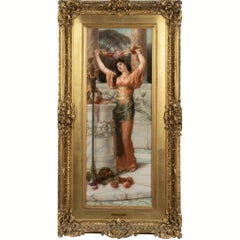
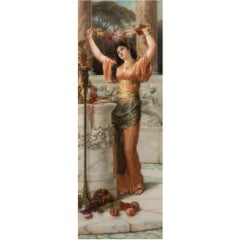
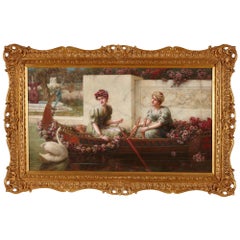
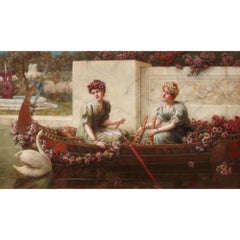
The present painting depicts Cerealia, the festival dedicated to Ceres, the Roman goddess of agriculture, grains and fertility, as dedicated in the inscription at left and hinted to by the fruits and vegetables on the altar at right. Her festival took place from mid- to end of April and was led by priestesses from the best Roman families. The festivities included races in the Circus Maximus, theater, music and dancing.
The painting is Semenowsky's most ambitious work known to date, a large format, multi-figured composition, whose size may indicate its intention as an entry to the Paris Salon. One can speculate that Semenowsky became inspired by Sir Lawrence Alma-Tadema's Spring, an intricate composition from 1894 depicting the same festival and of roughly same dimensions, albeit reversed.
Semenowsky populated his painting with numerous maidens in diaphanous dresses against a neoclassical background of luminescent, veined marble, performing the ritual sacrifices...
Category
19th Century Impressionist Émile Eisman-Semenowsky Art