Riccardo Tommasi Ferroni Still-life Prints
Italian, 1934-2000
Riccardo Tommasi Ferroni was an Italian painter and engraver. He was an exponent of the Neo-Figurative movement that followed stylistically the Italian painting tradition and, in particular, Mannerism and Baroque.
to
1
2
Overall Width
to
Overall Height
to
3
38
95
72
67
59
3
2
1
2
1
2
1
1
1
1
3
3
Artist: Riccardo Tommasi Ferroni
Redemption - Etching by Riccardo Tommasi Ferroni - 1970s
By Riccardo Tommasi Ferroni
Located in Roma, IT
Redemption is an etching and drypoint ealized by the Italian artist Riccardo Tommasi Ferroni (1934-2000).
Not signed nor numbered.
Tommasi Ferroni's style is recognizable in the...
Category
1970s Modern Riccardo Tommasi Ferroni Still-life Prints
Materials
Etching

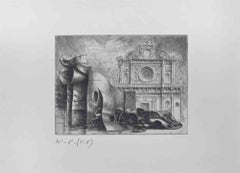
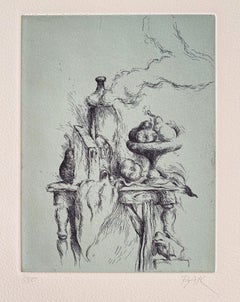
Cathedral - Etching by Riccardo Tommasi Ferroni - 1970s
By Riccardo Tommasi Ferroni
Located in Roma, IT
Cathedral is an etching realized by the Italian artist Riccardo Tommasi Ferroni (1934-2000).
The state of preservation is good.
Tommasi Ferroni's style is recognizable in the flu...
Category
1970s Modern Riccardo Tommasi Ferroni Still-life Prints
Materials
Etching
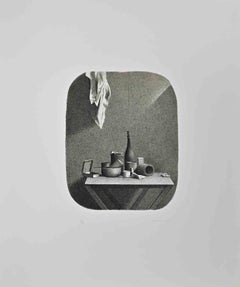
The Still Life - Etching by Riccardo Tommasi Ferroni - 1983
By Riccardo Tommasi Ferroni
Located in Roma, IT
The Still Life is an etching artwork realized by the Italian artist Riccardo Tommasi Ferroni (1934-2000), in 1983.
Hand-signed on the lower right margin.
Dated and Numbered on th...
Category
1980s Modern Riccardo Tommasi Ferroni Still-life Prints
Materials
Etching
Related Items
Magnolia 10 - Contemporary Figurative Drypoint Etching Print, Flower, Floral
By Marta Wakula-Mac
Located in Warsaw, PL
MARTA WAKUŁA-MAC: Master of Arts in Fine Art Education- Diploma in Fine Art Printmaking at the Institute of Art, Pedagogical University, Krakow, 2003. Member of Graphic Studio Dubl...
Category
2010s Contemporary Riccardo Tommasi Ferroni Still-life Prints
Materials
Paper, Drypoint, Etching

$170 Sale Price
20% Off
H 5.91 in W 6.11 in
The pot boiling by David Hockney (Six Fairy Tales from the Brothers Grimm)
By David Hockney
Located in New York, NY
From David Hockney’s celebrated Six Fairy Tales from the Brothers Grimm portfolio, an image from the story of ‘Fundevogel’. One of just a few in the series that depicts a single form with such complexity, drawn directly on the plate by Hockney. This is certainly an ode to Giorgio Morandi’s etchings...
Category
1960s Riccardo Tommasi Ferroni Still-life Prints
Materials
Etching, Aquatint
Zen Minimalist Flowers Etching American Modernist Ed Baynard Pop Art Print
By Ed Baynard
Located in Surfside, FL
ED BAYNARD (American, 1940-2016)
Flowers, Flowers in a Vase, Etching.
1979/1980,
Hand signed, dated l.r.,
Hand numbered from small edition 12/24,
Dimensions: 23 by 19 in. Framed 25 by 21 in
Born in Washington, D.C. in 1940. Raised in Washington, D.C. and newly graduated from high school, he flew to Europe living off and on in Paris and London. During this time, he designed costumes for Jimi Hendrix, worked as a graphic designer for the Beatles as well as Elizabeth Taylor and Richard Burton. Returning to New York, he dedicated his life to art after a surprise success with his first show in 1971 at the Willard Gallery in NYC. Ed's images are Zen-like in their simplicity and grace rendered in a flat, graphic style that recalls Japanese Ukiyo-e prints. His watercolors are luminous, like the rest of his representations regardless of the medium. The Japanese inspired ukiyo-e style woodblock prints and lithograph works he created at Tyler Graphics in 1980 contain a 20th century "floating world" sensibility. Ed's wish was to bring harmony, color, and a meditative stillness to this chaotic planet. He did so in a gentle and powerful way, always as an expression of his deep gratitude for the love and beauty, friendship, and concerns he held dearest. His first solo exhibition was in 1971 at New York's legendary Willard Gallery on the recommendation of Agnes Martin. Baynard went on to have exhibitions at galleries including Betty Parsons Gallery, New York (1973); Marian Goodman Gallery, New York (1977); John Berggruen Gallery, San Francisco (1980); and Barbara Gladstone Gallery, New York (1980/81).. Baynard manages to retain a simplicity of form inspired by a love of Japanese Woodblock prints. His new works reflect the same poetry of his earlier paintings, retaining his stylized compositions with their Zen like minimalism and Oriental calm, along with a new sense of rhythm and movement. Baynard uses familiar themes such as flowers, plants, pots, and vases, incorporating them into his delicate watercolor still lifes, thus creating stunning visual feasts. He was included in the 1972 Landscape exhibition at MoMA NY alone with other luminaries James Boynton...
Category
1980s American Modern Riccardo Tommasi Ferroni Still-life Prints
Materials
Etching
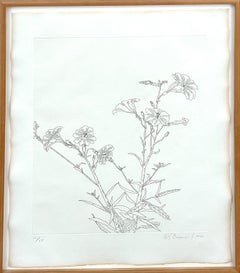
Zen Minimalist Flowers Etching American Modernist Ed Baynard Pop Art Print
By Ed Baynard
Located in Surfside, FL
ED BAYNARD (American, 1940-2016)
Flowers, Flowers in a Vase, Etching.
1979/1980,
Hand signed, dated l.r.,
Hand numbered from small edition 12/24,
Dimensions: 23 by 19 in. Framed 25 by 21 in
Born in Washington, D.C. in 1940. Raised in Washington, D.C. and newly graduated from high school, he flew to Europe living off and on in Paris and London. During this time, he designed costumes for Jimi Hendrix, worked as a graphic designer for the Beatles as well as Elizabeth Taylor and Richard Burton. Returning to New York, he dedicated his life to art after a surprise success with his first show in 1971 at the Willard Gallery in NYC. Ed's images are Zen-like in their simplicity and grace rendered in a flat, graphic style that recalls Japanese Ukiyo-e prints. His watercolors are luminous, like the rest of his representations regardless of the medium. The Japanese inspired ukiyo-e style woodblock prints and lithograph works he created at Tyler Graphics in 1980 contain a 20th century "floating world" sensibility. Ed's wish was to bring harmony, color, and a meditative stillness to this chaotic planet. He did so in a gentle and powerful way, always as an expression of his deep gratitude for the love and beauty, friendship, and concerns he held dearest. His first solo exhibition was in 1971 at New York's legendary Willard Gallery on the recommendation of Agnes Martin. Baynard went on to have exhibitions at galleries including Betty Parsons Gallery, New York (1973); Marian Goodman Gallery, New York (1977); John Berggruen Gallery, San Francisco (1980); and Barbara Gladstone Gallery, New York (1980/81).. Baynard manages to retain a simplicity of form inspired by a love of Japanese Woodblock prints. His new works reflect the same poetry of his earlier paintings, retaining his stylized compositions with their Zen like minimalism and Oriental calm, along with a new sense of rhythm and movement. Baynard uses familiar themes such as flowers, plants, pots, and vases, incorporating them into his delicate watercolor still lifes, thus creating stunning visual feasts. He was included in the 1972 Landscape exhibition at MoMA NY alone with other luminaries James Boynton...
Category
1980s American Modern Riccardo Tommasi Ferroni Still-life Prints
Materials
Etching
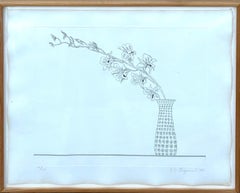
Zen Minimalist Flowers Etching American Modernist Ed Baynard Pop Art Print
By Ed Baynard
Located in Surfside, FL
ED BAYNARD (American, 1940-2016)
Flowers, Flowers in a Vase, Etching.
1979/1980,
Hand signed, dated l.r.,
Hand numbered from small edition 12/24,
Dimensions: 23 by 19 in. Framed 25 by 21 in
Born in Washington, D.C. in 1940. Raised in Washington, D.C. and newly graduated from high school, he flew to Europe living off and on in Paris and London. During this time, he designed costumes for Jimi Hendrix, worked as a graphic designer for the Beatles as well as Elizabeth Taylor and Richard Burton. Returning to New York, he dedicated his life to art after a surprise success with his first show in 1971 at the Willard Gallery in NYC. Ed's images are Zen-like in their simplicity and grace rendered in a flat, graphic style that recalls Japanese Ukiyo-e prints. His watercolors are luminous, like the rest of his representations regardless of the medium. The Japanese inspired ukiyo-e style woodblock prints and lithograph works he created at Tyler Graphics in 1980 contain a 20th century "floating world" sensibility. Ed's wish was to bring harmony, color, and a meditative stillness to this chaotic planet. He did so in a gentle and powerful way, always as an expression of his deep gratitude for the love and beauty, friendship, and concerns he held dearest. His first solo exhibition was in 1971 at New York's legendary Willard Gallery on the recommendation of Agnes Martin. Baynard went on to have exhibitions at galleries including Betty Parsons Gallery, New York (1973); Marian Goodman Gallery, New York (1977); John Berggruen Gallery, San Francisco (1980); and Barbara Gladstone Gallery, New York (1980/81).. Baynard manages to retain a simplicity of form inspired by a love of Japanese Woodblock prints. His new works reflect the same poetry of his earlier paintings, retaining his stylized compositions with their Zen like minimalism and Oriental calm, along with a new sense of rhythm and movement. Baynard uses familiar themes such as flowers, plants, pots, and vases, incorporating them into his delicate watercolor still lifes, thus creating stunning visual feasts. He was included in the 1972 Landscape exhibition at MoMA NY alone with other luminaries James Boynton...
Category
1980s American Modern Riccardo Tommasi Ferroni Still-life Prints
Materials
Etching
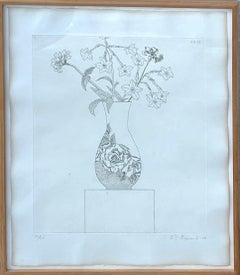
Zen Minimalist Flowers Etching American Modernist Ed Baynard Pop Art Print
By Ed Baynard
Located in Surfside, FL
ED BAYNARD (American, 1940-2016)
Flowers, Flowers in a Vase, Etching.
1979/1980,
Hand signed, dated l.r.,
Hand numbered from small edition 12/24,
Dimensions: 23 by 19 in. Framed 25 by 21 in
Born in Washington, D.C. in 1940. Raised in Washington, D.C. and newly graduated from high school, he flew to Europe living off and on in Paris and London. During this time, he designed costumes for Jimi Hendrix, worked as a graphic designer for the Beatles as well as Elizabeth Taylor and Richard Burton. Returning to New York, he dedicated his life to art after a surprise success with his first show in 1971 at the Willard Gallery in NYC. Ed's images are Zen-like in their simplicity and grace rendered in a flat, graphic style that recalls Japanese Ukiyo-e prints. His watercolors are luminous, like the rest of his representations regardless of the medium. The Japanese inspired ukiyo-e style woodblock prints and lithograph works he created at Tyler Graphics in 1980 contain a 20th century "floating world" sensibility. Ed's wish was to bring harmony, color, and a meditative stillness to this chaotic planet. He did so in a gentle and powerful way, always as an expression of his deep gratitude for the love and beauty, friendship, and concerns he held dearest. His first solo exhibition was in 1971 at New York's legendary Willard Gallery on the recommendation of Agnes Martin. Baynard went on to have exhibitions at galleries including Betty Parsons Gallery, New York (1973); Marian Goodman Gallery, New York (1977); John Berggruen Gallery, San Francisco (1980); and Barbara Gladstone Gallery, New York (1980/81).. Baynard manages to retain a simplicity of form inspired by a love of Japanese Woodblock prints. His new works reflect the same poetry of his earlier paintings, retaining his stylized compositions with their Zen like minimalism and Oriental calm, along with a new sense of rhythm and movement. Baynard uses familiar themes such as flowers, plants, pots, and vases, incorporating them into his delicate watercolor still lifes, thus creating stunning visual feasts. He was included in the 1972 Landscape exhibition at MoMA NY alone with other luminaries James Boynton...
Category
1980s American Modern Riccardo Tommasi Ferroni Still-life Prints
Materials
Etching
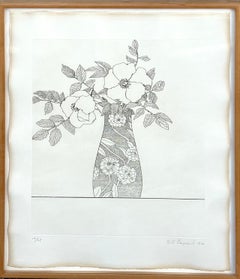
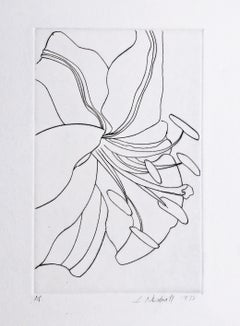
Elegant Flower etching, signed/n Artists Proof, from Estate of renowned curator
By Lowell Nesbitt
Located in New York, NY
Lowell Nesbitt
Untitled Flower, 1975
Etching on wove paper
Hand signed, numbered AP and dated on the front
24 × 19 inches
Image alone:
9.5 inches (vertical) x 5.75 inches (horizontal...
Category
1970s Modern Riccardo Tommasi Ferroni Still-life Prints
Materials
Etching
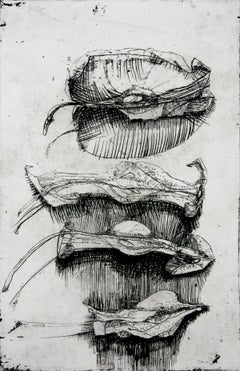
4 cores - XXI Century, Contemporary Etching Print, Figurative, Still life
By Zdzislaw Wiatr
Located in Warsaw, PL
ZDZISŁAW WIATR (born 1960)
He graduated from the Academy of Fine Arts in Cracow, at the Faculty of Graphic Arts in Katowice, where in 1986 he received a diploma with the honourable m...
Category
21st Century and Contemporary Contemporary Riccardo Tommasi Ferroni Still-life Prints
Materials
Paper, Etching
$189 Sale Price
20% Off
H 6.7 in W 4.34 in
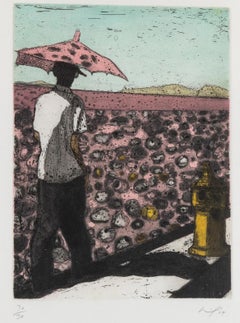
Peter Doig 'Lapeyrouse Wall' Limited Edition Signed Etching Print
By Peter Doig
Located in San Rafael, CA
Peter Doig (British, b. 1959).
Lapeyrouse Wall, 2004
Etching and aquatint printed in colors on wove paper
Signed and dated in pencil by the artist
Edition 30/30
Published by the arti...
Category
Early 2000s Contemporary Riccardo Tommasi Ferroni Still-life Prints
Materials
Etching
$4,800
H 23 in W 16 in D 1 in
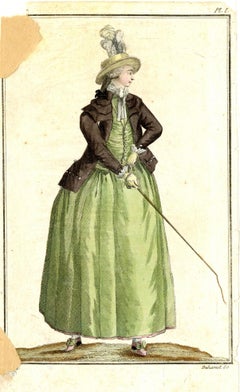
Group of 19th & 20th century hand colored fashion plates.
Located in Middletown, NY
19th century European
Group of 13 hand-colored English and Continental fashion plates and costume designs.
Each an etching with hand coloring in watercolor. Various sizes and condit...
Category
19th Century English School Riccardo Tommasi Ferroni Still-life Prints
Materials
Watercolor, Handmade Paper, Etching
Samuel Bak Surrealist Etching Israeli Bezalel Artist "Hidden Pear", Fruit Bowl
By Samuel Bak
Located in Surfside, FL
HIDDEN PEAR, color etching, signed in pencil, numbered 7/50, Jerusalem Print workshop blind stamp, image 7 ½ x 5 ½”, sheet 15 x 10 ¼”.
Samuel Bak (born 12 August 1933) is a Polish- American painter and writer who survived the Holocaust and immigrated to Israel in 1948. Since 1993, he has lived in the United States.
Samuel Bak was born in Wilno, Poland, Bak was recognized from an early age as having an artistic talent. He describes his family as secular, but proud of their Jewish identity.
By 1939 when Bak was six years old, the war began and Wilno was transferred from Poland to Lithuania. When Wilno was occupied by the Germans on June 24, 1941, Bak and his family were forced to move into the ghetto. At the age of nine, he held his first exhibition inside the Ghetto. Bak and his mother sought refuge in a Benedictine convent where a Catholic nun named Maria Mikulska tried to help them. After returning to the ghetto, they were deported to a forced labour camp, but took shelter again in the convent where they remained in hiding until the end of the war.
By the end of the war, Samuel and his mother were the only members of his extensive family to survive. His father, Jonas, was shot by the Germans in July 1944, only a few days before Samuel's own liberation. As Bak described the situation, "when in 1944 the Soviets liberated us, we were two among two hundred of Vilna's survivors--from a community that had counted 70 or 80 thousand." Bak and his mother as pre-war Polish citizens were allowed to leave Soviet-occupied Wilno and travel to central Poland, at first settling briefly in Lodz. They soon left Poland and traveled into the American occupied zone of Germany. From 1945 to 1948, he and his mother lived in Displaced Persons camps in Germany. He spent most of this period at the Landsberg am Lech DP camp in Germany. It was there he painted a self-portrait shortly before repudiating his Bar Mitzvah ceremony. Bak also studied painting in Munich during this period, and painted "A Mother and Son", 1947, which evokes some of his dark memories of the Holocaust and escape from Soviet-occupied Poland. In 1948, Bak and his mother immigrated to Israel. In 1952, he studied art at the Bezalel Academy of Arts and Design in Jerusalem. After serving in the Israel Defense Forces, he continued his studies in Paris (from 1956 at the École nationale supérieure des Beaux-Arts) and spent various periods of time in Rome, Paris, Switzerland and Israel before settling permanently in the United States. In 2001, Bak returned to Vilnius for the first time and has since visited his hometown several times. Samuel Bak is a conceptual artist with elements of post-modernism as he employs different styles and visual vernaculars, i.e. surrealism (Salvador Dali, Rene Magritte), analytical cubism (Picasso), pop art (Andy Warhol, Roy Lichtenstein) and quotations from the old masters. The artist never paints direct scenes of mass death. Instead, he employs allegory, metaphor and certain artistic devices such as substitution: toys instead of the murdered children who played with them, books, instead of the people who read them. Further devices are quotations of iconographical prototypes, i.e. Michelangelo's "Creation of Adam" on the Sistine Ceiling or Albrecht Dürer's famous engraving entitled "Melencholia" . In the late 1980s Bak opened up about his paintings, stating they convey “a sense of a world that was shattered.” He turns these prototypes into ironical statements. Irony in the art of Samuel Bak does not mean parody or derision, but rather disenchantment, and the attempt to achieve distance from pain. Recurring symbols are: the Warsaw Ghetto Child, Crematorium Chimneys or vast backgrounds of Renaissance landscape that symbolize the indifference of the outside world. These form a disturbing contrast with the broken and damaged images in the foreground. Samuel Bak's paintings cause discomfort, they are a warning against complacency, a bulwark against collective amnesia with reference to all acts of barbarism, worldwide and throughout the ages, through his personal experience of genocide.
In Bak's piece entitled Trains Bak creates a vast grey landscape with large mounts creating the structure of a train. Massive taper candles burn in the distance further down the train tracks, surrounding an eruption. The smoke from the candles and volcano pour into a sky of dark ominous clouds that lurk over the landscape. Here Bak has created a whole new meaning for “trains.” Many of Bak’s pieces incorporate aspects of Jewish culture and the holocaust with a dark and creative twist, such as Shema Israel...
Category
20th Century Surrealist Riccardo Tommasi Ferroni Still-life Prints
Materials
Etching
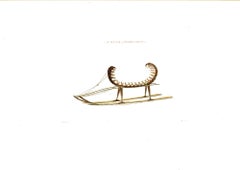
A Sledge of Kamtschatka – An image of a relic from Captain Cook's third voyage
By John Webber
Located in Middletown, NY
London: Scatcherd & Whitaker, 1784.
Etching with hand coloring in watercolor on cream wove paper, 7 1/2 x 10 (190 x 255); sheet 16 1/4 x 22 (414 x 560 mm), full margins. In good cond...
Category
Late 18th Century English School Riccardo Tommasi Ferroni Still-life Prints
Materials
Watercolor, Handmade Paper, Etching
$350
H 7.49 in W 10.04 in
Riccardo Tommasi Ferroni still-life prints for sale on 1stDibs.
Find a wide variety of authentic Riccardo Tommasi Ferroni still-life prints available for sale on 1stDibs. You can also browse by medium to find art by Riccardo Tommasi Ferroni in etching and more. Much of the original work by this artist or collective was created during the 1980s and is mostly associated with the modern style. Not every interior allows for large Riccardo Tommasi Ferroni still-life prints, so small editions measuring 20 inches across are available. Customers who are interested in this artist might also find the work of Piero Cesaroni, Franco Gentilini, and Mario Avati. Riccardo Tommasi Ferroni still-life prints prices can differ depending upon medium, time period and other attributes. On 1stDibs, the price for these items starts at $649 and tops out at $649, while the average work can sell for $649.