By Rikio Takahashi
Located in Soquel, CA
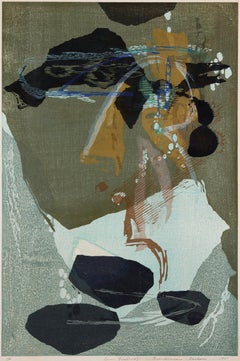
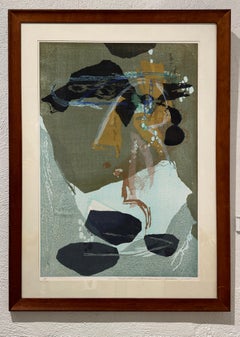
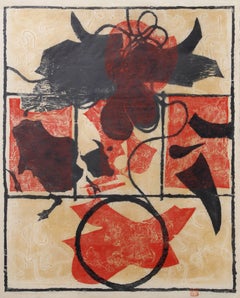
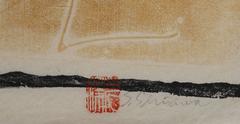
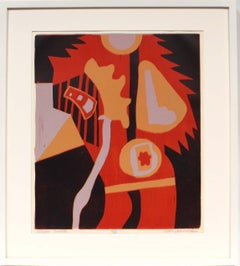
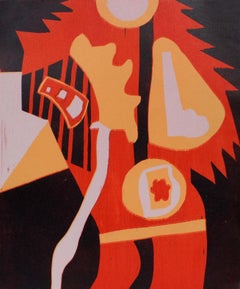
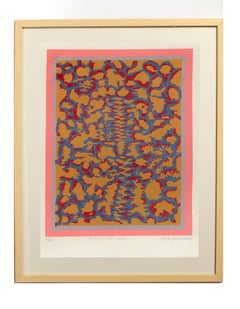
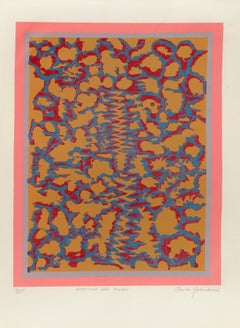
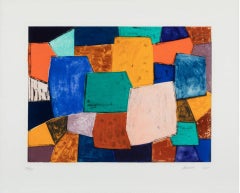
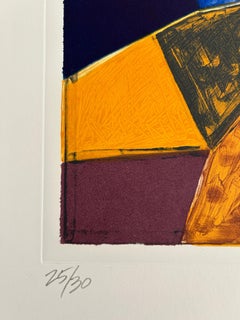
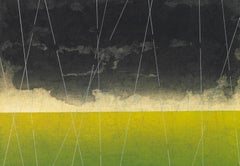
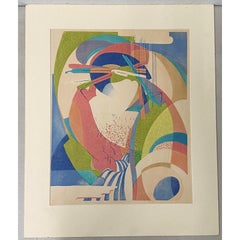
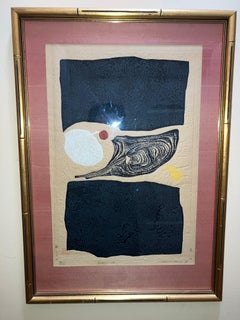
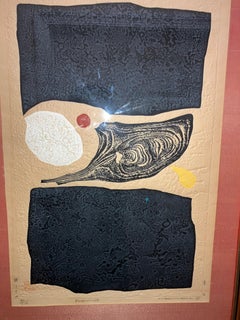
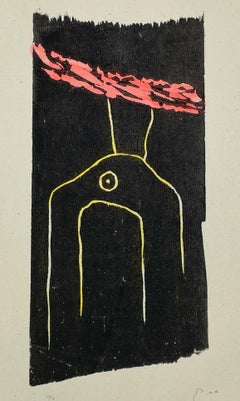
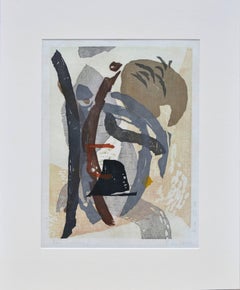
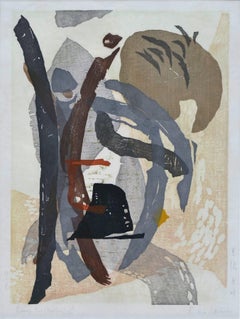
Dynamic abstract expressionist woodcut print done in neutral tones by Rikio Takahashi, 1958. TItled and numbered lower left. Signed by the artist lower right, Presented with archival mat and backing. Image size, 18.63"H x 13.63"W. Paper size, 22"H x 17"W. Mat size, 28.25"H x 23.13"W x .25"D. This print was one of five commissioned by the International Graphic Arts Society in 1958, New York from the artist over a period of three years in 1958. The print was limited to 200 impressions. The International Graphic Arts Society (IGAS) was a nonprofit organization founded in 1951 with the dual goals of promoting the work of contemporary printmakers and bringing print media to a wider audience. IGAS served as a driving force behind the post-World War II "Print Renaissance" in the United States for the next two decades. At the core of IGAS was a seven-member jury that was responsible for selecting the artists who would then be commissioned to produce editions that would eventually be sold to IGAS members. Among the artists published by IGAS are Karel Appel, Leonard Baskin, Hans Erni, Stanley W. Hayter, Jean Iurcat, Ynez Johnston, Ezio Martinelli, Seong Moy, Gabor Peterdi, Paul Shaub, Kiyoshi Saito, Ben Shahn, Carol Summers, Rikio Takahashi, Peter Takal and Ada Yunkers. [Sources: Syracuse University.
Rikio Takahashi specialized in depicting the forms of the Japanese garden, especially the classic gardens of Kyoto. He was the son of a 'Nihonga' ("Japanese-style painting") artist and from 1949-1955 became an important pupil of the seminal figure in modern Japanese printmaking, Onchi Kōshirō (1891-1955), whose late non-representational style had a significant influence. Takahashi studied at the Chouinard Art Institute [later to become integrated into the California Institute of Arts] in 1962 and 1963 and returned to the United States several years later to work with Ken Tyler at Tyler's renowned Gemini print studio. (See "Collaboration with Ken Tyler," below.)
Takahashi is one of the last true sōsaku hanga (creative print) artists. He successfully explored in an abstracted manner various forms found in gardens and nature. He is especially adept at the subtle partial overlay of one or more colors to create varied opacities and textures as well as complexity of shapes.
Many of his prints evoke an atmosphere of stillness and balance that have a sense of timelessness. Takahashi's prints vary in size, with some reaching roughly three feet in height.
Biography
Source: Modern Japanese Prints 1912-1989, Lawrence Smith, The British Museum Press, 1994, p. 35-36 and Rikio Takahashi, The Woodblock Prints published by Abe Publishing LTD., 1998, p. 199-205.
Takahashi was born in in 1917 at Honjo Wakamiyacho, Tokyo. His father Tarao was a Nihonga (Japanese style) painter, and his uncle was Imaizumi Toshiji, a Yoga (Western style) artist, from whom he first learned art. He failed to graduate from middle school and at the age of 17 he was co-managing, with his father, the family's photographic studio. In 1944 he married Sekino Shizu. In that same year he was conscripted as a photographer by the Navy. In 1945 his first daughter Setsuko was born, followed by his first son Mitsunori in 1946.
Takahashi quotes his artistic education as having taken place at the California Institute of Art in the 1960s, when he spent two years in the USA (1962-63). By then, however, he had studied informally for six years (1949-55) with Onchi Kōshirō (1891-1955). His early works are very close to Onchi's late abstract style, with much use of heavily grained driftwood and strongly contrasted colours. Gradually his printing became smoother, his prints very large, and his colours more internally harmonious. His works have been inspired mostly by Kyoto gardens and locations, and are in a sense almost calligraphic reworkings of a few themes in a semi-abstract style. Takahashi has exhibited with the Japanese Print Association since 1950 and since the mid-1960s with the College Women's Association of Japan annual show. After his USA visit he had many one-man shows in that country and became popular in the West.
Printing Technique Sources: Who's Who in Modern Japanese Prints, Frances Blakemore...
Category
1950s Abstract Expressionist Rikio Takahashi Art
MaterialsRice Paper, Woodcut