Samuel Grunvald Art

to
4
2
Overall Width
to
Overall Height
to
6
4
5
6
6
6
3
2
6
10,138
2,779
1,375
1,367
1
6
Artist: Samuel Grunvald
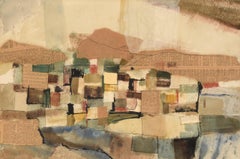
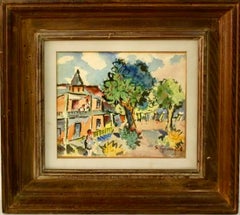
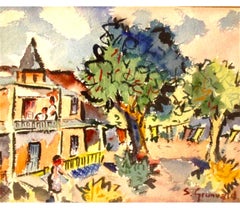
1940's Americana WPA Modernist Watercolor Painting Catskill Mountains Bungalow
By Samuel Grunvald
Located in Surfside, FL
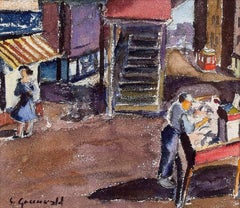
Bungalow (fauvist painting of New York scene) 1940's. image is 10X 11.5 inches. Hand signed lower right Watercolor painting on paper board Country Scene Samuel Grunvald was a Hunga...
Category

1940s Modern Samuel Grunvald Art

Materials

Watercolor, Paper, Board

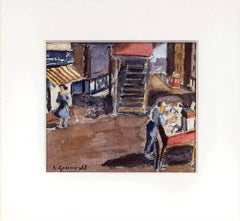
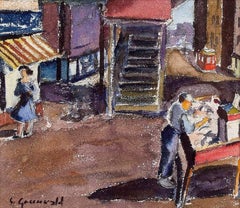
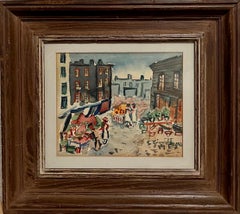
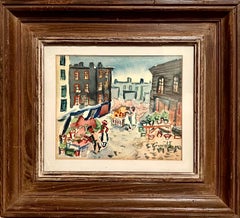
1940's American WPA Modernist New York City Watercolor Painting Tenement Market
By Samuel Grunvald
Located in Surfside, FL
The Market, (fauvist painting of NYC scene) 1940's. image is 10X 11.5 inches. Hand signed lower right Lower East Side Tenements Pushcart Market Watercolor on paper board. Samuel G...
Category

1940s Modern Samuel Grunvald Art

Materials

Watercolor, Board, Paper

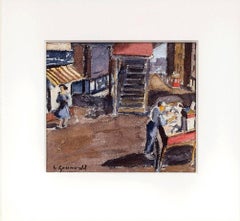
1940 American WPA Modernist New York City Watercolor Painting Pushcart Tenements
By Samuel Grunvald
Located in Surfside, FL
Samuel Grunvald was a Hungarian born American WPA artist known for abstract, landscape and seascape paintings. Arrived in the USA from Hungary in 1921 and...
Category

1940s Modern Samuel Grunvald Art

Materials

Watercolor

Skyline and Tugboat, East River, New York City
By Samuel Grunvald
Located in New York, NY
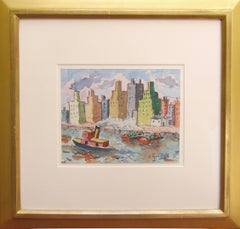
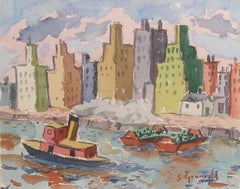
Samuel Grunvald excelled at watercolors and was a native New Yorker who portrayed his city as such as he depicted its skyline, architecture and particular character with love and ent...
Category

1940s Samuel Grunvald Art

Materials

Paper, Watercolor

1940's American WPA Modernist New York Watercolor Painting 59th st Central Park
By Samuel Grunvald
Located in Surfside, FL
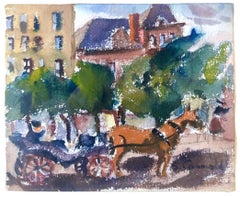
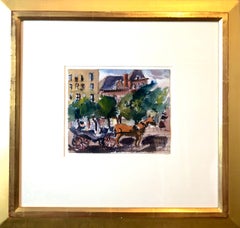
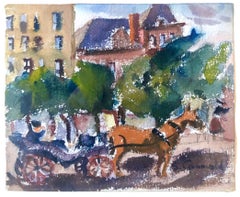
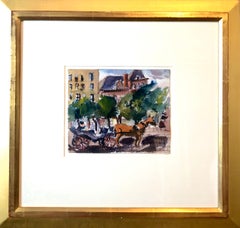
Horse and Buggy 59th st. Manhattan (fauvist painting of NYC outside central park) 1940's. image is 6.25 X 7.5 inches. Hand signed lower right Provenance: Greenwich Gallery (Greenwich...
Category

20th Century Modern Samuel Grunvald Art

Materials

Watercolor

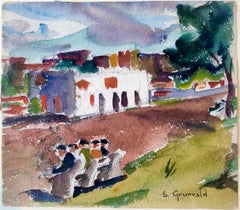
1930's American WPA Modernist New York City Watercolor Painting Harlem River Dr
By Samuel Grunvald
Located in Surfside, FL
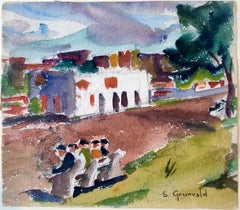
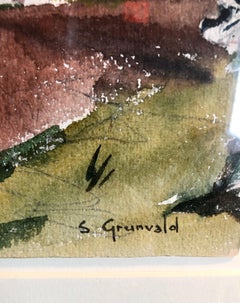
Harlem River Drive, 1938 (fauvist painting of men sitting on a park bench) image is 6.5 X 7.5 inches. Provenance: Greenwich Gallery (Greenwich CT) Samuel Grunvald was a Hungarian b...
Category

20th Century Modern Samuel Grunvald Art

Materials

Watercolor

Related Items
Abstract Expressionist Landscape Jay Milder Rhino Horn Painting American Pop Art
By Jay Milder
Located in Surfside, FL
This came from the collection of the Horace Richter Gallery, Old jaffa, Israel These were done in the 1990's Hand signed and dated. titled Old Jaffa. Jay Milder (born 1934) is an Am...
Category

20th Century Abstract Expressionist Samuel Grunvald Art

Materials

Paper, Gouache

Taxco, Mexico - 1930's Figurative Village Landscape
By Theodore Ernest Langguth
Located in Soquel, CA
A vintage watercolor capturing a daily scene in the Spanish colonial town of Taxco, Mexico by Theodore Ernest Langguth (German-American, 1861-1952). Titled, dated and signed lower ma...
Category

1930s American Impressionist Samuel Grunvald Art

Materials

Paper, Watercolor, Gouache, Pencil

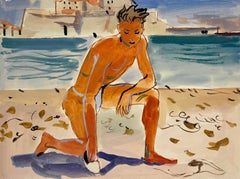
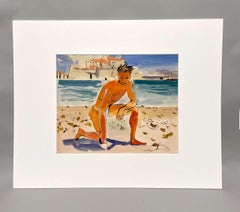
A French Modern 1950s Watercolor of a Young Male Bather by Andre Delfau
By Andre Delfau
Located in Chicago, IL
A vibrant, Modern 1950's watercolor of a young male bather kneeling against a sunny Mediterranean beach by notable French artist Andre Delfau. Painted most likely near Marseille in ...
Category

1950s Modern Samuel Grunvald Art

Materials

Watercolor, Paper

Country Home Near Charleston South Carolina
By Charles Parnelle
Located in Soquel, CA
Country home, an impressionist watercolor painting by Charles Parnelle (American, 20th Century). Presented in a wooden frame. Signed "Parnelle" lower right. Image: 8"H x 10"W. Framed size: 13"H x 15"W. Charles Parnelle was an artist and teacher from Charleston, South Carolina...
Category

1970s American Impressionist Samuel Grunvald Art

Materials

Paper, Watercolor

Country Home Near Charleston South Carolina
$460 Sale Price
20% Off
H 15 in W 15 in D 2 in
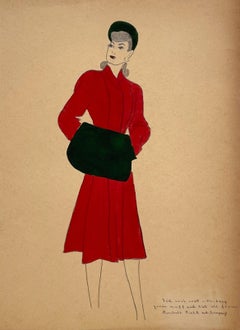
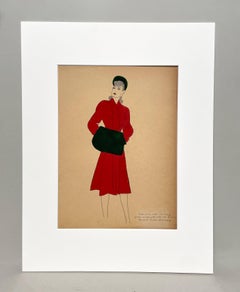
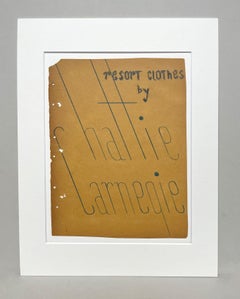
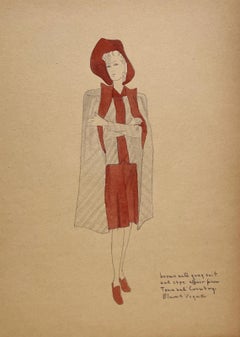
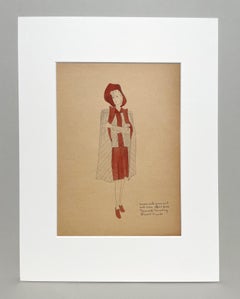
A Stylish Vintage 1940s Fashion Study, Designs for Women's Hat, Suit and Coat
Located in Chicago, IL
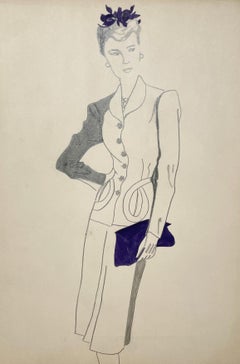
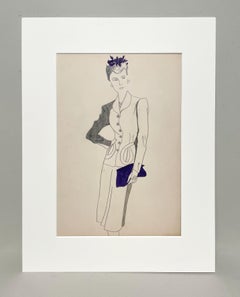
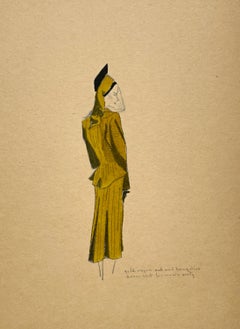
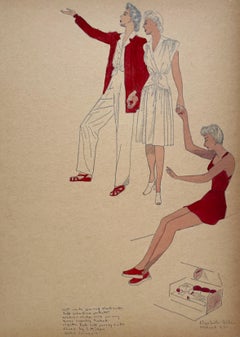
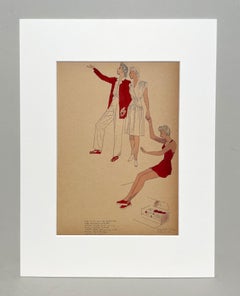
A stylish, vintage, 1940s fashion study featuring colorful designs for women's hat, suit, shoes & coat. Artwork size: 11 x 8 1/4 inches. Archivally matted to 16 x 12 inches. Pro...
Category

1940s American Modern Samuel Grunvald Art

Materials

Paper, Watercolor, Pencil

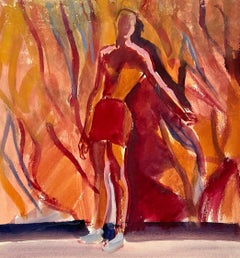
Colorful 1950s Standing Male Bather in South of France by Andre Delfau
By Andre Delfau
Located in Chicago, IL
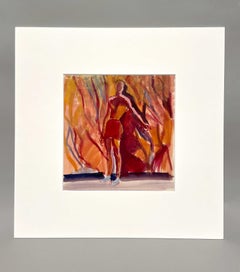
A vibrant 1950s Modern watercolor of a standing male bather in red & orange tones by notable French artist Andre Delfau. Painted in the south of France along the Cote d' azure (...
Category

1950s American Modern Samuel Grunvald Art

Materials

Paper, Watercolor

North on West Street (West Side Highway NYC Cityscape)
By De Hirsch Margules
Located in Wilton Manors, FL
De Hirsh Margules (1899-1965). North on West Street , 1939. Watercolor on Arches wove paper. Signed and dated in pencil by artist lower margin. Sheet measures 15 x 22 inches. Framed measurement: 27 x 34 inched. Incredibly vibrant and saturated color with no fading or toning of sheet. Provenance: Babcock Galleries, NYC De Hirsh Margules (1899–1965) was a Romanian-American "abstract realist" painter who crossed paths with many major American artistic and intellectual figures of the first half of the 20th century. Elaine de Kooning said that he was "[w]idely recognized as one of the most gifted and erudite watercolorists in the country". The New York Times critic Howard Devree stated in 1938 that "Margules uses color in a breath-taking manner. A keen observer, he eliminates scrupulously without distortion of his material." Devree later called Margules "one of our most daring experimentalists in the medium" Margules was also a well-known participant in the bohemian culture of New York City's Greenwich Village, where he was widely known as the "Baron" of Greenwich Village.[1] The New York Times described him as "one of Greenwich Village's best-known personalities" and "one of the best known and most buoyant characters about Greenwich Village. Early Life De Hirsh Margules was born in 1899 in the Romanian city of Iași (also known as Iasse, Jassy, or Jasse). When Margules was 10 weeks old, his family immigrated to New York City. Both of his parents were active in the Yiddish theater, His father was Yekutiel "Edward" Margules, a "renowned Jewish actor-impresario and founder of the Yiddish stage." Margules' mother, Rosa, thirty-nine years younger than his father, was an actress in the Yiddish theater and later in vaudeville. Although Margules appeared as a child actor with the Adler Family[11] and Bertha Kalich, his sister, Annette Margules, somewhat dubiously continued in family theater and vaudeville tradition, creating the blackface role of the lightly-clad Tondelayo (a part later played on film Hedy Lamarr) in Earl Carroll's 1924 Broadway exoticist hit, White Cargo. Annette herself faced stereotyping as an exotic flower: writing about her publicist Charles Bouchert stated that "Romania produces a stormy, temperamental type of woman---a type admirably fitted to portray emotion." His brother Samuel became a noted magician who appeared under the name "Rami-Sami." Samuel later became a lawyer, representing magician Horace Goldin, among others. A family portrait including a young De Hirsh, a portrait of Rosa and Annette together, and individual photos of Rosa and Edward can be found on the Museum of the City of New York website. At around age 9 or 10, Margules took art classes with the Boys Club on East Tenth Street, and his first taste of exhibition was at a student art show presented by the club. By age 11, he had won a city-wide prize (a box camera) at a children's art show presented by the department store Wanamakers. As a young teenager, Margules was already displaying a characteristic kindness and loyalty. Upon hearing that two friends (one of them was author Alexander King), were in trouble for breaking a school microscope, the nearly broke Margules gave them five dollars to repair the microscope . Margules had to approach a wealthy man that Margules had once saved on the subway from a heart attack. Margules didn't reveal the source of the five dollars to King until twenty-five years later. In his late teens, Margules studied for a couple of months in Pittsburgh with Edwin Randby, a follower of Western painter Frederic Remington. Thereafter he pursued a two-year course of studies in architecture, design and decoration at the New York Evening School of Art and Design, while working as a clerk during the day at Stern's Department Store. He was encouraged in these artistic pursuits by his neighbor, the painter Benno Greenstein (who later went by the name of Benjamin Benno). Artistic career In 1922, Margules began work as a police reporter for the City News Association of New York .Margules then considered himself something of an expert on art, and the painter Myron Lechay is said to have responded to some unsolicited analysis of his work with the remark "Since you seem to know so much about it, why don't you paint yourself?" This led to study with Lechay and a flurry of painting. Margules' first show was in 1922 at Jane Heap's Little Review Gallery. Thereafter Margules began to participate in shows with a group including Stuart Davis, Jan Matulka, Buckminster Fuller (exhibiting depictions of his "Dymaxion house") in a gallery run by art-lover and restaurateur Romany Marie on the floor above her cafe. Jane Heap, left, with Mina Loy and Ezra Pound During the 1920s, Margules traveled outside of the country a number of times. In 1922, with the intent of reaching Bali, he took a job as a "'wiper on a tramp steamer where [he] played nursemaid to the engine." He reached Rotterdam before he turned back. He would return to Rotterdam shortly thereafter. In 1927, Margules took a lengthy leave of absence from his day job as a police reporter in order to travel to Paris, where he "set up a studio in Montmartre's Place du Tertre, on the top floor of an almost deserted hotel, a shabby establishment, lacking both heat and running water." He studied at the Louvre and traveled to paint landscapes in provincial France and North Africa. Margules also joined the "Noctambulist" movement and experimented with painting and showing his artwork in low light.Jonathan Cott wrote that: the painter De Hirsch Margulies sat on the quays of the Seine and painted pictures in the dark. In fact, the first exhibition of these paintings, which could be seen only in a darkened room, took place in [ Walter Lowenfels'] Paris apartment. Elaine de Kooning remarked that studying the works of the Noctambulists confirmed Margules' "direction toward the use of primary colors for perverse effects of heavy shadow." It was also in Paris that Margules initially conceived his idea of "Time Painting", where a painting is divided into sectors, each representing a different time of day, with color choices meant to evoke that time of day. In Paris, his social circle included Lowenfels, photographer Berenice Abbott, publisher Jane Heap, composer George Anthiel, sculptor Thelma Wood, painter André Favory, writer Norman Douglas, writer and editor George Davis, composer and writer Max Ewing, and writer Michael Fraenkel. Upon his return to New York in 1929, Margules attended an exhibition of John Marin's paintings. While at the exhibition, he "launched into an eloquent explanation of Marin to two nearby women", and was overheard by an impressed Alfred Stieglitz. The famous photographer and art promoter invited Margules to dine with his wife, the artist Georgia O'Keeffe, and his assistant, painter Emil Zoler. Stieglitz thereafter became a friend and mentor to Margules, becoming for him "what Socrates was to his friends." Alfred Stieglitz Stieglitz introduced Margules to John Marin, who quickly became the most important painterly influence upon Margules. Elaine de Kooning later noted that Margules was "indebted to Marin and through Marin to Cézanne for his initial conceptual approach - for his constructions of scenes with no negative elements, for skies that loom with the impact of mountains." Margules himself said that Marin was his "father and ... academy." The admiration was by no means unreciprocated: Marin said that Margules was "an art lover with abounding faith and sincerity, with much intelligence and quick seeing." Stieglitz also introduced Margules to many other artistic and intellectual figures in New York. With the encouragement of Alfred Stieglitz, Margules in 1936 opened a two-room gallery at 43 West 8th Street called "Another Place." Over the following two years there were fourteen solo exhibitions by Margules and others, and the gallery was well-respected by the press. It was in this gallery that the painter James Lechay, Myron's brother, exhibited his first painting. In 1936, Margules first saw recognition by major art museums when both the Museum of Modern Art and the Museum of Fine Arts, Boston purchased his works. In 1942, Margules gave up working as a police reporter, and apparently dedicated himself thereafter solely to an artistic vocation. "The Baron of Greenwich Village"[edit] Margules made his mark not only as an artist, but also as an outsized personality known throughout Greenwich Village and beyond. To local residents, Margules was known as the "Baron", after Baron Maurice de Hirsch, a prominent German Jewish philanthropist. Margules was easily recognizable by the beret he routinely wore over his long hair. Writer Charles Norman said that he "dressed with a flair for sloppiness." He was said to "know everybody" in Greenwich Village, to the extent that when the novelist and poet Maxwell Bodenheim was murdered, Margules was the first one the police sought to identify the body. Margules' letters show him interacting with art world figures such as Sacha Kolin, John Marin and Alfred Stieglitz, as well as with prominent figures outside the art world such as polymath Buckminster Fuller and writer Henry Miller. Most of his friends and acquaintances found Margules a generous and voluble man, given to broadly emotionally expressive gestures and acts of kindness and loyalty. In 1929, he exhibited an example of this loyalty and fellow-feeling when he appeared in court to fight what the wrongful commitment of his friend, writer and sculptor Alfred Dreyfuss, who appeared to have been a victim of an illicit attempt to block an inheritance. The Greenwich Village chronicler Charles Norman described the bone-crushing hugs that Margules would routinely bestow on his friends and acquaintances, and speaks of the "persuasive theatricality" that Margules seemed to have inherited from his actor parents. Norman also wrote about Margules' routine acts of kindness, taking in homeless artists, constantly feeding his friends and providing the salvatory loan where needed. Norman also notes that Margules was blessed with a loud and good voice, and was apt to sing an operatic air without provocation. The writer and television personality Alexander King said I think the outstanding characteristics of my friend's personality are affirmation, emphasis, and overemphasis. He chooses to express himself predominantly in superlatives and the gestures which accompany his utterances are sometimes dangerous to life and limb. Of the bystanders, I mean. King also spoke with affectionate amusement about Margules' pride in his cooking, speaking of how "if he should ever invite you to dinner, he may serve you a hamburger with onions, in his kitchen-living room, with such an air of gastronomic protocol, such mysterious hints and ogliing innuendoes, as if César Ritz and Brillat-Savarin had sneaked out, only a moment before, with his secret recipe in their pockets." Margules was such a memorable New York personality that comic book writer Alvin Schwartz imagined him at the Sixth Avenue Cafeteria in a risible yet poignant debate with Clark Kent about whether Superman had the ability to stop Hitler. Margules' entrenchment in the Greenwich Village milieu can be seen in a photograph from Fred McDarrah's "Beat Generation Album" of a January 13, 1961 writers' and poets' meeting to discuss "The Funeral of the Beat Generation", in Robert Cordier [fr]'s railroad flat at 85 Christopher Street. Among the people in the same photograph are Shel Silverstein...
Category

1930s American Modern Samuel Grunvald Art

Materials

Watercolor, Rag Paper

Shaftesbury England, Figurative Landscape
By James Shearer
Located in Soquel, CA
Figurative landscape of Shaftesbury, Dorset, England by James Shearer (English, 20th Century). Presented in a giltwood frame. Signed "James Shearer" lower left. Titled "Shaftesbury D...
Category

1970s Impressionist Samuel Grunvald Art

Materials

Paper, Watercolor, Pencil

Shaftesbury England, Figurative Landscape
$460 Sale Price
20% Off
H 15.5 in W 18.5 in D 0.75 in
1950s "Mark" Oil Pastel and Gouache Figurative Painting NYC Modern Mid Century
By Donald Stacy
Located in Arp, TX
Donald Stacy "Mark" c.1950s Oil pastel and gouache paint on paper 14x17" unframed Unsigned Came from artist's estate Donald Stacy (1925-2011) New Jersey Studied: Newark School of ...
Category

Mid-20th Century Modern Samuel Grunvald Art

Materials

Paper, Oil Pastel, Gouache

Boats at Sausalito Harbor - Watercolor on Paper
Located in Soquel, CA
Boats at Sausalito Harbor - Watercolor on Paper Harbor scene by Bay Area artist Ralsten (American, 20th Century). Many boats are docked in the harbor. One of them is being cleaned b...
Category

Late 20th Century American Impressionist Samuel Grunvald Art

Materials

Paper, Watercolor

Boats at Sausalito Harbor - Watercolor on Paper
$760 Sale Price
20% Off
H 31.75 in W 39.75 in D 1.25 in
Bonnieux Village Luberon France
Located in Soquel, CA
Bonnieux Village Luberon France Bright and expressive white line woodcut in watercolor of Bonnieux Village Luberon France by Marilyn Heyman Marilyn H. Heilprin, (American, 1926-2020). Heilprin is an author, poet and artist from Bethesda, Maryland. Signed lower right "Marilyn Heilprin, titled lower left "Bonnieux WC 3 (watercolor #3). Marilyn Heilprin was born in New York City and has a B.A. from Smith College (1948) and M.A. in international relations from The American University (1963). A former research associate, writer and editor for federal agencies and private publishers, she attended writing workshops at Breadloaf, The American University, and Writers' Center in Bethesda, MD. She has published poems in literary journals and was a finalist in the Maryland State Poetry and Literary Society chapbook contests. She co-authored Leo Saal's memoir "Crossings: A Life in Russia and Germany in the First Half of the 20th Century." Feb. 2020, Marilyn Heilprin, 93, a retired editor, writer and researcher who created one of the earliest compendiums of international statistics and organizations. Image, 9"H x 12"W Sheet, 14.5"H x 16.5"W Frame, 15.25"H 17"W x .5"D Mrs. Heilprin, a former resident of Bethesda, Md., was born Marilyn Heyman in New York City. In the 1950s, she was a researcher and writer on handbooks about Mongolia, Finland, Germany, Austria, Lebanon, Syria and Israel for the Washington-area branch of the Human Relations Area Files, a nonprofit formed by several universities. The "Provincetown Print", a white-line woodcut print. Rather than creating separate woodblocks for each color, one block was made and painted. Small groves between the elements of the design created the white line. Because the artists often used soft colors, they sometimes have the appearance of a watercolor painting. Marilyn Heilprin, Ruth Cahnmann, George Chung, Susana deQuadros, Susan Due Pearcy, Leo Saal and Ann Zahn...
Category

Early 2000s American Impressionist Samuel Grunvald Art

Materials

Watercolor, Laid Paper, Woodcut

Bonnieux Village Luberon France
$600 Sale Price
20% Off
H 15.5 in W 17 in D 0.5 in
Village at the Base of the Andes Mountains - Watercolor Landscape on Paper
Located in Soquel, CA
Lush watercolor landscape by unknown artist Erazo (20th Century). In a small village, a lone figure walks down the street, away from the viewer. A large, snowcapped mountain rises dr...
Category

Late 20th Century Impressionist Samuel Grunvald Art

Materials

Paper, Watercolor

Previously Available Items
1940's Americana WPA Modernist Watercolor Painting Catskill Mountains Bungalow
By Samuel Grunvald
Located in Surfside, FL
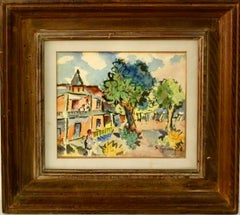
Bungalow (fauvist painting of New York scene) 1940's. image is 10X 11.5 inches. Hand signed lower right Country Scene Samuel Grunvald was a Hungarian born American WPA artist known for abstract, landscape and seascape paintings. Arrived in the USA from Hungary in 1921 and settled in New York City where he studied at the Art Students League. Grunvald worked for the Federal Art Project, taught at Colony House in NYC. Member: Art Guild, Watercolor Society, New York Watercolor Club. exhibited at Montross Gallery, NYC, World House Galleries, NYC, Leonard Hutton Gallery, NYC, Associated American Artists Gallery and the A.C.A. Gallery. Gunvald's work spanned many modern American movements from the WPA to Abstract Expressionist painting. He was a member of the American Watercolor Society and the Brooklyn Society of Artists. He exhibited with both of these organizations and at the Brooklyn Museum of Art. He was involved the the WPA being a Federal Arts Project artist. A number of prominent Jewish artists participated in this New Deal program among them Ben Shahn, Joseph Solman, William Gropper, Philip Guston Adolph Gottlieb, Mark Rothko, Milton Avery, Ben Shahn, the Soyers (Isaac, Moses, and Raphael), and many others Grunwald exhibited alongside other popular artists such as Paul Klee, Jean Arp, Max Ernst and Charles Burchfield. He also taught and lectured on art and easel painting, Federal Art Project, NYC. His work is included in the collections of the Museum of Modern Art and The Jewish Museum, New York. Americana. The Catskills became a major resort destination for Jewish New Yorkers in the mid-20th century. Borscht Belt is an informal term for the summer resorts of the Catskill Mountains in Sullivan and Ulster counties in upstate New York which were frequented by Ashkenazi Jews. At its peak of popularity, about 500 resorts operated in the region. Later changes in vacationing patterns have led most of those travelers elsewhere, although there are still bungalow communities and summer camps in the towns of Liberty, Bethel, Monticello and Fallsburg catering to Orthodox Jewish populations. Borscht Belt, The term, which derives from the name of a beet soup popular with people of Eastern European origin, can also refer to the Catskill region itself. In August, 1969, the Catskills were the site of a music and art festival in the town of Bethel, which had originally been planned for Woodstock, New York. Thirty-three of the best-known musicians of the era appeared during a sometimes rainy weekend in front of nearly half a million concertgoers. The event, featuring liberal drug use and nudity, exemplified the counterculture of the 1960s and 1970s. Select Exhibitions A.C.A. Gallery Associated American Artists Gallery, 1936-1955 American Watercolor Society, 1932-1942 New York Watercolor Club, 1935-1937 Humanist Art...
Category

1940s Modern Samuel Grunvald Art
Materials

Watercolor

1940's American WPA Modernist New York City Watercolor Painting Tenement Market
By Samuel Grunvald
Located in Surfside, FL
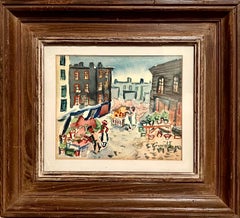
The Market, (fauvist painting of NYC scene) 1940's. image is 10X 11.5 inches. Hand signed lower right Lower East Side Tenements Pushcart Market Samuel Grunvald was a Hungarian born American WPA artist known for abstract, landscape and seascape paintings. Arrived in the USA from Hungary in 1921 and settled in New York City where he studied at the Art Students League. Grunvald worked for the Federal Art Project, taught at Colony House in NYC. Member: Art Guild, Watercolor Society, New York Watercolor Club. exhibited at Montross Gallery, NYC, World House Galleries, NYC, Leonard Hutton Gallery, NYC, Associated American Artists Gallery and the A.C.A. Gallery. Gunvald's work spanned many modern American movements from the WPA to Abstract Expressionist painting. He was a member of the American Watercolor Society and the Brooklyn Society of Artists. He exhibited with both of these organizations and at the Brooklyn Museum of Art. He was involved the the WPA being a Federal Arts Project artist. A number of prominent Jewish artists participated in this New Deal program among them Ben Shahn, Joseph Solman, William Gropper, Philip Guston Adolph Gottlieb, Mark Rothko, Milton Avery, Ben Shahn, the Soyers (Isaac, Moses, and Raphael), and many others Grunwald exhibited alongside other popular artists such as Paul Klee, Jean Arp, Max Ernst and Charles Burchfield. He also taught and lectured on art and easel painting, Federal Art Project, NYC. His work is included in the collections of the Museum of Modern Art and The Jewish Museum, New York. Americana. Select Exhibitions A.C.A. Gallery Associated American Artists Gallery, 1936-1955 American Watercolor Society, 1932-1942 New York Watercolor Club, 1935-1937 Humanist Art...
Category

1940s Modern Samuel Grunvald Art
Materials

Watercolor

1940 American WPA Modernist New York City Watercolor Painting Pushcart Tenements
By Samuel Grunvald
Located in Surfside, FL
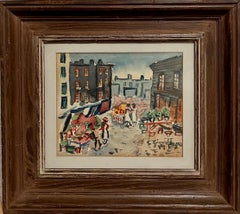
Samuel Grunvald was a Hungarian born American WPA artist known for abstract, landscape and seascape paintings. Arrived in the USA from Hungary in 1921 and settled in New York City where he studied at the Art Students League. Grunvald worked for the Federal Art Project, taught at Colony House in NYC. Member: Art Guild, Watercolor Society, New York Watercolor Club. exhibited at Montross Gallery, NYC, World House Galleries, NYC, Leonard Hutton Gallery, NYC, Associated American Artists Gallery and the A.C.A. Gallery. Gunvald's work spanned many modern American movements from the WPA to Abstract Expressionist painting. He was a member of the American Watercolor Society and the Brooklyn Society of Artists. He exhibited with both of these organizations and at the Brooklyn Museum of Art. He was involved the the WPA being a Federal Arts Project artist. A number of prominent Jewish artists participated in this New Deal program among them Ben Shahn, Joseph Solman, William Gropper, Philip Guston Adolph Gottlieb, Mark Rothko, Milton Avery, Ben Shahn, the Soyers (Isaac, Moses, and Raphael), and many others Grunwald exhibited alongside other popular artists such as Paul Klee, Jean Arp, Max Ernst and Charles Burchfield. He also taught and lectured on art and easel painting, Federal Art Project, NYC. His work is included in the collections of the Museum of Modern Art and The Jewish Museum, New York. Select Exhibitions A.C.A. Gallery Associated American Artists Gallery, 1936-1955 American Watercolor Society, 1932-1942 New York Watercolor Club, 1935-1937 Humanist Art...
Category

1940s Modern Samuel Grunvald Art
Materials

Watercolor

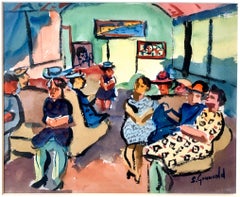
1940's American WPA Modernist New York City Watercolor Painting Subway Riders
By Samuel Grunvald
Located in Surfside, FL
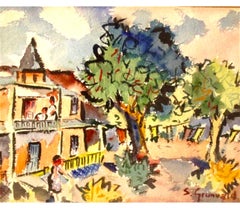
The Subway, (fauvist painting of NYC scene) 1940's. image is 8 X 9.5 inches. Hand signed lower right Provenance: Greenwich Gallery (Greenwich CT) Samuel Grunvald was a Hungarian b...
Category

1940s Modern Samuel Grunvald Art
Materials

Watercolor

1940's American WPA Modernist New York Watercolor Painting 59th st Central Park
By Samuel Grunvald
Located in Surfside, FL
Horse and Buggy 59th st. Manhattan (fauvist painting of NYC outside central park) 1940's. image is 6.25 X 7.5 inches. Hand signed lower right Provenance: Greenwich Gallery (Greenwich CT) Samuel Grunvald was a Hungarian born American WPA artist known for abstract, landscape and seascape paintings. Arrived in the USA from Hungary in 1921 and settled in New York City where he studied at the Art Students League. Grunvald worked for the Federal Art Project, taught at Colony House in NYC. Member: Art Guild, Watercolor Society, New York Watercolor Club. exhibited at Montross Gallery, NYC, World House Galleries, NYC, Leonard Hutton Gallery, NYC, Associated American Artists Gallery and the A.C.A. Gallery. Gunvald's work spanned many modern American movements from the WPA to Abstract Expressionist painting. He was a member of the American Watercolor Society and the Brooklyn Society of Artists. He exhibited with both of these organizations and at the Brooklyn Museum of Art. He was involved the the WPA being a Federal Arts Project artist. A number of prominent Jewish artists participated in this New Deal program among them Ben Shahn, William Gropper, Philip Guston Adolph Gottlieb, Mark Rothko, Milton Avery, Ben Shahn, the Soyers (Isaac, Moses, and Raphael), and many others Grunwald exhibited alongside other popular artists such as Paul Klee, Jean Arp, Max Ernst and Charles Burchfield. He also taught and lectured on art and easel painting, Federal Art Project, NYC. His work is included in the collections of the Museum of Modern Art and The Jewish Museum, New York. Select Exhibitions A.C.A. Gallery Associated American Artists Gallery, 1936-1955 American Watercolor Society, 1932-1942 New York Watercolor Club, 1935-1937 Humanist Art...
Category

20th Century Modern Samuel Grunvald Art
Materials

Watercolor

1930's American WPA Modernist New York City Watercolor Painting Harlem River Dr
By Samuel Grunvald
Located in Surfside, FL
Harlem River Drive, 1938 (fauvist painting of men sitting on a park bench) image is 6.5 X 7.5 inches. Provenance: Greenwich Gallery (Greenwich CT) Samuel Grunvald was a Hungarian born American WPA artist known for abstract, landscape and seascape paintings. Arrived in the USA from Hungary in 1921 and settled in New York City where he studied at the Art Students League. Grunvald worked for the Federal Art Project, taught at Colony House in NYC. Member: Art Guild, Watercolor Society, New York Watercolor Club. exhibited at Montross Gallery, NYC, World House Galleries, NYC, Leonard Hutton Gallery, NYC, Associated American Artists Gallery and the A.C.A. Gallery. Gunvald's work spanned many modern American movements from the WPA to Abstract Expressionist painting. He was a member of the American Watercolor Society and the Brooklyn Society of Artists. He exhibited with both of these organizations and at the Brooklyn Museum of Art. He was involved the the WPA being a Federal Arts Project artist. A number of prominent Jewish artists participated in this New Deal program among them Ben Shahn, William Gropper, Philip Guston Adolph Gottlieb, Mark Rothko, Milton Avery, Ben Shahn, the Soyers (Isaac, Moses, and Raphael), and many others Grunwald exhibited alongside other popular artists such as Paul Klee, Jean Arp, Max Ernst and Charles Burchfield. He also taught and lectured on art and easel painting, Federal Art Project, NYC. His work is included in the collections of the Museum of Modern Art and The Jewish Museum, New York. Select Exhibitions A.C.A. Gallery Associated American Artists Gallery, 1936-1955 American Watercolor Society, 1932-1942 New York Watercolor Club, 1935-1937 Humanist Art...
Category

20th Century Modern Samuel Grunvald Art
Materials

Watercolor

Urban Scene, Pushcart Series, NYC Tenements
By Samuel Grunvald
Located in Surfside, FL
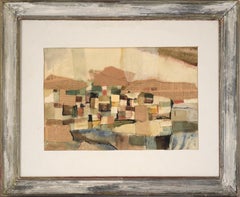
Arrived in US in 1921. Worked for Federal Art Project, taught at Colony House in NYC. Member: Art Guild, Watercolor Society, New York Watercolor Club. exhibited at Montross Gallery,...
Category

20th Century Modern Samuel Grunvald Art
Materials

Watercolor

Samuel Grunvald art for sale on 1stDibs.
Find a wide variety of authentic Samuel Grunvald art available for sale on 1stDibs. You can also browse by medium to find art by Samuel Grunvald in paint, watercolor, paper and more. Much of the original work by this artist or collective was created during the 20th century and is mostly associated with the modern style. Not every interior allows for large Samuel Grunvald art, so small editions measuring 10 inches across are available. Customers who are interested in this artist might also find the work of Emil Bisttram, Louis Berthomme Saint-Andre, and William Anzalone. Samuel Grunvald art prices can differ depending upon medium, time period and other attributes. On 1stDibs, the price for these items starts at $1,800 and tops out at $3,800, while the average work can sell for $2,350.
Artists Similar to Samuel Grunvald

Still Thinking About These?

All Recently Viewed