Items Similar to Elements



Want more images or videos?
Request additional images or videos from the seller.
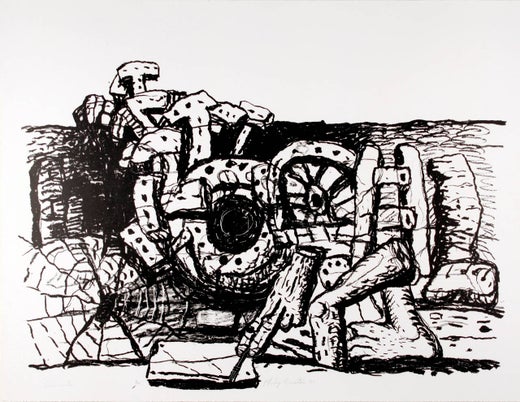
Philip GustonElements1980
1980
About the Item
Philip Guston was born in 1913 in Montreal, Canada. He began painting at the age of 12, and in 1927 he enrolled in the Los Angeles Manual Arts High School , where both he and Jackson Pollock studied under Frederick John de St. Vrain Schwankovsky and were introduced to modern European art, oriental philosophy, theosophy and mystic literature.
In the 1950s, Guston achieved success and renown as a first-generation Abstract Expressionist. During this period his paintings often consisted of blocks and masses of gestural strokes and marks of color floating within the picture plane. These works, with marks often grouped toward the center of the compositions, recall the “plus and minus” compositions by Piet Mondrian.
Like many of his contemporaries, Guston spent the years after World War II developing a personal style and vision out of the diverse range of realist and abstract influences that challenged American artists of his era. In the 1940s he constructed a private mythological world in paintings such as Martial Memory (1945; St Louis, MO, A. Mus.) and If this Be Not I (1945; St Louis, MO, Washington U., Gal. A.); in the latter a crowd of children, some masked or with faces partially covered, fill the columned porch of an old dilapidated Midwestern house. It is a night scene, predominantly blue in colour, richly and heavily painted. By 1947–8, when he painted The Tormentors (San Francisco, CA, MOMA), figures have almost disappeared, leaving behind only traces of floorboards, furniture and architecture. In the early 1950s he developed a lyrical abstract style in works such as Dial (1956; New York, Whitney), which towards the end of the decade evolved into single dark images embedded in a morass of grey paint, for example Painter I (1959; Atlanta, GA, High Mus. A.) and New Place (1964; San Francisco, CA, MOMA). His most radical shift came in the late 1960s with works such as Evidence (1970; San Francisco, CA, MOMA), when he confounded the art world with a new figurative style in which blunt cartoon shapes are used to create a personal iconography. Certain images recur in these paintings, such as the soles of shoes (as in Back View, 1977; San Francisco, CA, MOMA) and people’s heads (e.g. Painter in Bed, 1973; London, Saatchi Col.), inhabiting a sort of spare parts world in which the disembodied, separate items have a unique and surrealistic life of their own.
- Creator:Philip Guston (1913 - 1980, American)
- Creation Year:1980
- Dimensions:Height: 33 in (83.82 cm)Width: 43 in (109.22 cm)
- More Editions & Sizes:Edition of 50Price: $17,500
- Medium:
- Movement & Style:
- Period:
- Condition:
- Gallery Location:San Francisco, CA
- Reference Number:Seller: PG80-99871stDibs: LU56324172
Philip Guston
Philip Guston (1913–1980) was an influential American artist whose career evolved from social realism to abstract expressionism and finally to a unique form of figurative painting. Born in Montreal, Canada, to Russian-Jewish immigrant parents, Guston grew up in Los Angeles, where he was introduced to art and politics at a young age. His early years were marked by personal tragedy, including his father’s suicide, an event that profoundly influenced his later work. In the 1930s, Guston began his artistic career as a muralist under the Federal Art Project, inspired by the social realism of Mexican muralists like Diego Rivera. During this time, his work conveyed strong political and social messages, reflecting the struggles of the working class and the political tensions of the era. By the 1940s, Guston moved to New York, where he became associated with the burgeoning Abstract Expressionist movement alongside artists like Jackson Pollock and Willem de Kooning. His abstract works from this period were characterized by lush, painterly surfaces and a focus on emotional resonance. Despite his success as an Abstract Expressionist, Guston grew increasingly dissatisfied with abstraction’s limitations in addressing personal and societal concerns. In the late 1960s, he made a dramatic shift back to representational imagery, a move that shocked the art world. His later works incorporated cartoonish, symbolic figures—hooded Ku Klux Klan-like characters, shoes, lightbulbs, and disembodied heads—depicting themes of existential angst, political corruption, and personal reflection. These provocative images, such as in The Studio (1969), addressed racism, violence, and the complexities of human identity with biting humour and raw emotion. Critics initially derided Guston’s return to figuration, but his bold departure from abstraction ultimately cemented his legacy as a pioneering figure who challenged conventions and explored deeply personal and political themes. His work resonates with an unflinching honesty and continues to influence contemporary artists grappling with societal issues and the human condition. Guston died in 1980, leaving behind a body of work that defies categorization yet remains profoundly impactful. Today, he is celebrated as an artist who pushed boundaries and redefined what painting could be, inspiring generations with his fearless creativity and commitment to authenticity.
Berggruen Gallery
5.0
Recognized Seller
These prestigious sellers are industry leaders and represent the highest echelon for item quality and design.
1stDibs seller since 2011
7 sales on 1stDibs
Typical response time: 22 hours
Associations
Art Dealers Association of America
- ShippingRetrieving quote...Shipping from: San Francisco, CA
- Return Policy
Only orders placed on 1stDibs are protected if an item is damaged, isn't authentic, or isn't as described. Learn More