Want more images or videos?
Request additional images or videos from the seller
1 of 13
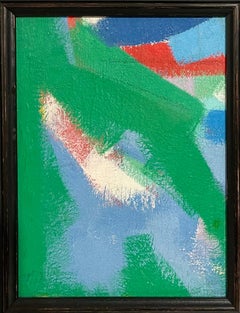
Hayward KingUntitled (Abstract Expressionist Painting)ca. 1955
ca. 1955
Price:$3,000
About the Item
- Creator:Hayward King (1928 - 1990, American)
- Creation Year:ca. 1955
- Dimensions:Height: 35 in (88.9 cm)Width: 29 in (73.66 cm)Depth: 1 in (2.54 cm)
- Medium:
- Movement & Style:
- Period:
- Condition:
- Gallery Location:Wilton Manors, FL
- Reference Number:1stDibs: LU245214842372
About the Seller
4.9
Platinum Seller
Premium sellers with a 4.7+ rating and 24-hour response times
Established in 2007
1stDibs seller since 2015
440 sales on 1stDibs
Typical response time: 4 hours
Authenticity Guarantee
In the unlikely event there’s an issue with an item’s authenticity, contact us within 1 year for a full refund. DetailsMoney-Back Guarantee
If your item is not as described, is damaged in transit, or does not arrive, contact us within 7 days for a full refund. Details24-Hour Cancellation
You have a 24-hour grace period in which to reconsider your purchase, with no questions asked.Vetted Professional Sellers
Our world-class sellers must adhere to strict standards for service and quality, maintaining the integrity of our listings.Price-Match Guarantee
If you find that a seller listed the same item for a lower price elsewhere, we’ll match it.Trusted Global Delivery
Our best-in-class carrier network provides specialized shipping options worldwide, including custom delivery.You May Also Like
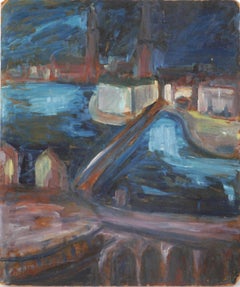
Mid Century Abstract Expressionist Cityscape
Located in Soquel, CA
Wonderful mid century abstract expressionist landscape of bridge over water cityscape, circa 1960. Illegible signature lower left ("Aioli"?). Conditi...
Category
1960s Abstract Expressionist Abstract Paintings
Materials
Masonite, Oil
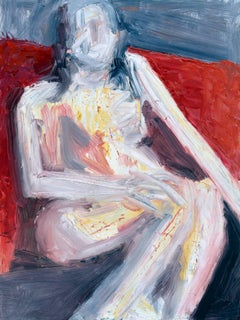
Abstract Expressionism --Seated Woman Figurative
By Daniel David Fuentes
Located in Soquel, CA
Figurative abstract painting by San Jose, California area artist Daniel David Fuentes (American, 20th Century). San Francisco bay area abstract expressionist and landscape artist dur...
Category
21st Century and Contemporary Abstract Expressionist Figurative Paintings
Materials
Masonite, Oil
$1,500
H 40 in W 30 in D 1 in
Edge
Located in Austin, TX
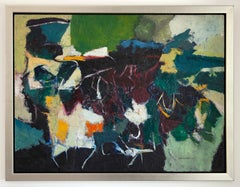
Waterline Fine Art, Austin, TX is pleased to present the following work:
Oil on board. Signed and dated lower right and verso, titled verso.
36.25 x 48 in.
40.5 x 52.25 in. (framed)
Framed in contemporary silver, tiered floater frame.
Dennis Eugene Norman Burton was a Canadian modernist who was born in Lethbridge, Ontario. He attended the Ontario College of Art from 1952 to 1956, and worked for the Canadian Broadcasting Corporation (CBC) as a graphic designer until 1960.
Inspired by a 1955 exhibition of the “Painters Eleven” at Toronto’s Hart House, as well as American Abstract Expressionist artists such as Robert Motherwell, Jack Tworkov, and Willem de Kooning, Burton shifted his focus toward abstraction in the mid-1950s.
Burton showed with the famed Isaacs Gallery in Toronto, becoming one of the youngest members on the gallery’s roster. A talented musician, he also played saxophone in the Artist’s Jazz Band in Toronto - a pioneering Canadian free-jazz group...
Category
1950s Abstract Expressionist Abstract Paintings
Materials
Masonite, Oil, Board
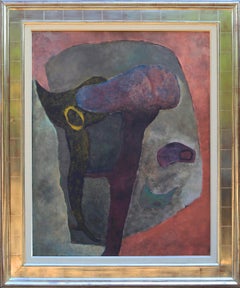
The Two Furies, Surrealist Abstract Oil Painting on Masonite by Theodoros Stamos
By Theodoros Stamos
Located in Long Island City, NY
Completed when the artist was only 25, this painting references a fight between two mythological figures. Commonly called Furies, the Erinyes or Eumenides were Greek goddesses of ven...
Category
1940s Abstract Expressionist Abstract Paintings
Materials
Masonite, Oil
Price Upon Request
H 42 in W 30 in
Bold German American Abstract Expressionist Color Field Oil Painting Carl Holty
By Carl Holty
Located in Surfside, FL
Carl Robert Holty (American 1900-1973)
Abstract Expressionism Oil on Masonite board.
Abstract with greens blues and red,
Dimensions 12 x 9-1/2 inches. Framed 17 X 14 inches
Hand...
Category
20th Century Abstract Expressionist Abstract Paintings
Materials
Masonite, Oil
Concert (unique, signed Abstract Expressionist painting by celebrated artist)
By Ben Wilson
Located in New York, NY
Ben Wilson
Concert, ca. 1989
Oil on masonite board (Hand Signed by the artist; also bears the Estate Stamp)
Boldly signed front and back, titled and dated on the back by Ben Wilson and also stamped on the back by the estate of Ben Wilson
42 × 48 inches
Unframed
This stunning painting is done by the second generation Abstract Expressionist artist Ben Wilson - one of the youngest artists to be given a show at prestigious ACA Gallery in 1940. This work "Concert" - depicting instruments, in a light, lyrically abstract painting. Exquisite colors and subtle imagery.
In 2017, he was the subject of a retrospective at the George Segal Gallery at Montclair State University from September 6 to November 4 and it was accompanied by a catalogue.
About Ben Wilson:
Ben Wilson was born in Philadelphia in 1913 to Jewish parents who had emigrated from Kiev and settled in New York City. He was educated in Manhattan public schools and graduated from City College in 1935. To gain exposure to a wider range of styles, he also studied at the National Academy of Design and at the Educational Alliance.
Admired by critics throughout his long career, Wilson was singled out as a “discovery” by the New York Times art critic Edward Alden Jewel even before his first one-man show at the Galerie Neuf in 1946. His paintings of the ’30s and ’40s were expressionistically rendered, often Biblical parables, filled with what he called “the grief of the intolerable” and reflecting an acute awareness of the agony of the time, from the Holocaust to the Spanish Civil War. A WPA artist who identified strongly with the plight of the Jews in Europe, he relentlessly explored themes of war, torment, and futility in his early decades of painting.
When times changed and social pressures subsided, Wilson’s mood lifted. He spent 1952-54 in Paris working at the Academie Julien. During the ’50s his involvement with specific imagery persisted but became more psychological and mythic in orientation. Influenced by Cubism, he created a vocabulary of interlocking shapes and bold, sweeping gestures that served as a transition between his early figurative expressionism and his later abstract constructivist concerns. Towards the end of the decade Wilson reached a crossroads, moving towards abstraction and searching for what he called “a scaffolding under the externals.”
By 1960, influenced by the Russian Constructivists, Mondrian, and Abstract Expressionism, Wilson turned to abstraction. Reexamining the basic elements of painting, he evolved his own personal vocabulary and structure, fusing the cerebral and the emotive. He became increasingly experimental, using house paint, sand, and other unorthodox materials in paintings that he worked from all directions, dripping, spraying, stenciling, and collaging. He employed elements of disjunction, repetitions of geometric motifs, linear networks, and complex overlays to create the transparent, multi-layer development of space that characterizes his later paintings. A consummate draftsman, Wilson filled notebook after notebook with drawings that he amplified in his paintings.
Eschewing popular movements, Wilson was always one to pursue a personal aesthetic. Despite more than 30 one-man shows and 50 years of teaching, he increasingly withdrew from the gallery scene but continued to paint daily until his death at age 88 in 2001 in Blairstown, New Jersey, where he and his sculptor wife Evelyn Wilson...
Category
1980s Abstract Expressionist Abstract Paintings
Materials
Masonite, Oil
Ozymandias (unique, signed Abstract Expressionist painting by renowned painter)
By Ben Wilson
Located in New York, NY
Ben Wilson
Ozymandias, 1989
Oil on masonite board
Boldly signed by Ben Wilson on the back
36 × 48 inches
Unframed
Provenance: acquired from the Estate of Ben Wilson
This work is titled "Ozymandias" after the famous sonnet written by Percy Bysshe Shelley (1792-1822). Shelley's poem is one of the most poignant meditations on the fleeting nature of human power and the inevitability of decline. The poem serves as a reminder that time erodes even the most imposing empires and leaders and that the pursuit of lasting fame and control is ultimately futile.
Depending on how one views Ben Wilson's Abstract Expressionist painting of "Ozymandias" -- some of the imagery might reveal the head of an angry king and a sickle.
Shelley's poem Ozymandias reads:
I met a traveler from an antique land...
Category
1980s Abstract Expressionist Abstract Paintings
Materials
Masonite, Oil
$15,000
H 36 in W 48 in D 0.3 in
White Landscape, Abstract Expressionist Collage by Keith Morrow Martin 1959
Located in Long Island City, NY
An abstract collage on wood by Kenneth Morrow Martin, American (1911-1983). Exhibited: 1st Knoxville Art Center National Exhibtion, 1961
White Landscape by Keith Morrow Martin...
Category
1950s Abstract Expressionist Mixed Media
Materials
Masonite, Varnish, Magazine Paper
Abstract Expressionist Painting American Late 1960's Mid Century New York Brown
Located in Buffalo, NY
Mid Century Modern, American Abstract Expressionist Painting on Masonite.
This wonderful work in hues of blue comes house in a contemporary natural wood frame presentation..
The ar...
Category
1960s Abstract Expressionist Abstract Paintings
Materials
Masonite, Acrylic
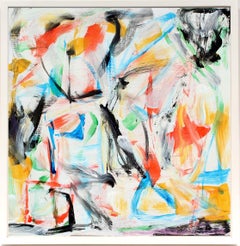
Abstract Expressionist Painting American 1960's Mid Century New York Colorful
Located in Buffalo, NY
Mid Century Modern, American Abstract Expressionist Painting on Masonite.
This wonderful work in exciting colors is housed in a contemporary white wood frame presentation..
The art...
Category
1960s Abstract Expressionist Abstract Paintings
Materials
Masonite, Acrylic
$340 Sale Price
20% Off
H 10 in W 10 in
More From This Seller
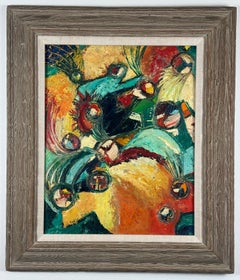
View AllUntitled (Abstract Expressionist Painting)
By Bertha Davis
Located in Wilton Manors, FL
Bertha G. Davis (1911-1997)
Untitled, ca. 1960's
Oil on cradled masonite panel.
16 x 20 inches; 24 x 28 inches framed.
Signed lower left. Artist estate stamp on verso.
Vintage custom wormy chestnut frame.
A painter of cityscapes, landscapes, and abstracts in Texas, Bertha G Davis was primarily a self-taught artist whose style was influenced by her early life experiences in pre-World War II Lithuania and later Mexico. Her style is expressionistic*, relying on color to denote her profound feelings. She works primarily in watercolor and acrylic with some mixed media*.
She is the daughter of Abraham and Dvora Germaize of Vilna, Lithuania and grew up in Jewish ghettos in Vilna, Alita, and Kovno. Davis was influenced by her father who was a decorative wood-worker and carpenter in Lithuania. The family of five daughters and a son escaped to Mexico City in the late 1920’s because of Jewish oppression. The images and emotions she experienced had no outlet.
She was known as a beauty, and at age 17 was named Jewish Miss Mexico, barely able to speak Spanish having just emigrated from Eastern Europe. Irving Davis, a merchant from Texas who had also come from Eastern Europe via Cuba, saw her at this event where she was crowned Jewish Miss Mexico, and three days later asked for her hand in marriage. They moved to a small town in Texas, raising a family.
Her daughter, Sylvia, was born when Davis was 20 and they were inseparable. As Sylvia became an actress, painter, and sculptor, Davis was amazed at the capacity for creativity. Davis didn’t begin her own artistic journey until she was 47, when her daughter Sylvia Caplan encouraged her to try. She was inspired by this daughter who gave her a drugstore palette of watercolors, paper and brushes and told her to “just try.” Davis did not put down her palette and brushes until her death in 1997.
Bertha G Davis was primarily self-taught but maintained a style oriented toward color and texture that reflected her strong feelings. Most of her early work was done while she lived in McAllen, Texas where she was known for her contribution to art and showed her work and the work of other artists at the Bertha Davis Gallery.
She studied with Stewart Van Orden, at Pan American College in 1960-61; and was a student at the Art Institute San Miguel Allende, Mexico, 1965. She was also a student of Harold Phenix...
Category
Mid-20th Century Abstract Expressionist Abstract Paintings
Materials
Masonite, Oil
$975 Sale Price
35% Off
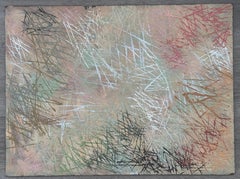
Etude III (abstract expressionist painting)
By Fredric Karoly
Located in Wilton Manors, FL
Fredric Karoly (1898-1987). Etude III, 1950. Oil on masonite panel measures 18 x 24 inches. Unframed. Signed, titled, dated on reverse. Good condition with minor paint loss at edges.
Biography:
An abstract painter, Karoly was born in Hungary and studied painting in Paris, architectural eingineering in Berlin, and emigrated to the U.S. in 1926. He began a successful career as a fashion and fabric designer. In 1948 he was working as a fashion director for Simplicity Patters, when he had a solo exhibition of of his oil paintings, wire montages, dry-pen drawings and abstract photography.
Solo Exhibitions:
Hugo Gallery (Alexandre Iolas) New York 1948; Gallery Mai. Paris 1949; New Gallery (Eugene Thaw) New York 1950; Museu de Arte, Sao Paulo, Brazil 1951; Miami Museum of Modern Art, Miami, Florida 1959; Loft Gallery, New York City, 1966.Group Exhibitions:
Hugo Gallery, New York 1947; Salon des Realities Nouvelles, Paris 1949-1953; Whitney Museum of American Art, New York (Annual) 1951-1953, 1963; Biennale of Sao Paulo, Brazil, 1951; International Independent Exhibition, Tokyo, 1951; Martha Jackson Gallery, New York, 1959; The Butler Institute of Art, Youngstown, Ohio, 1960; Stuttman Gallery, New York, 1960; The Art Institute of Chicago (Annual), 1960; International Watercolor Exhibition, Brookyln Museum, 1961; Westchester Art Museum, White Plains, NY, 1963; Whitney Museum, Annual, NY 1963; Cleveland Art Festival, Park Synagogue, Cleveland, 1963; Whitney Museum, Sculpture Annual, NY, 1964.Works in Institutional Collections:
Museu de Arte, San Paulo, Brazil; Museu de Bellas Artes, Buenos Aires, Argentina; New York University, New York; Washington University, St. Louis, Missouri; Finch College, NY; Barnard College, NY; Metropolitan Museum, Whitney Museum and Guggenheim Museum, New York; Museum of Fine Arts, St. Petersburg, FL.
Awards: National Council Arts Awards, 1968.
Frederic Karoly died on December 15, 1987 at the Inter-Continental Hotel in Manhattan, where he had made his home for many years.
Fredric Karoly was born in Budapest in 1893. According to Karoly’s own vitae, his exhibition history began in New York in 1947, when at the age of 54 he took part in a four-person group show at Hugo Gallery. His involvement with visual art however was apparently life long. In a brief introduction to his solo show at Galerie Mai in Paris in June of 1949, Jen Luc de Rudder, reports that Karoly began painting at the age of 12 in Budapest.
After several years of studying, then working in London, Paris and Berlin, Karoly emigrated to the United States in 1925 or 1926 (he probably first came to the US on a work visa in 1925). In New York, Karoly worked in women’s fashion as a designer.
In 1948 Karoly worked in a manner than was clearly influenced by the work of such European surrealists as Max Ernst, creating spiked automatic bi-chromatic paintings. His style progressed into a progressively more biomorphic vein, similar to explorations by Theodore Stamos, Daphnis, Milton Avery and Mark Rothko around the same period. He was supported with patronage during this period by Mrs. Mimi Baliff, who apparently supported the “Industrial Design Workshop” that she helped open to feature Karoly’s designs in 1948.
By the early 1950’s (1951) Karoly started experimenting with the drip and splatter process as well. Drip paintings dominated his process until the late 50’s-early 60’s, when linear compositional elements began to reemerge. By the late 50’s multi-layered drip grid motifs asserted a masque of spatial organization over looser washed fields and splatters of paint that Karoly worked off of. This development was consistent with concurrent explorations into the grid by artist Agnes Martin and others.
By the mid-50’s Karoly’s style began another transition into a more surface concerned “Color Field” style of painting. There are elements still reminding one of Abstract Expressionist concerns as such painters as Clifford Still. But the works that began to emerge from Karoly’s studio in 1958 presaged the Morris Lewis fan motifs and Friedl Dzubas’s epic and romantic color spewing expanses of canvas.
In 1959 Karoly began experiments using washes of turpentine diluted oil paint directly onto raw linen, and all of these subsequently suffered the consequences of oil oxidation and acidity upon the surfaces. However, many of Karoly’s washes in color field happily occurred on lightly prepared primed canvas surfaces as well.
By 1960 Karoly began reintroducing imagistic references to his visual content. There were also various references to Japanese and Zen influences. He experimented with a variety of processes that included mixed media and marbleized surfaces achieved by the intermixture of oil and water mediums. A calligraphic element also enter Karoly’s work in the early 60’s. Then in 1961 glued and assembled objects begin to show up in Karoly’s work in earnest. The influence of early POP artists, particularly Jasper Johns, and Robert Rauschenberg, become apparent. From 1961-63, a series of the assemblage works transition from canvas to the sculptural to pieces obviously intended for full scale installation. Many of these pieces were among the most fragile of his works primarily due to their reliance upon the of gluing of objects such as plastic or paper cups on flexible surfaces of stretched linen or canvas.
In the mid-60’s Karoly apparently produced a number of photo-silk screened series of Picasso, De Kooning and other significant artists of his generation. These were executed in a style somewhere between Rauschenberg’s and Roy Lichtenstein’s, primarily because of their reliance upon half tones and Ben-Day dot effects. Then Karoly began a series of paintings conflating his drip and grid styles with super imposed and painted over string. In the late 60’s Karoly embarked upon a series of multi-paneled stretched linen constructions often with slits and fiber optic back-lit elements that were prescient of the work of Dan Flavin and others. It was this body of work that was shown at Hofstra University’s Emily Lowe Gallery, and it was these works that suffered perhaps the most irreparable damage from a steam/water infiltration in a space where they were being stored.
The late professional start that Karoly had into the art world was balanced by his long life span and early immersion into the design issues of modernism as it emerged in turn of the century Europe and later evolved in America. He was clearly an artist who subscribed to the ethos of the new in abstraction and was obviously impressionable and in some instances prescient with regard to various trends in abstraction.
Several noteworthy and influential collectors and institutions during his 40 years of professional engagement acquired his work. The Whitney Museum of American Art had and may still own a large Karoly canvas from 1960, but this is doubtful as the artist failed to list it on the vitae he filed with MoMA in 1965. His work was recognized and honored by the Whitney with its inclusion in four of their annual survey shows (1951,1953, 1963 and 1964).
The artist’s surrealist influenced paintings from 1948-1950 were the focus of a solo exhibition held of his work by the Museo de Art in Sao Paulo and eight years later a ten year survey of his work was the focus of a solo show at the Miami Museum of Modern art. The Sao Paulo Museum in Brazil, and the Museo de Bellas Artes in Buenos Aires, Argentina each acquired Karoly paintings for their collections in the 1950’s.
One of Karoly’s surrealist pieces was apparently purchased by Christian Zervos, Picasso’s designated chronicler, who apparently also wrote a piece on Karoly in Cahiers D’Art in 1949. A 60’s piece of Karoly art that is in the New York University’s permanent collection is included in the MoMA Library’s catalog...
Category
Mid-20th Century Abstract Expressionist Abstract Paintings
Materials
Oil, Masonite
$2,000 Sale Price
20% Off
Etude (abstract expressionist painting)
By Fredric Karoly
Located in Wilton Manors, FL
Fredric Karoly (1898-1987). Etude, 1950. Oil on masonite panel measures 18 x 24 inches. Unframed. Signed, titled, dated on reverse. Good condition with minor paint loss at edges.
Biography:
An abstract painter, Karoly was born in Hungary and studied painting in Paris, architectural eingineering in Berlin, and emigrated to the U.S. in 1926. He began a successful career as a fashion and fabric designer. In 1948 he was working as a fashion director for Simplicity Patters, when he had a solo exhibition of of his oil paintings, wire montages, dry-pen drawings and abstract photography.
Solo Exhibitions:
Hugo Gallery (Alexandre Iolas) New York 1948; Gallery Mai. Paris 1949; New Gallery (Eugene Thaw) New York 1950; Museu de Arte, Sao Paulo, Brazil 1951; Miami Museum of Modern Art, Miami, Florida 1959; Loft Gallery, New York City, 1966.Group Exhibitions:
Hugo Gallery, New York 1947; Salon des Realities Nouvelles, Paris 1949-1953; Whitney Museum of American Art, New York (Annual) 1951-1953, 1963; Biennale of Sao Paulo, Brazil, 1951; International Independent Exhibition, Tokyo, 1951; Martha Jackson Gallery, New York, 1959; The Butler Institute of Art, Youngstown, Ohio, 1960; Stuttman Gallery, New York, 1960; The Art Institute of Chicago (Annual), 1960; International Watercolor Exhibition, Brookyln Museum, 1961; Westchester Art Museum, White Plains, NY, 1963; Whitney Museum, Annual, NY 1963; Cleveland Art Festival, Park Synagogue, Cleveland, 1963; Whitney Museum, Sculpture Annual, NY, 1964.Works in Institutional Collections:
Museu de Arte, San Paulo, Brazil; Museu de Bellas Artes, Buenos Aires, Argentina; New York University, New York; Washington University, St. Louis, Missouri; Finch College, NY; Barnard College, NY; Metropolitan Museum, Whitney Museum and Guggenheim Museum, New York; Museum of Fine Arts, St. Petersburg, FL.
Awards: National Council Arts Awards, 1968.
Frederic Karoly died on December 15, 1987 at the Inter-Continental Hotel in Manhattan, where he had made his home for many years.
Fredric Karoly was born in Budapest in 1893. According to Karoly’s own vitae, his exhibition history began in New York in 1947, when at the age of 54 he took part in a four-person group show at Hugo Gallery. His involvement with visual art however was apparently life long. In a brief introduction to his solo show at Galerie Mai in Paris in June of 1949, Jen Luc de Rudder, reports that Karoly began painting at the age of 12 in Budapest.
After several years of studying, then working in London, Paris and Berlin, Karoly emigrated to the United States in 1925 or 1926 (he probably first came to the US on a work visa in 1925). In New York, Karoly worked in women’s fashion as a designer.
In 1948 Karoly worked in a manner than was clearly influenced by the work of such European surrealists as Max Ernst, creating spiked automatic bi-chromatic paintings. His style progressed into a progressively more biomorphic vein, similar to explorations by Theodore Stamos, Daphnis, Milton Avery and Mark Rothko around the same period. He was supported with patronage during this period by Mrs. Mimi Baliff, who apparently supported the “Industrial Design Workshop” that she helped open to feature Karoly’s designs in 1948.
By the early 1950’s (1951) Karoly started experimenting with the drip and splatter process as well. Drip paintings dominated his process until the late 50’s-early 60’s, when linear compositional elements began to reemerge. By the late 50’s multi-layered drip grid motifs asserted a masque of spatial organization over looser washed fields and splatters of paint that Karoly worked off of. This development was consistent with concurrent explorations into the grid by artist Agnes Martin and others.
By the mid-50’s Karoly’s style began another transition into a more surface concerned “Color Field” style of painting. There are elements still reminding one of Abstract Expressionist concerns as such painters as Clifford Still. But the works that began to emerge from Karoly’s studio in 1958 presaged the Morris Lewis fan motifs and Friedl Dzubas’s epic and romantic color spewing expanses of canvas.
In 1959 Karoly began experiments using washes of turpentine diluted oil paint directly onto raw linen, and all of these subsequently suffered the consequences of oil oxidation and acidity upon the surfaces. However, many of Karoly’s washes in color field happily occurred on lightly prepared primed canvas surfaces as well.
By 1960 Karoly began reintroducing imagistic references to his visual content. There were also various references to Japanese and Zen influences. He experimented with a variety of processes that included mixed media and marbleized surfaces achieved by the intermixture of oil and water mediums. A calligraphic element also enter Karoly’s work in the early 60’s. Then in 1961 glued and assembled objects begin to show up in Karoly’s work in earnest. The influence of early POP artists, particularly Jasper Johns, and Robert Rauschenberg, become apparent. From 1961-63, a series of the assemblage works transition from canvas to the sculptural to pieces obviously intended for full scale installation. Many of these pieces were among the most fragile of his works primarily due to their reliance upon the of gluing of objects such as plastic or paper cups on flexible surfaces of stretched linen or canvas.
In the mid-60’s Karoly apparently produced a number of photo-silk screened series of Picasso, De Kooning and other significant artists of his generation. These were executed in a style somewhere between Rauschenberg’s and Roy Lichtenstein’s, primarily because of their reliance upon half tones and Ben-Day dot effects. Then Karoly began a series of paintings conflating his drip and grid styles with super imposed and painted over string. In the late 60’s Karoly embarked upon a series of multi-paneled stretched linen constructions often with slits and fiber optic back-lit elements that were prescient of the work of Dan Flavin and others. It was this body of work that was shown at Hofstra University’s Emily Lowe Gallery, and it was these works that suffered perhaps the most irreparable damage from a steam/water infiltration in a space where they were being stored.
The late professional start that Karoly had into the art world was balanced by his long life span and early immersion into the design issues of modernism as it emerged in turn of the century Europe and later evolved in America. He was clearly an artist who subscribed to the ethos of the new in abstraction and was obviously impressionable and in some instances prescient with regard to various trends in abstraction.
Several noteworthy and influential collectors and institutions during his 40 years of professional engagement acquired his work. The Whitney Museum of American Art had and may still own a large Karoly canvas from 1960, but this is doubtful as the artist failed to list it on the vitae he filed with MoMA in 1965. His work was recognized and honored by the Whitney with its inclusion in four of their annual survey shows (1951,1953, 1963 and 1964).
The artist’s surrealist influenced paintings from 1948-1950 were the focus of a solo exhibition held of his work by the Museo de Art in Sao Paulo and eight years later a ten year survey of his work was the focus of a solo show at the Miami Museum of Modern art. The Sao Paulo Museum in Brazil, and the Museo de Bellas Artes in Buenos Aires, Argentina each acquired Karoly paintings for their collections in the 1950’s.
One of Karoly’s surrealist pieces was apparently purchased by Christian Zervos, Picasso’s designated chronicler, who apparently also wrote a piece on Karoly in Cahiers D’Art in 1949. A 60’s piece of Karoly art that is in the New York University’s permanent collection is included in the MoMA Library’s catalog...
Category
Mid-20th Century Abstract Expressionist Abstract Paintings
Materials
Masonite, Oil
$2,000 Sale Price
20% Off
Untitled Series (six paintings)
Located in Wilton Manors, FL
A series of six abstract painting by American artist, Edward Pechmann Renouf (1906-1999). Oil on six individual masonite panels, each panel meas...
Category
1970s Abstract Expressionist Abstract Paintings
Materials
Masonite, Oil
$5,400 Sale Price
40% Off
Untitled (ER51) Abstract Expressionist painting
Located in Wilton Manors, FL
Edward Pechmann Renouf (1906-1999). Oil on panel measures 16 x 24 inches. Signed lower margin. Excellent condition.
Provenance: Allan Stone Pr...
Category
1970s Abstract Expressionist Abstract Paintings
Materials
Masonite, Oil
$1,200 Sale Price
20% Off
Untitled (ER 53) Abstract Expressionist Painting
Located in Wilton Manors, FL
Edward Pechmann Renouf (1906-1999). Oil on masonite panel, measures 16 x 24 inches. Excellent condition. Signed lower right.
Provenance: Allan Stone Projects, New York, NY.
Biography:
Birth place: Hsiku, China
Addresses: East St. Washington, CT
Profession: Painter, sculptor
Studied: Phillips Andover Acad., 1924; Harvard Univ., 1928; Columbia Univ., 1936-46; drawing & painting with Carlos Merida...
Category
1970s Abstract Expressionist Abstract Paintings
Materials
Masonite, Oil

$1,200 Sale Price
20% Off