Items Similar to A Pair of Portraits

Want more images or videos?
Request additional images or videos from the seller
1 of 8
Francis CotesA Pair of Portraits1751
1751
$67,855.69
£50,000
€58,358.34
CA$94,015.08
A$102,190.67
CHF 54,704.31
MX$1,235,248.37
NOK 689,380.94
SEK 635,788.24
DKK 435,843.57
About the Item
Pastel on paper stretched on canvas
Each 23 ¼ x 19 ¾ inches; 59 x 50 cm
Framed dimensions, each: 83 x 67.5 cm
Both signed ‘F. Cotes Px 1751’
Collections:
Captain Penton;
Christie’s, 18 April 1980, lot.68;
Private collection to 2025;
Lowell Libson & Jonny Yarker Ltd.
Literature:
Neil Jeffares, Dictionary of pastellists before 1800 (online edition),
cat. no. J.243.761
‘With respect to Crayon Painting, the present age has produced an uncommon instance of excellence in one of our own Countrymen. I mean the late Mr. Francis Cotes…it seems to be universally allowed by all good judges, that as a Crayon Painter, this celebrated Artist excelled most of his Contemporaries.’
This fine pair of pastels are both signed and dated by Francis Cotes 1751 and were made when he was at the height of his powers as an artist. Housed in spectacular carved, English Rococo frame, the portraits demonstrate Cotes’s remarkable skill as a pastellist. Cotes, one of the most celebrated portraitists of the mid-century, a founder member of the Royal Academy and widely patronised by London society, was enjoying a reputation equal to that of Reynolds at the time of his premature death in 1770. As his pupil James Russell observed, it was ‘universally allowed’ that as a ‘Crayon Painter’, Cotes ‘excelled most of his Contemporaries’, who included Rosalba Carriera, Jean-Étienne Liotard and Jean Baptiste Perronneau.
Born in London in 1726, Cotes was of Irish extraction (his father had been mayor of Galway in 1716). He spent his working life in Britain and was apprenticed to the successful portraitist and print-seller George Knapton in 1747. His earliest works appear similar in style and execution to those of Knapton, and another of Knapton’s pupils, Arthur Pond. By 1763 Cotes’s had established a successful portrait practice, enabling him to take a lease on a house at 32 Cavendish Square. Situated on the south side of the square, it was described in the sale catalogue after his death as a ‘Large and commodious House, with an elegant Suite of Five Rooms on the First Floor, and Coach Houses and Stabling.’ The house, located in a fashionable part of London, was remodelled by Cotes to include, in addition to his own studio, a room for pupils to paint in, and a gallery or ‘Shew Room’.
Expertly worked in pastel, this pair of pastels show the refinement of Cote’s technique and mastery of the medium, a mastery that may have resulted from a rivalry with the Swiss pastellist Jean-Étienne Liotard who was also practicing in London at this date. In his Elements of Painting with Crayons, published in 1777, John Russell outlined the method of executing pastel portraits he learnt from Cotes. We therefore have a remarkable explication of Cotes’s working practice. In line with contemporary painting, the ‘attitude’ of the sitter was essential, ‘if a young Lady, express more vivacity than in the majestic beauty of a middle-aged Woman.’
After explaining the rudiments of preparing the paper, which was generally blue in colour and stuck down on canvas, Russell discusses the method of taking the likeness: beginning with a sketch, before laying in the features. This having been completed, the painter uses a: ‘Crayon of pure Carmine’ to ‘carefully draw the Nostril and Edge of the Nose, next the shadow, then, with the faintest Carmine Teint, lay in the highest light upon the Nose and Forehead, which must be executed broad.’ Once this ‘dead-colouring’ was finished, the painter was instructed to ‘sweeten the whole together, by rubbing it over with his finger.’ Then the background was added, applied only very thinly closest to the head, to aid the illusion of volume, and finally the finishing ‘teints’: ‘vermillion’ on the forehead; the cheeks ‘a few touches of the orange-coloured Crayon’ and for the eyes ‘the most difficult feature to execute’, he advised using a sharpened pastel and the ‘finger as little as possible’. All these charac¬teristic elements can be seen masterfully deployed by Cotes in this fine pair of portraits.
Edward Edwards recorded that Cotes charged ‘twenty guineas for a three-quarter, forty for a half-length, and eighty for a whole length’. In line with other pastellists of the period, Cotes would have offered frames and glasses at an additional cost. The evidence suggests that Cotes generally supplied three types of frame: a standard Carlo Maratta pattern; an English Palladian frame and a French-inspired rococo frame, which as Jacob Simon has pointed out, was an anglicised version of the type favoured by Jean-Étienne Liotard. This elaborate, carved profile is precisely the option used by Cotes in the present pair of portraits.
- Creator:Francis Cotes (1726 - 1770, English)
- Creation Year:1751
- Dimensions:Height: 23.23 in (59 cm)Width: 19.69 in (50 cm)
- Medium:
- Movement & Style:
- Period:
- Condition:
- Gallery Location:London, GB
- Reference Number:1stDibs: LU1507217333242
About the Seller
5.0
Recognized Seller
These prestigious sellers are industry leaders and represent the highest echelon for item quality and design.
1stDibs seller since 2021
5 sales on 1stDibs
- ShippingRetrieving quote...Shipping from: Mitchum, United Kingdom
- Return Policy
More From This Seller
View All18th century pastel portrait of Lady Augusta Corbett and her son, Stuart
By Daniel Gardner
Located in London, GB
Collections:
Commissioned by Andrew Corbett, husband of the sitter;
The Venerable Stuart Corbett;
Sir Stuart Corbett;
By descent to 2002;
Sotheby’s, London 21 March 2002, lot.104;
Lowell Libson...
Category
18th Century Old Masters Portrait Drawings and Watercolors
Materials
Pastel, Gouache
Eighteenth-century Irish portrait of the Rev. Henry Dabzac
By Hugh Douglas Hamilton
Located in London, GB
Pastel on paper, oval
9 x 7 ¼ inches; 230 x 185 mm
Inscribed on the verso:
‘The Revd Henry Dabzac D.D./ late Senior Fellow of/ Trinity College Dublin/ ever to be lamented by all that knew/ Him. Extensive learning, zeal, gently tempered/ by a spirit of charity & above all, a strong/ faith & a piety deservedly gained/ the character of a great and good man./ This exceptional man died 12th May 1790/ This picture was his give to Jane [Mary] Crofton, his sincerely [missing] sister.’
Collections:
Rev. Dr Henry Dabzac gift to his sister, Jane Crofton (d.1797);
Sir Hugh Crofton (1763-1834);
By descent to 1990;
Private collection, Dorset to 2020.
Literature:
Robert Staveley, Traces of Past and Present, Dublin, 1895, p.74;
Neil Jeffares, Dictionary of Pastellists Before 1800, online edition, no.J3751247
This characteristic pastel portrait by Hugh Douglas Hamilton was made early in his career; it depicts precisely the kind of education, well-connected Irish sitter who fuelled his success. The Reverend Henry Dabzac was from a distinguished Huguenot family, a celebrated academic historian, Dabzac received the Donegall lectureship in 1764 and from 1785 was Librarian and Senior Fellow of Trinity College, Dublin. According to his earliest biographer, Hamilton was the son of a peruke-maker based in Crow Street, Dublin. As Anne Hodge has pointed out, this places Hamilton’s father at the heart of the city: Crow street was a narrow thoroughfare formed part of the busy warren of streets bordered by the old Houses of Parliament and Trinity College at one end, and by Dublin Castle at the other. It is perhaps telling that in this early portrait, Hamilton shows Dabzac in a splendid powdered wig and his clerical bands. In 1754 Hamilton was apprenticed to James Mannin, a ‘pattern drawer’ who two years later was appointed master of the school of ornament at the Dublin Society’s drawing school, run by Robert West. Here Hamilton took the first prize in the 1755 competition, winning a premium of £1/16/. Hamilton developed a popular and profitable method of making pastel likenesses of sitters in a distinctive oval format. Hamilton developed a technique of using a sharpened pastel to hatch shaded areas of the features and, in the case of this portrait of Dabzac, the white powdered wig, which is drawn with particular care. In 1764 Hamilton moved to London where this small, oval pastels proved...
Category
18th Century Old Masters Portrait Drawings and Watercolors
Materials
Pastel
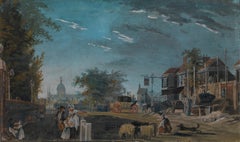
18th century view of the Elephant and Castle in London
Located in London, GB
Collections:
With Martyn Gregory;
Judy Egerton, 1984, acquired from the above;
By descent to 2014.
Exhibited:
London, Martyn Gregory, Exhibition of English & Continental Watercolours, 1984, no. 94.
London, Lowell Libson...
Category
18th Century Old Masters Landscape Paintings
Materials
Gouache, Vellum
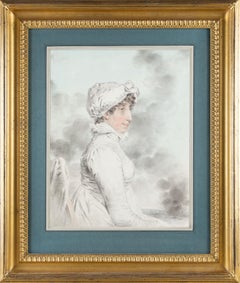
Regency portrait drawing of Arabella Graham-Clarke
By John Downman
Located in London, GB
Collections:
The sitter, and by descent;
Christie's, 19th March 1928, lot 6;
Private collection to 2019
Literature:
G.C. Williamson, John Downman, A.R.A., his Life and Works, Lon...
Category
Early 19th Century Old Masters Portrait Drawings and Watercolors
Materials
Pencil, Watercolor
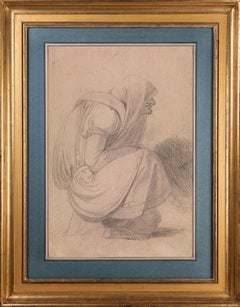
Drawing of a captive woman
By Henry Fuseli
Located in London, GB
Collections:
Sir Thomas Lawrence, who acquired the contents of Fuseli’s studio;
Susan, Countess of Guilford, née Coutts (1771-1837), acquired from the Lawrence estate;
Susan, Baroness North (1797-1884), daughter of the above;
Mrs A. M. Jaffé, acquired in France, c. 1950 to 2016.
Black chalks, on buff-coloured paper
Stamped verso: ‘Baroness Norths Collection / of Drawings by H Fuseli Esq.’
Framed dimensions: 26.38 x 20.63 inches
This boldly drawn sheet depicting a seated figure was made by Fuseli at an important and highly productive moment in his career. The monumental drawing is closely related to another sheet by Fuseli in the British Museum which Schiff published as subject unknown. Both drawings were made when Fuseli was designing his most important sequence of historical works, including scenes from Shakespeare and Milton, The Nightmare and The Death of Dido which was exhibited at the Royal Academy to great critical acclaim in 1781. The present drawing does not relate directly to any of Fuseli’s finished historical paintings of the period, but evidently the image of a slightly menacing, seated and covered old woman was precisely the sort of motif he was playing with. It is notable that the same figure reappears later in Fuseli’s work as the witch from Ben Jonson’s Witch’s Song which Fuseli produced as both a painting and engraving in 1812.
Fuseli returned to London in 1779 from a highly creative and productive period in Rome and established himself as one of the leading history painters of the period. Fuseli re-established contact with his old mentor Sir Joshua Reynolds, becoming a regular guest at his dinner table and visitor to his studio. The earliest and most striking manifestation of this strategy was Fuseli's Death of Dido, exhibited in 1781 at the Royal Academy. Executed on the same scale as Reynolds's version (Royal Collection), Fuseli's vertically oriented picture was hung directly opposite Reynolds's with its horizontal orientation, inevitably inviting comparison between the two works and garnering Fuseli much publicity and favourable reviews in the newspapers.
The present, previously unpublished sheet, relates closely to a drawing now in the British Museum. That sheet shows the same seated old woman, drawn on a smaller scale and more schematic in design, seated next to an anatomical drawing of a man. The pose of this figure is related to the pose of Dido in his Death of Dido; the foreshortened torso, arrangement of head, oblique view of Dido’s features and arms all suggest that the study can be viewed as an initial thought for the composition. Fuseli may have initially thought of including the figure of the hunched and covered old woman. Drawn on identical paper to the British Museum sheet, our study is an enlarged depiction of the same figure, more elaborately delineated and developed. The presence of a chain to the right of the figure, suggests that the iconography was related in some way to a scene of imprisonment.
Fuseli had first explored the motif of the hooded old woman in an early Roman drawing, 'The Venus Seller'. The idea of a grotesque old woman, hooded and with angular nose and projecting chin seen in profile was most spectacularly used by Fuseli in his sequence of paintings depicting The Three Witches from Macbeth. Fuseli seems to have kept the present sheet and may have returned to it when preparing a painting of The Witch and the Mandrake from Ben Jonson’s Witch’s Song from his Masque of Queens in 1812. Here the same seated figure looks out from under her hood and picks a mandrake by moonlight. Jonson’s drama had been performed at the court of James I in 1609, inspired the subject. To throw the nobility of the queens into relief, the poet added a coven of witches, one of whom declares: ‘I last night lay all alone, On the ground, to hear the mandrake groan; And plucked him up, though he grew full low, And, as I had done, the cock did crow.’ The figure was reversed in the associated etching which was published in 1812. It seems likely that the present drawing remained as part of Fuseli’s working archive of figure studies.
The present drawing was presumably purchased with the bulk of Fuseli’s drawings after the artist’s death by Sir Thomas Lawrence. Lawrence’s large group of Fuseli drawings were then acquired by Susan, Countess of Guildford (1771-1837). Lady Guildford was the eldest daughter of the banker Thomas Coutts (1735-1822), who himself had supported Fuseli’s journey to Rome in the 1770s and had remained one of the artist’s key...
Category
18th Century Old Masters Figurative Drawings and Watercolors
Materials
Chalk
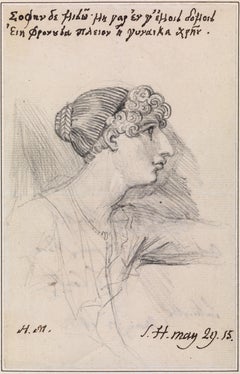
Portrait drawing of Harriot Mellon, Mrs Thomas Coutts
By Henry Fuseli
Located in London, GB
Inscribed by the artist in pen and brown ink, upper margin: 'σοφὴν δὲ μισῶ: μὴ γὰρ ἔν γ' ἐμοῖς δόμοις / εἴη φρονοῦσα πλείον' ἢ γυναῖκα χρή [Euripides, Hippolytus, 11, 640-41: “But a ...
Category
19th Century Old Masters Portrait Drawings and Watercolors
Materials
Pencil
You May Also Like
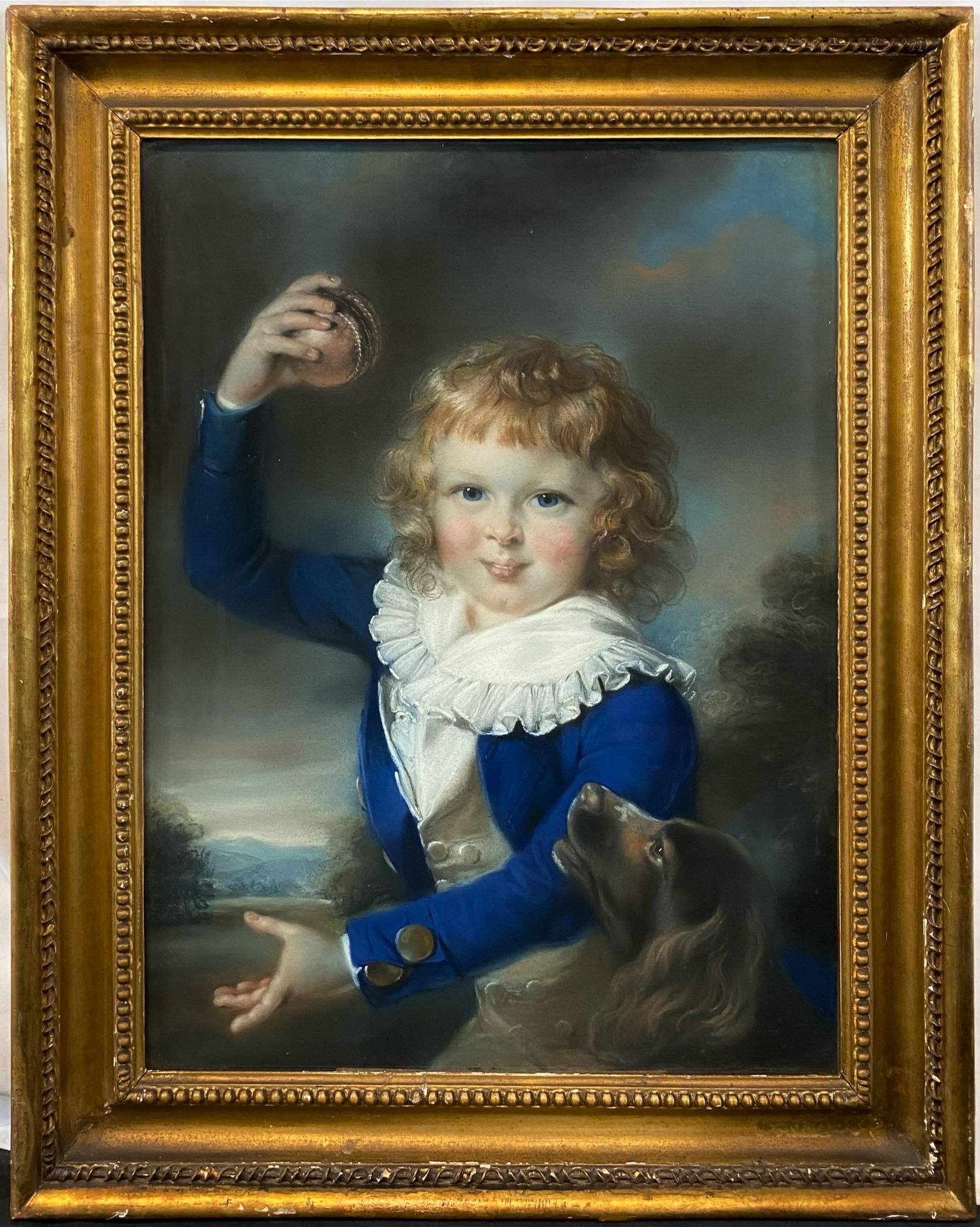
“Hon. George King, 1788” Pastel Portrait, Young Boy with Cricket Ball and Dog
By John Russell
Located in Yardley, PA
“Hon. George King, 1788” by John Russell (1745-1806)
Regarded as Britain’s foremost pastellist, John Russell is well known for his portraits of the wealthy middle class. In particul...
Category
1780s Old Masters Portrait Paintings
Materials
Canvas, Paper, Pastel

18th Century French Portrait Jean-Baptiste Soyer
By Jean-Baptiste Soyer
Located in Roma, IT
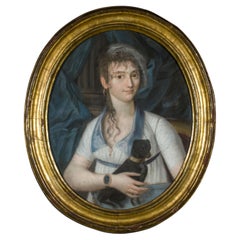
Beautiful pastel on paper laid down on canvas in an oval shape.
It depicts a young noblewoman portrayed three-quarter-length with her little dog in her arms.
Seated in a gilded armch...
Category
Late 18th Century Old Masters Portrait Paintings
Materials
Canvas, Glass, Wood, Paper, Pastel
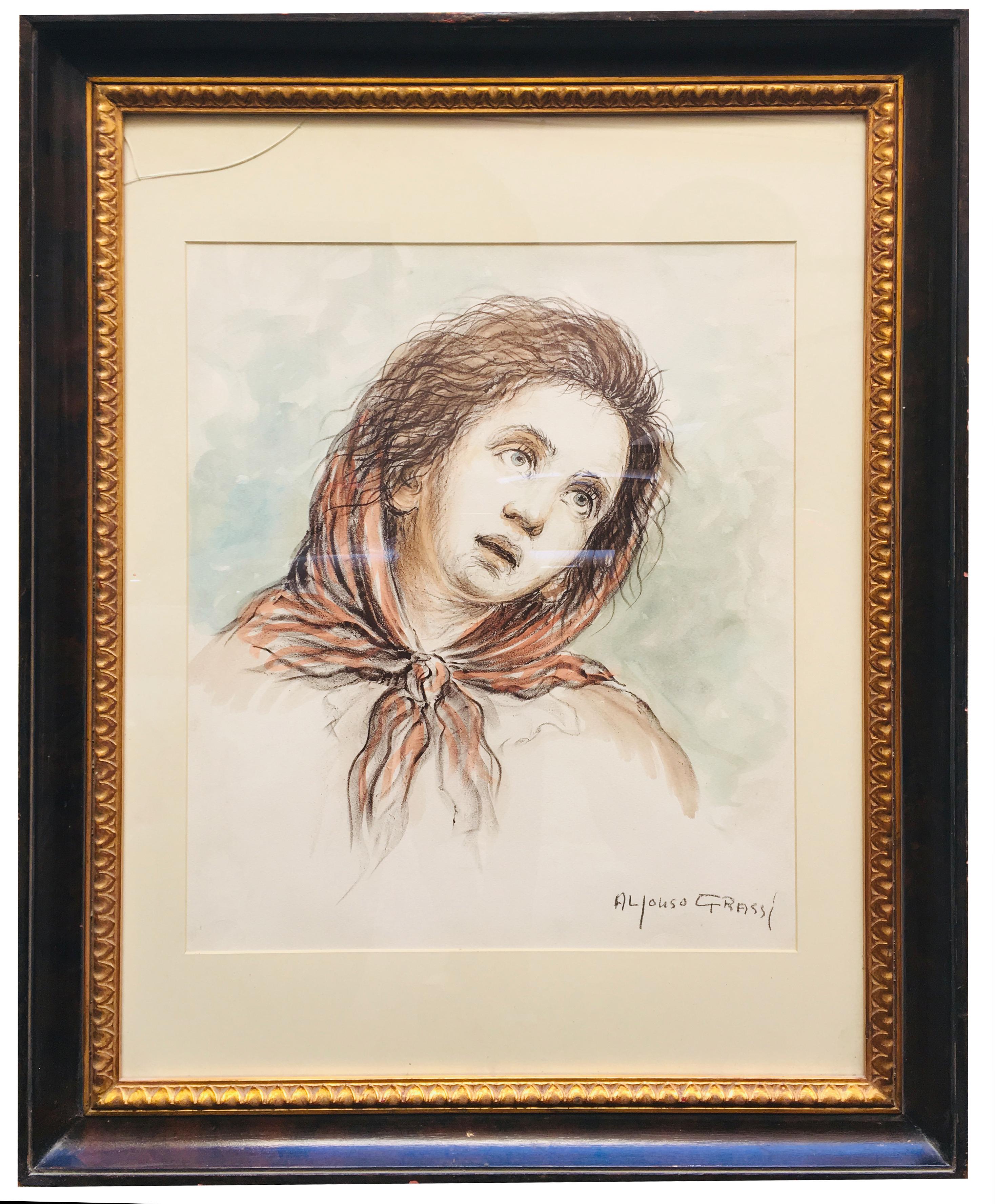
CHILD - Alfonso Grassi Pastel on paper Portrait italian Painting
By Alfonso Grassi
Located in Napoli, IT
CHILD - Pastel on paper cm.51x41 signed lower right by Alfonso Grassi, Italy.
Wooden frame with passeportout cm.94x73
Category
Late 20th Century Old Masters Portrait Paintings
Materials
Paper, Pastel
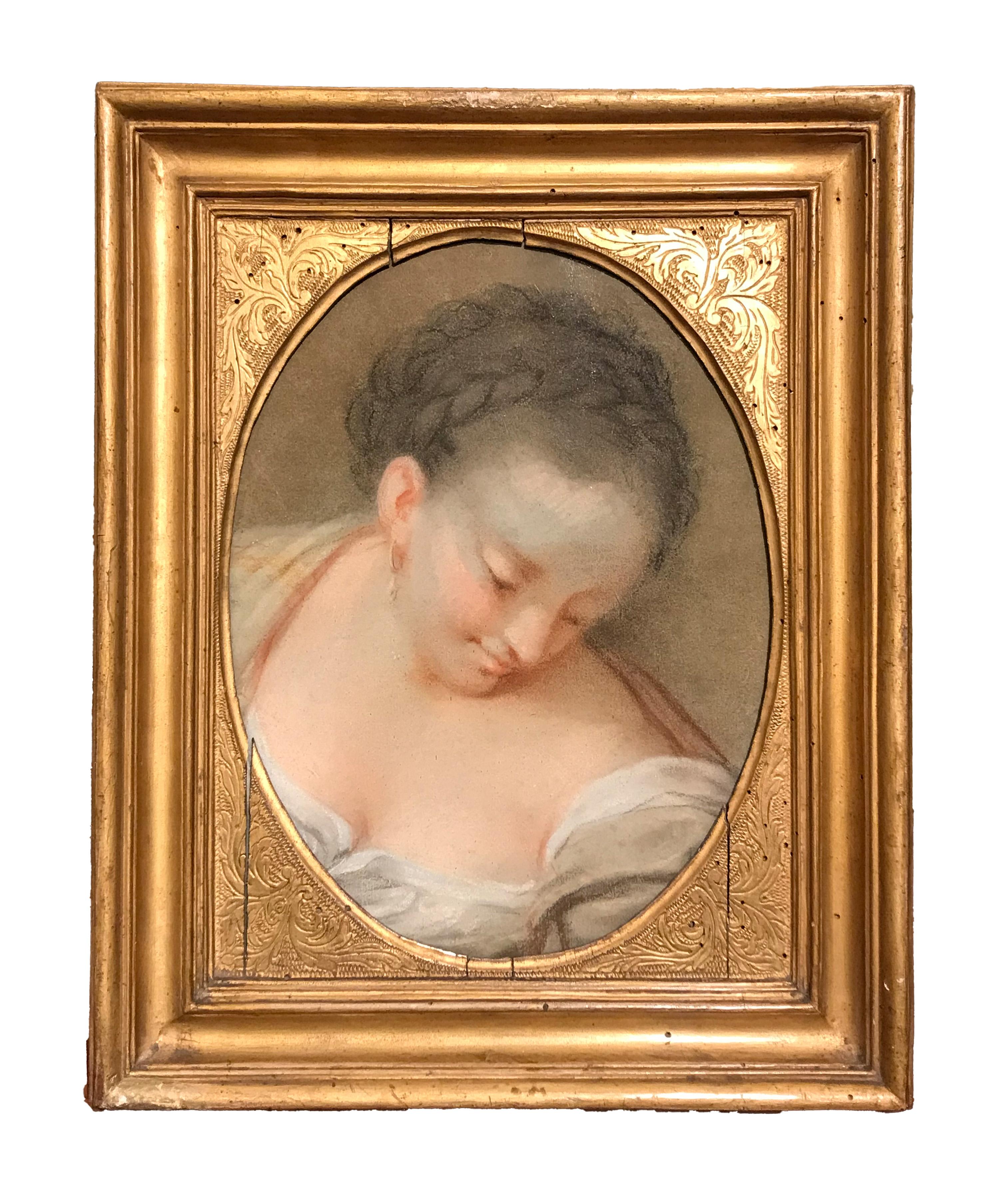
17th-18th Century By Benedetto Luti Head of a Girl Oil Pastel on Canvas
Located in Milano, Lombardia
Benedetto Luti (Florence, Italy, 1666 - Rome, Italy, 1724)
Title: Head of a Girl
Medium: Oil pastel on canvas
Dimensions: without frame 28 x 23.5 cm - with frame 38.5 x 33.5 cm
Origi...
Category
18th Century Old Masters Portrait Paintings
Materials
Canvas, Oil Pastel
$16,793 Sale Price
20% Off
17th-18th Century By Benedetto Luti Head of a Girl Oil Pastel on Canvas
Located in Milano, Lombardia
Benedetto Luti (Florence, Italy, 1666 - Rome, Italy, 1724)
Title: Head of a Girl
Medium: Oil pastel on canvas
Dimensions: without frame 28 x 23.5 cm - with frame 38.5 x 33.5 cm
Origi...
Category
18th Century Old Masters Portrait Paintings
Materials
Canvas, Oil Pastel
$16,793 Sale Price
20% Off
Portrait of a young woman in Louis XV period dress
Located in BELEYMAS, FR
French School
Portrait of a young woman in Louis XV period dress
Pastel on paper mounted on oval canvas
H. 68 cm; W. 54 cm (Frame: H. 102 cm; W. 71 cm)
18th century frame, anti-refle...
Category
Mid-18th Century French School Figurative Paintings
Materials
Canvas, Paper, Pastel