1930s Art

to
858
3,412
1,235
926
541
354
Overall Width
to
Overall Height
to
7,489
21,308
163,838
233,513
2,029
2,260
4,941
6,515
5,801
15,038
20,771
25,802
18,688
14,195
5,314
2,486
512
398
242
109
108
105
71
14
11
5
2
2
3,614
2,388
318
3,936
1,796
1,631
1,152
1,136
707
459
439
432
358
337
317
296
292
290
237
232
222
220
194
2,043
1,613
1,376
1,217
900
261
145
105
89
60
1,829
1,103
3,523
2,613
Period: 1930s
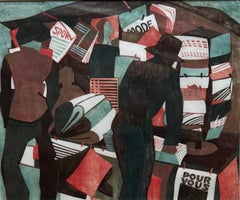
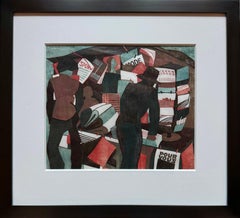
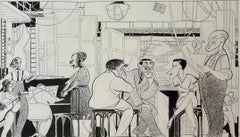
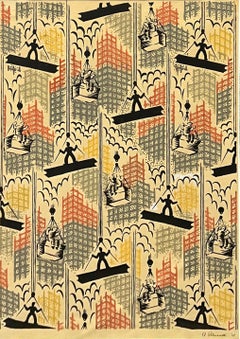
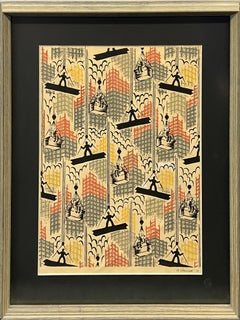
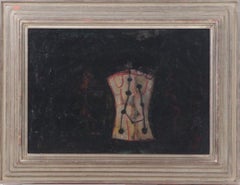
"NY Street Signs" Mid-20th Century WPA 1938 Modernist Abstract Realism Pop Art

"NY Street Signs" Mid-20th Century WPA 1938 Modernist Abstract Realism Pop Art

By Stuart Davis

Located in New York, NY

"NY Street Signs" Mid-20th Century WPA 1938 Modernist Abstract Realism Pop Art Stuart Davis (American, 1892-1964) "Street Signs" Modernist gouache and traces of pencil on paper in the proto-pop art style Davis is celebrated for, 1938, signed to lower right, framed. Image: 11 1/4 x 15 1/4 inches. Frame by Bark: 18 1/2 x 22 inches. LITERATURE: A, Boyajian, M. Rutkowski, Stuart Davis, A Catalogue Raisonne, Vol. 2, New Haven, Connecticut, 2007, vol. II, p. 632, no. 1232, illustrated. EXHIBITIONS: ACA Galleries, New York American Artists' Congress: Group Exhibition of Paintings and Sculpture, Dec. 3-16, 1939 (SDAB I, 12/3/39, p. 129). Outlines Gallery, Pittsburgh, Stuart Davis, Mar. 3-16, 1946. Coleman Art Gallery, Philadelphia, 5 Prodigal Sons: Former Philadelphia Artists: Ralston Crawford, Stuart Davis, Charles Demuth, Julian Levi, Charles Sheeler, Oct 4 - 30, 1947 (pamphlet), no. 12. PROVENANCE: The artist; Mr. and Mrs. Frank Bowles, New York, Apr. 3, 1956; thence by descent, Private Collection, New York. NOTES: According to the Catalogue Raissonne, "the title 'Street Signs' is recorded in the artist's account books...

Category

American Modern 1930s Art

Materials

Paper, Gouache, Pencil

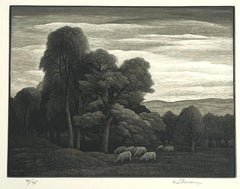
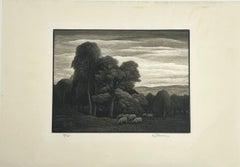
Antiquity - Original Woodcut Print - 1935

Antiquity - Original Woodcut Print - 1935

Located in Roma, IT

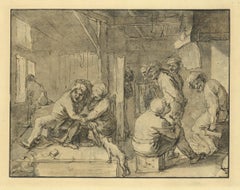
Antiquity 1935s is an original woodcut print on paper glued on ivory-colored cardboard, realized by Anonymous Artist of the XX Century. In excellent conditions: as good as new. Ima...

Category

Modern 1930s Art

Materials

Woodcut

Neon Lighting WPA Mid 20th Century Social Realism American Scene Modern Figures

Neon Lighting WPA Mid 20th Century Social Realism American Scene Modern Figures

By Maurice Becker

Located in New York, NY

Neon Lighting WPA Mid 20th Century Social Realism American Scene Modern Figures MAURICE BECKER (1889-1975) 'Neon Lighting 17 1/4 x 13 3/4 inches Oil on masonite Signed, dated 1936 and titled on verso BIO Maurice Becker, painter, political cartoonist and social reformer, was born in 1889 either in Gorky or Niznij Novgorod, in Russia. His family came to the United States in 1892, to New York City. After high school, Becker worked in a clothing factory. He studied with Ash Can School artist Robert Henri in 1908, and exhibited in the famous 1913 Armory Show in New York City when he was only twenty-four years of age. At the Armory show, Becker showed a drawing of a dog's head...

Category

American Modern 1930s Art

Materials

Masonite, Oil

LES HALEURS
LES HALEURS

LES HALEURS

By Jacques Villon

Located in Portland, ME

Villon, Jacques. LES HALEURS. GP E-332. Etching and drypoint, 1930. Final state. Edition of 50, numbered 34/50 and signed in pencil. 7 1/8 x 8 5/8 inches, 181 x 222 mm. (plate). Fra...

Category

1930s Art

Materials

Etching

Map of Chatham, Cape Cod

Map of Chatham, Cape Cod

Located in New York, NY

Original map of Chatham, Cape Cod, with recent hand-coloring, 1938. Light toning to edges; has original holes punched in left edge. From "Massachusetts Cit...

Category

1930s Art

Materials

Paper

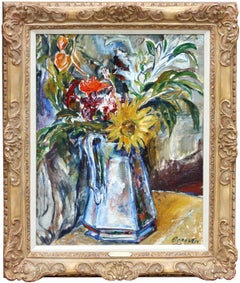
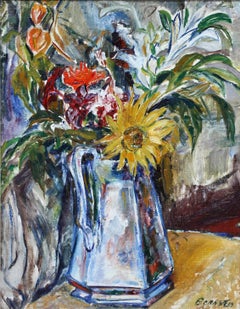
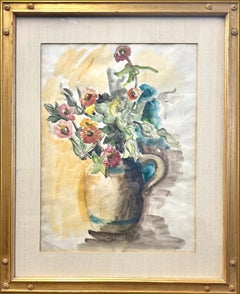
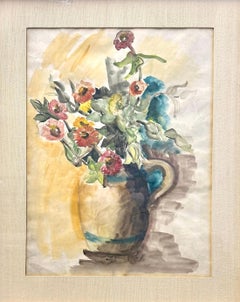
Flower Bouquet

Flower Bouquet

Located in Los Angeles, CA

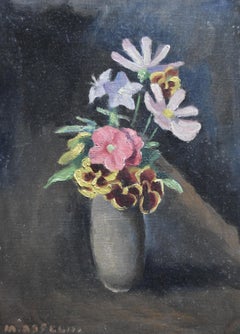
(Note: This work is part of our exhibition Connected by Creativity: WPA Era Works from the Collection of Leata and Edward Beatty Rowan) Watercolor on paper, 12 x 9 ½ inches unframed sheet, 15 x 12 ½ inches framed, signed lower left About the Artist: Nan Watson...

Category

American Modern 1930s Art

Materials

Watercolor

New York City Police Fortune Magazine Illustration

New York City Police Fortune Magazine Illustration

By Robert Riggs

Located in Miami, FL

This original illustration, titled "Cops at Ease in the Muster Room of a Station," is packed with character and detail and shows an unexpected and rare vision of the police in an off moment. Riggs unveils the real-life behind-the-scenes in this narrative work, which stylistically flaunts Riggs ' prodigious drawing skills. It accompanied the article Nineteen Thousand Cops published in the July 1939 issue of Fortune Magazine. This issue was dedicated to the city of New York and included a total of ten paintings by Riggs for this article on New York City's police department. Robert Riggs was a gay artist...

Category

Realist 1930s Art

Materials

Archival Paper, Charcoal

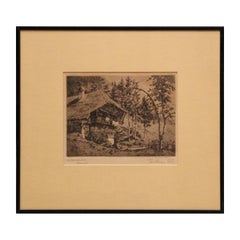
The Huts - Original China Ink Drawing by G. Pastre - 1930s

The Huts - Original China Ink Drawing by G. Pastre - 1930s

By Gaston Pastre

Located in Roma, IT

Image dimensions: 15.3 x 19.8 cm. The Huts is an original work realized by Gaston Pastre in the first half of the XX Century. Black ink and pencil. Hand-signed in ink on the lower right corner: G. Pastre. Very good conditions. Fresh and smart work representing a perspective of a small village with trees on the background. The glimpse is characterized by very simple and linear strokes and by an effective and impressionistic touch. This work has been realized by Gaston Pastre (1881 - 1947) a French painter, xilographer and illustrator. Among his other works, he illustrated "Le Livre de demain" (edition Fayard), "Les diaboliques...

Category

Modern 1930s Art

Materials

Ink

Jo Mora, Evolution of the Cowboy 1933, from Jo Mora Estate

Jo Mora, Evolution of the Cowboy 1933, from Jo Mora Estate

Located in Phoenix, AZ

"LAST ONE IN MINT CONDITION" Evolution of the Cowboy, 1933 Original Lithograph Excellent condition, came directly from Jo Mora Jr. Unframed!! SHIPPING CHARGES INCLUDE SHIPPING, PACKAGING & INSURANCE Original version was called Evolution of the Cowboy, 1933 or referred today as "Sweetheart of the Rodeo", Images from the poster were used for "Sweetheart of the Rodeo", the sixth album by American rock band the Byrds and was released on August 30, 1968. It was hated when released, today it is considered one of the great classics. This is an original lithograph from the Jo Mora Estate from Jo Mora Jr. Joseph Jacinto Mora (October 22, 1876 – October 10, 1947) was a Uruguayan-born American cowboy, photographer, artist, cartoonist, illustrator, painter, muralist, sculptor, and historian who wrote about his experiences in California. He has been called the "Renaissance Man of the West". Early life Mora was born on October 22, 1876, in Montevideo, Uruguay. His father was the Catalan sculptor, Domingo Mora, and his mother was Laura Gaillard Mora, an intellectual born in the Bordeaux region of France. His elder brother was F. Luis Mora, who would become an artist and the first Hispanic member of the National Academy of Design. The family entered the United States in 1880 and first settled in New York City, and then Perth Amboy, New Jersey. Jo Mora 1931 Yosemite map Jo Mora studied art at the Art Students League of New York and the Cowles Art School in Boston. He also studied with William Merritt Chase. He worked as a cartoonist for the Boston Evening Traveller, and later, the Boston Herald. In the spring of 1903, Mora arrived in Solvang, California. He stayed at the Donohue Ranch. He made plans to travel to the Southwest to paint and photograph the Hopi. He spent time at the Mission Santa Inés; those photographs are now maintained by the Smithsonian Institution. Mora visited many Spanish missions in California that summer by horseback. He followed the "Mission Trail", also called the "Kings Highway". In 1904, Mora visited Yosemite. Later, in 1904, to 1906, visited Arizona where he took photographs, painted and otherwise recorded the daily life of these Native Americans. Because the Hopi and other tribes have voiced their concerns more recently about photographs depicting religious ceremonies, the tribal nation should be contacted before they are used. He learned the Native languages and made detailed drawings of what he observed. Career In 1907, Mora wrote and illustrated the comic strip Animaldom. In 1907, Mora returned to California and married Grace Needham. Their son, Joseph Needham Mora, was born on March 8, 1908. The Moras moved to San Jose, California, where Mora continued his work. On 22 February 1911, the Native Sons of the Golden West Building, in San Francisco, with six terra cotta panels, by Domingo Mora and his son, Jo Mora, was dedicated. In 1915, he served on the International Jury of Awards at the Panama–Pacific International Exposition and displayed six sculptures.[9] In 1915-16 two of his sculptural commissions were revealed: the bronze memorial tablet with the profile of the late Archbishop Patrick W. Riordan for the Knights of Columbus and the Cervantes Monument in San Francisco's Golden Gate Park.[10][11] By 1919, he was sculpting for the Bohemian Club, including the Bret Harte Memorial plaque, completed in August 1919 and mounted on the outside of the private men's club building in San Francisco. Carmel-by-the-Sea In 1921, the Mora family relocated to Carmel-by-the-Sea, California, the largest art colony on the West Coast, making it their primary residence. He constructed a Craftsman-style home, which is located on the west side of San Carlos Street, the third house south of 1st Avenue. Mora received a commission for the bronze and travertine Cenotaph, for Father Junípero Serra in the Memorial Chapel at the west end of Mission Carmel. Mora was a director of the Carmel Art Association as early as 1934. His sculptures were exhibited between 1927 and 1934 in various galleries in Carmel. Jo Mora is a serious sculptor, a responsible amateur actor; when mixed up with pen and ink, a humorist! Comic strips was once his trade. He was famous at it. That was years ago but his art of cartooning bloomed again when in recent years he produced the well known Mora Map of the Monterey Peninsula. Most successful with bronze statue creations which decorate many gardens in East and West. If he has a specialty in figures it is cowboys. He knows his West. Jo Mora will ever be famed for his portrayal of Pancho Lopez, The Bad Man, at Carmel Playhouse. He does everything well and is handsome while doing it. He is happily married-alas! — Carmel Pine Cone During the Great Depression, Mora created the "Carmel Dollar" as part of Carmel's program, offering unemployed residents scrip for public service, exchangeable for groceries and essentials; a three-cent stamp on the certificate's back acknowledged their efforts. When full, merchants accepted the certified scrip for goods or a dollar. Architect Robert Stanton...

Category

Other Art Style 1930s Art

Materials

Lithograph

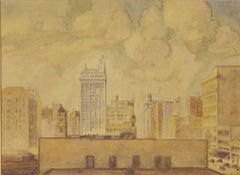
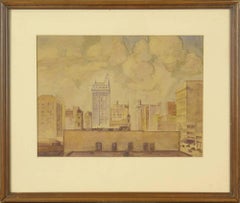
“East River New York Skyline”

“East River New York Skyline”

By Leon Dolice

Located in Southampton, NY

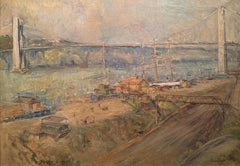
Original pastel on archival paper by the well known New York artist, Leon Dolice. Signed lower right by the artist. View of New York City skyline from the East River. Circa 1930. Con...

Category

Ashcan School 1930s Art

Materials

Pastel, Archival Paper

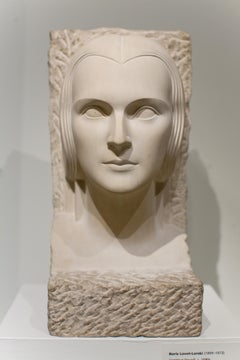
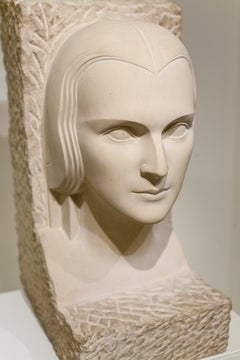
Boris Lovet-Lorski Limestone Art Deco Head, circa 1930
Boris Lovet-Lorski Limestone Art Deco Head, circa 1930
By Boris Lovet-Lorski

Located in New York, NY

White stone head in the art deco style. Born in Lithuania at the end of the nineteenth century, Boris Lovet-Lorski studied art at the Imperial Academy of Art in St. Petersburg before working briefly as an architect. He immigrated to New York in 1920 and became an American citizen five years later. His sculptures epitomize the ideals of the Art Deco decades: comprised of sleek lines and smooth surfaces, the streamlined compositions reflect the new technological forms of the machine age. Despite their modernist treatment, Lovet-Lorski’s elegant, stylized figures reference both ancient and classical sources and are characterized by a universal and serene sensibility. Concentrating on figural busts, familial groups, and standing female nudes as his subject matter, the artist rendered them in a variety of media. The materials range from the traditional bronze and marble to exotic woods and unusual stones; each is carefully selected so that its surface texture and color contribute to the emotive aura of the work. Carved out of a block of limestone, Untitled (Head) depicts a female visage nearly androgynous in its idealization. The delicate features of her face, the long, straight nose, thin pursed lips and high cheekbones, are made even more diminutive by the massive bulk of the stone that serves as their backdrop. The prominent widow’s peak of her hairline and the strong arch of her brow, two of Lovet-Lorski’s most distinctive characteristics, are elongated to accentuate the linear rhythms of the composition. The layers of her hair are delineated by stepped striations reminiscent of archaic precedents, which meld into structural columns and connect the form architecturally to the stone’s mass. Unlike the majority of Lovet-Lorski’s sculptures, in which the heads of the figures are tilted to the side or downward to convey a pensive mood, the woman in Untitled (Head) looks straight ahead. Her frontal positioning gives the composition a nearly perfect symmetry, in turn endowing the work with a still, eternal sensibility. The notched surface of the surrounding limestone stands in sharp contrast to the smoothness of her skin. In the twenties, the artist tended to finish his sculptures to a highly polished degree of refinement, but in the thirties he began to experiment with contrasts of texture and the aesthetic of the fragment. In this respect, the work is vaguely evocative of Egyptian funerary sculptures, in which the figures were carved with an eye for three-dimensionality but were left intact in a larger piece of stone to give them physical durability and permanence. Embodying classical ideals of stoicism and universal beauty, the sculpture ultimately exudes a surface allure that is difficult to resist. A similar example of this approach can be seen in the 1937 sculpture Diana, which resides in the permanent collection of the Hirshhorn Museum and Sculpture Garden, Washington D.C. Carved from a piece of black Belgian marble, the work is a stylized bust of the Greek goddess Diana...
Category

1930s Art

Materials

Limestone
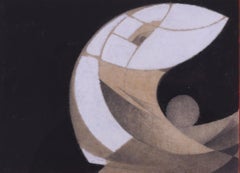
Column, 1933, Cubist Pastel on Paper by Benjamin Benno

Column, 1933, Cubist Pastel on Paper by Benjamin Benno

Located in Long Island City, NY

An original pastel drawing by Benjamin Benno, American (1901 - 1980). By the early 1930s he had established a reputation as a member of the international avant-garde and exhibited ...

Category

Cubist 1930s Art

Materials

Pastel

Abstract

Abstract

Located in Los Angeles, CA

This painting is part of our exhibition Charles Goeller: A Wistful Loneliness. Oil on canvas, 29 x 22 inches, Signed on frame verso “Painted by Charles L. Goeller” Exhibited: (Perh...

Category

American Modern 1930s Art

Materials

Oil

Fleet Street, London

Fleet Street, London

By Luigi Kasimir

Located in Fairlawn, OH

Fleet Street, London Soft ground etching & aquatint, c. 1936 Signed in pencil by the artist (see photo) Condition: Very good condition with brown paper tape along the edges of the la...

Category

1930s Art

Materials

Etching, Woodcut

Modernist Landscape with a  Hop Scotch Board

Modernist Landscape with a Hop Scotch Board

By Karl Fortress

Located in Buffalo, NY

A modernist oil painting by New York modernist Karl Fortress (1907-1993). The painting has provenance from the Cornell Art Museum. In excellent original condition. Signed lower le...

Category

American Modern 1930s Art

Materials

Canvas, Oil

Industrial Mural Study, Veterans Memorial Building, Santa Barbara WPA American

Industrial Mural Study, Veterans Memorial Building, Santa Barbara WPA American

Located in New York, NY

Industrial Mural Study, Veterans Memorial Building, Santa Barbara WPA American Joseph Edward Knowles (1907-1980) "Study for Industry Mural, Veterans Memorial Building, Santa Barbara, CA" 19 1/2 x 50 1/2 inches Oil on board, c. 1930s. Estate stamp verso Framed: 27 x 60 inches The completed mural is currently hanging on the wall, part of the building actually, at the Veterans Memorial Building in Santa Barbara. A photo of the work insitu is included in the attached photos. BIO Joseph Edward Knowles was born in Kendall, Montana, on June 15, 1907. He grew up in San Diego, California. At age twenty, two years before the beginning of the Great Depression, he moved north to another town on the coast of California---Santa Barbara. There he began studying fine art at the Santa Barbara School of the Arts* (1927-1930), under the supervision of Frank Morley Fletcher, previously director of the Edinburgh College of Art. Fletcher, who was trained in portraiture, landscape painting, and woodblock* printing, was a great influence on young Knowles. It was there that Knowles learned the art of color woodblock printmaking, a medium in which he showed great skill. Not long after completing his studies with Fletcher, Knowles began teaching art. For a period of thirty years, from 1930 to1960, he taught at the Cate School in Carpinteria, California. In 1934-1935, Knowles traveled throughout Europe, further developing his artistic skills in England, France, and Italy. Upon his return, he continued to teach art at various schools and institutions: Cate School, Crane Country School, extension classes at the University of California at Santa Barbara (UCSB), and at the Santa Barbara Museum of Art (SBMA). Knowles also served as an art education consultant for the County of Santa Barbara. In addition, he was founding co-director and president of the Santa Barbara Fine Arts Institute (1969-1972), which later developed a specialization in photography and became the Brooks Institute of Photography. Knowles died at his home in Santa Barbara on September 8, 1980. Much of Knowles' watercolor work is associated with what has been termed the "California School*," a loose grouping of artists throughout the state that included such figures as Millard Sheets, Phil Dike, Dong Kingman, George Post, and the Santa Barbara painters Dan Lutz and Standish Backus, Jr. The California School artists, including Knowles, were known for their fresh, direct, spontaneous style of watercolor painting. Knowles and other members of the school found inspiration in nature and the built environment alike, emphasizing elements of design in their exuberant, boldly stated, colorful scenes from everyday life. While painting in a representational* manner, Knowles generally avoided photographic realism, preferring subjective interpretation of his subjects. In this, as well as in his experimental approach and vigorous brushwork, he displayed a strongly modern sensibility. Knowles often used the wet-on-wet watercolor technique as he painted seascapes and landscapes, mostly along the California coast. He also employed dry-brush* techniques in many of his paintings, often leaving some of the white of the watercolor paper exposed. Some of the latter depict trees and other forms in a broken and airy manner that recalls Cezanne. Knowles' colored woodblock prints are more reserved and exact in their draftsmanship than his paintings. Spare, clean, lyrical lines are drawn to illustrate floral motifs and boat scenes with a touch of asymmetry conjuring Japanese woodblock prints. His murals from the post-World War II period are considerably more modern in their approach and show an emphasis on design and color. PROFESSIONAL ORGANIZATIONS California Watercolor Society (1940 - 1955) Santa Barbara Art Association (Vice President - 1952) ONE-MAN EXHIBITIONS Golden Gate International Exposition (GGIE) - San Francisco, California San Diego Fine Arts Gallery (SDMA) - San Diego, California Santa Barbara Museum of Art (SBMA) - Santa Barbara, California Cowie Galleries - Los Angeles, California Gallery de Silva - Santa Barbara, California Bradley Galleries - Santa Barbara, California MURALS Westmont College - Ellen Porter Hall Mural - Santa Barbara, California Safeway Grocery (now Vons Grocery on West Victoria Street) - Exterior Tile Mosaic - Santa Barbara, California Santa Barbara Bank & Trust - Interior Mosaic Panels, Santa Barbara, California Santa Barbara Girls Club - Interior Mosaic Mural - Santa Barbara, California Ernest Righetti High School - Mosaic Mural - Santa Maria, California Shell Oil Company - Mosaic Panel - California Beckman Instruments, Corporate Headquarters - Mosaic - Fullerton, California STAINED GLASS WINDOWS, WALLS and PANELS Katherine Thayer Cate Memorial Chapel - Cate School, Carpinteria, California William S. Porter Memorial Chapel - Cottage Hospital, Santa Barbara, California La Rinconada Building - Santa Barbara, California ILLUSTRATIONS "California's Wonderful Corner: True Stories for Children from the History of the Santa Barbara Region," by Walter A. Tompkins (1962 & 1975) China Designs: Two sets of dinnerware for Winfield China...

Category

American Realist 1930s Art

Materials

Oil, Board

"1st Class Travel" by Fox Photos

"1st Class Travel" by Fox Photos

Located in London, GB

"1st Class Travel" by Fox Photos September 1934: Mrs C Wylds behind the wheel with her pet pig at Terling in Essex. Unframed Paper Size: 16" x 20'' (inches) Printed 2022 Silver Ge...

Category

Modern 1930s Art

Materials

Black and White

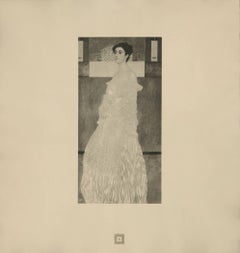
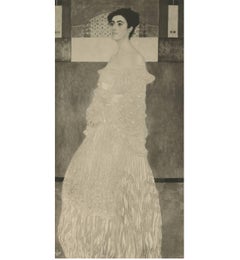
Italian Garden Landscape, Gustav Klimt An Aftermath collotype, 1931

Italian Garden Landscape, Gustav Klimt An Aftermath collotype, 1931

By (after) Gustav Klimt

Located in Chicago, IL

Original 1931 collotype created from Gustav Kilmt’s Italian Garden Landscape, oil on canvas, 1913. Published by Max Eisler and printed by Österreichischer Staatsdruckerei (Austrian State Printing Office), Vienna, in an edition of 500. In 1931, Max Eisler published the most notable posthumous collection of Gustav Klimt works to date. Using a complex gravure process, Klimt’s original...

Category

Vienna Secession 1930s Art

Materials

Paper

Dahlias
Dahlias

Dahlias

By Sir Jacob Epstein

Located in Douglas, Isle of Man

Sir Jacob Epstein K.B.E. 1880-1959, was an American born English sculptor, who pioneered modern sculpture. He had a very long and productive career and was considered the greatest s...

Category

1930s Art

Materials

Paper, Watercolor

'Cheetah Who Shops' Archival Photograph by Getty, 30x40

'Cheetah Who Shops' Archival Photograph by Getty, 30x40

Located in San Rafael, CA

American silent film actress Phyllis Gordon (1889 - 1964) window-shopping in Earls Court, London with her four-year-old cheetah who was flown to Britain from Kenya. (Photo by B C Par...

Category

Contemporary 1930s Art

Materials

Photographic Paper

"Lehigh County Village"

"Lehigh County Village"

By Walter Emerson Baum

Located in Lambertville, NJ

Jim’s of Lambertville is proud to offer this artwork by: Walter Emerson Baum (1884 - 1956) Born in Sellersville, Pennsylvania, Walter Baum was one of the only members of the New Ho...
Category

American Impressionist 1930s Art

Materials

Canvas, Oil

20th Century Impressionist Style Painting of Le Havre by Binet

20th Century Impressionist Style Painting of Le Havre by Binet

By Georges Jules Ernest Binet

Located in London, GB

20th century Impressionist style painting of Le Havre by Binet French, 1934 Canvas: Height 98cm, width 147cm Frame: Height 126cm, width 174cm, depth 8cm A luminous celebration of light, leisure, and local identity, this painting is a superb example of Georges Jules Ernest Binet...

Category

Impressionist 1930s Art

Materials

Canvas, Oil

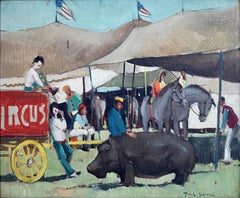
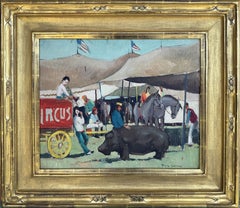
Au Circus
Au Circus

Au Circus

By Dietz Edzard

Located in Sheffield, MA

Dietz Edzard German, 1893-1963 Au Circus Oil on canvas 22 by 31 in. W/frame 32 by 41 in. Signed lower right Dietz Edzard was born in Bremen in 1893 Germany. He traveled extensive...

Category

Post-Impressionist 1930s Art

Materials

Oil

Spring verdure. Oil on canvas, 46.5x62.5 cm

Spring verdure. Oil on canvas, 46.5x62.5 cm

Located in Riga, LV

Janis Pupols (1886 – 1956) Graduated Landscape studio of V. Purvitis in Latvia Art academy (1927). He took part in exhibitions since 1925. Artist painted landscapes in different t...

Category

Impressionist 1930s Art

Materials

Canvas, Oil

Philip Joubert - British art portrait oil painting senior commander 1930's WWII

Philip Joubert - British art portrait oil painting senior commander 1930's WWII

By Charles Ernest Cundall

Located in Hagley, England

Painted circa 1930 this Modern British oil portrait of Philip Joubert has superb colouring and detail. Painted by Charles Cundall RA RWS, it came from the artist’s daughter and is framed in an earlier solid Empire frame. This is a fine example of a 20th century Modern British portrait. Philip Jourbet de la Ferte, Air Chief Marshall, was senior commander in the 1930's and World War II. Signed left. Provenance Family descent. James Bourlet and Sons labels verso. Artist’s daughter. Condition. Oil on canvas, image size 24 inches by 20 inches and in fine gallery condition. Housed in a fine Empire 19th century frame 30 by 26 inches, in good condition. Charles Cundall (1890-1971) - painter, potter and stained-glass artist, born in Stratford, Lancashire. After working as a designer for Pilkington's Pottery Company under Gordon Forsyth...
Category

Realist 1930s Art

Materials

Oil