Want more images or videos?
Request additional images or videos from the seller
1 of 10
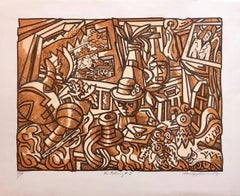
Jean CarzouCarzou French Modernist Color Lithograph Grand Canal Venice with Gondola Boat1968
1968
Price:$777
$1,100List Price
About the Item
- Creator:Jean Carzou (1907 - 2000, French)
- Creation Year:1968
- Dimensions:Height: 15 in (38.1 cm)Width: 22.25 in (56.52 cm)Depth: 0.2 in (5.08 mm)
- Medium:
- Movement & Style:
- Period:
- Condition:good. never been framed. minor wear.
- Gallery Location:Surfside, FL
- Reference Number:1stDibs: LU3824368961
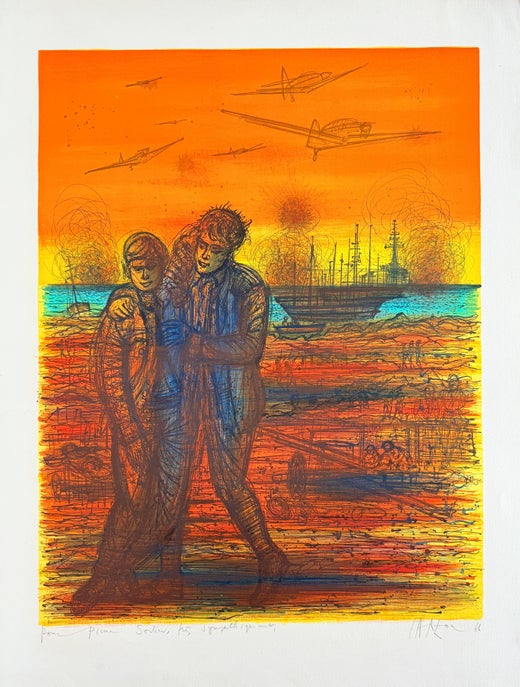
Jean Carzou
LIST OF MUSEUMS WITH WORKS BY JEAN CARZOU Musée National d’Art Moderne, Centre Georges Pompidou, Paris Musée d’Art Moderne de la Ville de Paris Musée de I’lle-de-France Musée d’Albi, France Musée de Cagnes Musée de Lyon Musée de Rouen Musée Cantini, Marseilles Musée d’Aix-en-Provence Musée des Baux-de-Provence Musée du Havre Bibliothèque Nationale, Paris State hermitage Museum, Leningrad Art Gallery of South Australia, Adelaide Municipal Museum, Dimona, Israel Djakarta Museum, Indonesia His work is also part of public collections in Cairo, Alexandria, Egypt; Kansas City, U.S.A.; Sofia, Bulgaria; Moscow, U.S.S.R. Upon graduation from the Lycée. Carzou devoted himself to studying painting in Montparnasse studios. He first showed his work at the Salon des Indépendents in 1930. Then he took part in various Salons, notably the Surindépendents, Salon d’Automne, Ecole de Paris, “Painters, Witnesses to their Times,” Comparaisons, etc. His first one-man show was held in a Rue de Seine gallery in 1939. Since then there have been more than one hundred one-man shows in Paris and elsewhere in France and abroad. He has been part of most official state exhibitions outside Paris and abroad: Biennials of Venice, São Paulo, Genoa: and exhibitions of French art in Yugoslavia, The Netherlands, Italy, Switzerland, Japan, Norway, and Australia. Caraou has won numerous prizes in painting, among them: the Hallmark Prize (three consecutive times in 1949, 1952 and 1955); Grand Prix de I’lle-de-France in 1954; Grand Prize for National Education, Tokyo, 1955; and the Grand Prix “Europe” at the first Bruges Biennial in 1958. He is an officer of Arts and Lettres and the Légion d’Honneur. In 1950, he traveled to Egypt and Lebanon for several exhibitions. In 1953, his exhibition devoted entirely to Venice was a huge success. The same year, a poll of museum-goers named Carzou’s The Lovers’ Lane their favorite painting. In 1955, a referendum organized by the magazine “Connaissance des Arts” placed him among the ten best painters of the post-war generation.
About the Seller
4.9
Platinum Seller
Premium sellers with a 4.7+ rating and 24-hour response times
Established in 1995
1stDibs seller since 2014
1,846 sales on 1stDibs
Typical response time: 1 hour
Authenticity Guarantee
In the unlikely event there’s an issue with an item’s authenticity, contact us within 1 year for a full refund. DetailsMoney-Back Guarantee
If your item is not as described, is damaged in transit, or does not arrive, contact us within 7 days for a full refund. Details24-Hour Cancellation
You have a 24-hour grace period in which to reconsider your purchase, with no questions asked.Vetted Professional Sellers
Our world-class sellers must adhere to strict standards for service and quality, maintaining the integrity of our listings.Price-Match Guarantee
If you find that a seller listed the same item for a lower price elsewhere, we’ll match it.Trusted Global Delivery
Our best-in-class carrier network provides specialized shipping options worldwide, including custom delivery.You May Also Like
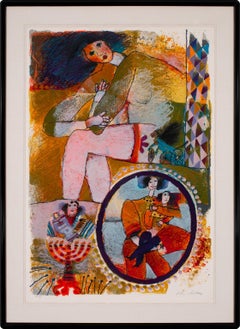
Théo Tobiasse "Cantate 51 de Bach" Signed 1979 Lithograph, Music & Memory Theme
By Théo Tobiasse
Located in Miami, FL
THÉO TOBIASSE – "CANTATE 51 DE BACH POUR LES JOURS DE LUMIÈRE"
⚜ Lithograph on paper ⚜ Hand signed and numbered ⚜ Conservation framed
SYMPHONIC FIGURATION FROM TOBIASSE’S FEMME SERI...
Category
1970s Modern Figurative Prints
Materials
Lithograph
$3,800
H 49.75 in W 36.375 in D 1.5 in
'Tree Root' . Hand colored lithogarph circa 1959.
By Jack Coutu
Located in Frome, Somerset
A fine Raymond John 'Jack' Coutu (1924-2017) ARE, ARCA. color lithograph/ engraving. 'Tree Root'. 6th of a 50 handmade edition by the artist.. circa 1959. Well listed Modern Artist. Signed and presented in the original framing. Raymond John "Jack" Coutu ARE ARCA (13 September 1924 – 17 May 2017) was an English printmaker, sculptor, etcher, engraver, carver, watercolourist and teacher. He was influenced by Oriental art.Jack Coutu was born Raymond John Coutu at Farnham, Surrey, England, and was educated at Farnham Grammar School.[ On leaving school in 1940, he worked at Abbott of Farnham, a coachbuilding company in Farnham, where his father Bert Coutu was also employed painting coats of arms and heraldic shields. In 1942, at the age of 18 during World War II, he joined the Royal Corps of Signals, where after training he served in Ceylon (now Sri Lanka), India, and Singapore. At the end of WWII, he was in Kure, Japan, in the Hiroshima Prefecture.
From 1947 to 1951, Coutu studied at the Farnham School of Art, followed by the Royal College of Art in London from 1951 to 1954 and the Central School of Art from 1951 to 1955. At the Central School of Art, Merlin Evans was an influence on Coutu's printmaking.
Coutu taught printmaking at the Central School of Art from 1957 to 1965 and then at the West Surrey College of Art and Design in Farnham from 1965 to 1985. In 1968, he started to carve netsuke (as practised in Japan) and he joined the Netsuke Kenkyukai Society, based in the United StatesHe is also a member of the Royal Society of Painter-Etchers and Engravers and the Printmakers Council.
Jack Coutu has exhibited at the Royal Academy in London, netsuke conventions, jointly with Michael Rothenstein...
Category
1950s Modern Landscape Prints
Materials
Lithograph
$709 Sale Price
20% Off
H 25.6 in W 34.26 in D 1.19 in
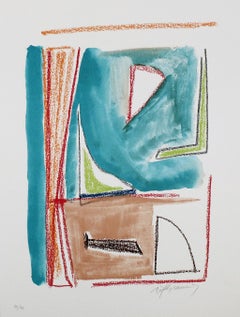
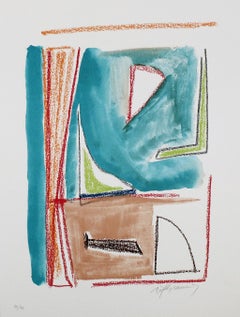
ALBERT RÀFOLS-CASAMADA: Estructures 2 - Lithograph on paper, Spanish Abstraction
By Albert Rafols Casamada
Located in Madrid, Madrid
ESTRUCTURES 2
Date of creation: 2006
Medium: Lithograph on paper
Edition: 75
Size: 41 x 31 cm
Observations:
Lithograph on paper signed by the artist and numbered edition of 75.
Alber...
Category
2010s Modern Abstract Prints
Materials
Lithograph
$334 Sale Price
20% Off
H 16.15 in W 12.21 in
Albert Rafols Casamada - ESTRUCTURES 2 Spanish Abstraction Contemporary Art
By Albert Rafols Casamada
Located in Madrid, Madrid
Albert Rafols Casamada - ESTRUCTURES 2
Date of creation: 2006
Medium: Lithograph on paper
Edition: 75
Size: 41 x 31 cm
Observations:
Condition: In very good conditions and never fram...
Category
2010s Modern Abstract Prints
Materials
Lithograph
$430 Sale Price
20% Off
Free Shipping
H 16.15 in W 12.21 in
"Six-Day War" (FRAMED) Abstract Lithograph 10" x 13" in (1967) by Zaccaria Zeini
Located in Culver City, CA
"Six-Day War" (FRAMED) Abstract Lithograph 10" x 13" in (1967) by Zaccaria Zeini
Medium: lithograph
Signed and dated
Zaccaria El Zeini (1932 - 1993) was raised in the popular dist...
Category
20th Century Modern Abstract Prints
Materials
Lithograph
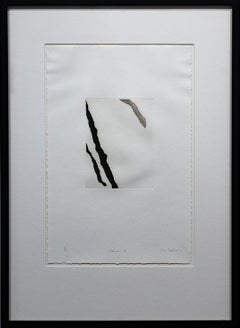
Douglas Semivan Abstract Modern "Receiver I" Signed and Numbered
By Douglas Semivan
Located in Detroit, MI
"Receiver I" is an abstract print of three diagonally placed lines. It is reminiscent of an early work by Georgia O'Keeffe, "Blue Lines X" in that both artists, Semivan and O'Keeffe, have achieved a beauty in the placement, width of, length and juxtapositions of simple lines to achieve a never ending balance and harmony for the viewer.
Born in Detroit, Michigan, Douglas Semivan...
Category
Late 20th Century American Modern Abstract Prints
Materials
Paper, Lithograph
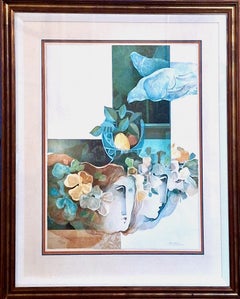
From “The Four Seasons Suite” Series
By Alvar Sunol Munoz-Ramos
Located in San Francisco, CA
This hand-signed, limited-edition lithograph with embossing is by the renowned Catalan Modernist artist Alvar Suñol Muñoz-Ramos, commonly known as Alvar. Part of “The Four Seasons” s...
Category
1970s Modern Figurative Prints
Materials
Paper, Lithograph
$1,350
H 37.25 in W 30.5 in D 1.5 in
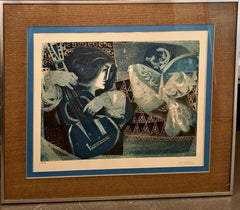
“Femme à La Guitare”
By Alvar Sunol Munoz-Ramos
Located in San Francisco, CA
A woman with flowing hair plays her guitar so beautifully that she captivates the full attention of a bird. Entranced, the creature responds with a full display of its feathers. The ...
Category
1980s Modern Figurative Prints
Materials
Paper, Lithograph
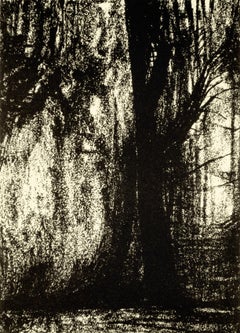
The Forest Henry Moore drawing of Yorkshire landscape for W.H. Auden poetry book
By Henry Moore
Located in New York, NY
One of a series of 18 lithographs drawn by the artist for the Auden Poems/Moore Lithographs 1974 book and portfolio. This work is from an edition of 25 printed on vellum aside from t...
Category
Late 20th Century Modern Landscape Prints
Materials
Lithograph
$1,200
H 25.25 in W 20.5 in
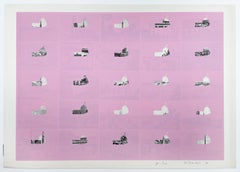
Berlin 2 by Dieter Roth architectural monument postcard in pink of Germany
By Dieter Roth
Located in New York, NY
Berlin 2, 1970
24 x 33.8 in. / 61 x 86 cm
Screen print in one color on offset lithograph, black on white card. Edition 100. “for Paul” written in pencil lower middle: this copy an ar...
Category
1970s Modern Abstract Prints
Materials
Lithograph, Screen
More From This Seller
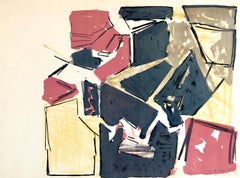
View AllIsraeli Josef Zaritsky Abstract Modernist Lithograph Print "Composition"
Located in Surfside, FL
Abstract Composition, 1959 Lithograph
This was from a portfolio which included works by Yosl Bergner, Menashe Kadishman, Yosef Zaritsky, Aharon Kahana, Moshe Tamir and Michael Gross.
Joseph (Yossef) Zaritsky (Hebrew: יוסף זריצקי; September 1, 1891 – November 30, 1985) was one of Israel's greatest artists and one of the early promoters of modern art in the Land of Israel both during the period of the Yishuv (Palestine, the body of Jewish residents in the Land of Israel before the establishment of the State of Israel) and after the establishment of the State. In 1948 Zaritsky was one of the founders of the "Ofakim Hadashim" group. In his works he created a uniquely Israeli style of abstract art, which he sought to promote by means of the group. For this work he was awarded the Israel Prize for painting in 1959.
Joseph Zaritsky...
Category
1950s Modern Abstract Prints
Materials
Lithograph
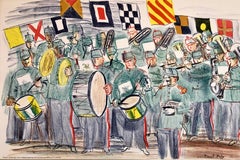
Raoul Dufy School Prints Colorful Modernist Drawing Lithograph Marching Band
By (after) Raoul Dufy
Located in Surfside, FL
Bright vibrant blue, yellow lithograph in color. This is signed in the plate and dated. Dufy's abstract drawing lithograph was drawn by the artist direct on to plastic plates newly d...
Category
1940s Modern Abstract Prints
Materials
Lithograph
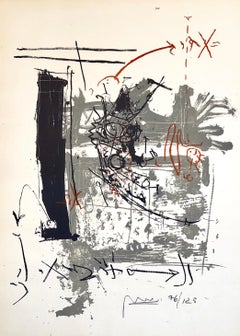
Israeli Tumarkin Abstract Modernist Graffiti Art Lithograph Print "Broken Hour"
Located in Surfside, FL
This was from a portfolio which included works by Yosl Bergner, Menashe Kadishman, Yosef Zaritsky, Aharon Kahana, Moshe Tamir and Michael Gross.
Yigal Tumarkin (also Igael Tumarkin...
Category
1950s Modern Abstract Prints
Materials
Lithograph
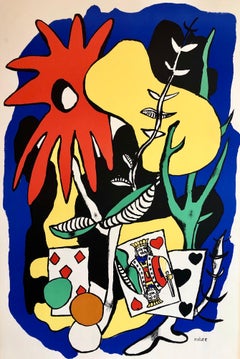
Fernand Leger School Prints Colorful Modernist King of Hearts Drawing Lithograph
By (after) Fernand Léger
Located in Surfside, FL
Bright vibrant blue, orange, red, yellow, green lithograph in color. This is signed in the plate and dated. Leger's abstract drawing lithograph was drawn by the artist direct on to p...
Category
1940s Modern Abstract Prints
Materials
Lithograph
Michael Gross Israeli Minimalist Conceptual Art, Abstract Jerusalem Silkscreen
By Michael Gross
Located in Surfside, FL
Michael Gross (Hebrew: מיכאל גרוס; 1920 – 4 November 2004) was an Israeli painter, sculptor and conceptual artist.
Michael Gross was born in Tiberias in the British-administered Palestine in 1920. He grew up in the farming village of Migdal. In 1939-1940, he left to study at the Teachers’ Training College in Jerusalem. In 1939, while he was away, his father was murdered by Arabs, and the family farm and home were destroyed. This event impacted on his work as an artist.
From 1943 to 1945, he studied architecture at Technion – Israel Institute of Technology in Haifa. From 1951 to 1954, he studied art at the École nationale supérieure des Beaux-Arts in Paris. He returned to Israel in 1954 and settled in the artists’ village of Ein Hod.
Gross's works are imbued with the light and spirit. They are minimalist, but never pure abstraction, always tied to natural form and laden with feeling. In his early paintings, Gross simplified form in order to concentrate on proportion, broad areas of color, and the size and placement of each element. This reductive process was also notable in his sculptures, whether in painted iron or other materials such as white concrete. In later paintings, he often juxtaposed large off-white panels with patches of tone, adding textured materials such as wooden beams, burlap and rope. Gross’s rough, freely-brushed surfaces, along with the use of soft pastel coloring, conjure up images of the Israeli landscape.
Education
1936-1940 Teachers Seminary, Jerusalem
1943-1945, Technion, Haifa, architecture, studied sculpture with Moshe Ziffer.
1951-1954 Beaux Arts, Paris with Michel Guimond
Teaching
1954 - 1954 Higher School of Education, Haifa.
1957-1960 Bezalel Academy of Arts and Design, Jerusalem
1960-1980 Oranim Art Institute, Tivon
Awards
1964: Hermann Struck Prize
1967: Dizengoff Prize
1971...
Category
1970s Modern Landscape Prints
Materials
Lithograph, Screen
Large Venezuelan Modernist Lithograph "The Balcony #3" Color Print
By Marius Sznajderman
Located in Surfside, FL
Marius Sznajderman was a painter, printmaker and scenic designer living and working in the United States.
Born in Paris, France in 1926 his Jewish parents had migrated to France from Poland in 1923. In November 1942 the family fled Nazi-occupied France for Spain before settling in Caracas, Venezuela. He attended the School of Fine Arts in Caracas where his teachers included illustrator Ramon Martin Durban, scenic designer Charles Ventrillon-Horber and painter Rafael Monasterios. and immigrated to the United States in 1949, where he received a Bachelor of Fine Arts and Master of Fine Arts from Columbia University in New York. He settled in Hackensack, New Jersey, where he lived and had a studio for more than 50 years before moving to Amherst, Massachusetts in 2015. His work, which includes painting, prints and collages, as well as set designs, is in more than 45 museum and public institution collections in the United States, Latin America and Israel. He held more than 40 solo exhibitions at galleries and museums and participated in more than 75 group shows around the globe.
He helped found the Taller Libre de Arte, an experimental workshop for the visual arts, sponsored by the Ministry of Education. The Taller Libre de Arte was a center for young artists to work and to meet with critics and intellectuals to discuss avant-garde ideas and artistic trends from Europe and Latin America. Among the notable artists who participated in the Taller Libre de Arte were Ramón Vásquez Brito, Carlos González Bogen, Luis Guevara Moreno, Mateo Manaure, Virgilio Trómpiz...
Category
20th Century Modern Figurative Prints
Materials
Lithograph
Still Thinking About These?
All Recently ViewedMore Ways To Browse
Paris Buffet
Venice Gondola Boat
Friedensreich Hundertwasser On Sale
Fundacio Joan Miro Lithograph
Gary Burnley
George Kolbe
Giacomo Balla Futur Balla
Goff Etchings
Gravure 1
Guy De Lussigny
Hearth Screen
Howard Hodgkin In A French Restaurant
Hubert Nicolas
Invader Heni
J Polk
Jakob Weder
Jane Rider
Japanese Tsushima