Charcoal Landscape Prints
to
1
Overall Width
to
Overall Height
to
1
1
1
1
3
1
1
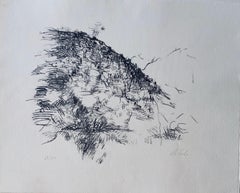
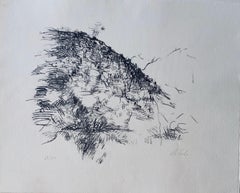
Artist: Anna Ticho
Medium: Charcoal
German Israeli Expressionist Abstract Lithograph Of Judeah Hills
By Anna Ticho
Located in Surfside, FL
Anna Ticho (אנה טיכו ) (1894-1980) was a Jewish artist who became famous for her drawings of the Jerusalem hills.
Anna Ticho was born in Brno, Moravia, then part of the Austro-Hungarian Empire (today the Czech Republic) in 1894. At the age of 15, she began to study drawing in Vienna in an art school under the directorship of Ernst Nowak...
Category
20th Century Expressionist Charcoal Landscape Prints
Materials
Charcoal, Lithograph
Related Items
Hand Painted+Drawn One Off-XL-Edition-Constant Gardener-British Awarded Artist
Located in London, GB
This stunning X-large hand drawn with original charcoal line drawing and hand painted with original oil and gesso paint; it is the No 2 of the only 10 Limited Editions;
The colours...
Category
2010s Abstract Impressionist Charcoal Landscape Prints
Materials
Gesso, Charcoal, Oil, Acrylic, Archival Paper, Giclée


$523
H 47.25 in W 31.5 in D 0.04 in
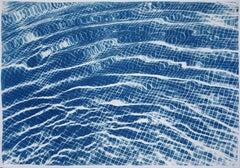
Miami Art Deco Pool, Blue Cyanotype on Paper, Abstract Shapes Water Reflections
By Kind of Cyan
Located in Barcelona, ES
This is an exclusive handprinted limited edition cyanotype.
"Miami Art Deco Pool" shows the movements of water over a tiled swimming pool floor.
Details:
+ Title: Miami Art Deco Poo...
Category
2010s Abstract Geometric Charcoal Landscape Prints
Materials
Emulsion, Watercolor, Photographic Paper, C Print, Lithograph, Other Medium
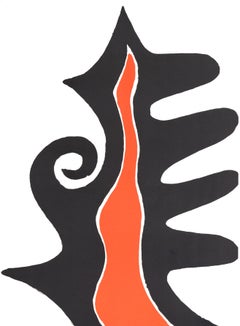
Alexander Calder, Black and Red Form, from Derriere le Miroir, 1973
Located in Southampton, NY
This exquisite lithograph by Alexander Calder (1898–1976), titled Formulaire noir et rouge (Black and Red Form), originates from the historic 1973 folio Derriere le Miroir, No. 201. ...
Category
1970s Modern Charcoal Landscape Prints
Materials
Lithograph
$716 Sale Price
20% Off
H 15 in W 11 in
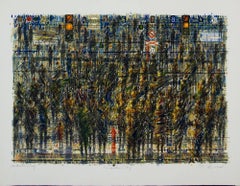
Computer City
By Bruno Zupan
Located in Paonia, CO
Computer City is a frenzy of colors and action. This is a city scene with stop lights, parking signs, directional signs, stop signs, digital time clock, buildings, streets and a mass...
Category
1970s Expressionist Charcoal Landscape Prints
Materials
Screen
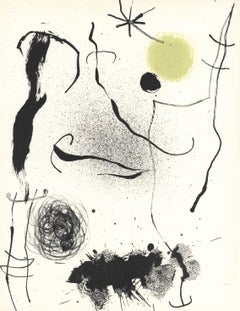
Joan Miro, Bouquet of Dreams for Leila, from XXe siecle, 1964
By Joan Miró
Located in Southampton, NY
This exquisite lithograph by Joan Miro (1893–1983), titled Bouquet de reves pour Leila, Poemes d'Yvan Goll (Bouquet of Dreams for Leila, Poems by Yvan Goll), from the album XXe siecl...
Category
1960s Surrealist Charcoal Landscape Prints
Materials
Lithograph
$716 Sale Price
20% Off
H 12.4 in W 9.65 in
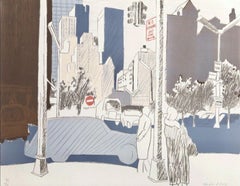
New York City Street Scene (L.18), Fairfield Porter
Located in Fairfield, CT
Artist: Fairfield Porter (1907-1975)
Title: Street Scene (L.18)
Year: 1969
Medium: Lithograph on Arches paper
Edition: 69/100, plus proofs
Size: 22.25 x 30 inches
Condition: Excellen...
Category
1960s Expressionist Charcoal Landscape Prints
Materials
Lithograph
$2,396 Sale Price
20% Off
H 22.25 in W 30 in
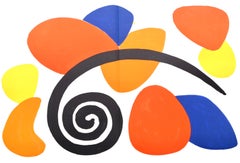
Alexander Calder, Composition with Spirals, from Derriere le miroir, 1968
Located in Southampton, NY
This exquisite lithograph by Alexander Calder (1898–1976), titled Composition aux Spirales (Composition with Spirals), from the folio Derriere le miroir, No. 173, originates from the 1968 edition published by Maeght Editeur, Paris, and printed by Mourlot Freres, Paris, 1968. Composition aux Spirales exemplifies Calder’s mastery of rhythm and form, translating his sculptural language of balance and motion into vivid, dynamic compositions on paper that capture his signature sense of energy and harmony.
Executed as a lithograph on velin paper, this work measures 15 x 22 inches, with centerfold, as issued. Unsigned and unnumbered as issued. The edition exemplifies the superb craftsmanship of Mourlot Freres, Paris.
Artwork Details:
Artist: Alexander Calder (1898–1976)
Title: Composition aux Spirales (Composition with Spirals), from the folio Derriere le miroir, No. 173
Medium: Lithograph on velin paper
Dimensions: 15 x 22 inches (38.1 x 55.88 cm), with centerfold, as issued
Inscription: Unsigned and unnumbered as issued
Date: 1968
Publisher: Maeght Editeur, Paris
Printer: Mourlot Freres, Paris
Condition: Well preserved, consistent with age and medium
Provenance: From the folio Derriere le miroir, No. 173, published by Maeght Editeur, Paris; printed by Mourlot Freres, Paris, 1968
Notes:
Excerpted from the folio (translated from French), The illustrations in this issue are original lithographs by Alexander Calder drawn in the workshops of the Arte printing shop. This issue of "Behind the Mirror" has a luxury edition drawn on velin de Lana and limited to CL examples numbered and signed by the artist on the colophon. The text of G. Carandente was translated from Italian by Alain Veinstein.
About the Publication:
Derriere le miroir (Behind the Mirror) was one of the most important art publications of the 20th century, created and published by Maeght Editeur in Paris from 1946 to 1982. Founded by the visionary art dealer and publisher Aime Maeght, the series served as both an exhibition catalogue and a work of art in its own right, uniting original lithographs by leading modern and contemporary artists with critical essays, poetry, and design of the highest quality. Printed by master lithographers such as Mourlot Freres and Arte, Derriere le miroir became synonymous with the artistic vanguard of postwar Europe. Each issue was devoted to a single artist or theme and published to accompany exhibitions at the Galerie Maeght in Paris, featuring works by Pablo Picasso, Henri Matisse, Georges Braque, Joan Miro, Marc Chagall, Alexander Calder, Fernand Leger, and Alberto Giacometti, among others. The publication reflected Maeght’s belief that art should be both accessible and elevated—an ideal realized through its luxurious production values, meticulous printing, and collaboration with the greatest creative minds of its time.
About the Artist:
Alexander Calder (1898–1976) was an American sculptor, painter, and printmaker whose pioneering innovations in kinetic art revolutionized 20th-century sculpture and transformed modern visual language. Born in Lawnton, Pennsylvania, into a family of artists, Calder initially trained as a mechanical engineer at the Stevens Institute of Technology before turning to art at the Art Students League in New York—a combination of technical precision and creative imagination that defined his career. Moving to Paris in 1926, he immersed himself in the avant-garde and formed friendships with Pablo Picasso, Alberto Giacometti, Joan Miro, Wassily Kandinsky, Salvador Dali, Marcel Duchamp, and Man Ray, whose ideas profoundly shaped his artistic philosophy. From Picasso, he absorbed structural invention; from Miro, lyrical abstraction; from Kandinsky, spiritual geometry; and from Duchamp and Man Ray, the courage to merge intellect and play. In Paris, Calder created his famous Cirque Calder, a miniature mechanical circus that introduced motion and performance as central components of sculpture, and by the early 1930s, he invented the mobile—a term coined by Duchamp—to describe his delicately balanced, moving sculptures that responded to air currents. Later, Jean Arp would name his stationary counterparts stabiles. These two inventions—sculptures that could either float and spin gracefully or stand monumentally still—transformed art into a dynamic dialogue between movement, balance, and space. Calder’s signature forms, painted in vivid reds, blacks, blues, and yellows, embodied both joy and precision, creating an art that was at once abstract, organic, and deeply human. Like Kandinsky and Miro, he viewed art as a form of rhythm and emotion; like Duchamp, he embraced innovation and humor; and like Giacometti and Dali, he was fascinated by perception, structure, and the unseen forces of motion. His monumental public sculptures—such as La Grande Vitesse (1969) in Grand Rapids and Flamingo (1973) in Chicago—redefined public art as a symbol of civic optimism and modern progress. A key bridge between European modernism and American abstraction, Calder’s influence extended to artists including Jean Tinguely, George Rickey, Donald Judd, Ellsworth Kelly, Richard Serra, and Olafur Eliasson, whose works in kinetic and spatial art continue to echo his vision. His gouaches, prints, and jewelry carried the same balance and movement as his sculptures, revealing a unified language of rhythm across media. Represented in every major modern museum—including MoMA, the Guggenheim, the Tate, and the Centre Pompidou—Calder remains celebrated for merging engineering, color, and poetry into an art of pure equilibrium. Standing alongside Pablo Picasso, Alexander Calder, Alberto Giacometti, Salvador Dali, Joan Miro, Wassily Kandinsky, Marcel Duchamp, and Man Ray, he remains one of the cornerstones of modern art—a visionary whose works breathe with motion, grace, and joy. His highest auction record was achieved by Poisson Volant (Flying Fish) (1957), which sold for $25.9 million at Christie’s, New York, on May 15, 2014, reaffirming Alexander Calder’s enduring legacy as one of the most inventive, dynamic, and collectible artists in the history of modern art.
Alexander Calder Composition...
Category
1960s Surrealist Charcoal Landscape Prints
Materials
Lithograph
$716 Sale Price
20% Off
H 15 in W 22 in
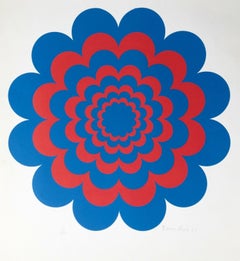
Flasher, Brian Rice
By Brian Rice
Located in Fairfield, CT
Artist: Brian Rice (1936)
Title: Flasher
Year: 1967
Edition: 67/175, plus proofs
Medium: Lithograph on wove paper
Size: 28.5 x 25 inches
Condition: Excellent
Inscription: Signed and ...
Category
1960s Pop Art Charcoal Landscape Prints
Materials
Lithograph
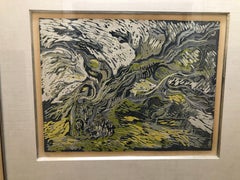
Mid century Israeli Expressionist
Located in San Francisco, CA
Bit of a mystery here. Really well done colored Linocut A very expressionistic style of a landscape with trees. I’m pretty sure it’s signed in Hebrew but cannot translate. A very low...
Category
Mid-20th Century Expressionist Charcoal Landscape Prints
Materials
Linocut
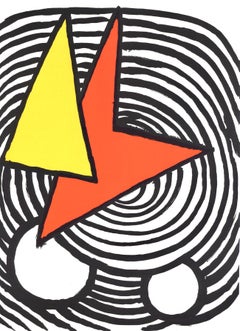
Alexander Calder, Spirals and Sunbursts, from Derriere le Miroir, 1973
Located in Southampton, NY
This exquisite lithograph by Alexander Calder (1898–1976), titled Spirales et eclats de soleil (Spirals and Sunbursts), originates from the historic 1973 folio Derriere le Miroir, No...
Category
1970s Modern Charcoal Landscape Prints
Materials
Lithograph
$716 Sale Price
20% Off
H 15 in W 11 in
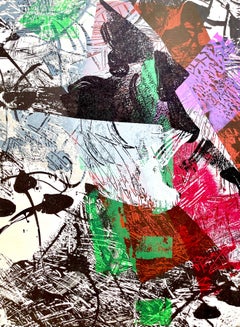
Jean-Paul Riopelle, Composition, L'édition de tête (after)
Located in Southampton, NY
Lithograph on vélin de Lana paper. Inscription: Unsigned and unnumbered, as issued. Good condition. Notes: From the folio, tête edition, Consacré à Jean-Paul Riopelle, Derrière le mi...
Category
1960s Modern Charcoal Landscape Prints
Materials
Lithograph
$1,036 Sale Price
20% Off
H 15 in W 11 in
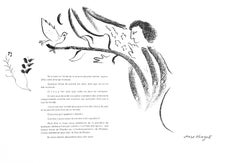
Marc Chagall, Homage to Georges Braque, from Derriere le Miroir, 1964
By Marc Chagall
Located in Southampton, NY
This exquisite lithograph by Marc Chagall (1887–1985), titled Hommage a Georges Braque (Homage to Georges Braque), originates from the 1964 folio Derriere le Miroir, Nos. 144–145–146, L’Hommage a Georges Braque (Tribute to Georges Braque). Published by Maeght Editeur, Paris, under the direction of Aime Maeght, and printed by Mourlot Freres, Paris, this luminous composition stands as Chagall’s poetic tribute to his friend and contemporary Georges Braque, “Neither the sun nor the brilliance of the moon can calm today this strange sadness.
Something close has gone, though his life was distant. And there is nothing with which this life can be compared. And from this departure there arise feelings inexpressible, like his colors which spoke but not to everyone. I have seen his plastic world so far from the worries of the day and his personality beyond this world. That is what he called “reality.” How true he was, and how troubling that is! Perhaps if we enter into the grandeur of certain French paintings — La Poix d’Avignon, a still life by Chardin, or The Embarkation for Cythera by Watteau — then the dream of Braque will seem clearer to us. And our path will become clearer too.” In Hommage a Georges Braque, Chagall fuses symbolic imagery to evoke themes of flight, harmony, and spiritual transcendence, celebrating Braque’s lifelong devotion to art and transformation. The composition reflects Chagall’s unique synthesis of emotion and imagination, merging the visionary with the intimate.
Executed on velin paper, this lithograph measures 15 x 22 inches (38.1 x 55.9 cm), with centerfold, as issued. Signed in the plate and unnumbered, as issued. The edition exemplifies Chagall’s lyrical command of color and form within the refined graphic artistry of Derriere le Miroir.
Artwork Details:
Artist: Marc Chagall (1887–1985)
Title: Hommage a Georges Braque (Homage to Georges Braque), from Derriere le Miroir, Nos. 144–145–146, L’Hommage a Georges Braque (Tribute to Georges Braque), 1964
Medium: Lithograph on velin paper
Dimensions: 15 x 22 inches (38.1 x 55.9 cm), with centerfold, as issued
Inscription: Signed in the plate and unnumbered, as issued
Date: 1964
Publisher: Maeght Editeur, Paris
Printer: Mourlot Freres, Paris
Condition: Well preserved, consistent with age and medium
Provenance: From the 1964 folio Derriere le Miroir, Nos. 144–145–146, published by Maeght Editeur, Paris
Notes:
Excerpted from the folio (translated from French): Taken from this special issue of “Behind the Mirror,” CCCL examples on velin de Rives were numbered, constituting the original edition of L’Hommage a Georges Braque. These deluxe examples also included an etching based on Trois oiseaux sur fond violet. The lithographs for this issue were printed in the ateliers of Maeght Editeur, Levallois. The text was printed by Fequet et Baudier, typographers. Finished printing May 13, 1964.
About the Publication:
Derriere le Miroir (translated as "Behind the Mirror") was an iconic French art periodical published from 1946 to 1982 by Maeght Editeur, one of the most influential art publishers of the 20th century. Founded by Aime Maeght in Paris, the publication was conceived as a visual and literary collaboration between leading modern artists, poets, and critics. Each issue functioned as both an exhibition catalogue and a work of art in itself—featuring original lithographs printed directly from the artists' stones or plates, alongside essays, poems, and critical commentary. Over the course of 36 years, Derriere le Miroir produced more than 250 issues and showcased an extraordinary roster of artists including Henri Matisse, Marc Chagall, Joan Miro, Georges Braque, Alexander Calder, Fernand Leger, Pierre Bonnard, Alberto Giacometti, Eduardo Chillida, Ellsworth Kelly, Francis Bacon, Paul Rebeyrolle, Claude Garache, Antoni Tapies, Bram van Velde, Pierre Alechinsky, Pol Bury, Shusaku Arakawa, and Gerard Titus-Carmel. Printed in the ateliers of Mourlot, Arte, and Imprimerie Moderne du Lion, the periodical set new standards for quality in color lithography, combining fine art printing with elegant typography and poetic text. Beyond its visual brilliance, Derriere le Miroir also became a cultural chronicle of postwar European modernism. Each issue coincided with exhibitions held at Galerie Maeght, providing a collectible and widely accessible record of groundbreaking shows. Its integration of image, text, and philosophy created a dialogue between art and literature that elevated the modern art book to new aesthetic heights. Today, Derriere le Miroir remains one of the most sought-after and historically significant art publications, prized by collectors and scholars alike for its craftsmanship, influence, and its role in defining the visual language of 20th-century modernism. The Maeght Foundation in Saint-Paul-de-Vence continues to honor this legacy through exhibitions and archival preservation of the series, affirming Derriere le Miroir's enduring place in the history of modern art and fine art publishing.
About the Artist:
Marc Chagall (1887–1985) was a Belarus-born French painter, printmaker, and designer whose visionary use of color and poetic symbolism made him one of the most beloved and influential artists of the 20th century. Rooted in the rich imagery of his Jewish heritage and childhood in Vitebsk, Chagall’s dreamlike compositions fused memory, folklore, faith, and romance with the expressive innovations of modern art. His work evolved alongside and in dialogue with the great modern masters—Pablo Picasso, Henri Matisse, Alexander Calder, Salvador Dali, Joan Miro, Georges Braque, Wassily Kandinsky, Marcel Duchamp, and Man Ray—artists who, like Chagall, redefined artistic language for a new century. Spanning painting, printmaking, stained glass, ceramics, stage design, and illustration, Chagall’s career reflected both his deep spirituality and his boundless imagination. His works are held in major museum collections worldwide, including the Museum of Modern Art, the Guggenheim, the Tate, and the Centre Pompidou. The highest price ever paid for a Marc Chagall artwork is approximately $28.5 million USD, achieved in 2017 at Sotheby’s New York for Les Amoureux (1928).
Marc Chagall Hommage a Georges Braque, Chagall Derriere le Miroir, Chagall Maeght Editeur Paris, Chagall Mourlot Freres, Chagall 1964...
Category
1960s Expressionist Charcoal Landscape Prints
Materials
Lithograph
$716 Sale Price
20% Off
H 15 in W 22 in
Previously Available Items
German Israeli Expressionist Abstract Lithograph Of Judeah Hills
By Anna Ticho
Located in Surfside, FL
Anna Ticho (אנה טיכו ) (1894-1980) was a Jewish artist who became famous for her drawings of the Jerusalem hills.
Anna Ticho was born in Brno, Moravia, then part of the Austro-Hungarian Empire (today the Czech Republic) in 1894. At the age of 15, she began to study drawing in Vienna in an art school under the directorship of Ernst Nowak...
Category
20th Century Expressionist Charcoal Landscape Prints
Materials
Charcoal, Lithograph
Charcoal landscape prints for sale on 1stDibs.
Find a wide variety of authentic Charcoal landscape prints available on 1stDibs. While artists have worked in this medium across a range of time periods, art made with this material during the 20th Century is especially popular. There are many well-known artists whose body of work includes ceramic sculptures. Popular artists on 1stDibs associated with pieces like this include and Anna Ticho. Frequently made by artists working in the Expressionist, all of these pieces for sale are unique and many will draw the attention of guests in your home. Not every interior allows for large Charcoal landscape prints, so small editions measuring 0.01 inches across are also available