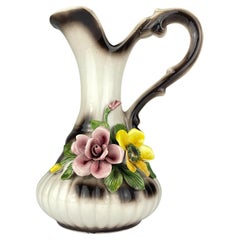
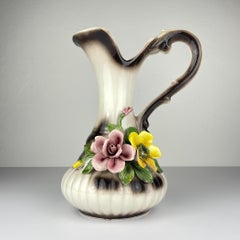
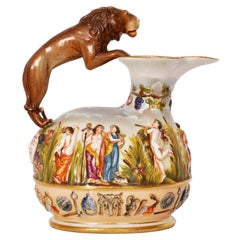
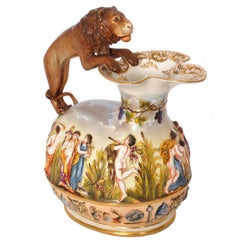
Capodimonte Jug

Vintage Capodimonte Ceramic Pitcher, Mid 20th Century

Vintage Capodimonte Ceramic Pitcher, Mid 20th Century

By Capodimonte

Located in Miklavž Pri Taboru, SI

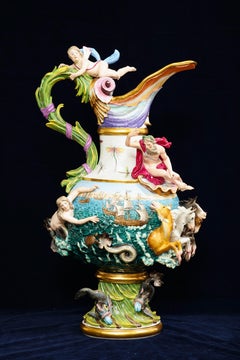
Large elegant porcelain jug with the Capodimonte stamp — the letter N under the crown. The rich

Category

Mid-20th Century Italian Mid-Century Modern Pitchers

Materials

Ceramic

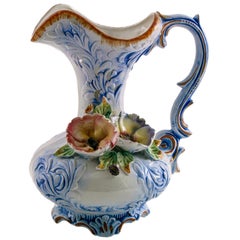
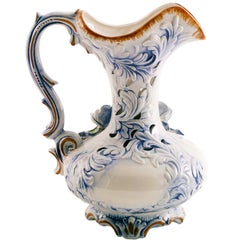
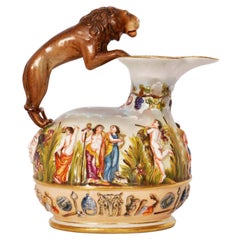
1930s Midcentury Baroque Large Italy Capodimonte Porcelain Pitcher

1930s Midcentury Baroque Large Italy Capodimonte Porcelain Pitcher

By Capodimonte

Located in Vigonza, Padua

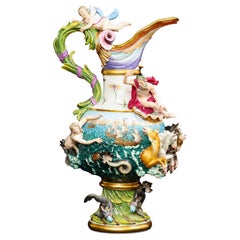
A modern Italian Capodimonte porcelain jug from the midcentury, 1930s, with handle decorated in

Category

Mid-20th Century Italian Baroque Jars

Materials

Ceramic

Recent Sales

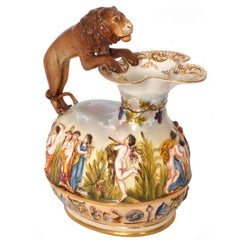
Antique Italian Porcelain Capodimonte Porcelain Lion Handle Pitcher Jug, 1880

Antique Italian Porcelain Capodimonte Porcelain Lion Handle Pitcher Jug, 1880

By Capodimonte

Located in Portland, OR

An unusual antique Italian porcelain pitcher jug in the Neoclassical style, Capodimonte, Circa 1880

Category

Antique 1880s Italian Neoclassical Planters, Cachepots and Jardinières

Materials

Porcelain

Antique Italian Porcelain Capodimonte Porcelain Lion Handle Pitcher Jug, 1880

Antique Italian Porcelain Capodimonte Porcelain Lion Handle Pitcher Jug, 1880

By Capodimonte

Located in Portland, OR

An unusual antique Italian porcelain pitcher jug in the Neoclassical style, Capodimonte, Circa 1880

Category

Antique 1880s Italian Neoclassical Planters, Cachepots and Jardinières

Materials

Porcelain

People Also Browsed

Bureau / Secretary Gustavian in Blue Painted In Pine. 18th Ctr. Swedish

Bureau / Secretary Gustavian in Blue Painted In Pine. 18th Ctr. Swedish

Located in Kastrup, DK

Gustavian secretary crafted in pine, finished in a charming blue tone with an elegant patina. The piece is composed of two sections with refined detailing throughout. The upper cabi...

Category

Antique Early 19th Century Swedish Gustavian Secretaires

Materials

Brass

Rene Lalique Piriac Vase Designed 1930 – Marcilhac 1043

Rene Lalique Piriac Vase Designed 1930 – Marcilhac 1043

By René Lalique

Located in Tunbridge Wells, GB

Heading : Rene Lalique Piriac vase – Marcilhac 1043 Date : Designed 1930 Origin : Wingen-sur-Moder. France Bowl Features : Clear and frosted glass with moulded blue stained band of f...

Category

Early 20th Century French Art Deco Vases

Materials

Art Glass

Pair of Tulips Murano Glass and Brass Sconces

Pair of Tulips Murano Glass and Brass Sconces

$3,629 / set

H 31.5 in W 21.26 in D 9.85 in

Pair of Tulips Murano Glass and Brass Sconces

Located in Puglia, Puglia

Pair of wall lamps, entirely handmade in Murano, Italy, that bring the energy of Nature and Feng Shui into your interior. This pair of modern organic wall lamps is composed of a hand...

Category

Early 2000s Italian Modern Wall Lights and Sconces

Materials

Brass

Italian Murano Art Glass Fruit Bookends

Italian Murano Art Glass Fruit Bookends

$1,250 / set

H 7.25 in Dm 4.75 in

Italian Murano Art Glass Fruit Bookends

By Alfredo Barbini

Located in New York, NY

A beautiful and substantial pair of Italian Murano pear and peach fruit bookends or decorative object sculptures, circa mid to late-20th century, Italy. These beautiful Murano art gl...

Category

Mid-20th Century Italian Modern Bookends

Materials

Art Glass, Blown Glass, Murano Glass

Rene Lalique Glass L'elegance Perfume Bottle

Rene Lalique Glass L'elegance Perfume Bottle

$6,583

H 3.86 in W 2.88 in D 0.91 in

Rene Lalique Glass L'elegance Perfume Bottle

By René Lalique

Located in Chelmsford, Essex

Rene Lalique clear and frosted glass L'elegance perfume bottle. This pattern features two dancing female figures amongst flowers. Sepia stained relief details. Moulded, 'R. LALIQUE' ...

Category

Vintage 1910s Bottles

Materials

Glass

Victorian Nécessaire de Voyage

Victorian Nécessaire de Voyage

$19,850

H 6 in W 12 in D 9 in

Victorian Nécessaire de Voyage

Located in New Orleans, LA

A work of extraordinary craftsmanship, this exquisite English vanity case is as much an item of luxury as it is of necessity. Known as a nécessaire de voyage, the case features a lux...

Category

Antique 19th Century English Victorian Jewelry Boxes

Materials

Velvet, Glass, Wood

Japanese Meiji Cloisonné Enamel Vase with Cherry Blossoms, Ota Tamashiro

Japanese Meiji Cloisonné Enamel Vase with Cherry Blossoms, Ota Tamashiro

Located in Long Island City, NY, NY

A Japanese Meiji Period Silver-Wire Cloisonné Enamel Vase with Cherry Blossoms and Narcissus, Attributed to Ota Tamashiro An elegant Japanese cloisonné enamel vase from the Meiji pe...

Category

Antique 19th Century Japanese Meiji Vases

Materials

Copper, Enamel

German bridal cabinet

German bridal cabinet

$4,380

H 70.08 in W 50.4 in D 21.26 in

German bridal cabinet

Located in Amsterdam, Noord Holland

A beautiful cabinet from the rural south of Germany. The cabinet was once given as a wedding gift. This cabinet is hand-painted in vibrant colours. The cabinet has its original hinge...

Category

Vintage 1950s German Folk Art Wardrobes and Armoires

Materials

Pine

Émile Gallé "Grenouilles" Fruitwood Cabinet

Émile Gallé "Grenouilles" Fruitwood Cabinet

$75,000

H 62.5 in W 26 in D 15.25 in

Émile Gallé "Grenouilles" Fruitwood Cabinet

By Émile Gallé

Located in New York, NY

This French Art Nouveau "Grenouilles" carved fruitwood cabinet by Émile Gallé features detailed and masterful marquetry depicting dragonflies and mushrooms in a lush, leafy landscape...

Category

Antique Early 1900s French Art Nouveau Cabinets

Materials

Beech, Fruitwood

Double Gourd Satsuma Vase

Double Gourd Satsuma Vase

$3,450

H 7 in W 3.5 in D 3.5 in

Double Gourd Satsuma Vase

Located in New Orleans, LA

This exquisitely detailed, double-gourd Japanese Satsuma vase represents the zenith of Japanese earthenware artistry. Elaborately hand-painted, it features detailed floral motifs, wh...

Category

Antique 19th Century Japanese Meiji Vases

Materials

Earthenware

Rare and Palatial Pair of Gilt Bronze and Malachite Seven Light Torcheres

Rare and Palatial Pair of Gilt Bronze and Malachite Seven Light Torcheres

Located in Long Island City, NY

A Rare and Palatial Pair of Mid 20th Century Gilt Bronze and Malachite Six Light Torcheres The body of baluster form above a gilt bronze mounted circular and square base, the neck m...

Category

Mid-20th Century French Belle Époque Floor Lamps

Materials

Malachite, Bronze, Ormolu

Rare Japanese Cloisonné Enamel Vase with Kingfisher and Reeds, Hayashi Kodenji

Rare Japanese Cloisonné Enamel Vase with Kingfisher and Reeds, Hayashi Kodenji

Located in Long Island City, NY, NY

A Rare Japanese Meiji Period Lobed Silver-Wire Cloisonné Enamel Vase with Kingfisher and Reeds, Attributed to the Hayashi Kodenji Studio A rare and elegant Japanese cloisonné enamel...

Category

Antique 19th Century Japanese Meiji Vases

Materials

Copper, Enamel

Monumental Japanese Three-Piece Peach Cloisonné Enamel Garniture, Nagoya Company

Monumental Japanese Three-Piece Peach Cloisonné Enamel Garniture, Nagoya Company

By Nagoya Craftsmen

Located in Long Island City, NY, NY

A Monumental Japanese Meiji Period Three-Piece Lobed Cloisonné Enamel Garniture with Birds, Butterflies, and Chrysanthemums on a Rare Pale Peach Ground, Attributed to the Nagoya Cloi...

Category

Antique 19th Century Japanese Meiji Garniture

Materials

Copper, Enamel

French 19th-20th Century Louis XVI Style Mahogany, Kingwood Parquetry Vitrine

French 19th-20th Century Louis XVI Style Mahogany, Kingwood Parquetry Vitrine

$37,950Sale Price|20% Off

H 59.5 in W 65.38 in D 16.75 in

French 19th-20th Century Louis XVI Style Mahogany, Kingwood Parquetry Vitrine

By François Linke

Located in Los Angeles, CA

A very fine French 19th/20th century Louis XVI style mahogany, kingwood and tulipwood parquetry three-door vitrine with ormolu-mounted floral wreaths, ribbons, female masks and centr...

Category

Antique Early 1900s French Louis XVI Vitrines

Materials

Marble, Bronze

Antique ca 1700 Japanese Arita Kakiemon Unusual shaped Bowl Flowers

Antique ca 1700 Japanese Arita Kakiemon Unusual shaped Bowl Flowers

Located in Amsterdam, Noord Holland

Very happy with this new arrival. Arita/Kakiemon bowl of unusual shape and design. Besides the very nice floral decoration there is superior overglaze blue Period unknown. ca 1700 ...

Category

Antique 17th Century Edo Decorative Dishes and Vide-Poche

Materials

Porcelain

French Pâte de Verre Vase by Argy-Rousseau

French Pâte de Verre Vase by Argy-Rousseau

By Gabriel Argy-Rousseau

Located in New York, NY

A French ‘Ecureuils dans l’Herbe” pâte de verre vase by Gabriel Argy-Rousseau. Nature, notably flowers and insects, held an important place among the themes developed by Argy-Rousse...

Category

Vintage 1920s French Art Deco Vases

Materials

Art Glass

Get Updated with New Arrivals
Save "Capodimonte Jug", and we’ll notify you when there are new listings in this category.

Capodimonte for sale on 1stDibs

If success is measured by lasting name recognition, Capodimonte porcelain would seem to be in the same league as such makers as Meissen, Sèvres and Wedgwood. Early examples of Capodimonte lamps — as well as the Italian manufacturer’s celebrated porcelain vases, figurines and sculptures — can be hard to come by, but the best later pieces possess the same over-the-top charm.

The Real Fabbrica (“royal factory”) di Capodimonte hasn’t actually produced porcelain since the early 19th century, when Charles’s son Ferdinand sold it. Although secondary manufacturers have built upon the aesthetic and kept the name alive, some connoisseurs of the royal product feel these pieces should be labeled “in the style of” Capodimonte.

The timeline of royal Capodimonte porcelain is decidedly brief. From beginning to end, its manufacture lasted approximately 75 years. King Charles VII of Naples, who founded the manufactory in 1743, began experimenting with porcelain around 1738, the year he married Maria Amalia of Saxony. No coincidence there. His new bride was the granddaughter of Augustus the Strong, Elector of Saxony and founder of Meissen, the first European hard-paste porcelain manufactory. Her dowry included 17 Meissen table services.

Struck by porcelain fever, Charles built a dedicated facility on top of a hill (capo di monte) overlooking Naples. He financed expeditions to search for the right clay. He hired chemists and artisans to experiment. His earliest successes were small white snuffboxes and vases, although efforts soon progressed to full sets of tableware, decorative objects and stylized figurines of peasants and theatrical personalities.

In 1759, Charles succeeded to the throne of Spain. He moved the manufactory with him — including 40 workers and 4 tons of clay — and continued operations in Madrid. Twelve years later, his son Ferdinand IV, who inherited the throne of Naples, built a new factory there that became known for distinctly rococo designs.

The Napoleonic wars interrupted production, and around 1807, oversight of the royal factories was transferred to a franchisee named Giovanni Poulard-Prad.

Beginning in the mid-18th century, porcelain made by Charles’s factory was stamped with a fleur-de-lis, usually in underglaze blue. Pieces from Ferdinand’s were stamped with a Neapolitan N topped by a crown. When secondary manufacturers began production, they retained this mark, in multiple variations. The value of these later 19th- and 20th-century pieces is determined by the quality, not the Capodimonte porcelain marks.

Find antique and vintage Capodimonte porcelain for sale on 1stDibs.