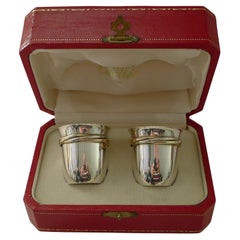
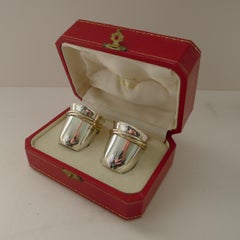
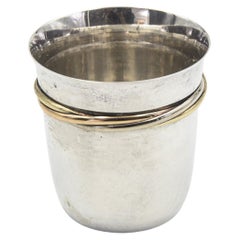
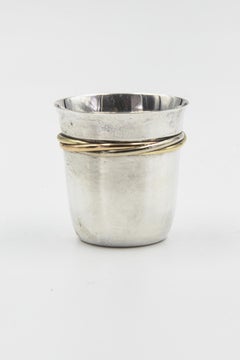
An assortment of cartier shot glasses is available on 1stDibs. A selection of these works in the
contemporary,
modern and
Surrealist styles can be found today in our inventory. These items have been produced for many years, with earlier versions available from the 20th Century and newer variations made as recently as the 21st Century. If you’re looking to add cartier shot glasses that pop against an otherwise neutral space in your home, the works available on 1stDibs include that feature elements of
brown,
black,
silver,
gray and more.
Kevin Frest,
Suzan Etkin,
Mikael Levin,
Todd Burris and
Peter Merom took a thoughtful approach to this subject that are worth considering. Each of these unique pieces was handmade with extraordinary care, with artists most often working in
silver gelatin print,
wood and
dye transfer print.
For its extraordinary range of bracelets, watches, rings and other adornments, French luxury house Cartier is undeniably one of the most well known and internationally revered jewelers in the world among clients both existing and aspirational.
Perhaps 1847 was not the ideal time to open a new watchmaking and jewelry business, as the French Revolution was not kind to the aristocracy who could afford such luxuries. Nevertheless, it was the year Louis-François Cartier (1819–1904) — who was born into poverty — founded his eponymous empire, assuming control of the workshop of watchmaker Adolphe Picard, under whom he had previously been employed as an assistant. Of course, in the beginning, it was a relatively modest affair, but by the late 1850s, Cartier had its first royal client, Princess Mathilde Bonaparte, niece of Napoleon Bonaparte, who commissioned the jeweler to design brooches, earrings and other accessories.
Under the leadership of Louis-François’s son, Alfred, who took over in 1874, business boomed. Royalty around the world wore Cartier pieces, including Tsar Nicholas II of Russia, the Maharaja of Patiala and King Edward VII, who had 27 tiaras made by the jewelry house for his coronation in 1902 and issued Cartier a royal warrant in 1904. (Today, the British royal family still dons Cartier pieces; Kate Middleton, Duchess of Cambridge, regularly sports a Ballon Bleu de Cartier watch.)
Cartier’s golden years, however, began when Alfred introduced his three sons, Louis, Pierre and Jacques, to the business. The brothers expanded Cartier globally: Louis reigned in Paris, Pierre in New York and Jacques in London, ensuring their brand’s consistency at their branches across the world. The trio also brought in such talents as Charles Jacqueau and Jeanne Toussaint.
One of Cartier’s earliest major successes was the Santos de Cartier watch — one of the world's first modern wristwatches for men. (Previously, a large number of people were using only pocket watches.) Louis designed the timepiece in 1904 for his friend, popular Brazilian aviator Alberto Santos-Dumont, who wanted to be able to check the time more easily while flying.
Cartier’s other famous timepieces include the Tank watch, which was inspired by the linear form of military tanks during World War I, and the so-called mystery clocks. Invented by watchmaker and magician Jean-Eugène Robert-Houdin and later crafted exclusively for Cartier in the house’s workshop by watchmaker Maurice Couët, the mystery clocks were so named because the integration of glass dials on which the clocks’ hands would seemingly float as well as structures that are hidden away within the base give the illusion that they operate without machinery.
On the jewelry side of the business, Cartier’s internationally renowned offerings include the Tutti Frutti collection, which featured colorful carved gemstones inspired by Jacques’s trip to India and grew in popularity during the Art Deco years; the panthère motif, which has been incorporated into everything from brooches to rings; and the Love bracelet, a minimal, modernist locking bangle inspired by medieval chastity belts that transformed fine jewelry.
While the Cartier family sold the business following the death of Pierre in 1964, the brand continues to innovate today, renewing old hits and creating new masterpieces.
Find contemporary and vintage Cartier watches, engagement rings, necklaces and other accessories on 1stDibs.
Dining and entertaining changed drastically when we began to set our tables with sterling silver for holiday gatherings, wedding receptions, engagement parties and, in some of today’s homes, everyday meals.
Often called the “Queen of metals,” silver has been universally adored for thousands of years. It is easy to see why it has always been sought after: It is durable, strong and beautiful. (Louis XIV had tables made entirely of silver.) Sterling silver is an alloy that is made of 92.5 percent silver — the “925” stamp that identifies sterling-silver jewelry refers to this number. The other 7.5 percent in sterling silver is typically sourced from copper.
Neoclassical-style sterling-silver goods in Europe gained popularity in the late 18th century — a taste for sterling-silver tableware as well as tea sets had taken shape — while in the United States, beginning in the 19th century, preparing the dinner table with sterling-silver flatware had become somewhat of a standard practice. Indeed, owning lots of silver goods during the Victorian era was a big deal. Back then, displaying fine silver at home was a status symbol for middle-class American families. And this domestic silver craze meant great profitability for legendary silversmith manufacturers such as Reed & Barton, Gorham Manufacturing Company and the International Silver Company, which was incorporated in Meriden, Connecticut, in 1898, a major hub of silver manufacturing nicknamed “Silver City.”
Today, special occasions might call for ceremonial silver designed by Tiffany & Co. or the seductive sterling-silver cutlery from remarkable Danish silversmith Georg Jensen, but there really doesn’t have to be an event on the calendar to trot out your finest tableware.
Event- and wedding-planning company maestro Tara Guérard says that some “investment pieces,” such as this widely enamored alloy, should see everyday use, and we’re inclined to agree.
“Sterling-silver flatware is a must-have that you can use every single day, even to eat cereal,” she says. “Personally, I want a sterling-silver goblet set for 12 to 20; I would use them every time I had a dinner party. Ultimately, there are no criteria for buying vintage pieces: Buy what you love, and make it work.”
Whether you’re thinking “ceremonial” or “cereal,” browse a versatile collection of vintage, new and antique sterling-silver wares on 1stDibs today.