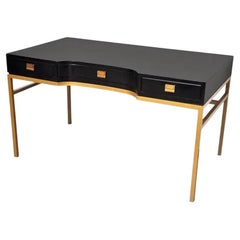
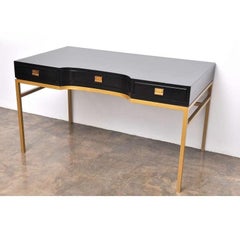
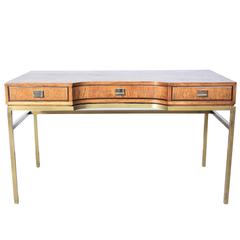
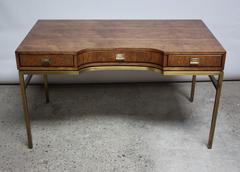
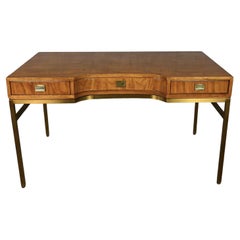
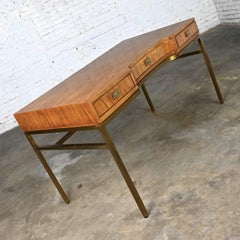
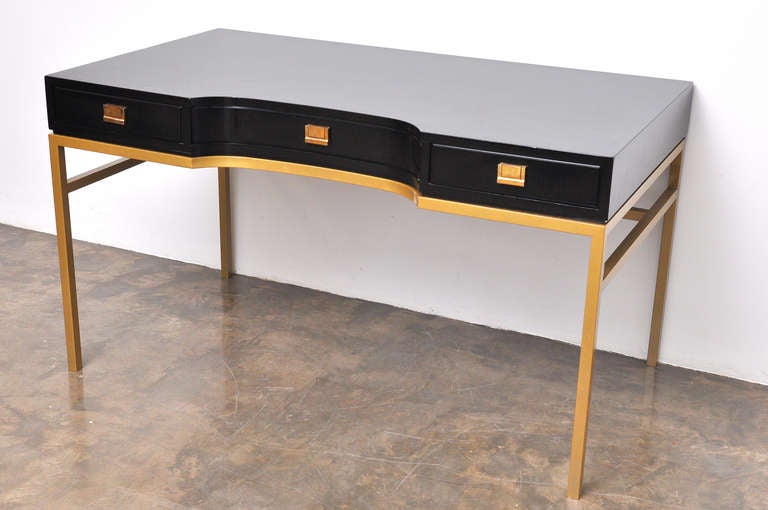
While vintage Drexel Furniture dining tables, dressers and other pieces remain highly desirable for enthusiasts of mid-century modern design, the manufacturer's story actually begins decades before its celebrated postwar-era Declaration line took shape.
In 1903, in the small town of Drexel in the foothills of North Carolina’s Blue Ridge Mountains, six partners came together to found a company that would become one of the country’s leading furniture producers. The first offerings from Drexel Furniture were simple: a bed, washstand and bureau all crafted from native oak wood, sold as a bedroom suite for $14.50.
One of Drexel’s early innovations was to employ staff designers, something the company initiated in the 1930s. This focus on design, which few other furniture companies were committing to at the time, allowed Drexel to respond to a variety of new and traditional tastes. This included making pieces inspired by historic European furniture, like the popular French Provincial–style Touraine bedroom and dining group that borrowed its curves from Louis XV-era furniture. Others replicated the ornate details of 18th-century chinoiserie or the embellishments of Queen Anne furniture. Always ready to adapt to new customer demands, during World War II, Drexel built a sturdy desk designed especially for General Douglas MacArthur.
In the postwar era, Drexel embraced the clean lines of mid-century modernism with the Declaration collection designed by Stewart MacDougall and Kipp Stewart that featured elegant credenzas and more made in walnut, and the Profile and Projection collections designed with sculptural shapes by John Van Koert. In the 1970s, Drexel introduced high-end furniture in a Mediterranean style.
Drexel changed hands and visions throughout the years. It was managed by one of the original partners — Samuel Huffman — until 1935, at which time his son Robert O. Huffman took over as president. It was then that the company began to expand, with several acquisitions of competitors in the 1950s, including Table Rock Furniture, the Heritage Furniture Co. and more.
With the manufacturer’s success — spurred by its embrace of advertising in home and garden magazines — it opened more factories in both North and South Carolina. By 1957, the company that had started with a factory of 50 workers had 2,300 employees and was selling its furniture nationwide.
Drexel underwent a series of name changes in its long history. Its acquisition of Southern Desk Company in 1960 bolstered its production of institutional furniture for dormitories, classrooms, churches and laboratories.
In the following decades, contracts with government agencies, hotels, schools and hospitals brought its high-quality furniture to a global audience. U.S. Plywood-Champion Papers bought Drexel Enterprises in 1968, and it became Drexel Heritage Furnishings.
In 2014, the last Drexel Heritage plant, in Morganton, North Carolina, closed its doors. The company rebranded as Drexel in 2017.
The vintage Drexel furniture for sale on 1stDibs includes end tables designed by Edward Wormley, walnut side tables designed by Kipp Stewart and lots more.
Organically shaped, clean-lined and elegantly simple are three terms that well describe vintage mid-century modern furniture. The style, which emerged primarily in the years following World War II, is characterized by pieces that were conceived and made in an energetic, optimistic spirit by creators who believed that good design was an essential part of good living.
ORIGINS OF MID-CENTURY MODERN FURNITURE DESIGN
CHARACTERISTICS OF MID-CENTURY MODERN FURNITURE DESIGN
MID-CENTURY MODERN FURNITURE DESIGNERS TO KNOW
ICONIC MID-CENTURY MODERN FURNITURE DESIGNS
VINTAGE MID-CENTURY MODERN FURNITURE ON 1STDIBS
The mid-century modern era saw leagues of postwar American architects and designers animated by new ideas and new technology. The lean, functionalist International-style architecture of Le Corbusier and Bauhaus eminences Ludwig Mies van der Rohe and Walter Gropius had been promoted in the United States during the 1930s by Philip Johnson and others. New building techniques, such as “post-and-beam” construction, allowed the International-style schemes to be realized on a small scale in open-plan houses with long walls of glass.
Materials developed for wartime use became available for domestic goods and were incorporated into mid-century modern furniture designs. Charles and Ray Eames and Eero Saarinen, who had experimented extensively with molded plywood, eagerly embraced fiberglass for pieces such as the La Chaise and the Womb chair, respectively.
Architect, writer and designer George Nelson created with his team shades for the Bubble lamp using a new translucent polymer skin and, as design director at Herman Miller, recruited the Eameses, Alexander Girard and others for projects at the legendary Michigan furniture manufacturer.
Harry Bertoia and Isamu Noguchi devised chairs and tables built of wire mesh and wire struts. Materials were repurposed too: The Danish-born designer Jens Risom created a line of chairs using surplus parachute straps for webbed seats and backrests.
The Risom lounge chair was among the first pieces of furniture commissioned and produced by celebrated manufacturer Knoll, a chief influencer in the rise of modern design in the United States, thanks to the work of Florence Knoll, the pioneering architect and designer who made the firm a leader in its field. The seating that Knoll created for office spaces — as well as pieces designed by Florence initially for commercial clients — soon became desirable for the home.
As the demand for casual, uncluttered furnishings grew, more mid-century furniture designers caught the spirit.
Classically oriented creators such as Edward Wormley, house designer for Dunbar Inc., offered such pieces as the sinuous Listen to Me chaise; the British expatriate T.H. Robsjohn-Gibbings switched gears, creating items such as the tiered, biomorphic Mesa table. There were Young Turks such as Paul McCobb, who designed holistic groups of sleek, blond wood furniture, and Milo Baughman, who espoused a West Coast aesthetic in minimalist teak dining tables and lushly upholstered chairs and sofas with angular steel frames.
Generations turn over, and mid-century modern remains arguably the most popular style going. As the collection of vintage mid-century modern chairs, dressers, coffee tables and other furniture for the living room, dining room, bedroom and elsewhere on 1stDibs demonstrates, this period saw one of the most delightful and dramatic flowerings of creativity in design history.
Choosing the perfect writing desk or writing table is a profoundly personal journey, one that people have been embarking upon for centuries.
Queen Atossa of Persia, from her writing table circa 500 B.C., is said to have been the originator of the art of handwritten letters. Hers was reportedly the first in a long and colorful history of penned correspondence that grew in popularity alongside literacy. The demand for suitable writing desks, which would serve the composer of the letters as well as ensure the comfort of the recipient naturally followed, and the design of these necessary furnishings has evolved throughout history.
Once people began to seek freedom from the outwardly ornate styles of the walnut and rosewood writing desks and drafting tables introduced in the name of Queen Victoria and King Louis XV, radical shifts occurred, such as those that materialized during the Art Nouveau period, when designers longed to produce furniture inspired by the natural world’s beauty. A prime example is the work of the famous late-19th-century Spanish architect Antoni Gaudí — his rolltop desk featured deep side drawers and was adorned with carved motifs that paid tribute to nature. Gaudí regularly combined structural precision with decorative elements, creating beautiful pieces of furniture in wood and metal.
Soon afterward, preferences for sleek, geometric, stylized forms in furniture that saw an emphasis on natural wood grains and traditional craftsmanship took hold. Today, Art Deco desks are still favored by designers who seek to infuse interiors with an air of luxury. One of the most prominent figures of the Art Deco movement was French decorator and furniture designer Émile-Jacques Ruhlmann. With his use of neoclassical motifs as well as expensive and exotic materials such as imported dark woods and inlays of precious metals for his writing desks, Ruhlmann came to symbolize good taste and modernity.
The rise in appreciation for Scandinavian modernism continues to influence the design of contemporary writing desks. It employs the “no fuss” or “less is more” approach to creating a tasteful, sophisticated space. Sweden’s master cabinetmaker Bruno Mathsson created gallery-worthy designs that are as functional as they are beautiful. Finnish architect Alvar Aalto never viewed himself as an artist, but, like Mathsson, his furniture designs reflected a fondness for organic materials and a humanistic approach. Danish designers such as Hans Wegner introduced elegant shapes and lines to mid-century desks and writing tables, often working in oak and solid teak.
From vintage desks to contemporary styles, 1stDibs offers a broad spectrum of choices for conducting all personal and business writing and reading activities.