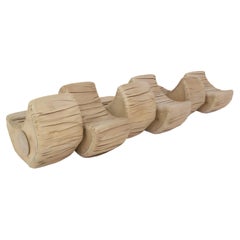
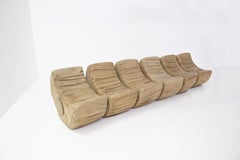
Born near Florence on March 1st 1940, Marzio Cecchi comes from a design environment, his mother being Giulia Carla Cecchi, a name famous in the world of fashion with her haute couture creations paraded at Palazzo Vecchio and Palazzo Pitti in Florence, Italy. Marzio Cecchi was a famous architect from Firenze who totally designed his projects. He graduated as an Architect from the University of Florence. Marzio Cecchi was an eclectic and visionary Architect, Designer and Artist. He died in an accident in New York on January 1st 1990, leaving timeless designs and one of a kind pieces highly collectible on the market.
Organically shaped, clean-lined and elegantly simple are three terms that well describe vintage mid-century modern furniture. The style, which emerged primarily in the years following World War II, is characterized by pieces that were conceived and made in an energetic, optimistic spirit by creators who believed that good design was an essential part of good living.
ORIGINS OF MID-CENTURY MODERN FURNITURE DESIGN
CHARACTERISTICS OF MID-CENTURY MODERN FURNITURE DESIGN
MID-CENTURY MODERN FURNITURE DESIGNERS TO KNOW
ICONIC MID-CENTURY MODERN FURNITURE DESIGNS
VINTAGE MID-CENTURY MODERN FURNITURE ON 1STDIBS
The mid-century modern era saw leagues of postwar American architects and designers animated by new ideas and new technology. The lean, functionalist International-style architecture of Le Corbusier and Bauhaus eminences Ludwig Mies van der Rohe and Walter Gropius had been promoted in the United States during the 1930s by Philip Johnson and others. New building techniques, such as “post-and-beam” construction, allowed the International-style schemes to be realized on a small scale in open-plan houses with long walls of glass.
Materials developed for wartime use became available for domestic goods and were incorporated into mid-century modern furniture designs. Charles and Ray Eames and Eero Saarinen, who had experimented extensively with molded plywood, eagerly embraced fiberglass for pieces such as the La Chaise and the Womb chair, respectively.
Architect, writer and designer George Nelson created with his team shades for the Bubble lamp using a new translucent polymer skin and, as design director at Herman Miller, recruited the Eameses, Alexander Girard and others for projects at the legendary Michigan furniture manufacturer.
Harry Bertoia and Isamu Noguchi devised chairs and tables built of wire mesh and wire struts. Materials were repurposed too: The Danish-born designer Jens Risom created a line of chairs using surplus parachute straps for webbed seats and backrests.
The Risom lounge chair was among the first pieces of furniture commissioned and produced by celebrated manufacturer Knoll, a chief influencer in the rise of modern design in the United States, thanks to the work of Florence Knoll, the pioneering architect and designer who made the firm a leader in its field. The seating that Knoll created for office spaces — as well as pieces designed by Florence initially for commercial clients — soon became desirable for the home.
As the demand for casual, uncluttered furnishings grew, more mid-century furniture designers caught the spirit.
Classically oriented creators such as Edward Wormley, house designer for Dunbar Inc., offered such pieces as the sinuous Listen to Me chaise; the British expatriate T.H. Robsjohn-Gibbings switched gears, creating items such as the tiered, biomorphic Mesa table. There were Young Turks such as Paul McCobb, who designed holistic groups of sleek, blond wood furniture, and Milo Baughman, who espoused a West Coast aesthetic in minimalist teak dining tables and lushly upholstered chairs and sofas with angular steel frames.
Generations turn over, and mid-century modern remains arguably the most popular style going. As the collection of vintage mid-century modern chairs, dressers, coffee tables and other furniture for the living room, dining room, bedroom and elsewhere on 1stDibs demonstrates, this period saw one of the most delightful and dramatic flowerings of creativity in design history.
Your living room — how your antique and vintage living room furniture is arranged, what style of furniture you’ve chosen, what kind of decor best suits your needs — should be an opportunity to express yourself as well as to unabashedly show off your design taste and preferences.
Common wisdom used to declare the kitchen the hub of the house. These days, the living room seems to have assumed the role of domestic focal point. Unlike the Victorian parlor, stiffly furnished and reserved for guests, today’s living room is a central place for reading and displaying your books, conversation and, well, living, with furnishings that lend themselves to both casual lounging and elegant entertaining.
A living room that doesn’t double as a family or TV room is a luxury. But even if the electronics are elsewhere, this is a hard-working, well-used space.
In an era that sees an increasing number of professionals working from home, sometimes your living room is multifunctional in ways you never thought possible. A corner of this room might be a designated home office, outfitted with a desk, your laptop and notebooks and, of course, the best possible lighting for those unscheduled Zoom calls. Perhaps you’ve sectioned off an area with side tables and armchairs for entertaining small groups while another corner of the room is home to a cozy reading nook.
The appetite for antique and vintage furniture — sculptural mid-century modern case pieces crafted in teak and other dark woods, the sexy, sensuous seating of the 1970s — has only broadened in recent years, with design lovers treasure hunting online and on Instagram.
A Scandinavian modern living room set, featuring lounge chairs and sofas by the likes of Hans Wegner or Kaare Klint, will help you introduce quality craftsmanship characterized by gentle, organic contours into your space, while a Camaleonda sofa by legendary Italian designer Mario Bellini will dazzle with its chunky form and convenient modular setup.
On 1stDibs, find an extraordinary collection of antique and vintage living room furniture inclusive of Space Age living room sets, other clever and provocative furnishings of the 1950s and ’60s, postmodern pieces and much more.