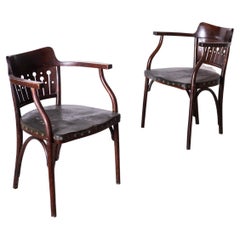
Thonet S 34 For Sale on 1stDibs
Choose from an assortment of styles, material and more with respect to the thonet s 34 you’re looking for at 1stDibs. Each thonet s 34 for sale was constructed with extraordinary care, often using
metal,
steel and
animal skin. If you’re shopping for a thonet s 34, we have 9 options in-stock, while there are 1 modern editions to choose from as well. You’ve searched high and low for the perfect thonet s 34 — we have versions that date back to the 20th Century alongside those produced as recently as the 21st Century are available. When you’re browsing for the right thonet s 34, those designed in
Art Deco and
Art Nouveau styles are of considerable interest. Many designers have produced at least one well-made thonet s 34 over the years, but those crafted by
Thonet,
Marcel Breuer and
Mart Stam are often thought to be among the most beautiful.
How Much is a Thonet S 34?
Prices for a thonet s 34 can differ depending upon size, time period and other attributes — at 1stDibs, they begin at $662 and can go as high as $4,985, while the average can fetch as much as $1,374.
Thonet for sale on 1stDibs
For more than 180 years, Thonet — or Gebrüder Thonet — has produced elegant and durable tables and cabinets as well as chairs, stools and other seating that wholly blur the lines between art and design. Widely known as a trailblazer in the use of bentwood in furniture, the European manufacturer has reimagined the places in which we gather.
Noted for his skill in parquetry, German-Austrian company founder Michael Thonet received an invitation from Austrian Chancellor Prince Metternich to contribute Neo-Rococo interiors to the Liechtenstein City Palace in Vienna. The Boppard-born Thonet had honed his carpentry skills in his father’s workshop, where he carried out experiments with plywood and modified the Biedermeier chairs that populated the studio.
Thonet’s work for the chancellor raised his profile, and the cabinetmaker gained international recognition, including at London’s Great Exhibition of 1851, which featured works created by members of the Arts and Crafts movement as well as industrial products of the day. Thonet showed a range of furniture at the fair and won the bronze medal for his bentwood chairs. He incorporated his family’s company, the Thonet Brothers, with his sons in 1853.
Bentwood furniture dates as far back as the Middle Ages, but it is the 19th-century cabinetmaker Thonet who is most often associated with this now-classic technique. Thonet in 1856 patented a method for bending solid wood through the use of steam, and from there, the bentwood look skyrocketed to furniture fame. The works of renowned mid-century modern designers such as Alvar Aalto, Arne Jacobsen, and Charles and Ray Eames that put this technological advancement to use would not be as extensive or celebrated were it not for the efforts of the pioneering Thonet.
Considered the world’s oldest mass-produced chair, Michael Thonet’s ubiquitous Chair No. 14 demonstrated that his patented bentwood technology made it possible to efficiently produce furniture on an industrial scale. Now known as the 214, it won the German Sustainability Award Design for 2021, a recognition of the company’s commitment to environmentally responsible production.
Often called the Coffee House chair — the company’s first substantial order was for a Viennese coffeehouse — the No. 14 remains an icon. Thonet originally designed the chair in 1859, and it is considered the starting point for modern furniture.
The bentwood process opened doors — there were investments in machinery and new industrial processes, and the business began mass-producing furniture. By the end of the 1850s, there were additional Thonet workshops in Eastern Europe and hundreds of employees. Michael Thonet’s reputation attracted the attention of notable architects including Otto Wagner, Marcel Breuer and Ludwig Mies van der Rohe.
The No. 14 was followed by the No. 18, or the Bistro chair, in 1867, and the 209, or the Architect’s chair, of which Le Corbusier was a fan. (The influential Swiss-French architect and designer used Thonet furniture in his Pavillon de l’Esprit Nouveau at the 1925 International Exposition of Decorative Arts in Paris.)
Thonet’s chair designs also appeared in artwork by Toulouse-Lautrec, John Sloan and Henri Matisse in his Interior with a Violin Case. The noteworthy Thonet rocking chair remains a marvel of construction — in the middle of the 19th century, Michael produced a series of rockers in which the different curved parts were integrated into fluid, sinuous wholes. Thanks to Thonet, the humble rocker acquired something unexpected: style. It was captured in the paintings of Pablo Picasso, Pierre-Auguste Renoir and James Tissot.
Thonet is currently split into global divisions. Thonet Industries U.S.A. was acquired in 1987 by Shelby Williams and joined the CF Group in 1999, while the Thonet brand in Germany is owned by Thonet GmbH.
Find a collection of antique Thonet furniture on 1stDibs.
A Close Look at Art-nouveau Furniture
In its sinuous lines and flamboyant curves inspired by the natural world, antique Art Nouveau furniture reflects a desire for freedom from the stuffy social and artistic strictures of the Victorian era. The Art Nouveau movement developed in the decorative arts in France and Britain in the early 1880s and quickly became a dominant aesthetic style in Western Europe and the United States.
ORIGINS OF ART NOUVEAU FURNITURE DESIGN
CHARACTERISTICS OF ART NOUVEAU FURNITURE DESIGN
- Sinuous, organic and flowing lines
- Forms that mimic flowers and plant life
- Decorative inlays and ornate carvings of natural-world motifs such as insects and animals
- Use of hardwoods such as oak, mahogany and rosewood
ART NOUVEAU FURNITURE DESIGNERS TO KNOW
ANTIQUE ART NOUVEAU FURNITURE ON 1STDIBS
Art Nouveau — which spanned furniture, architecture, jewelry and graphic design — can be easily identified by its lush, flowing forms suggested by flowers and plants, as well as the lissome tendrils of sea life. Although Art Deco and Art Nouveau were both in the forefront of turn-of-the-20th-century design, they are very different styles — Art Deco is marked by bold, geometric shapes while Art Nouveau incorporates dreamlike, floral motifs. The latter’s signature motif is the "whiplash" curve — a deep, narrow, dynamic parabola that appears as an element in everything from chair arms to cabinetry and mirror frames.
The visual vocabulary of Art Nouveau was particularly influenced by the soft colors and abstract images of nature seen in Japanese art prints, which arrived in large numbers in the West after open trade was forced upon Japan in the 1860s. Impressionist artists were moved by the artistic tradition of Japanese woodblock printmaking, and Japonisme — a term used to describe the appetite for Japanese art and culture in Europe at the time — greatly informed Art Nouveau.
The Art Nouveau style quickly reached a wide audience in Europe via advertising posters, book covers, illustrations and other work by such artists as Aubrey Beardsley, Henri de Toulouse-Lautrec and Alphonse Mucha. While all Art Nouveau designs share common formal elements, different countries and regions produced their own variants.
In Scotland, the architect Charles Rennie Mackintosh developed a singular, restrained look based on scale rather than ornament; a style best known from his narrow chairs with exceedingly tall backs, designed for Glasgow tea rooms. Meanwhile in France, Hector Guimard — whose iconic 1896 entry arches for the Paris Metro are still in use — and Louis Majorelle produced chairs, desks, bed frames and cabinets with sweeping lines and rich veneers.
The Art Nouveau movement was known as Jugendstil ("Youth Style") in Germany, and in Austria the designers of the Vienna Secession group — notably Koloman Moser, Josef Hoffmann and Joseph Maria Olbrich — produced a relatively austere iteration of the Art Nouveau style, which mixed curving and geometric elements.
Art Nouveau revitalized all of the applied arts. Ceramists such as Ernest Chaplet and Edmond Lachenal created new forms covered in novel and rediscovered glazes that produced thick, foam-like finishes. Bold vases, bowls and lighting designs in acid-etched and marquetry cameo glass by Émile Gallé and the Daum Freres appeared in France, while in New York the glass workshop-cum-laboratory of Louis Comfort Tiffany — the core of what eventually became a multimedia decorative-arts manufactory called Tiffany Studios — brought out buoyant pieces in opalescent favrile glass.
Jewelry design was revolutionized, as settings, for the first time, were emphasized as much as, or more than, gemstones. A favorite Art Nouveau jewelry motif was insects (think of Tiffany, in his famed Dragonflies glass lampshade).
Like a mayfly, Art Nouveau was short-lived. The sensuous, languorous style fell out of favor early in the 20th century, deemed perhaps too light and insubstantial for European tastes in the aftermath of World War I. But as the designs on 1stDibs demonstrate, Art Nouveau retains its power to fascinate and seduce.
There are ways to tastefully integrate a touch of Art Nouveau into even the most modern interior — browse an extraordinary collection of original antique Art Nouveau furniture on 1stDibs, which includes decorative objects, seating, tables, garden elements and more.
Finding the Right Armchairs for You
Armchairs have run the gamut from prestige to ease and everything in between, and everyone has an antique or vintage armchair that they love.
Long before industrial mass production democratized seating, armchairs conveyed status and power.
In ancient Egypt, the commoners took stools, while in early Greece, ceremonial chairs of carved marble were designated for nobility. But the high-backed early thrones of yore, elevated and ornate, were merely grandiose iterations of today’s armchairs.
Modern-day armchairs, built with functionality and comfort in mind, are now central to tasks throughout your home. Formal dining armchairs support your guests at a table for a cheery feast, a good drafting chair with a deep seat is parked in front of an easel where you create art and, elsewhere, an ergonomic wonder of sorts positions you at the desk for your 9 to 5.
When placed under just the right lamp where you can lounge comfortably, both elbows resting on the padded supports on each side of you, an upholstered armchair — or a rattan armchair for your light-suffused sunroom — can be the sanctuary where you’ll read for hours.
If you’re in the mood for company, your velvet chesterfield armchair is a place to relax and be part of the conversation that swirls around you. Maybe the dialogue is about the beloved Papa Bear chair, a mid-century modern masterpiece from Danish carpenter and furniture maker Hans Wegner, and the wingback’s strong association with the concept of cozying up by the fireplace, which we can trace back to its origins in 1600s-era England, when the seat’s distinctive arm protrusions protected the sitter from the heat of the period’s large fireplaces.
If the fireside armchair chat involves spirited comparisons, your companions will likely probe the merits of antique and vintage armchairs such as Queen Anne armchairs, Victorian armchairs or even Louis XVI armchairs, as well as the pros and cons of restoration versus conservation.
Everyone seems to have a favorite armchair and most people will be all too willing to talk about their beloved design. Whether that’s the unique Favela chair by Brazilian sibling furniture designers Fernando and Humberto Campana, who repurposed everyday objects to provocative effect; or Marcel Breuer’s futuristic tubular metal Wassily lounge chair; the functionality-first LC series from Charlotte Perriand, Le Corbusier and Pierre Jeanneret; or the Eames lounge chair of the mid-1950s created by Charles and Ray Eames, there is an iconic armchair for everyone and every purpose. Find yours on 1stDibs right now.