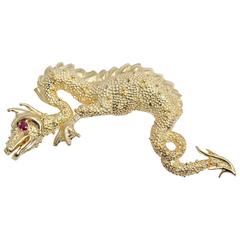
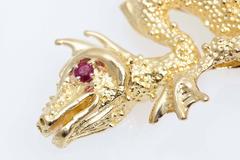
Van Cleef & Arpels Ruby Gold Dragon Brooch
By Van Cleef & Arpels
Located in New York, NY
Van Cleef & Arpels eighteen karat yellow gold dragon brooch containing a round ruby eye.
Category
Vintage 1970s Unknown Modern Brooches
Materials
Ruby, 18k Gold
Van Cleef & Arpels Ruby Gold Dragon Brooch
By Van Cleef & Arpels
Located in New York, NY
Van Cleef & Arpels eighteen karat yellow gold dragon brooch containing a round ruby eye.
Ruby, 18k Gold
One of the world’s foremost jewelry houses, Van Cleef & Arpels is particularly noted for a focus on technical virtuosity, craftsmanship and artistry, evident since its beginning. Rather than create earrings, bracelets, necklaces and other adornments primarily for the aim of displaying of wealth and opulence, Van Cleef & Arpels sought to produce jewelry that projected the wearer’s taste and style.
The company was formed a year after the 1895 marriage of Alfred Van Cleef, the son of a gem cutter, to Estelle Arpels, daughter of precious-stones dealer Salomon Arpels. Ten years later, Van Cleef & Arpels opened its first boutique on the Place Vendôme in Paris, setting the march on a square now crowded with dealers in bijouterie. (The company still occupies the New York flagship store opened in 1939 at Fifth Avenue and 57th Street.)
Born from a union of expertise in both jewelry making and gem selection, Van Cleef & Arpels distinguished itself with both the consistency of the color and clarity of its stones and the creativity of its designs. In doing so, the house would win a roster of dedicated, fashion-conscious clients that included the Duchess of Windsor, Marlene Dietrich, Barbara Hutton, Jacqueline Onassis and Elizabeth Taylor. In 1933, Van Cleef & Arpels patented its trademark Mystery Setting — a technique by which gems are fitted into an intricate matrix of slots and “drawers” that keep the setting hidden. Another signal innovation was the Zip necklace, introduced in 1951, which can be worn either around the neck or, with the zipper closed, as a bracelet.
But as much as to the firm’s craftsmanship, clients have been drawn by the insouciance and playfulness of Van Cleef & Arpels designers, as well as their attunement to the cultural climate. After the discovery of Tutankhamun’s tomb in 1922, the company produced several lavish pieces featuring hieroglyphics and other Egyptian motifs to go along with the geometric Art Deco jewelry of that decade and the next. Following World War II, as symbols of freedom and rebirth, the firm focused on naturalistic forms such as birds, flowers, fruit and flying insects. High society’s 1960s fascination with the Near East and India prompted such pieces as the best-selling Alhambra necklace, popularized by Princess Grace.
Lately, attention among collectors and connoisseurs has centered on Van Cleef & Arpels’s quality of workmanship as much as its glamour. The firm was the subject of a 2012 show at the Cooper-Hewitt, Smithsonian Design Museum, as well as exhibitions at the Bowers Museum in Santa Ana, California, in 2013 and at the Musée des Arts Décoratifs in Paris in 2014.
Find an exquisite collection of Van Cleef & Arpels jewelry on 1stDibs.
Rooted in centuries of history of adornment dating back to the ancient world, modern jewelry reimagines traditional techniques, forms and materials for expressive new pieces. As opposed to contemporary jewelry, which responds to the moment in which it was created, modern jewelry often describes designs from the 20th to 21st centuries that reflect movements and trends in visual culture.
Modern jewelry emerged from the 19th-century shift away from jewelry indicating rank or social status. The Industrial Revolution allowed machine-made jewelry using electric gold plating, metal alloys and imitation stones, making beautiful jewelry widely accessible. Although mass production deemphasized the materials of the jewelry, the vision of the designer remained important, something that would be furthered in the 1960s with what’s known as the “critique of preciousness.”
A design fair called the “Exposition Internationale des Arts Décoratifs et Industriels Modernes” brought global attention to the Art Deco style in 1925 and gathered a mix of jewelry artists alongside master jewelers like Van Cleef & Arpels, Mauboussin and Boucheron. Art Deco designs from Cartier and Van Cleef & Arpels unconventionally mixed gemstones like placing rock crystals next to diamonds while borrowing motifs from eclectic sources including Asian lacquer and Persian carpets. Among Cartier’s foremost design preoccupations at the time were high-contrast color combinations and crisp, geometric forms and patterns. In the early 20th century, modernist jewelers like Margaret De Patta and artists such as Alexander Calder — who is better known for his kinetic sculptures than his provocative jewelry — explored sculptural metalwork in which geometric shapes and lines were preferred over elaborate ornamentation.
Many of the innovations in modern jewelry were propelled by women designers such as Wendy Ramshaw, who used paper to craft her accessories in the 1960s. During the 1970s, Elsa Peretti created day-to-night pieces for Tiffany & Co. while designers like Lea Stein experimented with layering plastic, a material that had been employed in jewelry since the mid-19th century and had expanded into Bakelite, acrylics and other unique materials.
Find a collection of modern watches, bracelets, engagement rings, necklaces, earrings and other jewelry on 1stDibs.
This deep red gem is the color of heat and passion — vintage and antique ruby jewelry is perfect for those born in the middle of summer.
Rubies are one of the few gemstones that can give diamonds a run for their money. Just consider the Van Cleef & Arpels “scarf” necklace the Duke of Windsor presented to the Duchess on her 40th birthday, in 1936 — set with diamonds and dripping with rubies, a testament to the deep-red gemstone’s power — or the slippers encrusted with 4,600 rubies that Harry Winston made to commemorate The Wizard of Oz’s golden anniversary. July babies have permission to adorn themselves with this beautiful red stone even when it’s not their birthday.
Rubies are considered precious stones — along with diamonds, sapphires and emeralds — and have a hardness of 9.0 on the Mohs Scale, surpassed only by Moissanite and diamonds. They are composed of corundum, a colorless mineral that is also the basic material of sapphires. In the July birthstone, the red of the gemstone — and the various hues seen in sapphires — are produced by the presence of trace elements. In the case of a ruby, this element is chromium. Rubies range in color from vermilion to a violet red. They are also pleochroic, which means that a stone’s hue can vary depending on the direction of viewing. The most sought-after color is pigeon’s blood: pure red with a hint of blue.
Rubies that are hosted in dolomite marble are the most prized: Because the marble is low in iron, so are the rubies, resulting in a more intense color. Rubies found in basalt, which has a higher iron content, are generally darker and less intense.
When shopping for antique and vintage ruby jewelry, remember that the 4Cs of selecting the perfect diamond — color, clarity, cut and carat — also apply to rubies.
According to the Gemological Institute of America, the color of the July birthstone should be a vibrant to slightly purplish red, and the stone should be clear and inclusion-free. Accordingly, the cut should show off its color and clarity. As for the last criterion, fine rubies more than a carat in weight are rare. Often, large rubies are more expensive than diamonds of comparable weights.
Find a collection of ruby necklaces, ruby rings and other accessories on 1stDibs.
Vintage brooches, which refer to decorative jewelry traditionally pinned to garments and used to fasten pieces of clothing together where needed, have seen increasing popularity in recent years.
While jewelry trends come and go, brooches are indeed back on the radar thanks to fashion houses like Gucci, Versace, Dior and Saint Laurent, all of which feature fun pinnable designs in their current collections. Whether a dazzlingly naturalistic Art Nouveau dragonfly, a whimsical David Webb animal, a gem-studded bloom or a streamlined abstract design, these jewels add color and sparkle to your look and a spring to your step.
Given their long history, brooches have expectedly taken on a variety of different shapes and forms over time, with jewelers turning to assorted methods of ornamentation for these accessories, including enameling and the integration of pearls and gemstones. Cameo brooches that originated during the Victorian age are characterized by a shell carved in raised relief that feature portraits of a woman’s profile, while 19th-century micromosaic brooches, comprising innumerable individually placed glass fragments, sometimes feature miniature depictions of a pastoral scene in daily Roman life.
At one time, brooches were symbols of wealth, made primarily from the finest metals and showcasing exquisite precious gemstones. Today, these jewels are inclusive and universal, and you don’t have to travel very far to find an admirer of brooches. They can be richly geometric in form, such as the ornate diamond pins dating from the Art Deco era, or designer-specific, such as the celebrated naturalistic works created by Tiffany & Co., the milk glass and gold confections crafted by Trifari or handmade vintage Chanel brooches of silk or laminated sheer fabric. Chanel, of course, has never abandoned this style, producing gorgeously baroque CC examples since the 1980s.
Brooches are versatile and adaptable. These decorative accessories can be worn in your hair, on hats, scarves and on the lower point of V-neck clothing. Pin a dazzling brooch to the lapel of your blazer-and-tee combo or add a cluster of smaller pins to your overcoat. And while brooches have their place in “mourning jewelry,” in that a mourning brooch is representative of your connection to a lost loved one, they’re widely seen as romantic and symbolic of love, so much so that a hardcore brooch enthusiast might advocate for brooches to be worn over the heart.
Today, find a wide variety of antique and vintage brooches for sale on 1stDibs, including gold brooches, sapphire brooches and more.