By Clement Massier
Located in Palm Beach, FL
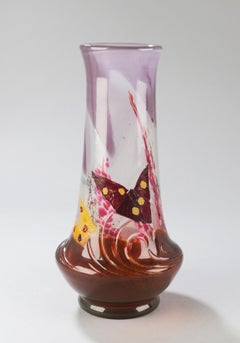
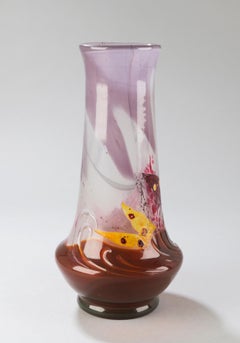
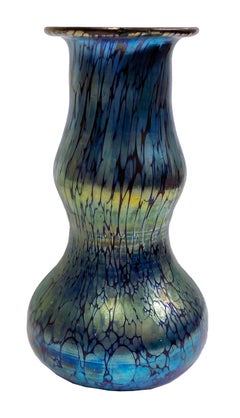
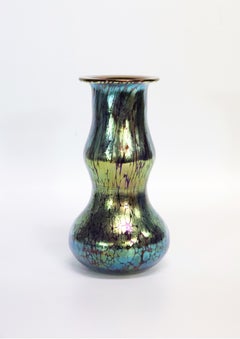
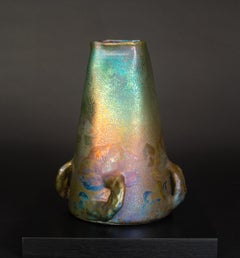
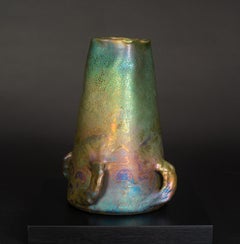
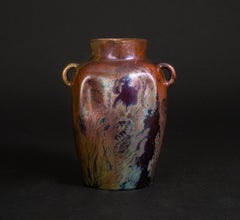
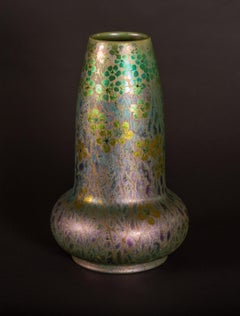
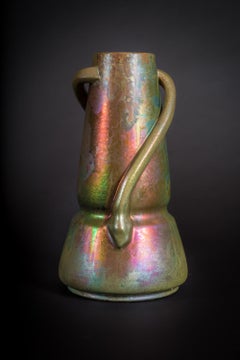
An accomplished ceramist born into a multi-generational family of potters working in Valauris, France, Clement Massier (1844-1917) transcended his family’s metier. Rather than creating utilitarian objects as a means unto themselves, he used the ceramic medium as an aesthetic platform to make art. From 1883 until his death, he created these innovative pieces, including his famous lusterware, at his Golfe Juan studio. Massier’s metallic luster glazes produce the dual properties of reflectivity and transparency to create iridescence. In order to achieve this, Massier fired his ceramics in a three-tiered process at increasingly lower temperatures. He applied the final glaze created from a metallic clay compound with a brush. When the blackened vessels had fully cooled, they were buffed until shiny to reveal his iridescent inspirations of nature. Each piece produced was a unique object revealing not only the hand of the artist but also the variable effects of temperature, natural elements and their interactive relationships. Among the many international awards earned during his lifetime, Massier was awarded a gold medal in 1889 at l’Exposition Universelle in Paris. At the Exposition, it was Massier’s ceramic glazing techniques using turquoise metallic luster which captured the world’s attention.
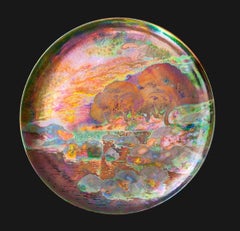
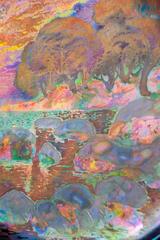
Massier's glazes are are illusory interpretations fused into fired earthenware. Conversely, the ceramic object’s solidity belies its ephemeral nature which constantly changes in light. This duality naturally inherent to this medium is a theme which Massier echoes in his subject matter. On the merits of Japonisme, he presents a garden landscape as a work of art. Though inspired by nature, it is an interpretation rather than a copy. The dual natures of iridescence: reflection and transparency, create the framework from which to relate this scene. Acidic colors, so characteristic of Massier’s later lusterware, blend into an abstraction suggestive of the essential elements of fire, water, air and earth. Abstraction acts in a reductive manner to suggest profundity and absolute spiritual truths while simultaneously speaking to the transitory aspect of life and the ephemerality found in nature.
He divides the scene into three zones. In the background, a cloudy sky is lit up in magnificent colors from a setting sun. In the foreground, by contrast, there is a large expanse of water. The middle ground features a copse of taupe-colored trees whose brushwork, noticeably applied by a fanned paint...
Category
Early 1900s Art Nouveau Clement Massier More Art
MaterialsEarthenware, Luster