Daum Sculptures

For collectors, Daum is a name in the first rank of the French makers of art glass, along with those of Émile Gallé and René Lalique. Led in its early decades by the brothers Auguste (1853–1909) and Antonin Daum (1864–1931), the company, based in the city of Nancy, established its reputation in the Art Nouveau period, and later successfully adopted the Art Deco style.

In 1878, lawyer Jean Daum took over the ownership of a glassworks as payment for a debt and installed his sons as proprietors. Initially, Daum made glass for everyday purposes such as windows, watches and tableware, but the success that Gallé enjoyed at the 1889 Universal Exposition in Paris — the international showcase for which the Eiffel Tower was built — inspired the Daum brothers to begin making art-glass pieces. They produced popular works of cameo glass, a decorative technique in which an outer layer of glass is acid-etched or carved off to reveal the layer below, but Daum became best known for vessels and sculptures in pâte de verre — a painstaking method in which finely ground colored glass is mixed with a binder, placed in a mold and then fired in a kiln. 

Though early Daum glass was never signed by individual artists, the firm employed some of the masters of the naturalistic, asymmetrical Art Nouveau style, including Jacques Grüber, Henri Bergé and Amalric Walter (whose first name is frequently misspelled). Daum also collaborated with furniture and metalware designer Louis Majorelle, who created wrought-iron and brass mounts for vases and table lamps. In the 1960s, Daum commissioned fine artists, most notably Salvador Dalí and sculptor César Baldaccini, to design glass pieces. As you see from the works offered on 1stDibs, Daum has been home to an astonishingly rich roster of creative spirits and is today a state-owned enterprise making pâte de verre figurines. 

to
3
Overall Width
to
Overall Height
to
3
1
1
1
2
1
1
1
1
1
1
3
214
214
211
154
135
2
1
Artist: Daum
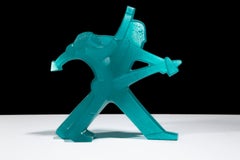
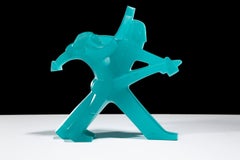
Dan Dailey : Daum Figurative Glass Sculpture "Les Danseurs (The Dancers)"

Dan Dailey : Daum Figurative Glass Sculpture "Les Danseurs (The Dancers)"

By Daum

Located in Detroit, MI

"Les Danseurs" (French for "The Dancers") is a 1979 collaboration between Daum and artist Dan Dailey. This glass figurative sculpture of two dancers, a man and a woman coated in an icy blue palate, was created with glass paste blown in a light blue mold and etched on the external surface. This work is numbered 57 from an edition of 200, signed on the sculpture in diamond-point with "D Dailey" and "DAUM FRANCE" and is included with a certificate of authenticity signed and numbered by Daum and Dan Dailey. Dan Dailey is an American glass artist who was born in Philadelphia in 1947. He emerged from the Studio Glass movement that was founded by Harvey Lilleton and collaborated with Crisallerie Daum for more than twenty years. His education includes studying under Roland Jahn and Harvey Lilleton at the Philadelphia College of Art in the 1960s and a teaching fellowship at the Rhode Island School of Design in 1970 where he also became Dale Chihuly's first graduate student He is professor emeritus at the Massachusetts College of Art where he founded their glass program. His work has been exhibited and collected all over the world, spanning over a hundred exhibitions and collections. The studio of Daum is a name that precedes itself. The only crystal manufacturer employing the glass paste process for art glass, the studio was founded in 1878 by the Daum family in Nancy, France. The studio has become synonymous with the Art Nouveau period but continues to produce high end and high quality decorative art to this very day. Artists that have worked with Daum include Charles Schneider, Arman, Hilton McConnico, Philippe Starck, Salvador Dali, Cyril Phan, Richard Texier, Emilio Robba...

Category

1970s Daum Sculptures

Materials

Glass

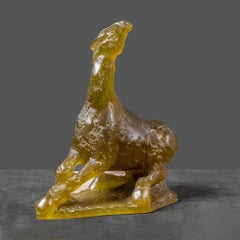
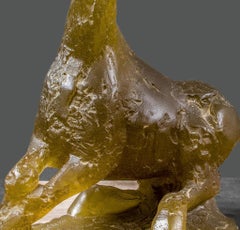
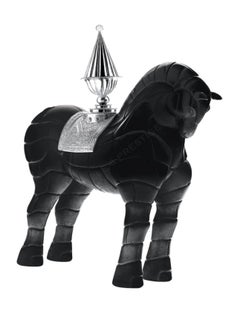
Horse Carrying Fire by Hilton McConnico

Horse Carrying Fire by Hilton McConnico

By Daum

Located in Boca Raton, FL

A mythical piece of Daum's legacy, "Horse Carrying Fire" is inspired by legend. This magnificent horse with its fine silver embellishment appears to have stepped straight out of a th...

Category

20th Century Art Deco Daum Sculptures

Materials

Glass

Related Items
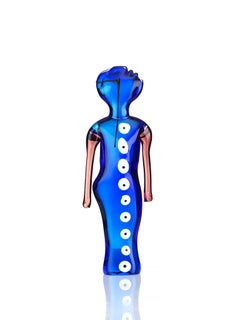
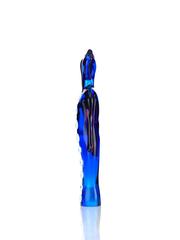
Arlequin bleu à droite

James CoignardArlequin bleu à droite, 2005

$5,527

H 19.69 in W 6.3 in D 2.37 in

Arlequin bleu à droite

By James Coignard

Located in Östermalm, Stockholms län

Murano Glass. Edition of 28/30 ex. Free shipment worldwide. With just a few strokes of his brush he conjures up an entire world. James Coignard extends the boundaries between c...

Category

Early 2000s Contemporary Daum Sculptures

Materials

Glass

PRINCE BLAZE (The Official Dragon Prince Of 2024: The Year Of The Dragon)

PRINCE BLAZE (The Official Dragon Prince Of 2024: The Year Of The Dragon)

By Mauro Oliveira

Located in LOS ANGELES, CA

**NEW YEAR FINAL 90 DAYS SALE UNTIL MARCH 31ST** **STORE CLOSURE - UP TO 80% OFF - TAKE ADVANTAGE OF IT** **EVERYTHING MUST GO UNTIL APRIL1ST!** >>Th...

Category

21st Century and Contemporary Pop Art Daum Sculptures

Materials

Metal

Juggler / - Artistic naturalness -

Juggler / - Artistic naturalness -

Located in Berlin, DE

Claire Jeanne Robertine Colinet (1880 Brussels - 1950 Asnières-sur-Seine), Juggler, around 1920. Brownish patinated bronze with gilded balls on a round, multi-profiled stone base (10...

Category

1920s Art Deco Daum Sculptures

Materials

Bronze

Antique Pair of Russian Wolf Hound/Borzoi Dog Portrait Sculptures circa 1930's

Antique Pair of Russian Wolf Hound/Borzoi Dog Portrait Sculptures circa 1930's

Located in SANTA FE, NM

Antique Pair of Russian Wolfhounds/Borzois Dog Portrait Sculptures by Scalini (aka Scali; Italian, 20th century) circa 1930's Patinated spelter 9 x 14 inches (on bases) Though rath...

Category

1920s Art Deco Daum Sculptures

Materials

Cast Stone, Bronze

Relining Nude (WG6)
Relining Nude (WG6)

Waylande GregoryRelining Nude (WG6), 1950's

$2,000

H 12 in W 14 in D 8.5 in

Relining Nude (WG6)

By Waylande Gregory

Located in Wilton Manors, FL

Waylande Gregory (1905-1971). Nude Reclining, ca. 1950's. Painted composite cast from original sculpted in 1930's. Casting sanctioned and approved by the artist during his lifetime in partnership with MPI, Museum Pieces Incorporated. Very few examples were produced and even fewer survive. Waylande Gregory was considered a major American sculptor during the 1930's, although he worked in ceramics, rather than in the more traditional bronze or marble. Exhibiting his ceramic works at such significant American venues for sculpture as the Whitney Museum of American Art in New York City and at the venerable Pennsylvania Academy of the Fine Arts in Philadelphia, he also showed his ceramic sculptures at leading New York City galleries. Gregory was the first modern ceramist to create large scale ceramic sculptures, some measuring more than 70 inches in height. Similar to the technique developed by the ancient Etruscans, he fired his monumental ceramic sculptures only once. Gregory was born in 1905 in Baxter Springs, Kansas and was something of a prodigy. Growing up on a ranch near a Cherokee reservation, Gregory first became interested in ceramics as a child during a native American burial that he had witnessed. He was also musically inclined. In fact, his mother had been a concert pianist and had given her son lessons. At eleven, he was enrolled as a student at the Kansas State Teacher's College, where he studied carpentry and crafts, including ceramics. Gregory's early development as a sculptor was shaped by the encouragement and instruction of Lorado Taft, who was considered both a major American sculptor as well as a leading American sculpture instructor. In fact, Taft's earlier students included such significant sculptors as Bessie Potter Vonnoh and Janet Scudder. But, Taft and his students had primarily worked in bronze or stone, not in clay; and, Gregory's earliest sculptural works were also not in ceramics. In 1924, Gregory moved to Chicago where he caught the attention of Taft. Gregory was invited by Taft to study with him privately for 18 months and to live and work with him at his famed "Midway Studios." The elegant studio was a complex of 13 rooms that overlooked a courtyard. Taft may have been responsible for getting the young man interested in creating large scale sculpture. However, by the 1920's, Taft's brand of academic sculpture was no longer considered progressive. Instead, Gregory was attracted to the latest trends appearing in the United States and Europe. In 1928 he visited Europe with Taft and other students. "Kid Gregory," as he was called, was soon hired by Guy Cowan, the founder of the Cowan Pottery in Cleveland, Ohio, to become the company's only full time employee. From 1928 to 1932, Gregory served as the chief designer and sculptor at the Cowan Pottery. Just as Gregory learned about the process of creating sculpture from Taft, he literally learned about ceramics from Cowan. Cowan was one of the first graduates of Alfred, the New York School of Clayworking and Ceramics. Alfred had one of the first programs in production pottery. Cowan may have known about pottery production, but he had limited sculptural skills, as he was lacking training in sculpture. The focus of the Cowan Pottery would be on limited edition, table top or mantle sculptures. Two of the most successful of these were Gregory's Nautch Dancer, and his Burlesque Dancer. He based both sculptures on the dancing of Gilda Gray, a Ziegfield Follies girl. Gilda Gray was of Polish origin and came to the United States as a child. By 1922, she would become one of the most popular stars in the Follies. After losing her assets in the stock market crash of 1929, she accepted other bookings outside of New York, including Cleveland, which was where Gregory first saw her onstage. She allowed Gregory to make sketches of her performances from the wings of the theatre. She explained to Gregory, "I'm too restless to pose." Gray became noted for her nautch dance, an East Indian folk dance. A nautch is a tight, fitted dress that would curl at the bottom and act like a hoop. This sculpture does not focus on Gray's face at all, but is more of a portrait of her nautch dance. It is very curvilinear, really made of a series of arches that connect in a most feminine way. Gregory created his Burlesque Dancer at about the same time as Nautch Dancer. As with the Nautch Dancer, he focused on the movements of the body rather than on a facial portrait of Gray. Although Gregory never revealed the identity of his model for Burlesque Dancer, a clue to her identity is revealed in the sculpture's earlier title, Shimmy Dance. The dancer who was credited for creating the shimmy dance was also Gilda Gray. According to dance legend, Gray introduced the shimmy when she sang the Star Spangled Banner and forgot some of the lyrics, so, in her embarrassment, started shaking her shoulders and hips but she did not move her legs. Such movement seems to relate to the Burlesque Dancer sculpture, where repeated triangular forms extend from the upper torso and hips. This rapid movement suggests the influence of Italian Futurism, as well as the planar motion of Alexander Archipenko, a sculptor whom Gregory much admired. The Cowan Pottery was a victim of the great depression, and in 1932, Gregory changed careers as a sculptor in the ceramics industry to that of an instructor at the Cranbrook Academy in Bloomfield Hills, Michigan. Cranbrook was perhaps the most prestigious place to study modern design in America. Its faculty included the architect Eliel Saarinen and sculptor Carl Milles. Although Gregory was only at Cranbrook for one and one half years, he created some of his finest works there, including his Kansas Madonna. But, after arriving at Cranbrook, the Gregory's had to face emerging financial pressures. Although Gregory and his wife were provided with complimentary lodgings, all other income had to stem from the sale of artworks and tuition from students that he, himself, had to solicit. Gregory had many people assisting him with production methods at the Cowan Pottery, but now worked largely by himself. And although he still used molds, especially in creating porcelain works, many of his major new sculptures would be unique and sculpted by hand, as is true of Kansas Madonna. The scale of Gregory's works were getting notably larger at Cranbrook than at Cowan. Gregory left the surface of Kansas Madonna totally unglazed. Although some might object to using a religious title to depict a horse nursing its colt, it was considered one of Gregory's most successful works. In fact, it had a whole color page illustration in an article about ceramic sculpture titled, "The Art with the Inferiority Complex," Fortune Magazine, December, 1937. The article notes the sculpture was romantic and expressive and the sculpture was priced at $1,500.00; the most expensive sculpture...

Category

1950s Art Deco Daum Sculptures

Materials

Plaster

Large Rare Signoretto Murano Glass Aventurine Menorah Italian Sculpture Judaica

Large Rare Signoretto Murano Glass Aventurine Menorah Italian Sculpture Judaica

Located in Surfside, FL

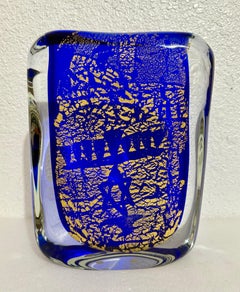
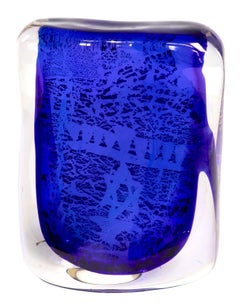
Giancarlo Signoretto (Italian, 1962-) Glass Sculpture Undated Hand signed and dedicated to a gallery on underside. Depicting a gold menorah and a Jewish star of David over cobalt...

Category

20th Century Modern Daum Sculptures

Materials

Blown Glass

Erte CHINCHILLA Sculpture, 21.5"H

Erte CHINCHILLA Sculpture, 21.5"H

By Erte - Romain de Tirtoff

Located in Lake Worth Beach, FL

Artist/Designer; Manufacturer: Erte (Romain de Tirtoff) (Russian/ French, 1892-1990) Marking(s); notes: signed; ed. 270/375; 1990 Materials: bronze Dimensions (H, W, D): 21.5"h, 9.25...

Category

20th Century Art Deco Daum Sculptures

Materials

Bronze

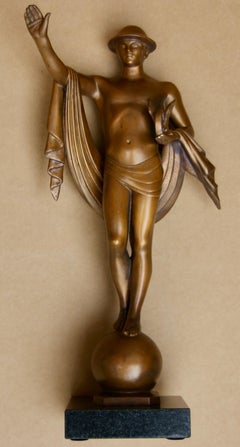
Rare Folk Art Hebrew Judaica Carved Gilded Wood Lions Torah Synagogue Sculpture

Rare Folk Art Hebrew Judaica Carved Gilded Wood Lions Torah Synagogue Sculpture

Located in Surfside, FL

Paint and gold paint on wood Circa early to mid 20th century. This is not signed A treasure from a proud congregation. It is a hand-carved wooden sculpture showing the Tablets of the Law flanked by two Lions of Judah. Their paws held the tablets. Their roaring mouths faced outward, protecting the commandments from threats. In a foliage design with gold and silver paint. Circa 1920-1940's. This Neoclassical, Judaic, Art Deco, Egyptian revival, Shul, Aron Kodesh hand carving, wood with gilding, Hebrew lettering ten commandments sign sculpture, was produced probably in New York. There was a show at the Folk Art Museum titled “Gilded Lions and Jeweled Horses: The Synagogue to the Carousel” That featured these antique magnificent pieces. From gilded lions to high-stepping horses, the sacred to the secular, and the Old World to the New, “Gilded Lions and Jeweled Horses: The Synagogue to the Carousel” traces the journey of Jewish woodcarvers and other artisans from Eastern and Central Europe to America and the unsung role they played in establishing a distinct Jewish culture in communities throughout the United States. The exuberant artworks stand as a testament to a history of survival and transformation and provide a surprising revelation of the link that was forged between the synagogue and the carousel as immigrant Jewish artists transferred symbolic visual elements into this vernacular American idiom. The first major study of this important aspect of the Jewish contribution to American folk art, the exhibition features approximately one hundred artworks and objects, including rare documentary photographs of Eastern European synagogue arks and carved gravestones, sacred carvings, papercuts, and carousel animals. Some of these same Jewish European carvers worked on Coney Island amusement park rides and carousel horses and other carnival and circus carvings.

Category

Early 20th Century Folk Art Daum Sculptures

Materials

Metal

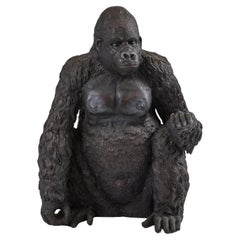
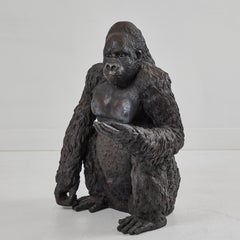
Cast Bronze Lifesize  Gorilla

Cast Bronze Lifesize Gorilla

Located in Palm Desert, CA

This bronze gorilla sits astutely with it's left hand out and it's right arm relaxed to the ground. The glass eyes are black and reflect surrounding light and give this fella a compa...

Category

Late 20th Century Daum Sculptures

Materials

Bronze

Chroma First Order Stormtrooper Helmet Sculpture, Glass Mixed Media

Chroma First Order Stormtrooper Helmet Sculpture, Glass Mixed Media

By CHROMA aka Rick Wolfryd

Located in Cuauhtemoc, Ciudad de México

ALTERATION ART . . . is a collaboration process between Rick Wolfryd, fine artist and art dealer with over 40 years experience, and various Mexican Huichol artists and Mexican Huicho...

Category

2010s Pop Art Daum Sculptures

Materials

Glass, Mixed Media

Vintage Jerusalem Sculpture Wall Plaque 1930's  Palestine Israeli Bezalel School

Vintage Jerusalem Sculpture Wall Plaque 1930's Palestine Israeli Bezalel School

Located in Surfside, FL

Repousse sculptural plaque from the original Bezalel Art School in Jerusalem. This is marked "Made in Palestine" as it is from the British Mandate period. It is in an Orientalist des...

Category

20th Century Modern Daum Sculptures

Materials

Metal

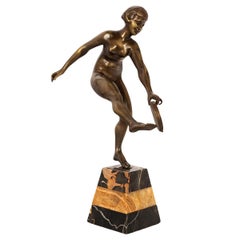
Louis Icart Art Deco Style Fascination Recast Bronze Dancing Woman Statue

Louis Icart Art Deco Style Fascination Recast Bronze Dancing Woman Statue

By Louis Icart

Located in Plainview, NY

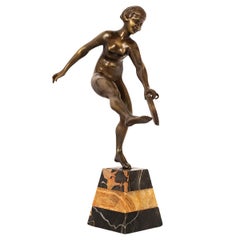
"Fascination" Art Deco Bronze Recast After Louis Icart, Dancing Woman on Marble Base Inspired by the iconic etchings of Louis Icart (1888–1950), this exquisite bronze sculpture title...

Category

Late 20th Century Art Deco Daum Sculptures

Materials

Bronze

Previously Available Items
Daum Nancy Vase Origin African Mask Art Deco Lines Crystal Paste Ocean Blue

Daum Nancy Vase Origin African Mask Art Deco Lines Crystal Paste Ocean Blue

By Daum

Located in Paris, FR

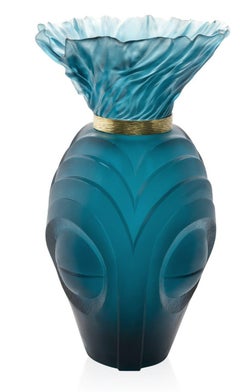
Daum x Gims 2021 Crystal vase designed by Gims and made by Maison Daum Patinated bronze ring Original artwork of 8 copies + 4 AP (2 for the artist, 2 for the Daum Museum) The artwork...

Category

21st Century and Contemporary Art Deco Daum Sculptures

Materials

Glass

Daum sculptures for sale on 1stDibs.

Find a wide variety of authentic Daum sculptures available for sale on 1stDibs. You can also browse by medium to find art by Daum in glass and more. Not every interior allows for large Daum sculptures, so small editions measuring 10 inches across are available. Customers who are interested in this artist might also find the work of Aharon Bezalel, Sergio Bustamante, and Jenny Day. Daum sculptures prices can differ depending upon medium, time period and other attributes. On 1stDibs, the price for these items starts at $3,600 and tops out at $5,200, while the average work can sell for $4,400.
Questions About Daum Sculptures
  • 1stDibs ExpertJune 6, 2024
    To identify Daum crystal, look for the maker's mark, usually found at the bottom of the piece. Most crystal ware produced by the luxury maker will feature the brand's logo or a hand-applied artist's signature. You can compare the markings on your piece with images featured on trusted online resources to learn more about them. Alternatively, you can consult a certified appraiser or knowledgeable antiques dealer for assistance with identification. On 1stDibs, explore a selection of Daum crystal.
  • 1stDibs ExpertApril 5, 2022
    How Daum glass is made involves a process unique to the manufacturer, called pâte de verre. It involves filling a refractory mold with finely crushed glass and then baking the piece in a kiln. Shop a collection of Daum glassware on 1stDibs.
  • 1stDibs ExpertApril 5, 2022
    Yes, all Daum vases are signed. Authentic Daum glass work will have the signature “Daum Nancy” and incorporate the cross of Lorraine. Looking for a signature is one of the best ways to ensure authenticity. Browse a range of authentic Daum vases and other glassware on 1stDibs.
  • 1stDibs ExpertMarch 22, 2022
    Yes, Daum glass is normally signed. The location of the company's mark varies, but it usually says "Daum Nancy" above, below or beside the cross of Lorraine, a cross with two crossbars. Find a variety of Daum glass on 1stDibs.
  • 1stDibs ExpertMarch 15, 2024
    Yes, Daum crystal is typically marked. The French maker usually adds the word "Daum Nancy" and its logo, a double cross called the Cross of Lorraine, to its pieces. You can locate the mark in a discreet area, such as on the bottom of stemware and decorative objects. Find a selection of Daum Nancy crystal wares on 1stDibs.