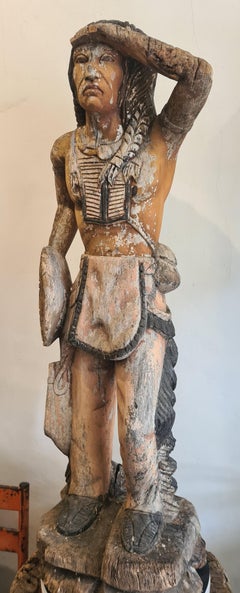
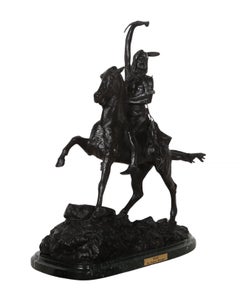
A 20th Century wood carved male figure, a 'Cigar Store Indian' with original polychrome decoration.
A now controversial subject, but none the less charming rendition, of a native North American man originally probably used as an advertising figure. Wonderful quality of carving capturing the stance of the man looking out to the distance, hair flowing to his back and plait to the side, all the details of his costume, his native dress and hairpipe breastplate (suggesting he is possibly a Comanche) and chest ornament, apron, trousers, mocassins, shield and arrows. The original Polychrome decoration has weathered beautifully as has the wood itself to present a sculpture that would adorn any collection or interior.
Because of the general illiteracy of the populace, early store owners used descriptive emblems or figures to advertise their shops' wares. American Indians and tobacco had always been associated because American Indians introduced tobacco to Europeans. As early as the 17th century, European tobacconists used figures of American Indians to advertise their shops.
Because European carvers had never seen a Native American, these early cigar-store "Indians" looked more like Africans with feathered headdresses and other fanciful, exotic features. These carvings were called "Black Boys" or "Virginians" in the trade. Eventually, the European cigar-store figure...
Category
Mid-20th Century American Realist Doris Warner Sculptures