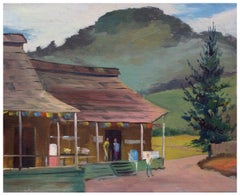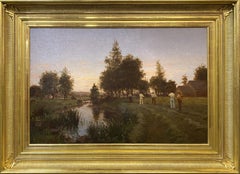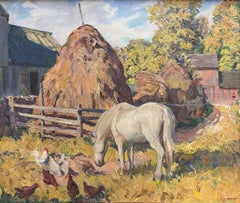
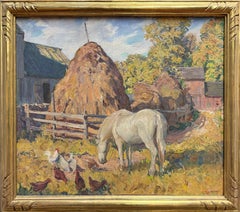
"White Horse" Frederick Lester Sexton, Bucolic Barn, Farm Scene, White Horse
By Frederick Lester Sexton
Located in New York, NY
Frederick Lester Sexton White Horse Signed lower right Oil on canvas 25 x 30 inches Provenance Part of a Collection received from the Lyme Art Association. Frederick Lester Sexton received a lot of reviews and exhibitions in the 1920s, 1930s, and 1940s, when he was at the height of his career. Because it captured the personal view of many people's wish to ignore national issues and simply live their lives in their homes, his work was favorably welcomed. The rise of modernist styles like Abstract Expressionism, which started to take over the American art scene in the 1950s, also contributed to Sexton's fall in popularity. As collectors and regular spectators discover once more that realism is a valid component of American art because it speaks directly and clearly to the beauty they perceive in their surroundings, many artists, like Sexton, are experiencing a renaissance. Cheshire, Connecticut, was the birthplace of Frederick Sexton in 1889. His father, J. Frederick Sexton, was the Rector of St. Peter's Church in Cheshire and a well-known Episcopal clergyman. The mother, Mary Louise Lester, was an amateur painter and came from a pretty well-known Hartford family. Frederick was killed in an open-hearth fire when he was eighteen months old. His right hand was badly burned and was never to be opened again. The father kept the family together after his mother passed away when he was nineteen. Sexton's mother taught him art, and he went to public schools in New Haven. He received the prestigious Winchester Prize for a year of study in Spain while attending the Yale School of Fine Art, where he studied under Augustus Tack...
1930s American Impressionist Frederick Lester Sexton Art
Canvas, Oil