Located in Moreno Valley, CA
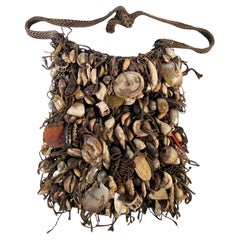
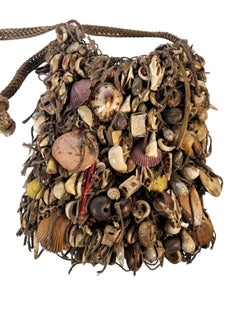
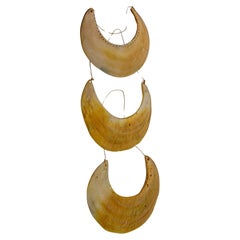
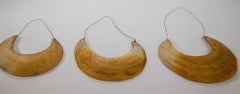
Antique Collectible Ethnic Tribal Folk Art Crescent Shell Pieces Choker Necklaces from Papua New Guinea.
Shell pieces cut from the gold lipped pearl oyster found off the waters of Papua New Guinea.
Their opalescent color ranges from deep gold yellow to pale yellow.
Each is pierced at the crescent point for a cord attachment enabling the owner to wear them singly or together around the neck.
One had a line of holes along the inner edge of the crescent as a decorative feature.
Highly Collectible Museum Pieces, worn by men and women rare old Kina Shell Necklaces (Huge Mother of Pearl Crescent) Pectoral Collected from the Foi Tribe (Papua New Guinea), Circa 1920’s.
From the Art collection of Marian and John Scott.
Acquisition date: 1969.
Evaluation date records: 1982.
About: For the people of the Highlands, shells were considered treasures. As they were items that came from distant shores of Papua New Guinea they were already objects used for trade. The number one source of mother of pearl wealth was and is still is from the Thursday Island, one of the chain of Island that suggests the ancient land bridge across the Torres Straits from Cape York, Australia to New Guinea. They were fashioned into objects of adornment worn on costumes, hair, nose, etc.
Of particular rarity was the gold lipped pearl shell.
References: Plumes and Arrows, Inside New Guinea, COlin Simpson, Angus and RObertson, 1968.
CATEGORY
Anthropology: Ethnography.
Tribal Kina Shell Pectoral Necklace, Pearl shell ornamentation (neck).
Kina (shell money) Oject part of Pacific Cultures Collections.
Purchased from the amazing private collection of Mark Lissauer who spent his life collecting niche ethnographic pieces.
About Mark Lissauer:
Mark Lissauer spent forty years travelling abroad for months at a time collecting ethnographic artefacts primarily from New Guinea and the islands of the West Pacific, and from Asia and Himalayan countries. Fluent in five languages and having in the course of business travelled to more than forty countries, Mark is well-known to museums and art-collectors around the world for his long career and his interesting and diverse collection of rare ethnographic material.
Mark knows the origin and symbolism of each piece. Through extensive research and more than ninety trips around the globe, Mark familiarised himself with the traditions of the various cultures he visited in order to understand the meaning of each object to its region and tribe. His home has a specialist library and several rooms are filled with tribal carvings, textiles and ethnographica.
He acquired his first tribal piece in 1948 during a business trip to Milne Bay, New Guinea, and has since documented the acquisition of some 35,000 items. Several thousands of these have been sold to important private collections and museums worldwide, including the Rockefeller Museum, the British Museum and the Musée National des Arts d’Afrique et d’Océanie, now incorporated into the Louvre Museum.
Estimator certificate of authenticity by Wayne Heathcote Tribal Art Dealer and Expert.
Heathcote has a flash gallery in Brussels, where much of the tribal art business is centred, and is an expert at Sotheby's tribal art sale...
Category
Early 20th Century Papua New Guinean Tribal Jef Deconinck Busts
MaterialsShell, Abalone, Mother-of-Pearl