Seth Eastman Art

American, 1808-1875

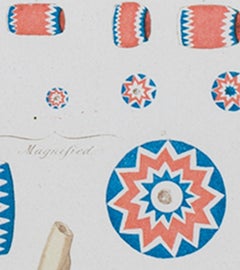
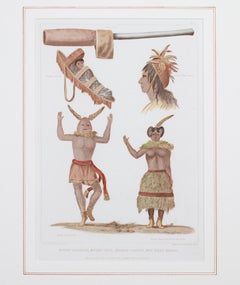
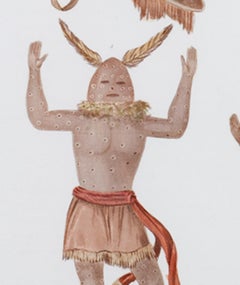
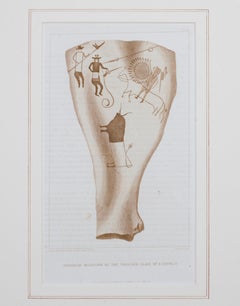
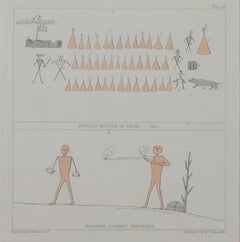
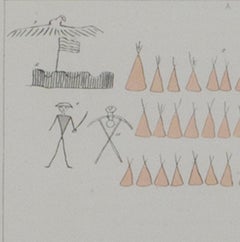
Seth Eastman is known primarily for his depictions of daily life among the Dakota and Ojibwe tribes in Minnesota. He was born to Robert and Sarah Lee Eastman on January 24, 1808, in Brunswick, Maine. Eastman attended the United States Military Academy at West Point, New York, where he received training in sketching and topography. While at West Point, he began to paint scenes featuring the daily life of local Native American tribes. In 1830, Eastman was assigned to topography duty on the frontier and spent a short time at Fort Snelling before returning to West Point to teach. While at Fort Snelling, Eastman married Wakaninajinwin, the fifteen-year-old daughter of Cloud Man, a Dakota chief. Eastman left in 1832 for another military assignment soon after the birth of their baby girl, Winona and declared his marriage ended when he left. Winona was also known as Mary Nancy Eastman and was the mother of Charles Alexander Eastman, author of Indian Boyhood. From 1833–40, Eastman taught drawing at West Point. In 1835 he married his second wife, Mary Henderson, the daughter of a West Point surgeon. In 1841, he returned to Fort Snelling as a military commander and remained there with Mary and their five children for the next seven years. It was during this time that Eastman began visually recording the everyday way of life of the Dakota and Ojibwe people. His wife Mary also became involved in preserving Indian culture by writing books on local tales and legends, which he would illustrate for her. The most important of these books was entitled Dahcotah: Or, Life and Legends of the Sioux Around Fort Snelling. In 1847, Henry R. Schoolcraft, a former Indian agent, was chosen to conduct a study of the American Indian people. Eastman illustrated the six-volume set, published between 1851 and 1857 as Historical and Statistical Information Respecting the History, Condition, and Prospects of the Indian Tribes of the United States. The U.S. House of Representatives Committee on Military Affairs also commissioned Eastman to paint images of 17 important military forts, which he completed between 1870–75. These paintings are now housed in the United States Capitol in Washington, D.C. Eastman's works are significant for Minnesota history because art historians believe that Eastman based many of his paintings and sketches on his observations in the Sioux villages of Kaposia and Little Crow, as well as in Scott, Wabasha and Winona counties. Eastman died of a stroke while painting at his home in Washington, D.C., on August 31, 1875.

to
5
5
4
3
1
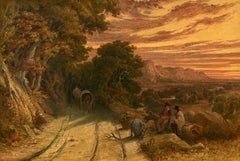
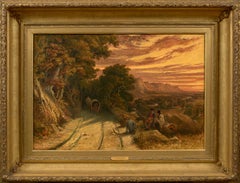
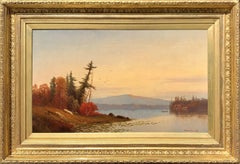
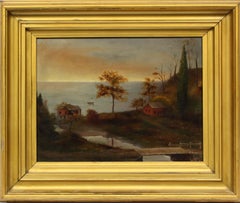
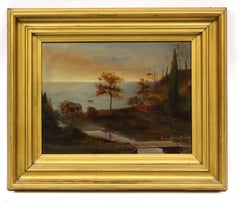
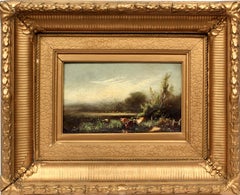
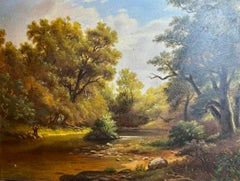
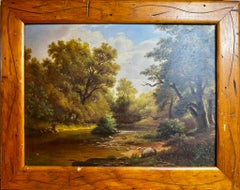
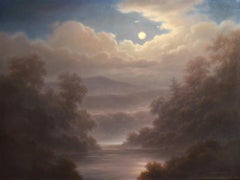
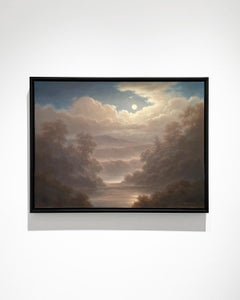
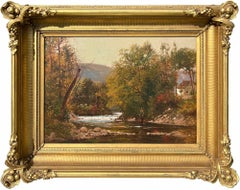
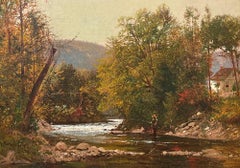
Road-Side View (View in Wisconsin)

Road-Side View (View in Wisconsin)

By Seth Eastman

Located in New York, NY

Label on stretcher bar: No. 175. / AMERICAN ART-UNION. /Road-Side View / Painted by / Seth Eastman / Distributed December 20, 1850.

Category

19th Century Hudson River School Seth Eastman Art

Materials

Oil

Related Items
Hunt Slonem "Summer Dusk Bunnies" Bunnies, Butterflies

Hunt Slonem "Summer Dusk Bunnies" Bunnies, Butterflies

By Hunt Slonem

Located in Boston, MA

Artist: Slonem, Hunt Title: Summer Dusk Bunnies Series: Bunnies Date: 2025 Medium: Lithograph on Paper Unframed Dimensions: 16" x 24" Framed Dimensions: 22" x 29" x 1.25" Sign...

Category

2010s Contemporary Seth Eastman Art

Materials

Lithograph

Sunset on the Hudson River by Hermann Simon (American, 1846-1895)

Sunset on the Hudson River by Hermann Simon (American, 1846-1895)

Located in New York, NY

Painted by Hudson River School artist Hermann Simon (1846-1895) , "Sunset on the Hudson River" is oil on canvas, measures 15 x 25 inches, and is signed and dated 1875 at the lower ri...

Category

19th Century Hudson River School Seth Eastman Art

Materials

Canvas, Oil

Hudson River Landscape by American Artist Johann Hermann Carmiencke (1810-1867)

Hudson River Landscape by American Artist Johann Hermann Carmiencke (1810-1867)

By Johann Hermann Carmiencke

Located in New York, NY

Painted by Hudson River School artist Johann Hermann Carmiencke, "Hudson River Landscape" is oil on canvas and measures 12 x 18 inches. The painting is signed and dated 1865 at the l...

Category

19th Century Hudson River School Seth Eastman Art

Materials

Canvas, Oil

1920s Century Country Creek Landscape

1920s Century Country Creek Landscape

Located in Soquel, CA

Serene early 20th century landscape of a winding creek in verdant country side with a distant farmhouse in the background, by an unknown artist (American, 20th Century), c. 1920. Pre...

Category

1920s Hudson River School Seth Eastman Art

Materials

Canvas, Oil

Dusk Forest Scene, Catskills by Lockwood DeForest (American, 1850-1932)

Dusk Forest Scene, Catskills by Lockwood DeForest (American, 1850-1932)

Located in New York, NY

"Dusk Forest Scene, Catskills," 1875 by Hudson River School painter Lockwood DeForest (American, 1850-1932) is oil on artists card-stock and measures 9.5 x 7 inches. The work is signed by DeForest, and dated May 13, 1875 at lower right. The work is framed in an elegant, period appropriate frame, and ready to hang. Lockwood DeForest was born in New York in 1850 to a prominent family. He grew up in Greenwich Village and on Long Island at the family summer estate in Cold Spring Harbor. As was customary for a cultivated family in the Gilded Age, the DeForests made frequent trips abroad. Excursions to the great museums, which were prominent on the DeForests agenda, deepened the young Lockwood's familiarity with European painting and sculpture. Though he had begun drawing and painting somewhat earlier, it was during a visit to Rome in 1868 that nineteen-year-old DeForest first began to study art seriously, taking painting lessons from the Italian landscapist Hermann David Salomon Corrodi (1844–1905). More importantly, on the same trip, Lockwood met one of America’s most celebrated painters, (and his maternal great- uncle by marriage) Frederic Edwin Church (1826–1900), who quickly became his mentor. DeForest accompanied Church on sketching trips around Italy and continued this practice when they both returned to America in 1869. Early on in his career, de Forest made a habit of recording the date and often the place of his oil sketches, as to create a visual diary of his travels. Lockwood’s profession as a landscape painter can be primarily attributed to Frederic E. Church and his belief in the young artist’s talent. DeForest often visited Church in the Hudson River community of Catskill where, in addition to sketching trips and afternoons of painting, he assisted with the architectural drawings and planning of Olana. In 1872, DeForest took a studio at the Tenth Street Studio Building in New York. During these formative years DeForest counted among his friend’s artists such as Sanford Robinson Gifford (1823–80), George Henry Yewell (1830–1923), John Frederick Kensett (1816–72), Jervis McEntee (1828–91), and Walter Launt Palmer (1854–1932). Over the next decade DeForest experienced success as a painter. He exhibited for the first time at the National Academy of Design in 1872, and made two more painting trips abroad, in 1875–76 and 1877–78, traveling to the major continental capitals but also the Middle East and North Africa. His trip to the Middle East and the library at Church’s home, Olana, established his interest in design during his mid-twenties. From about 1878 to 1902, landscape painting was overshadowed by his activities and preoccupation with East Indian architecture and décor, a style that became quite fashionable in late nineteenth century America. From 1879-1883, de Forest founded Associated Artists along with Louis Comfort Tiffany, Candace Wheeler...

Category

19th Century Hudson River School Seth Eastman Art

Materials

Oil, Board

Late 19th Century Tonalist Landscape -- Afternoon by the Pond

Late 19th Century Tonalist Landscape -- Afternoon by the Pond

Located in Soquel, CA

Gorgeous tonalist oil painting woman walking in field by pond with home in background by Willis Seaver Adams (American, 1844-1921), circa 1880. Trees and an amazing sky in the background add depth and interest to this beautiful piece. Signed "W. S. Adams" lower right corner. Condition: Previous restoration includes relining of canvas. Frame is vintage gilt molded and wood frame and shows previous repair of molding losses. Image size: 20"H x 24"W. Auctions records for the artist exceed $6,000. Willis Seaver Adams was known for his landscapes of the Connecticut River Valley. A relative recluse for much of his artistic life, his loneliness can be seen in much of his works. Oil miniatures were the focus for almost all of his later works. He is credited with over 425 oils, watercolors, and drawings. Willis Seaver was born in 1844 on a farm in Suffield, near the Connecticut River. He intermittently attended the Suffield Academy, and always wanted to be a painter. A wealthy doctor became his patron, and financed his studies in 1868 at the Royal Academy in Antwerp. When the doctor passed away, Adams returned home and struggled to make a living painting. After working for a photographer for three years, he opened his own studio. Adams helped organize Cleveland's first watercolor exhibit in 1876. Soon thereafter, he completed a portrait of Rutherford B. Hayes, then governor of Ohio, prior to his becoming President of the United States. This portrait enhanced Adams notoriety. In 1878, Adams traveled to Italy where he opened a studio in Venice, and became friendly with neighbor James Whistler. Prior to returning to Springfield, Adams lived in Florence, Italy for three years. He returned to became an instructor for the Springfield Art Association, and began to exhibit his works at the galleries of James D. Gill. His first one-man exhibit was held there in 1894. Other successful exhibitions took place in Chicago, New York, and Boston. Although his works garnered respectable prices and reflected his success, Adams felt he was due more recognition. In 1906, he moved to Greenfield, Massachusetts and converted a barn into a studio. There, he fell into relative obscurity, accompanied mainly by his dog, Collie. In 1921, Adams passed away. Examples of Willis Adams works can be seen at the Kent Memorial Library, the Wadsworth Atheneum, and the Suffield Academy. Several Suffield residents are thought to own Adams paintings.

Category

1880s Hudson River School Seth Eastman Art

Materials

Linen, Oil

Mount Washington,  New Hampshire

Mount Washington, New Hampshire

By Edmund Darch Lewis

Located in Saratoga Springs, NY

Edmund Darch Lewis (1835-1910) Mount Washington, New Hampshire 50 x 58 inches, signed & dated 1859 Description The area near Mount Washington in New Hampshire was visited by m...

Category

1850s Hudson River School Seth Eastman Art

Materials

Canvas, Oil

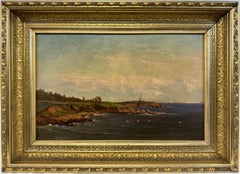
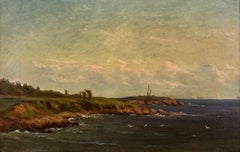
Antique Hudson River School Framed Coastal Luminous Seascape Oil Painting

Antique Hudson River School Framed Coastal Luminous Seascape Oil Painting

Located in Buffalo, NY

Antique American Hudson River School coastal seascape. Most likely a view of Maine. Oil on board. Image size, 8 by 12 inches.

Category

1870s Hudson River School Seth Eastman Art

Materials

Canvas, Oil

YES TO LIFE-NO TO DRUGS (Oui À La Vie-Non À La Drogue) 1987 Signed Lithograph

YES TO LIFE-NO TO DRUGS (Oui À La Vie-Non À La Drogue) 1987 Signed Lithograph

By Sami Burhan

Located in Union City, NJ

YES TO LIFE-NO TO DRUGS (Oui À La Vie-Non À La Drogue) is a handmade color lithograph by the internationally recognized Syrian artist Mohammad Sami Burhan printed on archival Arches ...

Category

1980s Contemporary Seth Eastman Art

Materials

Lithograph

Large Scale Early 20th Century Bucolic Mt. Hood Landscape Oil Painting

Large Scale Early 20th Century Bucolic Mt. Hood Landscape Oil Painting

By William M. Lemos

Located in Soquel, CA

Gorgeous landscape with two cows drinking water in a pond with Mt. Hood in background by listed artist William M. Lemos (American, 1861-1942). Signed "W.M. Lemos" lower right. Presented in vintage gilt-toned frame that shows wear (included as-is). Condition: Good: previously owned and used, with little or no signs of wear and is in good condition. No structural issues. Image size: 29"H x 49"W. Born in New York, Professor Lemos moved to San Francisco in 1887 where he established a studio at 106 Geary Street. He later moved to Santa Cruz in 1896, where he settled, painting murals for many local businessmen and the Santa Cruz Beach Boardwalk. As a boy Lemos earned money by wandering the streets and painting on request. Arriving in San Francisco in 1887, he established a studio at 106 Geary. With his wife Mabel, he worked in Los Angeles for a few years in the 1890s. After settling in Santa Cruz in 1896, he painted murals for many local businessmen. When the original Beach Casino was built there at the Boardwalk in 1904, Lemos was the first concessionaire and worked there for nearly 40 years. On his platform in the Casino, Lemos did paintings of redwoods, still lifes, forest fires, beach scenes, and marines. Many of his oils were done on redwood slabs which were popular with the tourists; in the early days these paintings sold for one dollar and up depending on the size of the work. After his vision failed and he was unable to paint, his last years were mostly spent fishing off the Municipal Pier with a friend who baited his hook for him because he could no longer see. In the March 27, 1941 Santa Cruz Sentinel News Lemos reminisced, "Them were the days when the Boardwalk was only twelve feet long and when business got slow I picked up my shotgun and went across the street and shot ducks where the Casa del Rey Hotel now stands." Exhibited: Calif. State Fair, 1885; Mechanics' Inst. (SF), 1889. In: Santa Cruz City Museum; Wawona Hotel (Yosemite). Edan Hughes, "Artists in California, 1786-1940" His mother was Julia Lemos, a Chicago artist famous for her depiction of the Chicago fire, “Two of Julia’s children became successful artists. Her eldest son, William, was a naïve still life, landscape, and mural painter. As a young boy in New York, he would wander the streets, earning money for the family, by ‘painting on request.’ At age 26, William moved to San Francisco, California. He opened an art studio and kept it running until he moved to Santa Cruz with his wife, Mabel, in 1896. During this period, he worked as a fresco artist painting ‘murals for many local businessmen.’ Exhibited California State Fair, Sacramento, 32nd annual, per Sacramento Daily Union, September 9, 1885. and article goes on to say “William Lemos and wife, Sacramento – Art school exhibits in which are shown such a variety of designs in decorative art, flower painting, and ornamentation, that one must give time to the examination.” Exhibited Mechanics Institute, San Francisco, 1889. “Lemos and his wife were in Fresno California 1890...

Category

Early 20th Century Hudson River School Seth Eastman Art

Materials

Canvas, Oil, Stretcher Bars

Previously Available Items
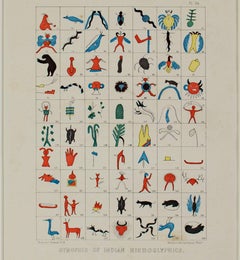
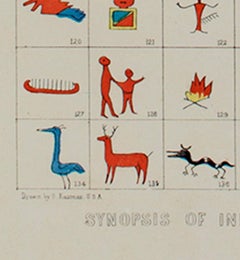
Synopsis of Indian Hieroglyphics Pl. 59

Synopsis of Indian Hieroglyphics Pl. 59

By Seth Eastman

Located in Milwaukee, WI

"Synopsis of Indian Hieroglyphics Pl. 59" is an original color lithograph by Seth Eastman. This piece depicts 70 small images depicting Native American symbols. 8" x 5 1/4" art 18 ...

Category

1850s Seth Eastman Art

Materials

Lithograph
Seth Eastman art for sale on 1stDibs.

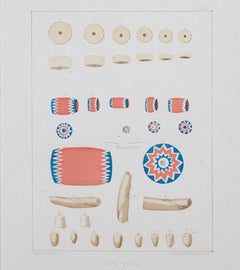
Find a wide variety of authentic Seth Eastman art available for sale on 1stDibs. You can also browse by medium to find art by Seth Eastman in lithograph, engraving, oil paint and more. Not every interior allows for large Seth Eastman art, so small editions measuring 16 inches across are available. Customers who are interested in this artist might also find the work of and Thomas Moran. Seth Eastman art prices can differ depending upon medium, time period and other attributes. On 1stDibs, the price for these items starts at $475 and tops out at $65,000, while the average work can sell for $475.