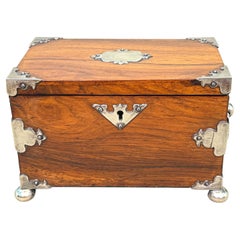
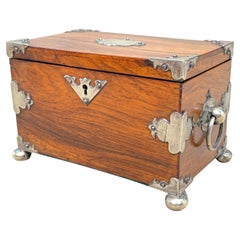
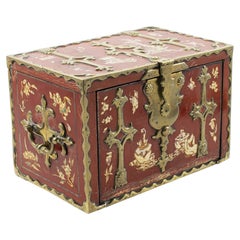
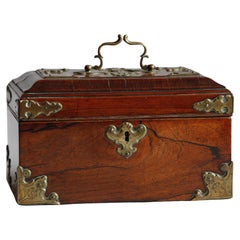
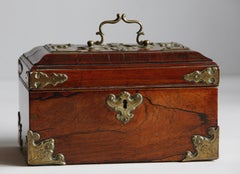
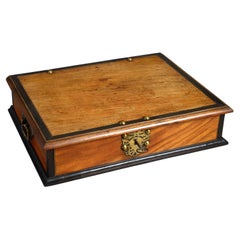
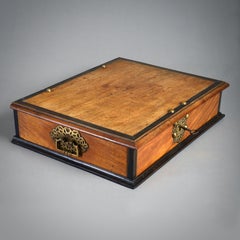
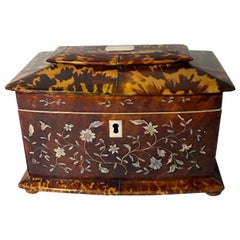
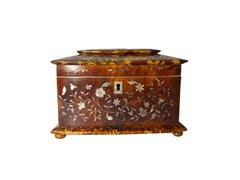
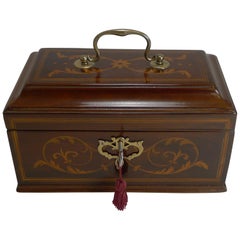
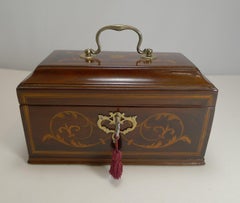
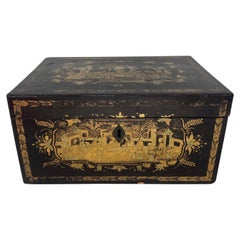
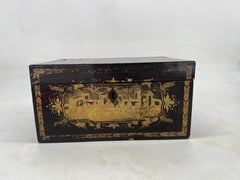
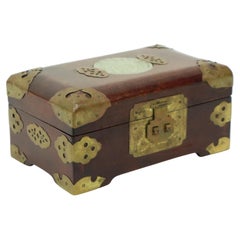
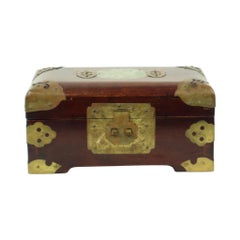
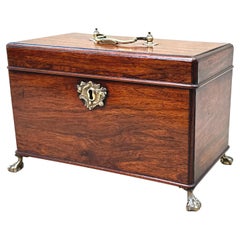
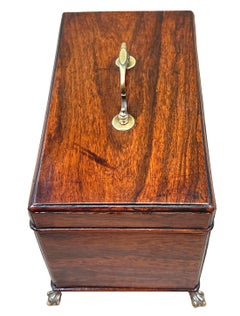
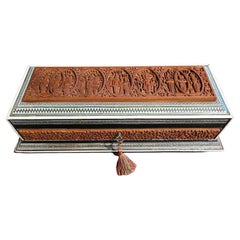
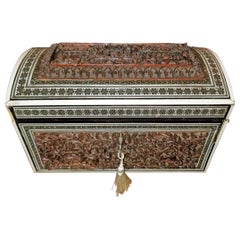
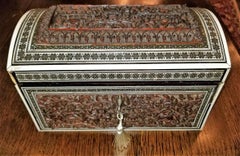
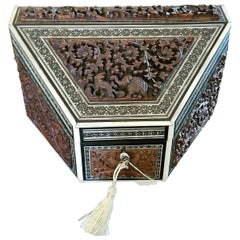
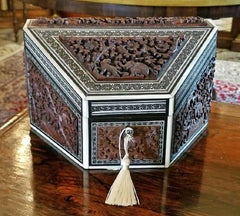
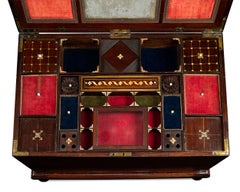
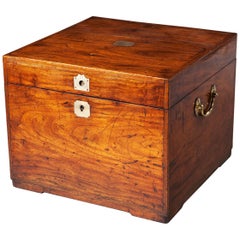
PRESENTING AN ABSOLUTELY STUNNING AND EXCEPTIONAL 19C Anglo Indian Highly Carved Padouk Sadeli Mosaic Scroll Box of Hindu Gods from circa 1870-80.
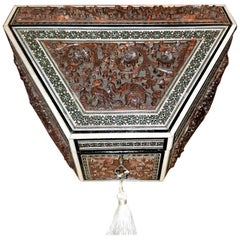
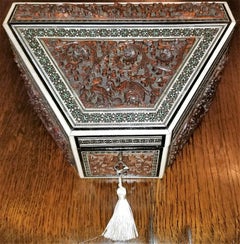
The box case is made from sandalwood with highly hand-carved padouk wood reliefs on all sides and banded and edged in fabulous ‘Sadeli Mosaic’, made from faux ivory/bone, ebony, silver, semi-precious green stone, etc., in various geometric patterns.
The carved lid of this box is EXCEPTIONAL!
It is HIGHLY HAND-CARVED and depicts 13 Hindu Gods: Vishnu, Shiva, Harihara, etc., in 9 oval shaped reliefs, surrounded by foliage etc.
The sides and rear have highly carved foliage relief panels.
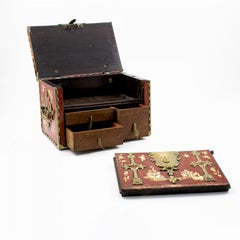
The lid opens to reveal the original red velvet lining (also on the base) in SUPERB CONDITION throughout.
The QUALITY of the ‘sadeli mosaic’ work is EXCEPTIONAL all over.
It has its key and working lock.
It sits on it’s 4 original brass turned ball feet.
THIS IS A HIGH QUALITY & VERY RARE AND DESIRABLE BOX!
SADELI MOSAIC: “Anglo Indian boxes were made in India for the English residents from the early part of the 18th century. They were brought back or sent back to England usually by the people who had commissioned them. From the beginning of the nineteenth century they were imported more commercially, although not in any significant numbers until the middle decades. They were very highly valued, especially the early ones, to the extent that the designs were copied on late 19th and early 20th century tins.
The ancient art of Sadeli Mosaic is said to have been introduced from Shiraz in Persia via Sind to Bombay, a long time before the Anglo Indian boxes were made. It was a technique, which required a high degree of skill and patience. It was executed very lavishly, in that the frequent cuts wasted a great amount of the precious materials used. The workmanship was however more than commensurable to the value of the materials.
Ivory, silver, pewter (or other metals), wood and horn were cut into faceted rods which were bound together to form geometric patterns. When the glue has set, the rods were sliced in transverse sections. This gave the maker a number of angled circular pieces in the original pattern. Several variations of patterns could be achieved by combining the materials in different ways. The ivory was sometimes dyed green to give an extra color.
The mosaic pieces in a combination of patterns, often separated by ivory, ebony, horn or silver stringing were used to veneer sandalwood boxes. In the early boxes, which date from the turn of the 18th to the 19th century, there are large panels of mosaic covering tops and sides of boxes. It took incredible skill to cover such large areas without any shakes or wavering of the pattern. The corners and joins on these boxes are impeccably matched.
The makers (reputed to be Persian) of Sadeli mosaic made in the first two decades of the 19th century displayed a total understanding of the qualities of the different materials they used. They combined substances, which can expand and contract according to atmospheric conditions with others, which are hard and unyielding. The result was a sharp definition of the lines and patterns, which made up the whole design.
On the early boxes the designs look deceptively simple. The fact is, they emerged from a culture, which had mastered geometry and understood how to generate a pattern from a set number of points. The patterns are so harmoniously combined that their incredible complexity is not immediately apparent.
The earliest Sadeli boxes...
Category
19th Century Indian Anglo-Indian Antique Padouk Boxes