Want more images or videos?
Request additional images or videos from the seller
1 of 10
Mantel Clock 19th Century Louis XVI Period by Deniere À Paris
$21,539.56List Price
About the Item
- Dimensions:Height: 17.33 in (44 cm)Width: 5.52 in (14 cm)Depth: 5.52 in (14 cm)
- Style:Louis XVI (Of the Period)
- Materials and Techniques:
- Place of Origin:
- Period:
- Date of Manufacture:1820-1830
- Condition:Rewired: The clock is in excellent and perfect working condition. In addition, it was recently cleaned and serviced by a professional clockmaker who specializes in maintaining museums. The clock is in excellent and perfect working condition. In addition, it was recently cleaned and serviced by a professional clockmaker who specializes in maintaining museums.
- Seller Location:Warsaw, PL
- Reference Number:1stDibs: LU5826226972882
About the Seller
5.0
Vetted Professional Seller
Every seller passes strict standards for authenticity and reliability
Established in 2021
1stDibs seller since 2021
34 sales on 1stDibs
Typical response time: 10 hours
Authenticity Guarantee
In the unlikely event there’s an issue with an item’s authenticity, contact us within 1 year for a full refund. DetailsMoney-Back Guarantee
If your item is not as described, is damaged in transit, or does not arrive, contact us within 7 days for a full refund. Details24-Hour Cancellation
You have a 24-hour grace period in which to reconsider your purchase, with no questions asked.Vetted Professional Sellers
Our world-class sellers must adhere to strict standards for service and quality, maintaining the integrity of our listings.Price-Match Guarantee
If you find that a seller listed the same item for a lower price elsewhere, we’ll match it.Trusted Global Delivery
Our best-in-class carrier network provides specialized shipping options worldwide, including custom delivery.You May Also Like
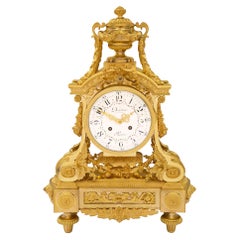
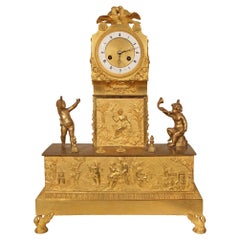
French 19th Century Louis XVI Style Ormolu Clock Signed by Denière
By Jean-François Denière
Located in West Palm Beach, FL
A stunning French 19th century Louis XVI st. ormolu clock signed by Denière. The clock is raised by elegant topie shaped feet below beautiful block rosettes. At the center is a richl...
Category
Antique 19th Century French Louis XVI Mantel Clocks
Materials
Ormolu
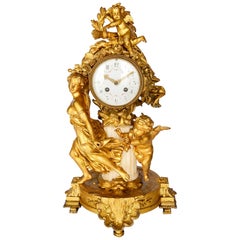
French 19th Century Louis XVI Style Mantel Clock
Located in Brighton, Sussex
An enchanting late 19th century French gilded ormolu and marble mantel clock, depicting cherubs playing, one chasing a young girl, the other hiding amongst a wreath and foliage. The ...
Category
Antique Late 19th Century French Louis XVI Mantel Clocks
Materials
Marble, Ormolu
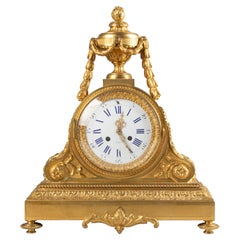
Large 19th Century Louis XVI Style Bronze Ormolu Mantel Clock Guibal Paris
Located in Casteren, Noord-Brabant
A fine and large Louis XVI style French mantel clock, from the end of the Napoleon III period, 1870-1880. The clock is bronze casted and has a fire-gilded finish, the dial is enamele...
Category
Antique 1870s French Louis XVI Mantel Clocks
Materials
Brass, Bronze, Enamel, Ormolu
$7,060
Free Shipping
H 20.08 in W 16.15 in D 9.06 in
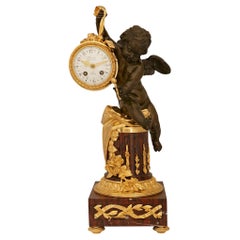
French 19th century Louis XVI st. Bronze, Ormolu and Marble Clock, by Denière
By Jean-François Denière
Located in West Palm Beach, FL
A superb and high quality French 19th century Louis XVI st. patinated Bronze, Ormolu and Rouge Griotte marble clock, by Jean Francois Denière. This stunning clock is raised by four O...
Category
Antique 19th Century French Louis XVI Table Clocks and Desk Clocks
Materials
Griotte Marble, Bronze, Ormolu
$17,800
H 16.5 in W 7.75 in D 6 in
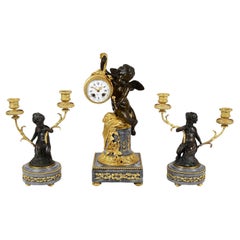
French 19th Century Cherub clock set, by Deniere, Paris
By Maison Deniere
Located in Brighton, Sussex
An enchanting and very good quality French 19th Century grey marble and gilded ormolu clock garniture, each piece with a patinated bronze cherub seated hold candle sticks either side...
Category
Antique 19th Century French Mantel Clocks
Materials
Marble, Bronze, Ormolu
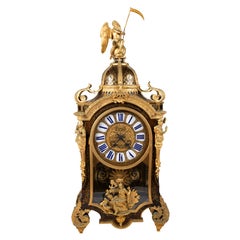
Louis XVI Boulle mantel clock, 19th Century.
By André-Charles Boulle
Located in Brighton, Sussex
A very good quality 19th Century French Louis XVI style Boulle mantel clock, having Father Time perched above the brass inlaid dome, scrolling foliate ormolu mounts, white enamel Rom...
Category
Antique 19th Century French Louis XIV Mantel Clocks
Materials
Brass
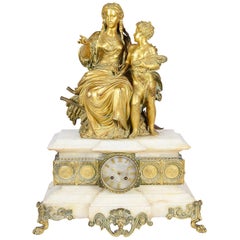
Classical French Louis XVI Style Mantel Clock, 19th Century
Located in Brighton, Sussex
A very good quality 19th century French Louis XVI style gilded ormolu and marble mantel clock, depicting a mother and child after harvesting above an eight day duration chiming clock...
Category
Antique Late 19th Century French Louis XVI Mantel Clocks
Materials
Marble, Ormolu
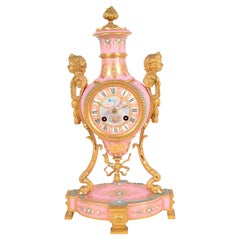
Louis XVI Style Pink Porcelain Mantel Clock, 19th Century
Located in Brighton, Sussex
A very good quality French 19th Century Louis XVI style gilded ormolu and 'Severs' style pink porcelain mantel clock. In the form of a vase with an inset clock face, an eight day dur...
Category
Antique Late 19th Century French Louis XVI Mantel Clocks
Materials
Ormolu
French 19th Century Louis XVI St. Ormolu Mantel Clock
Located in West Palm Beach, FL
A spectacular and unique French early 19th century Louis XVI st. ormolu mantel clock, signed by Chapsal a Paris. The clock is raised on finely chased swan supports below a rectangula...
Category
Antique 19th Century French Louis XVI Mantel Clocks
Materials
Ormolu
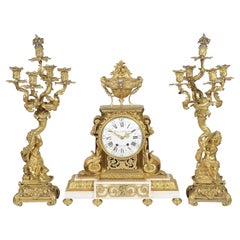
French Louis XVI Style Mantel Clock + Candelabra, 19th Century
Located in Brighton, Sussex
A very good quality mid 19th Century French gilded ormolu Louis XVI style mantel clock with a matched pair of classical five brach candelabra, with putti supporting cornucopia. The c...
Category
Antique 19th Century French Louis XVI Mantel Clocks
Materials
Ormolu
$16,387
H 24.81 in W 20.48 in D 8.27 in
More From This Seller
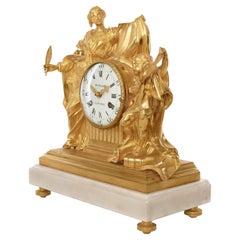
View AllMantel Clock 18th Century Louis XVI Period by Baillon À Paris
Located in Warsaw, PL
This exceptional mantel clock was crafted by Jean-Baptiste Baillon III, one of the most renowned and innovative horologists of his era. Baillon served an elite clientele, including t...
Category
Antique 18th Century French Louis XVI Mantel Clocks
Materials
Marble, Bronze
$5,600 Sale Price
28% Off
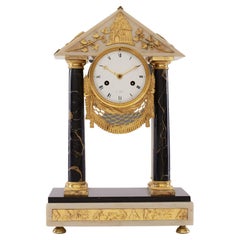
Mantel Clock 19th Century Louis XV Period
Located in Warsaw, PL
An exquisite 19th-century Louis XV-style mantel clock, showcasing a harmonious blend of Neoclassical and Rococo influences. This elegant timepiece features a finely crafted white ena...
Category
Antique Late 18th Century French Louis XV Mantel Clocks
Materials
Marble, Bronze
Mantel Clock 19th Century Louis Philippe Charles X Period
Located in Warsaw, PL
This striking mantel clock is a fine example of the Empire style, a period characterized by its grandeur and inspiration from classical antiquity. The clock showcases a masterful com...
Category
Antique Mid-19th Century French Charles X Mantel Clocks
Materials
Carrara Marble, Bronze, Gold Leaf
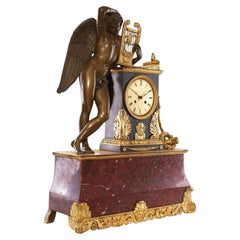
Mantel Clock 19th Century Louis Philippe Charles X Period
Located in Warsaw, PL
Empire pendulum clock
Depicting Virgil,an ancient Roman poet of the Augustan period.He has been traditionally ranked as one of Rome's greatest po...
Category
Antique Early 19th Century French Louis Philippe Mantel Clocks
Materials
Malachite, Bronze
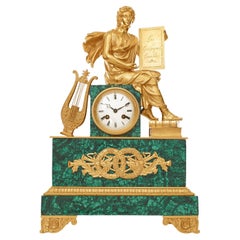
Mantel Clock 19th Century Transitional Period
Located in Warsaw, PL
This elegant mantel clock is a fine example of the Empire style, a period characterized by its grandeur and inspiration from classical antiquity. The clock showcases a masterful comb...
Category
Antique Early 18th Century French Industrial Mantel Clocks
Materials
Bronze
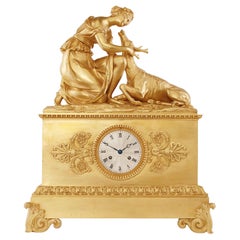
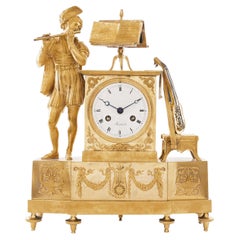
Mantel Clock 19th Century Styl Empire by Ferdinand Berthoud À Paris
Located in Warsaw, PL
Ormolu bronze mantel clock flanked by a troubadour and musical instruments, signed 'Ferdinand Berthoud a Paris'.
The end of the 18th and beginning of the 19th century was a crucial time in which new technological advances helped to make watches more accurate and more portable. During the 1790s, the production of gilded bronze increased considerably as working conditions improved. The freedom of trade initiated by the French Revolution allowed many casters to develop large factories. The new factory environment gave them a chance to execute all stages of bronze work including drawing, casting, gilding, assembly, and trade of art objects. While the bronzers took creative liberty in creating all kinds of clocks in contrast to the noble and rigorous structure carried by the movement of neoclassicism. Under the reign of Empire, the case designs started gradually to develop away from a proportionate and strict classicism towards a baroque style and revival style. The rediscovery of medieval civilization was one of the intellectual curiosities of the beginning of the 19th century, with much input from the Ancien Régime and its institutions, rites and the medieval churches in which family ceremonies occurred.
This early nineteenth-century figural mantel clock is surmounted by a medieval musician. To be more precise, it is a french troubadour. Troubadours were known for composing and performing lyric poetry for the nobility back during medieval times. The clock is featuring a chiselled bronze troubadour, dressed in medieval fashion while holding a flute, playing a tune from sheet music called "Du Troubadour" that is resting on top of the rectangular clock case. In addition to that, the clock features a gilt bronze lute or vielle resting on a small stool on the opposite side of the clock’s case. The white enamel dial features the inscription Berthoud and is underlined by a bronze entourage chiselled with palmette motif, plus encompassed by c-scrolls and wreaths. The original hands are in blued steel and encircled by Roman numerals indicating hour next to Arabic numerals indicating minutes.
The small details that adorn the hexagonal plinth are reliefs, depicting two water fountains or basins on both sides with a lyre in between. The sculpted image of a lyre raised above the background features also foliage garlands tied on top with ribbons. The clock rests on seven spinning feet.
The clock was made in the well-known workshop of the Berthoud’s family that was recognized for their excellent work by the King.
Berthoud Clockmakers History.
Ferdinand Berthoud was a horologist and author of extensive treatises on timekeeping as well as a Swiss clockmaker serving the king of France, that produced many marine clocks, including a weight-driven version that inspired the first American sea-going clock. He was born in Plancemont, Switzerland, the son of an architect and judiciary. In 1741 he began a three-year apprenticeship as a clockmaker under his brother, Jean-Henri. He made his first marine chronometer in 1754 (sent for trial in 1761) and in 1764 was appointed a member of the Royal Society, London and Horloger Mécanicien de Sa Majesté et de la Marine ayant l'inspection de la construction des Horloges Marines. In 1769, Ferdinand Berthoud sent for his nephew Pierre-Louis Berthoud (1754–1813), commonly known as Louis Berthoud, a talented young watchmaker and clockmaker, inviting him to come to Paris from Couvet, Switzerland, to pursue his apprenticeship. Louis helped Ferdinand manufacture and repair the sea clocks...
Category
Antique Late 18th Century French Louis XVI Mantel Clocks
Materials
Bronze
Still Thinking About These?
All Recently ViewedMore Ways To Browse
Gothic Fusee Clock
Grand Mantel Clock Garniture
Inclined Plane Clock
Jon Sarriugarte
Mauthe Mantel Clock
Mid19 Bronze
Sailor Clock
Sevres Biscuit Clock
Small Louchet Paris Gilt Bronze Vase
Sputnik Clock
Thomas Wagstaffe
Vintage Kieninger Mantel Clock
Vintage Pewter Clocks
Vintage Wooden Propeller Clock
World War 2 Clock
2003 Moorcroft
Antique Clocks Derbyshire
Antique Welch Clock