By Butterfield Paris
Located in New Orleans, LA
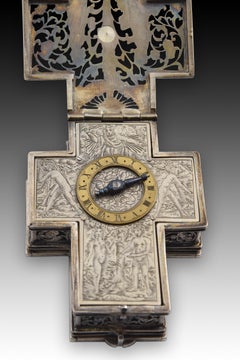
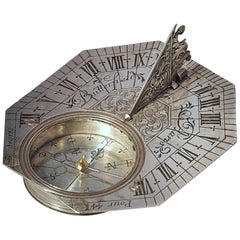
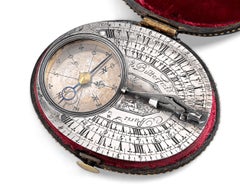
The ultimate 17th century traveler's companion, this rare and exquisite equatorial sundial by Michael Butterfield (1635-1724) is one of the first reliable and portable methods of telling time. The silver oval-form plate is meticulously engraved with indicators of the hours for specific latitudes of 42, 46, 49 and 52 degrees, which are divided in 15-degree increments that account for the rotation of the earth during a 24-hour period. In order to operate the sundial, the user must position the plate at a parallel angle that equals the local latitude. The gnomon, or pointer, must be pointed toward true north in order to give accurate time. Butterfield sundials are known for their hinged, adjustable gnomons that feature a diminutive bird, as displayed in the present example.
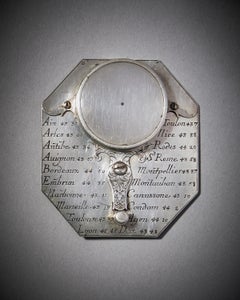
The reverse of the sundial plate is engraved with the latitudes for various French and European locations, which makes using the sundial easier to manipulate. Butterfield sundials are known as "semi-universal" horizontal dials, meaning that it can be used at different latitudes, but not in the full range of 0 to 90 degrees. Though Butterfield was not the inventor of this type of dial, the precision of his workmanship and the tell-tale bird gnomon became synonymous with this type of sundial. To find an example in such pristine condition that was made by and signed by Butterfield is quite exceptional.
About Michael Butterfield
Michael Butterfield was a British clockmaker who moved to Paris in the early 1660s. His portable sundials...
Category
17th Century French Other Antique Silver More Clocks