Want more images or videos?
Request additional images or videos from the seller
1 of 21
Viennese Enameled Silver Table Clock Attributed to Herman Bohm
$7,500List Price
About the Item
- Dimensions:Height: 7 in (17.78 cm)Diameter: 3 in (7.62 cm)
- Materials and Techniques:
- Place of Origin:
- Period:
- Date of Manufacture:c1880s
- Condition:Wear consistent with age and use.
- Seller Location:New York, NY
- Reference Number:1stDibs: LU8384235318672
About the Seller
5.0
Vetted Professional Seller
Every seller passes strict standards for authenticity and reliability
Established in 1990
1stDibs seller since 2023
12 sales on 1stDibs
Typical response time: 1 hour
Authenticity Guarantee
In the unlikely event there’s an issue with an item’s authenticity, contact us within 1 year for a full refund. DetailsMoney-Back Guarantee
If your item is not as described, is damaged in transit, or does not arrive, contact us within 7 days for a full refund. Details24-Hour Cancellation
You have a 24-hour grace period in which to reconsider your purchase, with no questions asked.Vetted Professional Sellers
Our world-class sellers must adhere to strict standards for service and quality, maintaining the integrity of our listings.Price-Match Guarantee
If you find that a seller listed the same item for a lower price elsewhere, we’ll match it.Trusted Global Delivery
Our best-in-class carrier network provides specialized shipping options worldwide, including custom delivery.You May Also Like
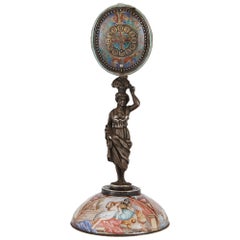
Antique Silver and Enamel Viennese Table Clock
Located in London, GB
This 19th century, Austrian table clock is crafted in silver and the complex champleve enamel technique. The base of the clock is a semi-spherical dome inlaid with enamel panels of c...
Category
Antique Late 19th Century Austrian Neoclassical Table Clocks and Desk Cl...
Materials
Silver, Enamel
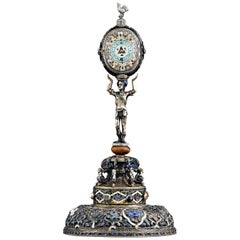
Viennese Enamel Soldier Clock
By Tobias Katzenberger
Located in New Orleans, LA
A work of exceptional detail, this magnificent Viennese clock takes the art form of enameling to new heights. The elaborately fashioned timepiece rests atop the head of a soldier, who stands on a pedestal populated by sphinxes. Exceptional details encase the entire piece, from the rooster finial to the gem-studded base. A hand-painted portrait of the heroic soldier on the reverse completes this stunning piece.
Particularly popular during the 19th century, Viennese enamels...
Category
Antique Early 19th Century Austrian Other Mantel Clocks
Materials
Multi-gemstone, Enamel
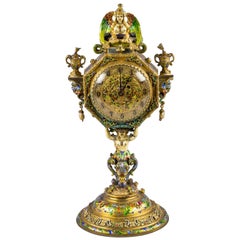
Viennese Silver Gilt and Enamel Sphinx Clock, circa 1880
Located in New York, NY
In Renaissance style.
Category
Antique 1880s Austrian Table Clocks and Desk Clocks
Materials
Silver, Enamel
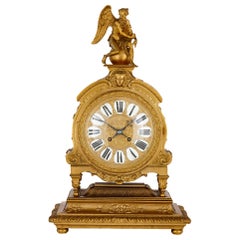
Gilt-Bronze Clock with Enamel Numerals Attributed to Henri Picard
By Henri Picard
Located in London, GB
Gilt-bronze clock with enamel numerals attributed to Henri Picard
French, circa 1860
Measures: Height 73cm, width 45cm, depth 23cm
The elaborate case of this beautiful mantel clock has a large central circular dial with enamel Roman numerals for the hours and engraved on the edge with Arabic numbers for the minutes. The surmount is a gilt bronze group of Father Time, depicted as an elderly male figure seated on a circular globe. The quality throughout is exceptional, demonstrating the very best of 19th century craftsmanship.
This clock is after a design by André-Charles Boulle (French, 1642-1732) and similar to examples of equally fine quality and casting known to have been made by 19th Century bronzier Henri Picard (French, fl. 1831-1864), therefore we can attribute the case to Picard. The movement is stamped for Parisian clock...
Category
Antique Mid-19th Century French Napoleon III Mantel Clocks
Materials
Ormolu, Bronze
$47,738
H 28.75 in W 17.72 in D 9.06 in
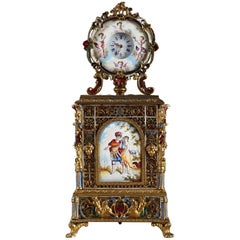
Viennese Enamel and Gilt Brass Table Clock, Mid-19th Century
Located in Paris, FR
Small table clock in gilt brass richly decorated with openwork scrollwork, acanthus leaves, flowers, and masks in multicolored enamel. The main faces...
Category
Antique 1850s Austrian Renaissance Revival Table Clocks and Desk Clocks
Materials
Enamel, Brass
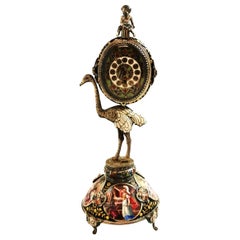
Antique Viennese Enamel and Silver Gilt Clock Austria circa 1870 Bird Ostrich
Located in London, GB
A pretty Antique Silver Gilt and Viennese Enamel Clock. This oval Clock rests on the back of an ostrich, which in turn stands on a domed base. Th...
Category
Antique 19th Century Austrian Table Clocks and Desk Clocks
Materials
Silver, Enamel
$6,274 Sale Price
20% Off
Free Shipping
H 0.4 in W 0.4 in D 0.4 in
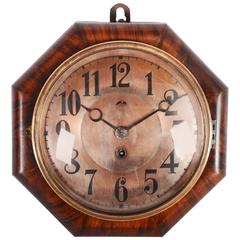
Art Deco Wall Clock Attributed to Junghans
Located in Vienna, AT
Walnut wood octagonal box, clock face with Arabic numbers, restored new battery movement.
Category
Vintage 1920s German Wall Clocks
Materials
Glass, Wood
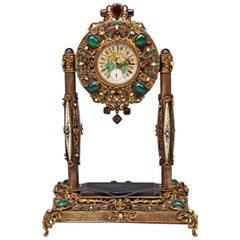
Vienna Enamel Table Clock Silver Nacre Enamel Onyx Semiprecious Stones
By Viennese Manufactory
Located in Vienna, AT
Stunning Viennese enamel vintage table clock - made of:
-- silver
-- nacre
-- enamel (excellently chiselled)
-- onyx
-- semiprecious stones
Attention: The table clock is par...
Category
Antique 1870s Austrian Victorian Table Clocks and Desk Clocks
Materials
Onyx, Silver, Enamel
$6,588
H 9.25 in W 6.1 in D 4.13 in
Viennese Enameled Silver and Rock Crystal Coupe and Cover by Herman Bohm
Located in West Palm Beach, FL
Viennese mannerist style enameled silver and rock crystal coupe and cover, by Herman Bohm, last quarter 19th century, the silver mounts to base and cover w...
Category
Antique Early 19th Century Decorative Bowls
Materials
Glass

$38,900
H 5.25 in W 6.25 in D 4 in
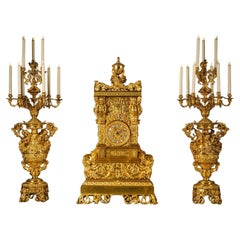
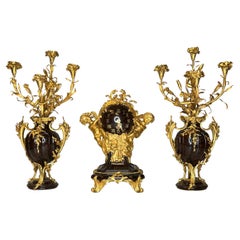
A Monumental Renaissance Revival Clock Garniture, Attributed to Feuchère
Located in Brighton, West Sussex
A Large and Important Louis Philippe Period Gilt-Bronze Three-Piece Clock Garniture.
Attributed to the Feuchère family. The clock movement by Hémon.
In the Renaissance revival style. Comprising a clock and a pair of nine-light candelabra. The clock case of architectural out-shape with cherubic term figures supporting a rectangular pediment centred by an urn. The sides of the clock tower cast in relief with strapwork and foliage. The dial inset with enamel Roman numeral chapters. The twin-barrel clock movement with tic-tac escapement, silk suspension and countwheel strike to bell. Pendulum and winding key.
The candelabra as twin-handled vases supporting tiered branches with candle nozzles. Modelled en suite with naturalistic scrolls and foliage. Surmounted by finials modelled as an eagle toying with a serpent. The scrolled handles flanked by cherubic figures and serpents. The bodies fronted by bacchic masks and supported on socles bearing angels.
France, Circa 1835.
The clock movement signed ‘HEMON A PARIS’. The clockmaker Claude Hémon was established at rue de St. Martin circa 1810-1820.
Dimensions, the clock:
Height : 106 cm 42 inches
Width : 58 cm 23 inches
Depth : 38 cm 15 inches
Weight : 72 kg
Dimensions, the candelabra:
Height : 104 cm 41 inches
Width : 36 cm 14 inches
Depth : 36 cm 14 inches
Weight : 28 kg (each)
This magnificent clock garniture of palatial size is designed in the Renaissance revival style and dates to the Louis Philippe period. Executed in sculptural gilt-bronze with leaves, scrolls, masks and exotic birds, the naturalistic ornament represents an elaborate system of allegories and mythological iconography which recall the influence of Italian Mannerist art in France.
The distinctive design reflects a new style which replaced the neoclassism of the French Empire period. With the fall of Napoleon Bonaparte, artists and designers sought a new decorative vocabulary with which to aggrandise the Bourbon restoration. With the French revolution and Louis XVI’s execution still within living memory, it seemed too soon for a revival of the style of the Grand Siècle. Instead they looked further back to the time of François I, whose patronage of Italian artists had brought the Renaissance to France. The idea of a renaissance revival appealed to the new Bourbon monarchs and their patronage ignited great creativity in the arts.
The reigns of Louis XVIII and Charles X, who were brothers of the late King, Louis XVI, and later of Louis Philippe I, nicknamed the Citizen King, coincided with the enlightenment and the dawn of the industrial age. Great technical progress was made in metallurgy and casting which raised the art of bronze making to new heights in the hands of great masters such as Pierre-Philippe Thomire (1751-1843) and Pierre- Jean-François Denière (1774-1866).
The renaissance provided a rich and varied source book in architecture, furniture and other decorative arts for designers such as Claude Aimé Chenavard (1798-1838) whose Album de l’ornemaniste (1835) became a reference work. Léon Feuchère (1804-1857) also produced drawings of interiors, silver, bronzes and furniture and was a scion of the prominent family of bronze castors established by his grandfather Pierre-François Feuchère (1737-1823) who had worked as a gilder for the bronze caster Pierre Gouthière before setting up a bronze foundry that would become one of the largest in Paris under the management of his son Lucien-François (d. 1841) and grand-son Armand (1797-1866). A number of drawings by Léon Feuchère have recently been discovered by the Rijksmuseum and probably belonged to the collection of Louis-Philippe-Albert, duc d’Orléans, comte de Paris (1838-1894). Louis-Philippe-Albert was the grandson of the French king, Louis-Philippe I (1773-1850), who granted him the title of comte de Paris, and the son of Ferdinand-Philippe, duc d’Orléans (1810-1842). Ferdinand-Philippe was an important collector and sponsored many young artists to create metalwork objets d’art, notably a celebrated surtout de table made by Claude-Aimé Chenavard and Jean-Jacques Feuchère (1807-1852), a cousin of Armand and Léon. Principally remembered as a sculptor, Jean-Jacques Feuchère trained in the family foundry and designed small objects, cigar boxes...
Category
Antique Early 19th Century French Renaissance Revival Mantel Clocks
Materials
Bronze
$252,329
H 41.74 in W 22.84 in D 14.97 in
More From This Seller
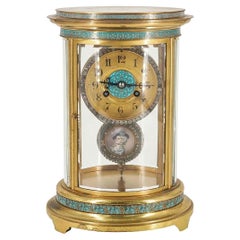
View AllChampleve Enameled and Jeweled Brass Mantel Clock by Japy Freres
Located in New York, NY
Our lovely champleve enameled bronze and glass mantel clock with movement by Japy Freres of Paris for Theodore B. Starr of New York City dates from the 1900s to 1910s and is distingu...
Category
Early 20th Century French Belle Époque Mantel Clocks
Materials
Bronze
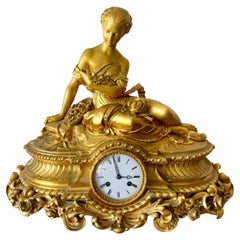
Figural Gilt Bronze Mantel Clock by Raingo Freres
By Raingo Frères
Located in New York, NY
Our lovely gilt bronze mantel clock with movement by Raingo Freres of Paris features the finely sculpted figure of a beautiful female caring for a newborn chick.
With original pen...
Category
Antique Late 19th Century Neoclassical Revival Mantel Clocks
Materials
Bronze
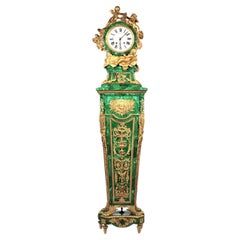
Antique Louis XVI Style Malachite Gilt Bronze Tallcase Clock After Riesener
Located in New York, NY
Magnificent antique (mid to late 19th century) tallcase grandfather clock after the original French Louis XVI period design by Jean-Henri Riesener (1734-1806), with finely cast ormol...
Category
Antique Late 19th Century French Louis XVI Grandfather Clocks and Longca...
Materials
Malachite, Bronze
Francois Linke Louis XVI Style Gilt Bronze and Marble Mantel Clock Garniture
Located in New York, NY
Exceptional garniture in the Louis XV/XVI style with gilt bronze mounts attributed to Léon Messagé (1842-1901) and Francois Linke (1855-1946), including mantel clock and pair of cand...
Category
Early 20th Century French Louis XV Mantel Clocks
Materials
Marble, Bronze
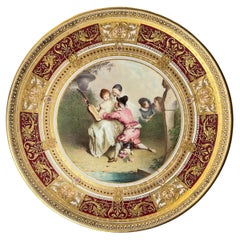
Viennese Porcelain Charger by Antonin Boullemier (1840-1900)
By Royal Vienna Porcelain
Located in New York, NY
Antique Royal Vienna porcelain plate painted by Antonin Boullemier (1840-1900), depicting courting lovers and with extensive neoclassical mofits and gilt decorations. Excellent cond...
Category
Antique Late 19th Century Austrian Porcelain
Materials
Porcelain
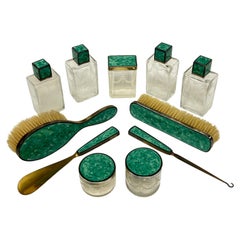
Antique French Enameled Silver and Glass Vanity Set
Located in New York, NY
Our antique (early 20th century) French grooming set is crafted from molded glass with engraved bellflower garland motif, with vermeil silver mounts and green enamel. Included are f...
Category
Early 20th Century French Glass
Materials
Glass
Still Thinking About These?
All Recently ViewedMore Ways To Browse
Viennese Enamel Clock
Hermann Bohm
Herman Bohm
Antique German Table Clocks
Brass Skeleton Clock
Calendar Clock
Automaton Clock
Blue Enamel Clock
Purple Clock
White Table Clock
Mid Century Modern Lucite Clocks
Murano Glass Clocks
Art Deco Table And Mantel Clock
Italian Marble Clocks
Digital Clock
Georgian Bracket Clock
Table Pendulum Clock
1920s Art Deco Clock