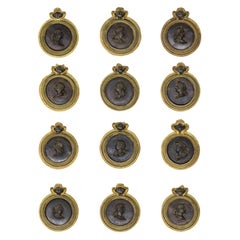
Nineteenth century portraits with busts of Roman emperors and consorts
(12) Terracotta, 31 x 23 cm
The urgent need to propagandistically spread the effigy of the ruler in office throughout the empire produced, in Roman times, the practice of portraying the emperor on the most easily circulated object, coins. The typing of the portrait, in profile and up to the collarbones, thus became a repertoire, to which acronyms synthesizing names, offices and attributes were associated.
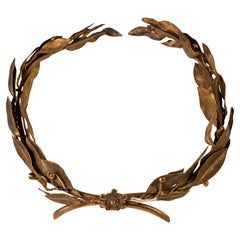
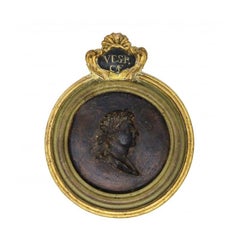
The terracotta roundels present in bas-relief the profiles of the emperors of the gens flavia and claudia, with some spouses. Identification is made easier by the abbreviation of their names and by the initials "CAE", or caesar, imperial qualification, painted on the top of the tondi. The emperors wear the laurea insignis on their heads, a laurel wreath knotted on the nape of the neck, the original symbol of victory in the Greek Pythian Games. The crown was then attributed to the victorious generals, and thus to the emperors, being the imperator, literally, the "commander in charge of the troops". The spouses instead have a traditional bun and the initials "VX", that is uxor, "wife".
Proceeding in chronological order, it is possible to observe the profiles of Livia Drusilla Claudia (LIVI), wife of Augusto, member of the gens Claudia but adopted by the Iulia family when Augusto died; mother of the future emperor Tiberius, she was deified on her death in 29 AD Agrippina Minore (AGGR), mother of Emperor Nero, the first true august of the family, regent while her son was still a child between 49 and 54 AD Nero (NER) , son of Agrippina, ruler during the fire of Rome...
Category
19th Century Italian Antique Classical Roman Abstract Sculptures