Items Similar to Derby Coffee Cup, Monochrome Sepia Landscapes Zachariah Boreman, ca 1785
Want more images or videos?
Request additional images or videos from the seller
1 of 18
Derby Coffee Cup, Monochrome Sepia Landscapes Zachariah Boreman, ca 1785
$2,390per set
£1,773.47per set
€2,065.85per set
CA$3,326.90per set
A$3,704.80per set
CHF 1,928.14per set
MX$45,679.74per set
NOK 24,556.39per set
SEK 23,080.62per set
DKK 15,413.82per set
Shipping
Retrieving quote...The 1stDibs Promise:
Authenticity Guarantee,
Money-Back Guarantee,
24-Hour Cancellation
About the Item
This is a very rare and stunning coffee cup and saucer made by Derby in about 1785. The set has a white ground with graceful gilding, and two stunning little landscapes painted by Zachariah Boreman.
The Derby Porcelain factory has its roots in the late 1740s, when Andrew Planché, a Walloon Huguenot refugee, started making simple porcelain toys shaped like animals in his back yard. In 1756 Staffordshire enameller William Duysbury and banker John Heath started a new porcelain factory with Planché and this was to grow out to the largest factory of its time, buying up the bankrupted Chelsea and Bow factories, as well as the stock of several other workshops including that of James Giles. The combination of various traditions, porcelain making skills and sophisticated clients enabled Duesbury to create one of the best porcelain factories of the 18th and 19th Centuries, which after many ups and downs is still operative today.
Zachariah Boreman was one of the most celebrated painters at Derby. Born in London in 1738, he arrived at Derby around 1774 after working at Chelsea, and remained until 1794, when he left in frustration with Michael Kean, the owner. Even though Boreman became one of the prime landscape painters at Derby, Kean would not pay him more and this caused Boreman to go back to London and work for the Simms decorating studio until his death in 1810. Boreman was known as a highly respected and likable person, and he became famous for his fine landscapes. His style was most probably influenced by Paul Sandby, the chief drawing instructor at the Royal Military Academy at Woolwich. His little landscapes are restrained, with often muted brown and green shades; in Boreman's landscapes, less is more although his drawing and stippled brush style is extraordinarily detailed.
These two landscapes, one of a river with sailing boats, a fortress by the water, and people; the other of some people and a horse by the waterside, a large house in the background. They are beautifully finely painted in monochrome sepia, a popular style at the time. The gilding by Thomas Soar consists of very fine festoons with tied ribbons, wreaths around the landscape paintings, and a fine floral chain on the cup handle.
The set is marked with the hand painted puce crowned double baton Derby mark that was used between 1782 and 1800, as well as an impressed Z and the gilders mark 1 for Thomas Soar.
DOCUMENTATION: a coffee cup and saucer of the same service are shown in colour plate 19 on page 55 of John Twitchett's "Derby Porcelain 1748-1848 An Illustrated Guide".
CONDITION REPORT The set is in excellent antique condition without damage, repairs or crazing, and only some very minor scratches as visible in the pictures.
Antique British porcelain is never perfect. Kilns were fired on coal in the 1700s, and this meant that china from that period can have some firing specks from flying particles. British makers were also known for their experimentation, and sometimes this resulted in technically imperfect results. Due to the shrinkage in the kiln, items can have small firing lines or develop crazing over time, which should not be seen as damage but as an imperfection of the maker's recipes, probably unknown at the time of making. Items have often been used for many years and can have normal signs of wear, and gilt can have signs of slight disintegration even if never handled. I will reflect any damage, repairs, obvious stress marks, crazing or heavy wear in the item description but some minor scratches, nicks, stains and gilt disintegration can be normal for vintage items and need to be taken into account.
There is widespread confusion on the internet about the difference between chips and nicks, or hairlines and cracks. I will reflect any damage as truthfully as I can, i.e. a nick is a tiny bit of damage smaller than 1mm and a chip is something you can easily see with the eye; a glazing line is a break in the glazing only; hairline is extremely tight and/or superficial and not picked up by the finger; and a crack is obvious both to the eye and the finger. Etcetera - I try to be as accurate as I can and please feel free to ask questions or request more detailed pictures!
DIMENSIONS (diameters) 7cm (2.75"); saucer 14.2cm (5.6").
- Creator:Crown Derby (Maker),Derby (Maker)
- Dimensions:Height: 1 in (2.54 cm)Diameter: 1 in (2.54 cm)
- Sold As:Set of 2
- Style:Romantic (In the Style Of)
- Materials and Techniques:
- Place of Origin:
- Period:1780-1789
- Date of Manufacture:ca 1785
- Condition:Wear consistent with age and use. In perfect antique antique condition without damage, crazing or repairs, and only very minimal wear.
- Seller Location:London, GB
- Reference Number:Seller: A-DER731stDibs: LU4805142640902
About the Seller
5.0
Gold Seller
Premium sellers maintaining a 4.3+ rating and 24-hour response times
Established in 2016
1stDibs seller since 2019
225 sales on 1stDibs
Typical response time: 2 hours
- ShippingRetrieving quote...Shipping from: London, United Kingdom
- Return Policy
Authenticity Guarantee
In the unlikely event there’s an issue with an item’s authenticity, contact us within 1 year for a full refund. DetailsMoney-Back Guarantee
If your item is not as described, is damaged in transit, or does not arrive, contact us within 7 days for a full refund. Details24-Hour Cancellation
You have a 24-hour grace period in which to reconsider your purchase, with no questions asked.Vetted Professional Sellers
Our world-class sellers must adhere to strict standards for service and quality, maintaining the integrity of our listings.Price-Match Guarantee
If you find that a seller listed the same item for a lower price elsewhere, we’ll match it.Trusted Global Delivery
Our best-in-class carrier network provides specialized shipping options worldwide, including custom delivery.More From This Seller
View AllH&R Daniel Coffee Cup Duo, Plain Shape, White with Landscape, 1825-1830
By H&R Daniel
Located in London, GB
This is an extremely rare and beautiful coffee cup and saucer made by H&R Daniel some time between 1825 and 1830. The set is potted in the "plain" shape and bears pattern no. 4652 wi...
Category
Antique 1820s English Rococo Revival Tea Sets
Materials
Porcelain
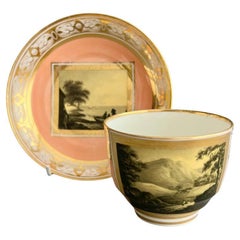
Barr Flight & Barr Teacup, Salmon with Monochrome Sepia Landscapes, ca 1810
By Barr, Flight & Barr Worcester
Located in London, GB
On offer is a very rare teacup and saucer made by Barr Flight & Barr in about 1810. The set has a beautifully soft salmon ground colour, an elegant gilt border motif, and beautiful m...
Category
Antique 1810s English Regency Porcelain
Materials
Porcelain
$1,450 / set
Free Shipping
Chelsea-Derby Chocolate Cup Set, Gilt Stripes, Puce Flowers, Rococo 1770-1775
By Derby, Chelsea-Derby, Chelsea Porcelain
Located in London, GB
This is a beautiful chocolate cup set made by Chelsea-Derby between 1770 and 1775, which was the Rococo era. The set consists of a cup, a saucer and a cover, and is decorated in a st...
Category
Antique 1770s English Rococo Tea Sets
Materials
Porcelain
$1,175 / set
Free Shipping
Worcester Coffee Cup, Monochrome Black Print "Tea Party no.3", Georgian ca 1760
By 1st Period Worcester Dr. Wall
Located in London, GB
This is a very charming coffee cup and saucer made by Worcester in their First Period (sometimes called the Dr Wall Period) in about 1760. The items are decorated in a black overglaz...
Category
Antique 1760s English George III Porcelain
Materials
Porcelain
$590 / set
Free Shipping
Samuel Alcock Tearcup Trio, Maroon, Yellow, Gilt and Fine Landscapes, ca 1845
By Samuel Alcock & Co.
Located in London, GB
A true trio consisting of a teacup, a coffee cup and a saucer, “rustic bean” shape, in deep maroon and pale yellow ground, with gilt and finely painted landscape reserves
Pattern 95...
Category
Antique 1840s English Rococo Revival Tea Sets
Materials
Porcelain
$435 / set
Free Shipping
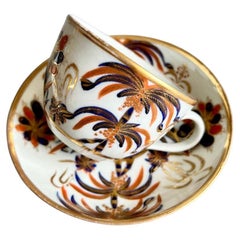
New Hall Hybrid Hard Paste Teacup, Palm Tree patt. 484, Georgian ca 1810
By New Hall
Located in London, GB
This is a beautiful teacup and saucer made by New Hall around the year 1810. The set is decorated in the very desired but rare palm tree pattern with the number 484.
We also have a ...
Category
Antique 1810s English Regency Tea Sets
Materials
Porcelain
You May Also Like
Georgian Derby Cup and Saucer Duo in Pattern 561, Puce Mark Circa 1800
By Derby
Located in Lincoln, Lincolnshire
This is a good porcelain duo of a cup and saucer by the Derby factory, made during the George 111rd period, circa 1800.
Both pieces are well potted in the Hamilton flute shape wit...
Category
Antique Early 19th Century British George III Porcelain
Materials
Porcelain
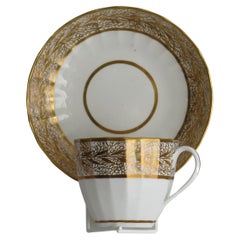
Georgian Derby Trio Tea & Coffee Cup & Saucer Pattern 569, Puce Mark Circa 1795
By Derby
Located in Lincoln, Lincolnshire
This is a good porcelain TRIO of a Tea Cup, Coffee Cup and saucer by the Derby factory, made during the George 111rd period, circa 1795.
The pieces are well potted in the Hamilton...
Category
Antique Late 18th Century British George III Porcelain
Materials
Porcelain
Richard Ginori Italian Porcelain Espresso Coffee Tea Cup Saucer
By Richard Ginori
Located in New York, NY
A beautiful vintage Italian porcelain espresso coffee or tea demitasse cup and saucer 'Toscana' by designer Richard Ginori, circa mid-20th century, ...
Category
Mid-20th Century Italian Country Porcelain
Materials
Ceramic, Porcelain
Richard Ginori Italy Mantua "Italian Scene" Demitasse Cup and Saucer Set
By Richard Ginori
Located in Clifton Springs, NY
Rare Richard Ginori demitasse or espresso cup and saucer set was made of fine semi-translucent porcelain in Italy. It is decorated with early landscape-based Mantua, or "Italian Sce...
Category
Mid-20th Century Italian Art Deco Porcelain
Materials
Porcelain
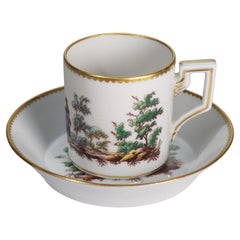
Regency Period Derby Cup and Saucer Duo Hand Painted, Circa 1830
By Royal Crown Derby Porcelain
Located in Lincoln, Lincolnshire
This is a beautiful porcelain duo of a cup and saucer by the Derby factory, made during the late Georgian, Regency period of the first half of the 19th century, circa 1830
The han...
Category
Antique Early 19th Century British Regency Porcelain
Materials
Porcelain
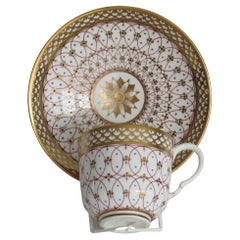
Coffee Cup and Saucer Nantgarw Porcelain, circa 1815
By Nantgarw Pottery, Moses Webster
Located in Melbourne, Victoria
A rare coffee cup and saucer in Nantgarw’s superb soft-paste porcelain. Each piece is gilded and decorated in one of the London workshops with ...
Category
Antique 1810s Welsh Regency Porcelain
Materials
Porcelain