Tri-State Area - Still-life Prints
to
110
135
94
311
171
75
Overall Width
to
Overall Height
to
211
107
93
42
40
40
18
7
7
5
3
1
66
29
27
24
16
4
3
579
199
1
2
3
3
2
8
55
144
238
88
2
430
267
86
181
177
164
124
89
75
63
59
59
44
40
39
35
31
30
25
25
24
23
23
287
213
123
67
56
78
376
786
2,789
1,230
Item Ships From: Tri-State Area
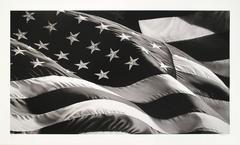
Untitled (Flag)
By Robert Longo
Located in New York, NY
Untitled (Flag), 2013
Archival pigment print
26 1/4 × 43 in (66.7 × 109.2 cm)
Edition of 36
Category
2010s Contemporary Tri-State Area - Still-life Prints
Materials
Archival Pigment
Price Upon Request
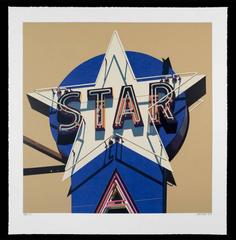
Star, from American Signs Portfolio
By Robert Cottingham
Located in New York, NY
ROBERT COTTINGHAM
Star, from American Signs portfolio, 2009
screenprint in colors, on wove paper, with full margins,
40 1/8 x 39 1/8 in (101.9 x 99.4 cm)
signed, dated `2009' and numbered edition of 100 in pencil
--
Robert Cottingham
B. 1935, BROOKLYN, NEW YORK
Born in 1935 in Brooklyn, Robert Cottingham is known for his paintings and prints of urban American landscapes, particularly building facades, neon signs, movie marquees, and shop fronts. After serving in the U.S. Army from 1955 through 1958, he earned a BFA at Pratt Institute, Brooklyn, in 1963. Cottingham began his professional artistic career as an art director for the advertising firm Young and Rubicam in the early 1960s. Although he is typically associated with Photorealism, Cottingham never considered himself a Photorealist, but rather a realist painter working in a long tradition of American vernacular scenes. In this respect, his work often draws parallels to a number of American painters such as Stuart Davis, Charles Demuth, Edward Hopper, and Charles Sheeler.
Cottingham’s interest in the intersections of art and commerce derive from his career as an adman and the influence of Pop art. Many of his paintings convey an interest in typography and lettering, as well as an awareness of the psychological impact of certain isolated words and letters. In his facades, techniques from advertising, namely cropping and enlarging, often produce words of enigmatic or comical resonance such as “Art,” “Ha,” or “Oh.” Cottingham’s enlarged sense of scale is reminiscent of James Rosenquist’s work, while his interest in text suggests the influence of Robert Indiana and Jasper Johns. In general, Cottingham viewed his work as continuing the legacy of Pop artists such as Andy Warhol, who also had a background in advertising.
In 1964, Cottingham relocated to Los Angeles for work. There, inspired by the drastically different environment of the West Coast metropolis, he began to commit seriously to painting. Fascinated by Hollywood’s exaggerated glitz and the downtrodden atmosphere of the downtown, Cottingham saw in Los Angeles the relics of a bygone commercial heyday and desired to capture its kitschy and uncanny atmosphere, bathed in the near perpetual sunlight of Southern California.
In 1968, Cottingham ended his advertising career in order to devote all his time to painting. In the late 1960s, he started using photography in his practice, first as an initial reference point for his process. After selecting a photograph, he translates it into black-and-white drawings by projecting the image onto gridded paper...
Category
Early 2000s Photorealist Tri-State Area - Still-life Prints
Materials
Screen

Price Upon Request
American Signs portfolio
By Robert Cottingham
Located in New York, NY
ROBERT COTTINGHAM
American Signs portfolio, 2009
The complete set of twelve screenprints in colors, on wove paper, with full margins, 40 1/8 x 39 1/8 in (101.9 x 99.4 cm)
all signed, dated `2009' and numbered edition of 100 in pencil, published by Exhibit A Fine Art and Editions and American Images Atelier, New York, all in excellent condition, contained in original gray silk-covered box with artist and title embossed with gold foil.
Robert Cottingham
B. 1935, BROOKLYN, NEW YORK
Born in 1935 in Brooklyn, Robert Cottingham is known for his paintings and prints of urban American landscapes, particularly building facades, neon signs, movie marquees, and shop fronts. After serving in the U.S. Army from 1955 through 1958, he earned a BFA at Pratt Institute, Brooklyn, in 1963. Cottingham began his professional artistic career as an art director for the advertising firm Young and Rubicam in the early 1960s. Although he is typically associated with Photorealism, Cottingham never considered himself a Photorealist, but rather a realist painter working in a long tradition of American vernacular scenes. In this respect, his work often draws parallels to a number of American painters such as Stuart Davis, Charles Demuth, Edward Hopper, and Charles Sheeler.
Cottingham’s interest in the intersections of art and commerce derive from his career as an adman and the influence of Pop art. Many of his paintings convey an interest in typography and lettering, as well as an awareness of the psychological impact of certain isolated words and letters. In his facades, techniques from advertising, namely cropping and enlarging, often produce words of enigmatic or comical resonance such as “Art,” “Ha,” or “Oh.” Cottingham’s enlarged sense of scale is reminiscent of James Rosenquist’s work, while his interest in text suggests the influence of Robert Indiana and Jasper Johns. In general, Cottingham viewed his work as continuing the legacy of Pop artists such as Andy Warhol, who also had a background in advertising.
In 1964, Cottingham relocated to Los Angeles for work. There, inspired by the drastically different environment of the West Coast metropolis, he began to commit seriously to painting. Fascinated by Hollywood’s exaggerated glitz and the downtrodden atmosphere of the downtown, Cottingham saw in Los Angeles the relics of a bygone commercial heyday and desired to capture its kitschy and uncanny atmosphere, bathed in the near perpetual sunlight of Southern California.
In 1968, Cottingham ended his advertising career in order to devote all his time to painting. In the late 1960s, he started using photography in his practice, first as an initial reference point for his process. After selecting a photograph, he translates it into black-and-white drawings by projecting the image onto gridded paper...
Category
Early 2000s American Realist Tri-State Area - Still-life Prints
Materials
Screen

Price Upon Request
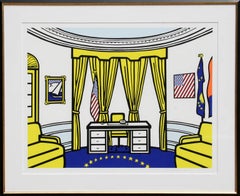
The Oval Office
By Roy Lichtenstein
Located in Long Island City, NY
Artist: Roy Lichtenstein
Title: The Oval Office (C. 277)
Year: 1992
Medium: Screenprint on Rives, signed, dated and numbered in pencil
Edition: 17/175
Image: 30 x 39.25 inches
...
Category
1990s Pop Art Tri-State Area - Still-life Prints
Materials
Screen
Price Upon Request
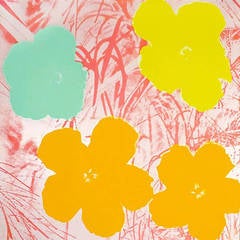
Flowers FS II.70, 1970
By Andy Warhol
Located in New York, NY
Andy Warhol
Flowers (FS II.70), 1970
silkscreen on paper
36 x 36"
ed. of 250
signed in ball point pen and numbered with a rubber stamp on verso
Category
1960s Pop Art Tri-State Area - Still-life Prints
Materials
Archival Ink
Price Upon Request
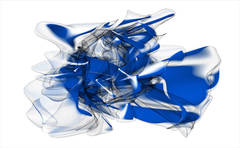
Blue Sonica Whisper
By Marjan Moghaddam
Located in New York, NY
Blue Sonica Whisper
Category
21st Century and Contemporary Contemporary Tri-State Area - Still-life Prints
Materials
Archival Ink
Price Upon Request