Items Similar to Salt on Mina Mina
Want more images or videos?
Request additional images or videos from the seller
1 of 14
Dorothy NapangardiSalt on Mina Mina2002
2002
$15,500
£11,962.64
€13,618.75
CA$22,132.66
A$24,139.99
CHF 12,719.71
MX$289,502.84
NOK 160,157.43
SEK 149,423.65
DKK 101,708.02
About the Item
Dorothy Napangardi spent her early childhood living a nomadic life at Mina Mina near Lake Mackay in the Tanami Desert during the late 1950s and early 1960s. This idyllic life came to a close when her family was forcibly relocated to the government settlement at Yuendumu. When Dorothy married, she moved to Alice Springs and bore him four daughters and later, after the marriage eventually broke down, gave birth to her youngest child, Annette, by another man. It was here, in Alice Springs in 1987, that she began painting.
Dorothy’s early artistic endeavors were heavily influenced by memories of her childhood. Her subject matter was principally the Bush Plum and Bush Banana, wild fruits that grow in abundance near Mina Mina, changing in color as they ripen, which she mirrored in her depictions.
The paintings, at such an early stage in her career, clearly marked Dorothy as an artist of great talent. Her superb sense of composition created a rhythmic effect as semi-naturalistic depictions were entwined in an altogether geometric formation.
In 1990, Dorothy began painting exclusively for the Premont gallery, the environment and financial security that was provided enabled Dorothy to experiment freely and develop her artistic repertoire rapidly and the relationship that developed lasted up until her tragic death in 2013. Dorothy created works that drew on her innate visual consciousness, developed during those early years spent in the vast unlimited expanses of the desert.
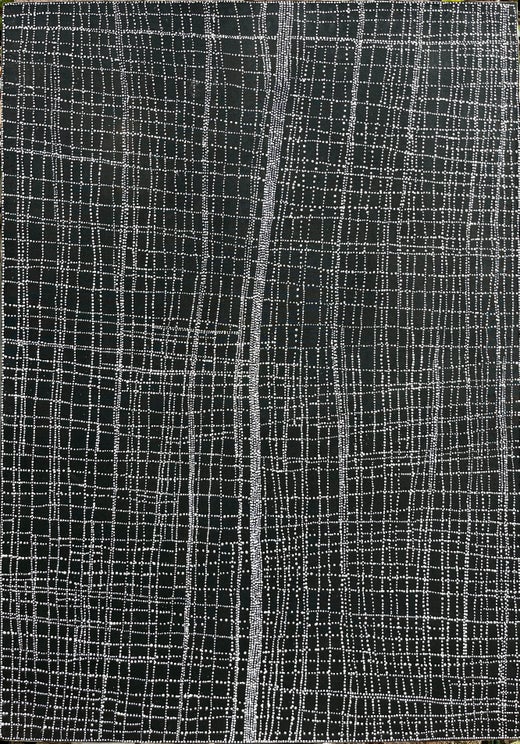
From 1997 onward, Dorothy began producing works which traced the grid-like patterns of the salt encrustations on the Mina Mina clay pans marking a significant artistic shift in her work. Over three years, her paintings became less and less contrived and increasingly spare, all detail pared back to the barest essentials. These new works, in which Dorothy began to explore the Women’s Digging Sticks Dreaming and other stories related to the travels of the Karntakurlangu, compel the spectator's eye to dance across the painted surface, just as these ancestral women danced in the hundreds across the country during the region's creation.
Dancing digging sticks magically emerged from the ground at Mina Mina, equipping the large band of women for their travels over a vast stretch of country. The tall desert oaks which are found there today symbolize the emergence of the digging sticks that rose up from beneath the ground itself. As these works developed, her extraordinary spatial ability enabled her to create mimetic grids of the salt encrustations across the claypans of Mina Mina.
The lines of white dots trace the travels of her female ancestors as they danced their way, in joyous exultation, through the saltpans, spinifex and sandhills, clutching their digging sticks in their outstretched hands.
Little wonder then, that the surfaces of Dorothy’s canvases become dense rhythms of grids, as she mapped the paths of these dancing women. In 2001 Dorothy Napangardi was the recipient of the 18th National Aboriginal and Torres Strait Islander Art Award and in the following year a solo exhibition of her work was curated for the Museum of Contemporary Art in Sydney.
- Creator:Dorothy Napangardi (1950 - 2013, Aboriginal Australian)
- Creation Year:2002
- Dimensions:Height: 68.51 in (174 cm)Width: 48.23 in (122.5 cm)
- Medium:
- Movement & Style:
- Period:
- Condition:
- Gallery Location:Miami, FL
- Reference Number:1stDibs: LU13617283412
Dorothy Napangardi
Dorothy Napangardi spent her early childhood living a nomadic life at Mina Mina near Lake Mackay in the Tanami Desert during the late 1950s and early 1960s. She recalled camping at claypans and soakages with her mother, Jeanie Lewis Napururrla, learning to collect the plentiful bush tucker and grinding seeds for damper cooked on hot ashes. This idyllic life came to a close when her family was forcibly relocated to the government settlement at Yuendumu. Dorothy’s early artistic endeavors were heavily influenced by memories of her childhood. Her subject matter was principally the Bush Plum and Bush Banana, wild fruits that grow in abundance near Mina Mina, changing in colour as they ripen, which she mirrored in her depictions. The paintings, at such an early stage in her career, clearly marked Dorothy as an artist of great talent. Her superb sense of composition created a rhythmic effect as semi-naturalistic depictions were entwined in an altogether geometric formation. In the late 1980s, the government marketing company Aboriginal Arts Australia closed its Alice Springs outlet and its manager Roslyn Premont opened her own, Gallery Gondwana. From 1997 onward, Dorothy began producing works which traced the grid-like patterns of the salt encrustations on the Mina Mina clay pans marking a significant artistic shift in her work. Over a three-year period, her paintings became less and less contrived and increasingly spare, all detail pared back to the barest essentials. These new works, in which Dorothy began to explore the Women’s Digging Sticks Dreaming and other stories related to the travels of the Karntakurlangu, compel the spectator’s eye to dance across the painted surface, just as these ancestral women danced in the hundreds across the country during the region’s creation. Dancing digging sticks magically emerged from the ground at Mina Mina, equipping the large band of women for their travels over a vast stretch of country. The tall desert oaks which are found there today symbolise the emergence of the digging sticks that literally rose up out from beneath the ground itself. As these works developed, her extraordinary spatial ability enabled her to create mimetic grids of the salt encrustations across the claypans of Mina Mina. The lines of white dots trace the travels of her female ancestors as they danced their way, in joyous exultation, through the saltpans, spinifex and sandhills, clutching their digging sticks in their outstretched hands. In 2001 Dorothy Napangardi was the recipient of the 18th National Aboriginal and Torres Strait Islander Art Award and in the following year a solo exhibition of her work was curated for the Museum of Contemporary Art in Sydney. Dorothy’s paintings have enjoyed considerable commercial success. Creating these paintings has in no way undermined her personal integrity. While Dorothy Napangardi’s paintings may be seen as important commodities and major investments, her work can be so beautiful and ethereal, as to border on the sublime.
About the Seller
5.0
Vetted Professional Seller
Every seller passes strict standards for authenticity and reliability
Established in 2011
1stDibs seller since 2012
75 sales on 1stDibs
- ShippingRetrieving quote...Shipping from: Les Adrets-de-l'Estérel, France
- Return Policy
More From This Seller
View AllNgayuku Kgura (My Country)
By Yannima Tommy Watson
Located in Miami, FL
Yannima Tommy Watson is a Pitjantjatjara artist born around the 1930s, in the bush some 44km west of the small isolated community of Irrunytju. Not yet very well known to the French public, despite his participation in the architectural project of the Musée du Quai Branly, Tommy Watson is nevertheless often considered the greatest living Aboriginal artist.
Like many aborigines of his generation, he lived a traditional, nomadic or semi-nomadic life before his contact with Western civilization; then he will occupy the only jobs that the Aborigines find: herdsmen (until Yuendumu), laborers for the construction of infrastructures in the desert. Throughout this period he became familiar with his "country", a harsh region, and deepened his knowledge, both profane and sacred, relating to Dreams and Dreamtimes, to the connections between sacred sites and the Ancestors. He will even work in Papunya, where the artistic movement started. But the Pijantjarra are intransigent with tradition…no question at this time of revealing the motives and the secret stories.
The North of South Australia, the region where he is from, was touched by the pictorial movement only at the very beginning of the 2000s. In 2001, Tommy began his career as an artist in Irrunytju (Wingellina). He is a young artist… He learns by observing other painters and draws on the experiences of a long life and on the exceptional knowledge he has stored up. But quickly he will find his way, a radically new style where color plays a major role. Very quickly, the iconography now well known by the artists of Yuendumu, or the Western Desert, Balgo or Lajamanu disappeared. The symbols are no longer there. As Rover Thomas, Emily Kame or Paddy Bedford had done before him, this is a real artistic revolution. For Tommy, it is not a question of describing his Dream (Caterpillar), the routes taken by the Ancestors. He concentrates on a site, a story, sometimes very profane, the memory of a meeting, of a hunting party, tries to condense his memories, the information of which he is the depositary, to add a poetic touch to it, sometimes melancholy, and this gives a painting with a very abstract aspect. It is a painting where the emotion is very present, undoubtedly less cerebral than the art of the neighbors of the north the Pintupi, like Ronnie Tjampitjinpa, George...
Category
2010s Contemporary Abstract Paintings
Materials
Linen, Cotton Canvas, Acrylic
Tingari
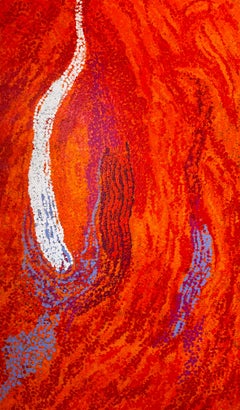
By Ronnie Tjampitjinpa
Located in Miami, FL
Ronnie Tjampitjinpa was born around 1943 at Tjiturrunya, about 100km west of the Kintore ranges in Western Australia. Following an extended drought in the 1950s, Ronnie's family move...
Category
2010s Abstract Geometric Abstract Paintings
Materials
Cotton Canvas, Acrylic
Eternity
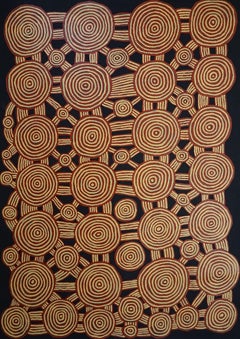
By Evelyne Ballestra
Located in Miami, FL
Evelyne Ballestra's work with signs, symbols and esoteric spirituality reflects her passion for the ancient past and represents a symbolic return to the ground from which we emerged. Her work creates a commentary about “beginnings” and the transmission of signs and emotions through visual elements evoking a spiritual essence to our scientific notion of etymology. After studying under Rolf Dürig, Ballestra began her flower...
Category
21st Century and Contemporary Expressionist Figurative Paintings
Materials
Canvas, Oil
Untitled
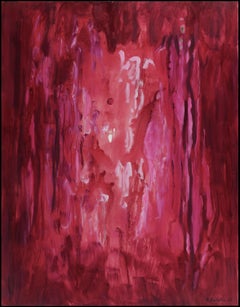
By Jean Sanglar
Located in Miami, FL
Jean Sanglar was born in France in 1926. He draws with taste and talent from an early age, however, his family will only consider this a mere hobby. After studying law, he later took...
Category
Late 20th Century Neo-Expressionist Abstract Paintings
Materials
Mixed Media, Oil Pastel
Aux Confins du Dire
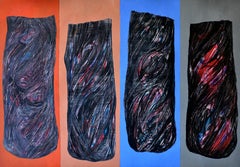
By Evelyne Ballestra
Located in Miami, FL
Evelyne Ballestra's work with signs, symbols and esoteric spirituality reflects her passion for the ancient past and represents a symbolic return to the ground from which we emerged....
Category
21st Century and Contemporary Expressionist Figurative Paintings
Materials
Canvas, Oil
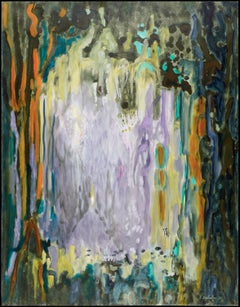
Noir - Pierre I
Located in Miami, FL
Alexandre Valette holds a master's degree in Art History and is an artist with multiple artistic practices. He has been exploring drawing since his y...
Category
2010s Contemporary Abstract Paintings
Materials
Canvas, Ink, Acrylic
You May Also Like
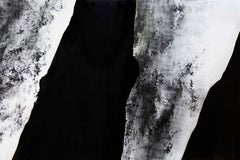
Untitled 593 - 21st Century, Contemporary Art, Abstract, Acrylic Painting
By Maria Paola Coda
Located in Barcelona, Catalonia
Maria Paola Coda's creative process dwells on a permanent search for the beauty hiding within our state of mind. Coda examines and translates the vibratory element of beauty that goe...
Category
21st Century and Contemporary Contemporary Abstract Paintings
Materials
Canvas, Acrylic
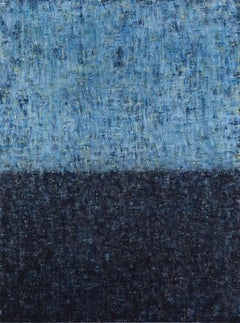
Untitled 3389 - 21st Century, Contemporary Art, Abstract, Acrylic Painting
By Maria Paola Coda
Located in Barcelona, Catalonia
Maria Paola Coda's creative process dwells on a permanent search for the beauty hiding within our state of mind. Coda examines and translates the vibratory element of beauty that goe...
Category
21st Century and Contemporary Contemporary Abstract Paintings
Materials
Canvas, Acrylic
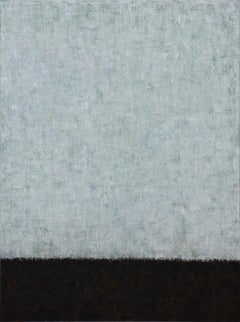
Untitled 1999- 21st Century, Contemporary Art, Abstract, Acrylic Painting
By Maria Paola Coda
Located in Barcelona, Catalonia
Maria Paola Coda's creative process dwells on a permanent search for the beauty hiding within our state of mind. Coda examines and translates the vibratory element of beauty that goe...
Category
21st Century and Contemporary Contemporary Abstract Paintings
Materials
Canvas, Acrylic
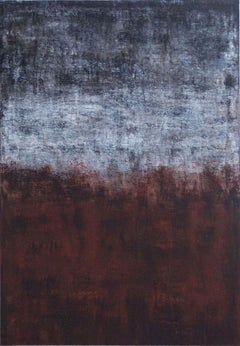
1811 - 21st Century, Contemporary Art, Abstract, Acrylic Painting
By Maria Paola Coda
Located in Barcelona, Catalonia
Maria Paola Coda’s matter painting is born as a series of respectful monuments to beauty as well as a channel of the poetical emotions of the mutation. Maria Paola Coda’s painting is...
Category
21st Century and Contemporary Contemporary Abstract Paintings
Materials
Canvas, Acrylic
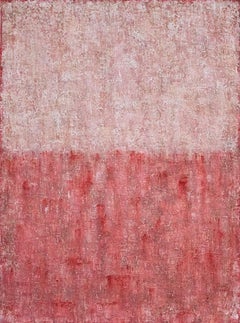
On the Verge of Singularity
Located in Zofingen, AG
On the Verge of Singularity
The past dissolves, and the structures that once shaped reality no longer hold. Uncertainty is not a transition—it is the rupture that demands the emerge...
Category
2010s Contemporary Abstract Paintings
Materials
Canvas, Plaster, Acrylic
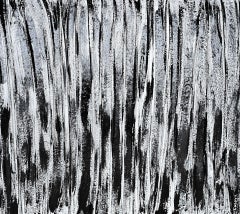
Untitled 173 - 21st Century, Contemporary Art, Abstract, Acrylic Painting
By Maria Paola Coda
Located in Barcelona, Catalonia
“Untitled 173” presents a striking visual dichotomy, with its canvas split horizontally into two distinct halves. The upper section envelops the viewer in a deep black, suggesting an...
Category
21st Century and Contemporary Contemporary Abstract Paintings
Materials
Canvas, Acrylic