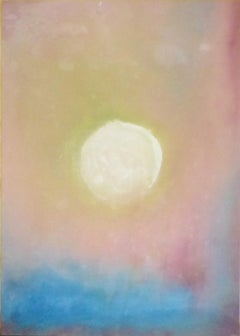
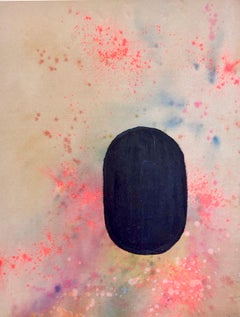
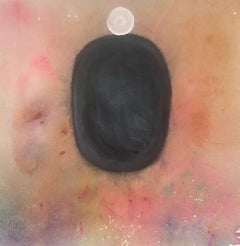
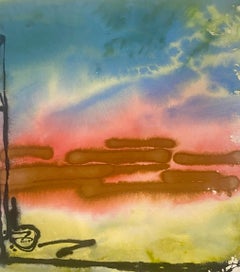
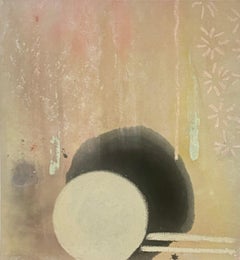
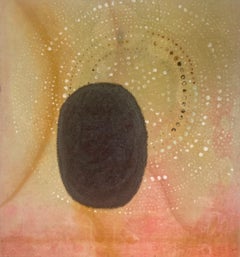
Waterline Fine Art, Austin, TX is pleased to present the following work:
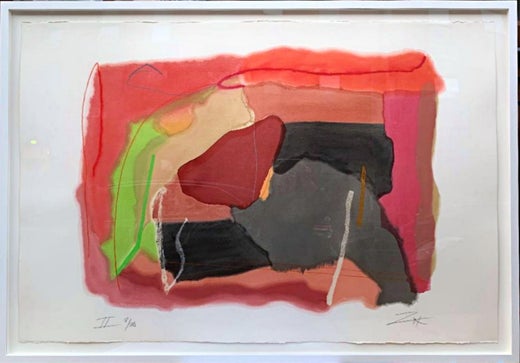
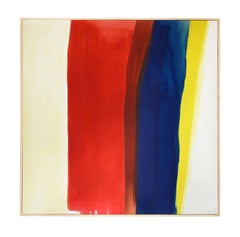
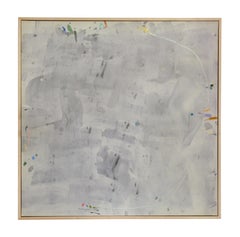
Acrylic on canvas. Signed and dated lower right, titled verso.
69 x 68.25 in.
70.5 x 70 in. (framed)
Custom framed in a solid maple floater.
Provenance
Private Collection, Hilton Head Island, SC
Cleve Gray was born Cleve Ginsberg in New York on September 22, 1918. The family subsequently changed its surname to ‘Gray’ in 1936. He attended the Ethical Culture School in New York, and completed his college preparatory studies at Phillips Academy in Andover, MA, where he won the Morse Prize for most promising art student. In 1940, Gray graduated summa cum laude from Princeton University with degrees in art and archaeology. He wrote his thesis on Chinese landscape painting, which would later become an important influence on his own painterly practice.
Gray joined the U.S. Army in 1942 and was deployed to the U.K., France, and Germany, where he sketched wartime destruction. After the liberation of Paris in 1944, he began informal studies with the French artists André Lhote and Jacques Villon, which continued following the conclusion of the war. Soon after, he began to exhibit his work at the Galerie Durand-Ruel in Paris, followed shortly by his first solo exhibition at the Jacques Seligmann Gallery in New York in 1947. Before 1950, Gray would participate in group exhibitions at such venerable institutions as the Metropolitan Museum of Art, New York; the Corcoran Gallery, Washington, D.C.; the Whitney Museum of American Art, New York; and the Art Institute of Chicago.
In the 1960s, he formed a close friendship with the first generation Abstract Expressionist Barnett Newman. It was during this time that Gray experienced an artistic metamorphosis, dissolving his earlier cubist compositions in a sea of distilled color. This dramatic body of work marked the beginning of an artistic meditation that would last for over 40 years. The rigors of French modernism, the ethos of Abstract Expressionism, and the meditative restraint of Chinese and Japanese scroll painting commingle with astounding affect. The atmospheric, subdued tones of his 1960s paintings gradually gave way to bright, monochromatic fields of color, hazily washed onto the canvas in stain like swathes. Much of his work from the last three decades of his career feature striking graphic brushwork that conjures the influence of Japanese and Chinese calligraphy.
Beginning with his marriage in 1957 to the French author and New Yorker staff writer, Francine Du Plessix, Gray would spend the remainder of his life working out of his home base in Warren, CT, while continuously exhibiting and participating in residencies around the world. He enjoyed representation and exhibitions with some of the most influential galleries of the day, including the Betty Parsons Gallery, Staempfli Gallery, Salander-O’Reilly Galleries, Eva Cohon Gallery, and Berry-Hill Gallery. Cleve Gray died in Hartford, CT in 2004, at the age of 86.
Gray's work is included in the collections of the Metropolitan Museum of Art, the Museum of Modern Art (MoMA), the Whitney Museum of American Art, the Brooklyn Museum, the Solomon R. Guggenheim Museum, and many other museums and institutional collections around the world.
Source: The New York Times and
Loretta Howard...