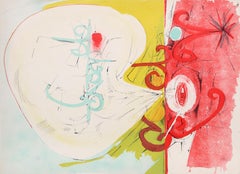
Items Similar to Dangerous Liaisons: Yellow, red, Tiffany blue abstract print with poetry
Want more images or videos?
Request additional images or videos from the seller
1 of 9
Rene RicardDangerous Liaisons: Yellow, red, Tiffany blue abstract print with poetry1990
1990
$3,000
£2,227.34
€2,595.46
CA$4,164.97
A$4,658.78
CHF 2,424.46
MX$57,351.17
NOK 30,844.11
SEK 28,937.85
DKK 19,364.75
Shipping
Retrieving quote...The 1stDibs Promise:
Authenticity Guarantee,
Money-Back Guarantee,
24-Hour Cancellation
About the Item
Touched by the influence of Andy Warhol, champion of a young Jean-Michel Basquiat, Rene Ricard served as enfant terrible of the 1980s New York art scene. In this abstract painted composition, Ricard combines expressive poetry with vibrant color. A bright yellow forms the background for two rounded rectangles printed in Tiffany blue, a favorite color of Ricard. Rimmed with bright red, the rectangles contain a hand-written poem in red cursive. Below the title, which is printed across both frames, the poem reads:
"It is inconceivable that a Group of people Would conspire to plot the Destruction Of an individual. Who Would Want to Harm one? / In the House of Lords alone, I can count up to...Not even a memory,...One Could become not even a memory, Say a consortium of enemies / Posing as collectors Bought up an Artist's entire output...A match, a Flash and good Bye posterity."
Rene Ricard was known to destroy his own art -- here, as in many of his works, he speaks obliquely about his own self-destructive excesses. Dangerous Liaisons includes another recurrent Ricard motif: the shapes of two inked and printed lithography stones as the poems' frames, suggesting the symbiotic expressiveness of poetry and visual art. Here the heavy limestone slabs used to print lithographs function as literal and figurative frames for Ricard's urgent cursive and emotionally-charged poetry.
Ricard was a poet and art critic who published numerous books of his poetry, and his increasing use of text in his work over the 1980's and early 1990's reflects this interest in the written word. He viewed visual art and poetry not as separate mediums but as interconnected means of expression that could enhance each other. Ricard's confessional hand-painted and hand-written poetry is almost always accompanied by the artist's outsized signature, integrated into the composition, or placed at its center. Here, Ricard signs his initials in the plate, and again on the paper in a flourish of red pencil, displaying the artist's unabashed confidence and flamboyance.
This confidence (and Ricard's bedroom-eyed allure) attracted the attention of Andy Warhol, and the young Rene (formerly Albert Napoleon Ricard) became his protege. He would appear in three Warhol films, even playing the Factory founder himself in "Andy Warhol Story". Warhol would later call the famously acid-tongued Ricard "The George Sanders of the Lower East Side, the Rex Reed of the art world."
By the early 1980s, Rene Ricard was a fixture in the New York art scene, not only as an accomplished artist, but as a critic. Penning enlightening and poetic essays for Artforum, he turned his attention to rising stars such as Julian Schnabel and Alex Katz. Ricard famously wrote the first major article on Jean-Michel Basquiat. “The Radiant Child” is credited with launching Basquiat’s career, and is considered a seminal contemporary art essay.
A photograph of the lithography stones from which Dangerous Liaisons was printed is published with an accompanying poem in Ricard's 1990 book of poetry Trusty Sarcophagus, published by Inanout Press and printed in Italy. (pp 54-55)
- Creator:Rene Ricard (1946 - 2014, American)
- Creation Year:1990
- Dimensions:Height: 16.5 in (41.91 cm)Width: 23 in (58.42 cm)
- Medium:
- Movement & Style:
- Period:
- Condition:This print is not previously owned and has been stored in the archives of the publisher since its publication.
- Gallery Location:New York, NY
- Reference Number:1stDibs: LU121129192122
Rene Ricard
Born Albert Napoleon, artist Rene Ricard moved to New York in the 1960s at the age of 18. With that relocation, Albert died, and Rene was born. Instantly adopted into Andy Warhol’s glittering orbit, Ricard thrived in the city, with its heady concentration of art, culture, and debauchery. He acted in underground films, playing Warhol in the artist’s own Andy Warhol Story, and was lauded by the New York Times in 1981 as “splendid” for his turn in the independent film Underground USA. He was a renowned art writer who launched the careers of artist like Jean-Michel Basquiat and Keith Haring with his poetic essays. In New York, Ricard found the center of his life. In his memoir “Rene Ricard” painter and close friend William Rand calls the artist “the Baudelaire of Avenue C…a brilliant, elusive and glamorous underground figure” adding that Rene’s stomping ground, the East Village, was a “…Halloween show all year round: squatters…hustlers, freaks…” Ricard could be found at any given time of day or night walking these streets, linking up with an endless stream of friends and acquaintances. The city’s underbelly was a bustling hub of culture: one could find artists, critics, gallerists and poets such as Nan Goldin, Julian Schnabel, Francesco Clemente, Bill Stelling, Jean-Michel Basquiat, and Allen Ginsburg mingling in the same gritty milieu. Like the rapidly-changing city, Rene's life was in flux: he moved between living situations and struggled intermittently with addiction, leaving a trail of makeshift canvases and alternately bleak, tender, and acerbic poetry. He had gained prominence and fame as an art critic and poet throughout the 1960s and 70s, but his nascent painting career took shape after gaining the attention of the Petersburg Press Gallery. They were to present his first exhibition in New York in 1990. The upcoming show proved to be a motivating force, harnessing Ricard's raw talent by providing him with studio assistants and a place to work at Petersburg’s studio on Lafayette Street. The show was to be entitled “Mal de Fin”. French for "Bad End", Mal de Fin may be a play on "fin de siècle": the end of an era and the beginning of another, and "mal du siècle": sickness of the century, a phrase attributed to the 18th/19th century French writer François-René de Chateaubriand. Chateaubriand’s notion of turn-of-the-century ennui no doubt resonated with the famously moody artist, and Ricard’s name change may have been inspired by Chateaubriand’s first name François-René. Mal de Fin’s body of work reflected not only his wild lifestyle, but the artist’s interest in spirituality, literature, and art itself.
About the Seller
5.0
Recognized Seller
These prestigious sellers are industry leaders and represent the highest echelon for item quality and design.
Gold Seller
Premium sellers maintaining a 4.3+ rating and 24-hour response times
Established in 1968
1stDibs seller since 2019
320 sales on 1stDibs
Typical response time: 1 hour
- ShippingRetrieving quote...Shipping from: New York, NY
- Return Policy
Authenticity Guarantee
In the unlikely event there’s an issue with an item’s authenticity, contact us within 1 year for a full refund. DetailsMoney-Back Guarantee
If your item is not as described, is damaged in transit, or does not arrive, contact us within 7 days for a full refund. Details24-Hour Cancellation
You have a 24-hour grace period in which to reconsider your purchase, with no questions asked.Vetted Professional Sellers
Our world-class sellers must adhere to strict standards for service and quality, maintaining the integrity of our listings.Price-Match Guarantee
If you find that a seller listed the same item for a lower price elsewhere, we’ll match it.Trusted Global Delivery
Our best-in-class carrier network provides specialized shipping options worldwide, including custom delivery.More From This Seller
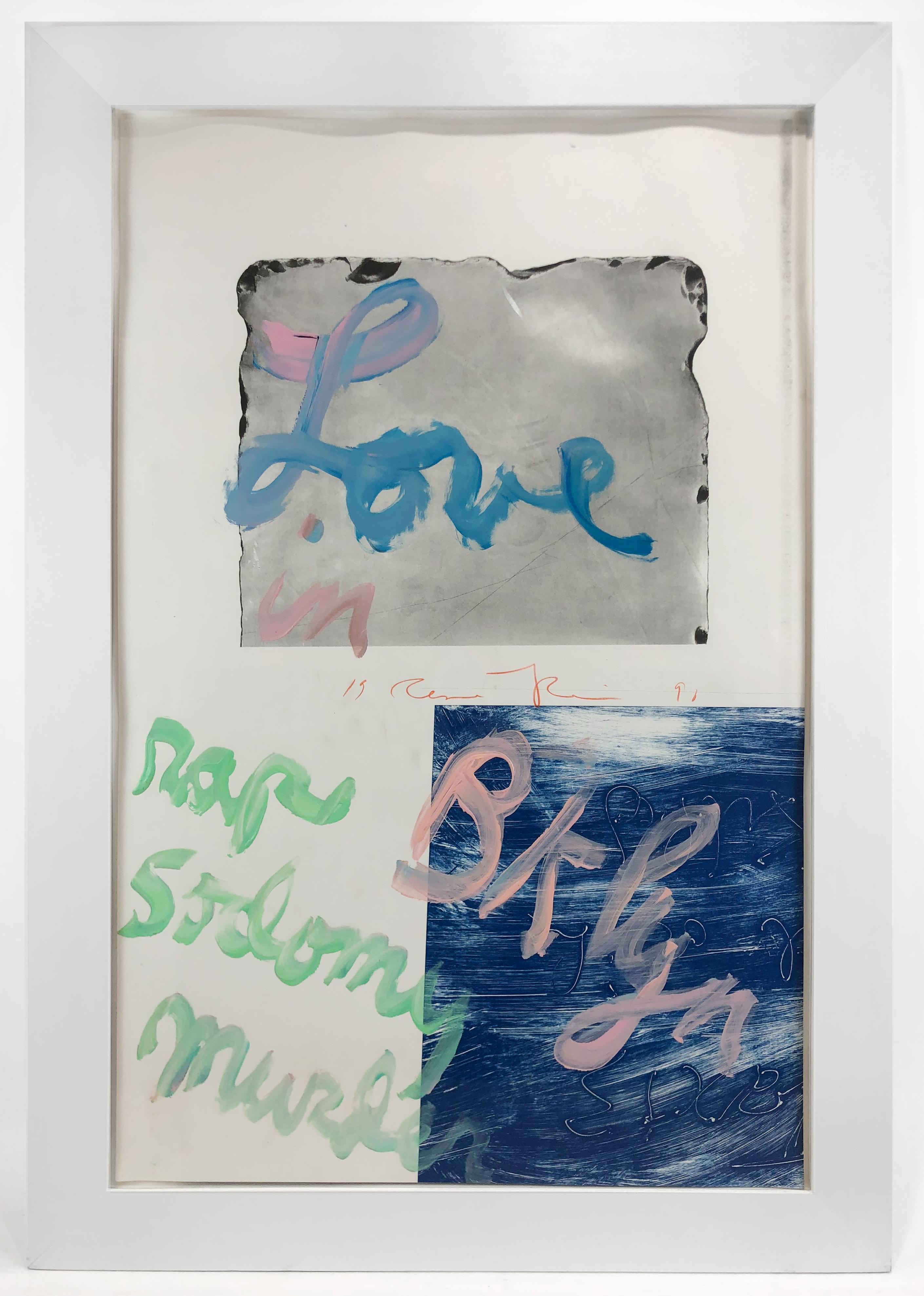
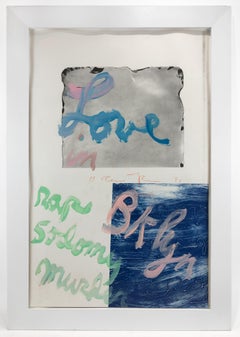
View AllLove in Brooklyn by Rene Ricard poetry painting
By Rene Ricard
Located in New York, NY
Love in Brooklyn, painted in baby blue, light pink, and pale green, depicts a stark image of Brooklyn, which had not yet seen the development spreading across Manhattan: “Love in Bro...
Category
1990s Abstract Paintings
Materials
Oil, Acrylic, Screen
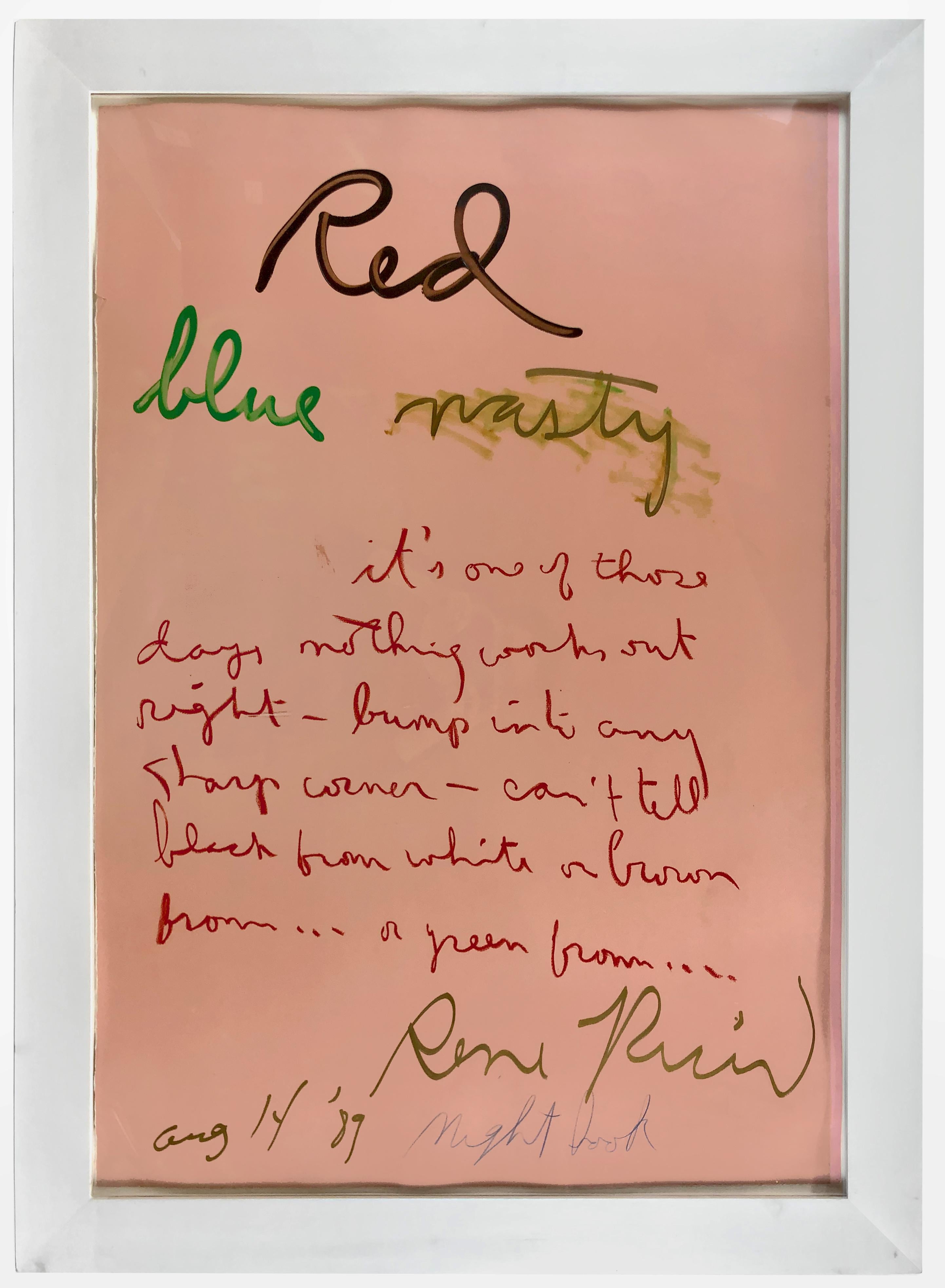
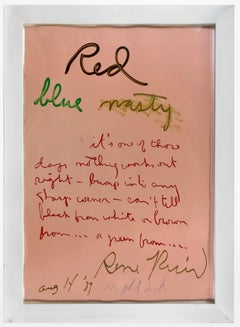
Rene Ricard Red Blue Nasty, 1989 poetry painting Keith Haring reference
By Rene Ricard
Located in New York, NY
Frustration is center stage, written in cursive: "It's one of those days nothing works out right -- bump into any sharp corner – can’t tell flesh from white or brown from…or green fr...
Category
1980s Contemporary Abstract Paintings
Materials
Oil, Acrylic, Screen
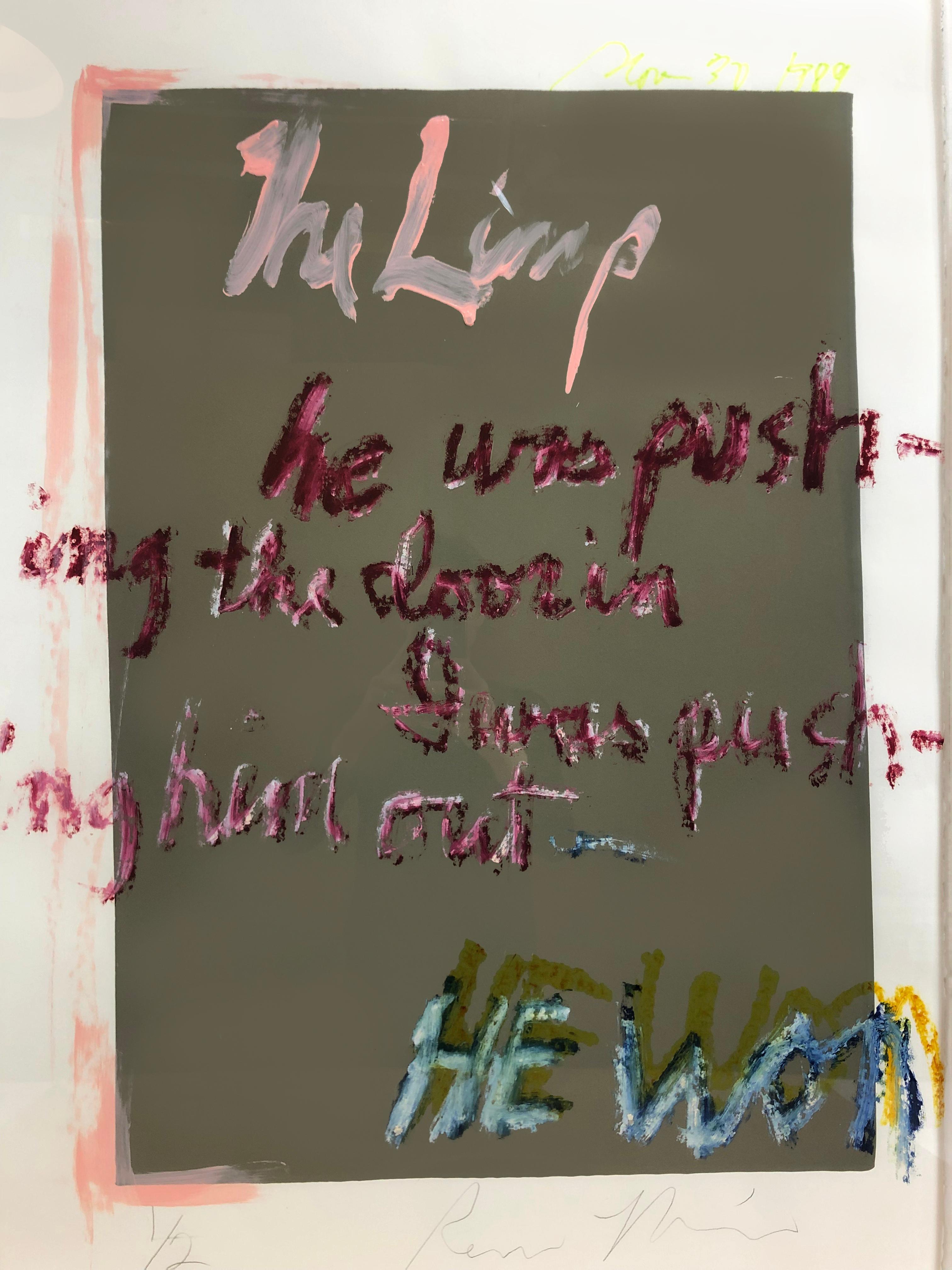
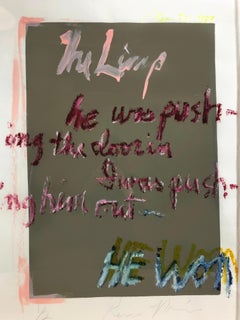
The Limp by Rene Ricard abstract poetry painting
By Rene Ricard
Located in New York, NY
The Limp conjures the image of Rene consumed with energy and righteousness, then resignation: "He was pushing the door in, I was pushing him out / He won". The words are scrawled in ...
Category
1980s Abstract Abstract Paintings
Materials
Oil, Acrylic, Screen
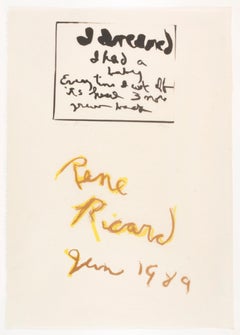
I Dreamed by Rene Ricard: abstract yellow and black brushwork with poetry
By Rene Ricard
Located in New York, NY
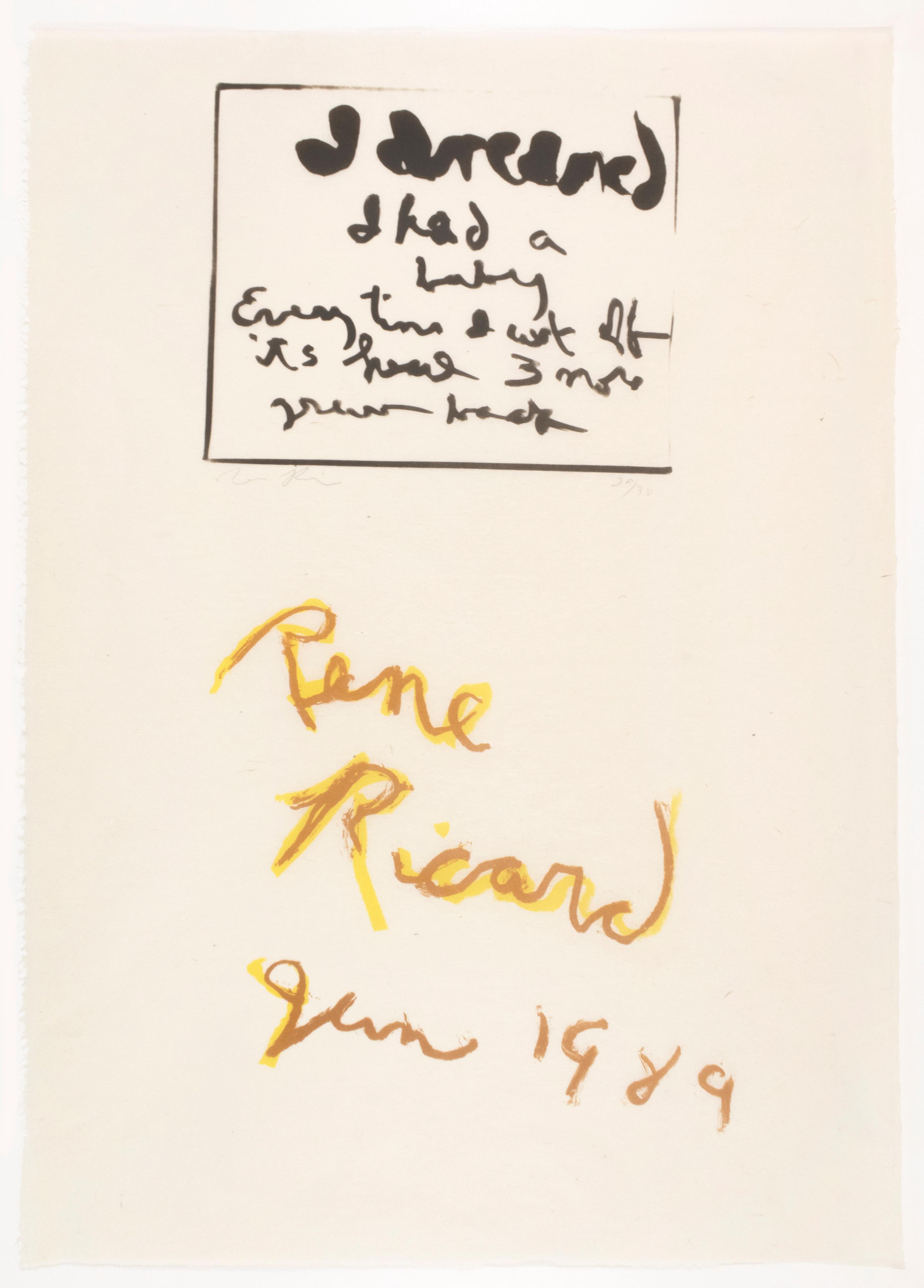
Abstract yellow and black Rene Ricard print with hand painted poetry on handmade paper. Printed in black ink at the top of the sheet and framed with a thin line, the artist's loose h...
Category
1980s Contemporary Abstract Prints
Materials
Lithograph
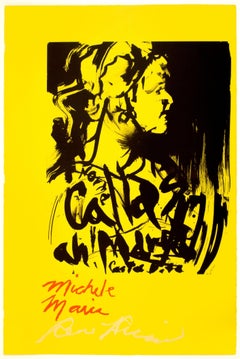
Michele Maria: bright yellow red Maria Callas opera artist portrait with poetry
By Rene Ricard
Located in New York, NY
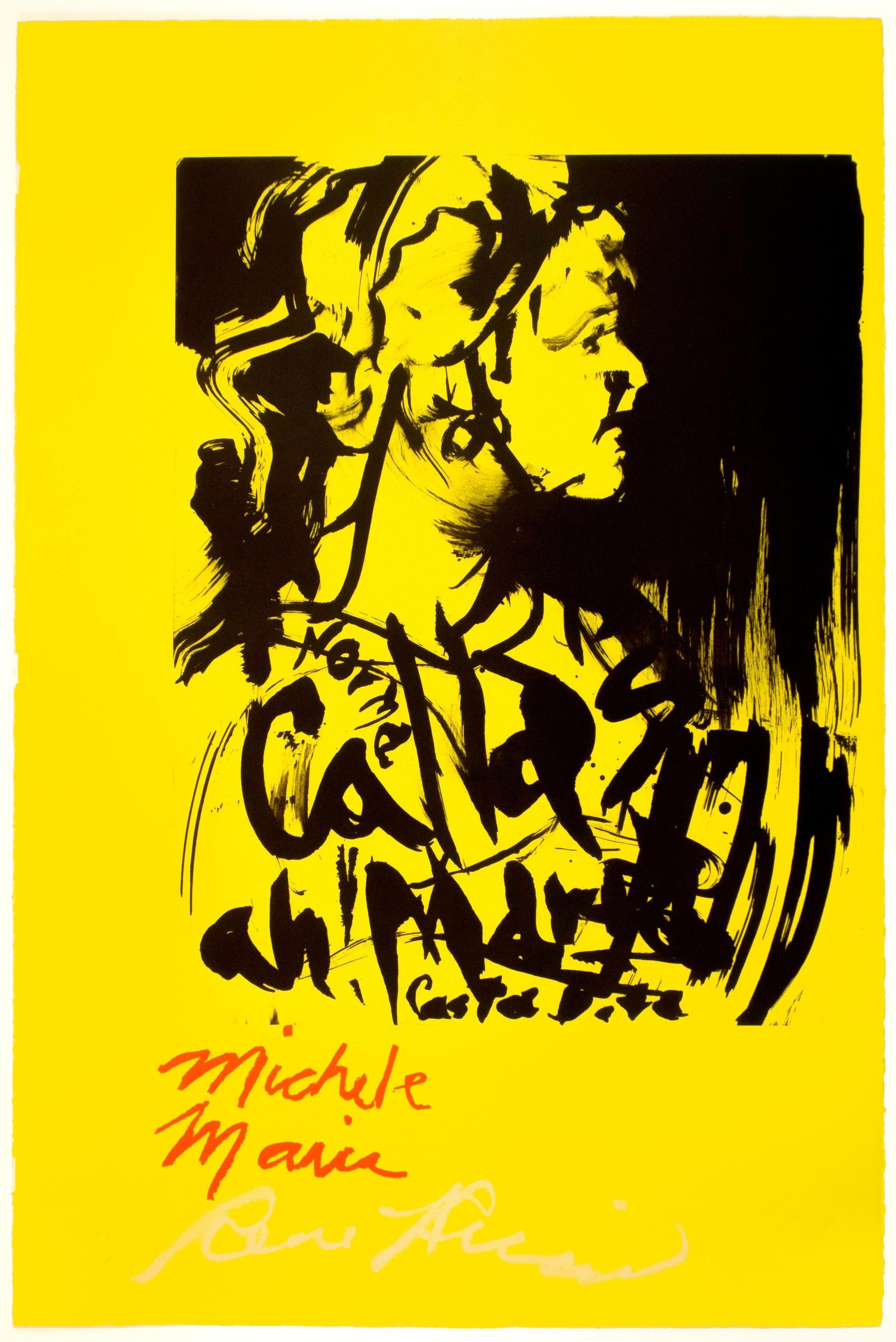
Touched by the influence of Andy Warhol, champion of a young Jean-Michel Basquiat, Rene Ricard served as enfant terrible of the 1980s New York art scene. In this bright yellow, red, ...
Category
1980s Contemporary Abstract Prints
Materials
Lithograph, Screen, Woodcut
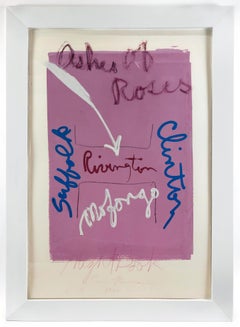
Ashes of Roses by Rene Ricard 1989 New York Lower East Side poetry LES
By Rene Ricard
Located in New York, NY
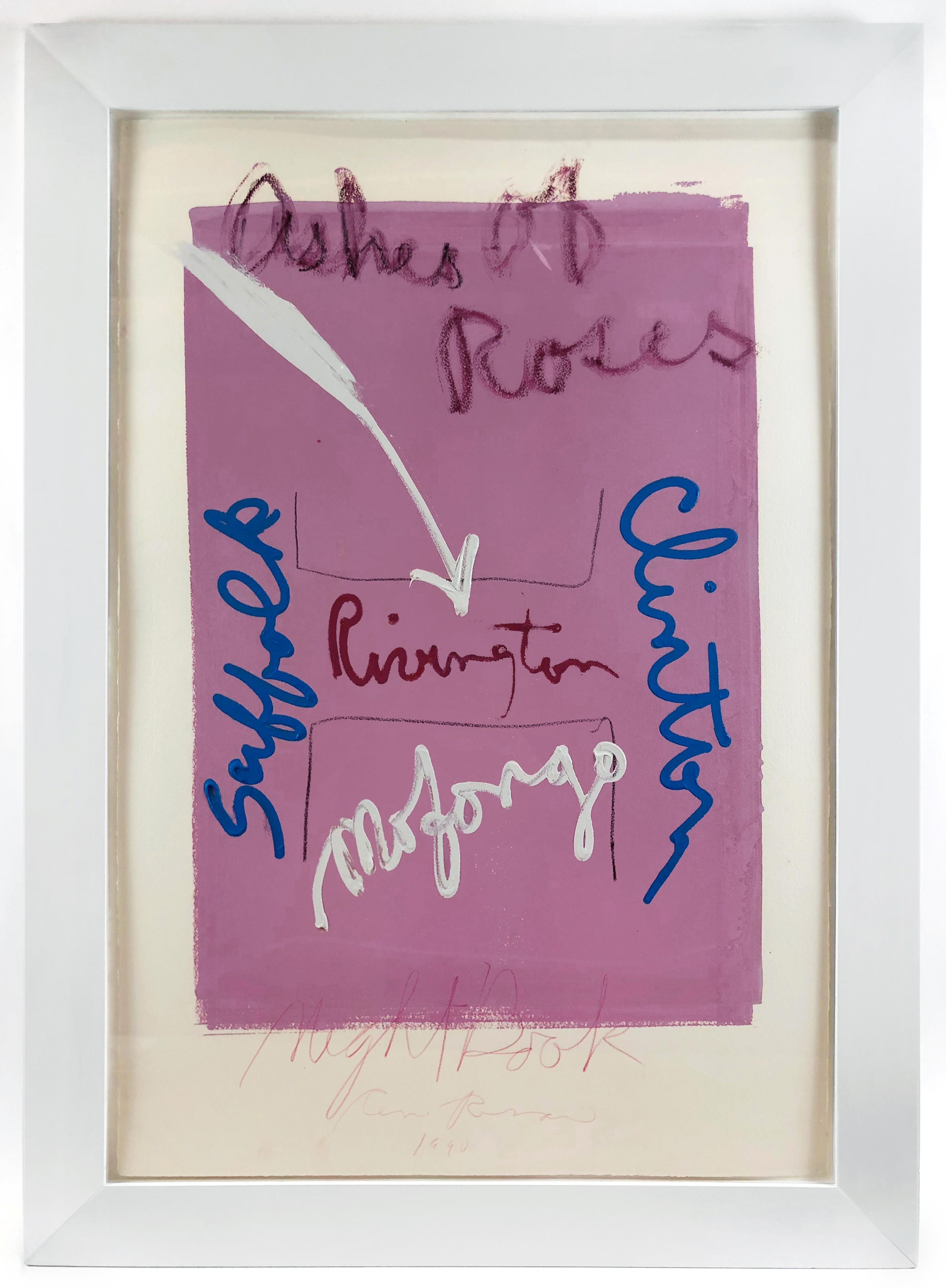
Ashes of Roses is Rene Ricard's mauve-colored map of Rivington Street between Suffolk and Clinton Street, with a white arrow pointing to the word mofongo, indicating a Puerto Rican r...
Category
1980s Abstract Paintings
Materials
Oil, Acrylic, Screen
You May Also Like
"Page 4" Small Abstraction in White, Blue, Yellow and Red
By Margo Margolis
Located in Wellesley, MA
"Page 4" Small Abstraction in White, Black, Blue, Yellow and Red. Flashe on Canvas, 14 x 11 Inches.
This painting has a very sophisticated sensibility in tha...
Category
2010s Abstract Abstract Paintings
Materials
Vinyl, Mixed Media
Tantra Abstractions, Pop Art Serigraph by John Grillo
By John Grillo
Located in Long Island City, NY
Artist: John Grillo, American (1917 - 2014)
Title: Tantra Abstractions
Year: 1980
Medium: Serigraph, signed and numbered in pencil
Edition: 200, AP 30
Image Size: 30 x 22 inches...
Category
1980s Pop Art Abstract Prints
Materials
Screen
Dear Picasso, from Homage to Pablo Picasso portfolio, Silkscreen, Signed/N
By Shusaku Arakawa
Located in New York, NY
Shusaku Arakawa
Dear Picasso, from Homage to Picasso portfolio, 1973 (Hommage a Picasso)
Color Silkscreen on Satin Arches Velincarton
Hand signed and numbered 3/90 in graphite pencil...
Category
1970s Conceptual Abstract Prints
Materials
Screen
$2,800 Sale Price
20% Off
Unique Abstract Multi Layer Primary Colors Screen Print, 1/1
By Michael William Eggleston
Located in Soquel, CA
Brightly colored one-of-a-kind multi-layer abstract composition in primary colors, one of one created by Michael William Eggleston (American, 20th Century). Initialed "MWE" on the bo...
Category
Late 20th Century Abstract Expressionist Abstract Prints
Materials
Paper, Ink, Screen
The Delusion of Fashion - Yellow, 1969 (M.647)
By Joan Miró
Located in Greenwich, CT
The Delusion of Fashion - Yellow (from the series also known as 'Fashion Frenzy' or 'El delirio de la moda') is a lithograph on paper, image size 49.5 x 34", signed Miró lower right ...
Category
20th Century Modern Prints and Multiples
Materials
Paper, Lithograph
Colorful Abstract Lithograph by Dimiti Petrov
By Dimitri Petrov
Located in Long Island City, NY
Untitled - Red Face Blowing Smoke
Dimitri Petrov, American (1919–1986)
Date: circa 1975
Lithograph, signed and numbered in pencil
Edition of 250, L
Size: 22 x 30 in. (55.88 x 76.2 cm)
Category
1970s Abstract Expressionist Abstract Prints
Materials
Lithograph