Want more images or videos?
Request additional images or videos from the seller
1 of 7
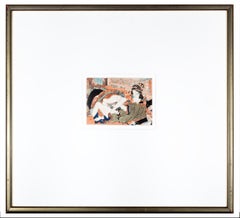
Torii KotondoCombing Hair (Kamisuki) — 1920s Bijin-ga Masterpiece1929
1929
Price:$1,260
$1,400List Price
About the Item
About the Seller
5.0
Recognized Seller
These prestigious sellers are industry leaders and represent the highest echelon for item quality and design.
Platinum Seller
Premium sellers with a 4.7+ rating and 24-hour response times
Established in 1995
1stDibs seller since 2016
334 sales on 1stDibs
Typical response time: 1 hour
Associations
International Fine Print Dealers Association
Authenticity Guarantee
In the unlikely event there’s an issue with an item’s authenticity, contact us within 1 year for a full refund. DetailsMoney-Back Guarantee
If your item is not as described, is damaged in transit, or does not arrive, contact us within 7 days for a full refund. Details24-Hour Cancellation
You have a 24-hour grace period in which to reconsider your purchase, with no questions asked.Vetted Professional Sellers
Our world-class sellers must adhere to strict standards for service and quality, maintaining the integrity of our listings.Price-Match Guarantee
If you find that a seller listed the same item for a lower price elsewhere, we’ll match it.Trusted Global Delivery
Our best-in-class carrier network provides specialized shipping options worldwide, including custom delivery.You May Also Like
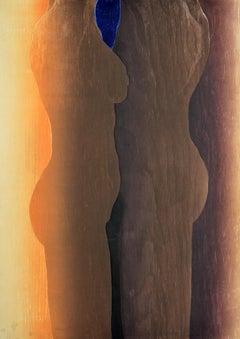
"Encuentro" 2006 Original Unique Signed Artist Proof 28x20in Woodcut Mexican
By Antonio Díaz Cortés
Located in Miami, FL
Antonio Diaz Cortes (Mexico, 1935)
'Encuentro' (meeting), 2006
woodcut on paper Velin Arches 300 g.
27.6 x 19.7 in. (70 x 50 cm.)
P/A (Artist Proof), unique piece
Unframed
ID: DIA-10...
Category
Early 2000s Contemporary Nude Prints
Materials
Ink, Linocut, Woodcut, Engraving
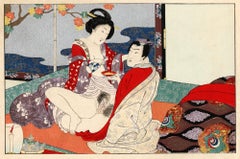
Seishi Ai-oi Genji – Set of 12 Shunga works together w/astrological commentary
By Utagawa Kunisada (Toyokuni III)
Located in Middletown, NY
Set of 12 woodblock prints in colors on handmade, laid mulberry paper, 6 3/4 x 10 1/4 inches (170 x 258 mm), printed in Ka-ei 4 (1851). Each print with minor handling wear, otherwise in excellent condition with bright and fresh color, and with details printed in silver ink. The images themselves contain several illusive characters indicating the publisher which are obfuscated by figures, as intended. Presented loose, as issued. A fine set.
The astrological commentary print has a large and meandering blind stamp with a bird and palm frond motif. This print lists various phrases concerning the Twelve Zodiac Animals as historically counted in Japan, and appears to include erotic commentary on the traits of people born under each of the twelve signs.
These Shunga images were issued in books that paralleled (in an erotic fashion...
Category
Mid-19th Century Edo Nude Prints
Materials
Ink, Handmade Paper, Woodcut
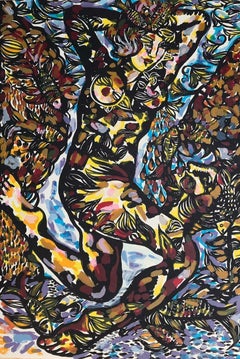
Zaida de Río, ¨Untitled 3¨, 2020, Woodcut, 42.9x29.1 in
By Zaida del Río
Located in Miami, FL
Zaida del Rio (Cuba, 1954)
'Untitled 3', 2020
woodcut on paper Intaglio 300 g.
43 x 29.2 in. (109 x 74 cm.)
Edition of 40
ID: DER-105
Unframed
Category
2010s Contemporary Figurative Prints
Materials
Paper, Woodcut
'Lovers of Okazaki' Original Erotic Shunga Woodblock Print by Utagawa Hiroshige
By Utagawa Hiroshige (Ando Hiroshige)
Located in Milwaukee, WI
The present work is an excellent example of the erotic Shunga prints produced by Utagawa 'Ando' Hioshige and his school. Shunga imagery became especially widespread in Japan with the...
Category
Mid-19th Century Edo Figurative Prints
Materials
Woodcut
'Courtesan and Young Man at Fuchu' Original Erotic Shunga Woodblock
By Utagawa Hiroshige (Ando Hiroshige)
Located in Milwaukee, WI
The present work is an excellent example of the erotic Shunga prints produced by Utagawa 'Ando' Hioshige and his school. Shunga imagery became especially widespread in Japan with the...
Category
Mid-19th Century Edo Figurative Prints
Materials
Woodcut
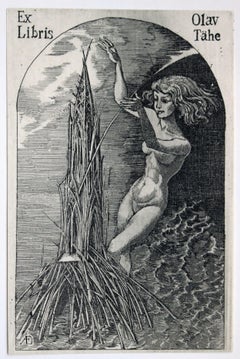
Ex libris. Paper, woodcut, 11x7cm
Located in Riga, LV
Ex libris Olav Tähe
Paper, woodcut, 11x7cm
Category
1990s Jugendstil Nude Prints
Materials
Paper, Woodcut
$172 Sale Price
20% Off
H 4.34 in W 2.76 in D 0.04 in
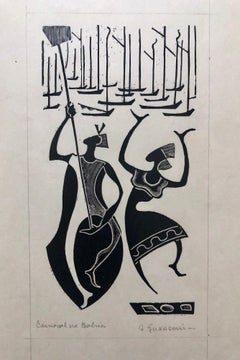
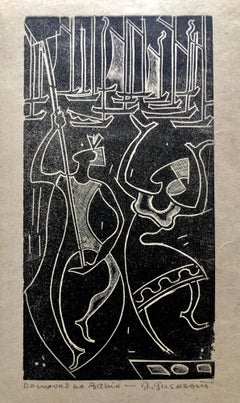
1945 Brazilian Master, Art Deco Nudes Serigraph Woodcut Carnaval Bahia
By Odetto Guersoni
Located in Surfside, FL
Genre: Brazilian Art Deco, African Diaspora
Bahian Carnival
Subject: Abstract
Medium: Print
Surface: Paper
Country: Brazil
Dimensions of overall paper are listed.
This is from a series of work he did in the 1940's, we sold one called Ritmo Negro, they are about Afro-Brazilian jazz, dance and music.
Odetto Guersoni was born in the city of Jaboticabal, State of São Paulo, in 1924. From 1936 to 1941 he attended the Liceu de Artes de Ofícios in São Paulo, beginning his artistic career in 1945, when he exhibited paintings in the Hall of the Plastic Artists Union . Two years later he was part of the collective group of 19, alongside Aldemir, Charoux, Otavio Araújo, Grassmann, Maria Leontina and several other artists that time would make famous. He then practiced a figurative painting of accentuated Expressionist lauds, characterized by deformation and coloring, raw and Satirical- as, moreover, so many of his fellow exhibitors at the time. As a French government scholar, Odette Guerzoni went to Paris in 1947 and the following year took part in the Peintres et Graveurs Etrangers and Art Libre exhibitions. Student of engraving by Renê Cottet, gradually transformed this expressive medium into his favorite, to the detriment of painting, which he practically abandoned soon after.
In 1947, he participated in the 19 Painters exhibition at the Prestes Maia Gallery together with Lothar Charoux, Maria Leontina,Grassmann, Aldemir Martins, Luiz Sacilotto and hiró. Guersoni was awarded a scholarship by the French government, and traveled to Paris, where he began work in engraving. Back in Brazil, in 1951, he founded the Art Workshop, in São Paulo. In 1954, he returned to Europe for a year, financed by the International Labor Organization (ILO). In Geneva, he studied engraving with René Cottet (1902 - 1992) and worked in Stanley william Hayter's studio, Atelier 17, in Paris (1901 - 1988). From 1956 to 1957, he became director of the Union of Plastic Artists of São Paulo. From 1960, he attended, as a trainee, some art schools in the United States and Japan such as The New York School of Printing and Osaka University. In 1971, also in Japan, he attended the workshop of I. Jokuriti. Two years later, he was voted Best Recorder of the Year by the Paulista Association of Art Critics - APCA. He took part in a special room at the Ibero-American Biennial in Montevideo in 1983. The Pinacoteca do Estado de São Paulo - Pesp presents a retrospective of his work in 1994.
Odetto Guersoni explores the wide spectrum of possibilities of the engraving. In addition to using techniques such as metal etching, lithograph, serigraph, linocut and, especially, woodcut he developed, in the 1950s, the philigraphy, in which the forms he developed gained points of embroidery made by Bonadei (1906 - 1974) . And, in the 1960s, the plastigraphy, in which he makes engravings on pasty surfaces, obtained from gypsum or other soft material. In the 1970s, technical investigations were associated with pictographic, ideographic, archaic symbol searches, Brazilian cave paintings and plant forms. The drawings are reduced to stylized, geometric shapes and transformed into abstract graphic elements. The artist works with few matrices, which, organized in rectangles, squares or circles, become modules to be combined. Guersoni juxtaposes them, adds, changes colors, and thereby composes colorful mandalas and structural geometries. Based on concise compositions, it produces color vibrations through optical illusions. In many of his woodcut works of the 1980s he uses smooth wood, knives, saws, gouges, punches, avoiding the natural textures of wood. In printing, it leaves the vibrant color and employs dosed inks with colorless masses, obtaining transparencies by superpositions. New journeys of study and specialization in engraving techniques took him in 1954 to Switzerland, 1960 to the United States, and in 1966 to Germany and Austria. Today, after having performed more than 40 individuals including 16 abroad and having participated in more than 50 collectives in several countries, Guersoni is considered one of the most notable Brazilian engravers. Conquered awards in several shows.
CHRONOLOGY
Individual exhibitions
1946 - Sao Paulo SP - 10th Salon of the Artists' Union, at the Prestes Maia Gallery
1947 - São Paulo SP - 19 Painters, at the Prestes Maia Gallery
1948 - Paris France - Peintres et Graveurs Etrangers at the École des Beaux-Arts
1949 - São Paulo SP - 13th Salon of the Artists' Union, at the Prestes Maia Gallery
1951 - São Paulo SP - 1st Paulista Salon of Modern Art, at Prestes Maia Gallery - silver medal
1953 - São Paulo SP - 2nd International Biennial of São Paulo, at MAM / SP
1954 - São Paulo SP - 3rd Paulista Salon of Modern Art, in the Prestes Maia Gallery
1955 - Rio de Janeiro RJ - 4th National Salon of Modern Art
1955 - Salvador BA - 5th Baiano Salon of Fine Arts, in Belvedere da Sé - honorable mention
1962 - São Paulo SP - Leirner Prize for Contemporary Art at the Folha Art Gallery - 1st printing award
1963 - Curitiba PR - 20th Salão Paranaense de Belas Artes, at the Public Library of Paraná
1963 - Rio de Janeiro RJ - Individual, no MAM / RJ
1968 - Bradford England - First International Print Biennale
1970 - São Paulo SP - Antonio Henrique Amaral, Odetto Guersoni, Tomie Ohtake, Pedro Tort and Gerda Brentani, in the Alberto Bonfiglioli Gallery
1971 - São Paulo SP - 11th International Biennial of São Paulo, at the Biennial Foundation - acquisition award
1973 - Punta del Este Uruguay - 1st Engraving Meeting of the Prata Basin Countries - International Prize
1977 - São Paulo SP - The Groups: the 40's, at the Lasar Segall Museum
1982 - São Paulo SP - Ismenia Coaracy, Odetto Guersoni and Alice Brill...
Category
1940s Art Deco Nude Prints
Materials
Woodcut
$600
H 8.5 in W 12 in D 0.1 in
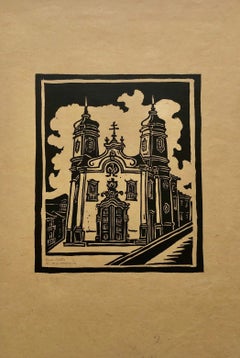
1945 Brazilian Master, Art Deco Serigraph Woodcut Colonial Architecture Mission
By Odetto Guersoni
Located in Surfside, FL
Genre: Brazilian Art Deco, African Diaspora
Bahian Carnival
Subject: Abstract
Medium: Print
Surface: Paper
Country: Brazil
Dimensions of overall paper are listed.
This is from a series of work he did in the 1940's, we sold one called Ritmo Negro, they are about Afro-Brazilian jazz, dance and music.
Odetto Guersoni was born in the city of Jaboticabal, State of São Paulo, in 1924. From 1936 to 1941 he attended the Liceu de Artes de Ofícios in São Paulo, beginning his artistic career in 1945, when he exhibited paintings in the Hall of the Plastic Artists Union . Two years later he was part of the collective group of 19, alongside Aldemir, Charoux, Otavio Araújo, Grassmann, Maria Leontina and several other artists that time would make famous. He then practiced a figurative painting of accentuated Expressionist lauds, characterized by deformation and coloring, raw and Satirical- as, moreover, so many of his fellow exhibitors at the time. As a French government scholar, Odette Guerzoni went to Paris in 1947 and the following year took part in the Peintres et Graveurs Etrangers and Art Libre exhibitions. Student of engraving by Renê Cottet, gradually transformed this expressive medium into his favorite, to the detriment of painting, which he practically abandoned soon after.
In 1947, he participated in the 19 Painters exhibition at the Prestes Maia Gallery together with Lothar Charoux, Maria Leontina,Grassmann, Aldemir Martins, Luiz Sacilotto and hiró. Guersoni was awarded a scholarship by the French government, and traveled to Paris, where he began work in engraving. Back in Brazil, in 1951, he founded the Art Workshop, in São Paulo. In 1954, he returned to Europe for a year, financed by the International Labor Organization (ILO). In Geneva, he studied engraving with René Cottet (1902 - 1992) and worked in Stanley william Hayter's studio, Atelier 17, in Paris (1901 - 1988). From 1956 to 1957, he became director of the Union of Plastic Artists of São Paulo. From 1960, he attended, as a trainee, some art schools in the United States and Japan such as The New York School of Printing and Osaka University. In 1971, also in Japan, he attended the workshop of I. Jokuriti. Two years later, he was voted Best Recorder of the Year by the Paulista Association of Art Critics - APCA. He took part in a special room at the Ibero-American Biennial in Montevideo in 1983. The Pinacoteca do Estado de São Paulo - Pesp presents a retrospective of his work in 1994.
Odetto Guersoni explores the wide spectrum of possibilities of the engraving. In addition to using techniques such as metal etching, lithograph, serigraph, linocut and, especially, woodcut he developed, in the 1950s, the philigraphy, in which the forms he developed gained points of embroidery made by Bonadei (1906 - 1974) . And, in the 1960s, the plastigraphy, in which he makes engravings on pasty surfaces, obtained from gypsum or other soft material. In the 1970s, technical investigations were associated with pictographic, ideographic, archaic symbol searches, Brazilian cave paintings and plant forms. The drawings are reduced to stylized, geometric shapes and transformed into abstract graphic elements. The artist works with few matrices, which, organized in rectangles, squares or circles, become modules to be combined. Guersoni juxtaposes them, adds, changes colors, and thereby composes colorful mandalas and structural geometries. Based on concise compositions, it produces color vibrations through optical illusions. In many of his woodcut works of the 1980s he uses smooth wood, knives, saws, gouges, punches, avoiding the natural textures of wood. In printing, it leaves the vibrant color and employs dosed inks with colorless masses, obtaining transparencies by superpositions. New journeys of study and specialization in engraving techniques took him in 1954 to Switzerland, 1960 to the United States, and in 1966 to Germany and Austria. Today, after having performed more than 40 individuals including 16 abroad and having participated in more than 50 collectives in several countries, Guersoni is considered one of the most notable Brazilian engravers. Conquered awards in several shows.
CHRONOLOGY
Individual exhibitions
1946 - Sao Paulo SP - 10th Salon of the Artists' Union, at the Prestes Maia Gallery
1947 - São Paulo SP - 19 Painters, at the Prestes Maia Gallery
1948 - Paris France - Peintres et Graveurs Etrangers at the École des Beaux-Arts
1949 - São Paulo SP - 13th Salon of the Artists' Union, at the Prestes Maia Gallery
1951 - São Paulo SP - 1st Paulista Salon of Modern Art, at Prestes Maia Gallery - silver medal
1953 - São Paulo SP - 2nd International Biennial of São Paulo, at MAM / SP
1954 - São Paulo SP - 3rd Paulista Salon of Modern Art, in the Prestes Maia Gallery
1955 - Rio de Janeiro RJ - 4th National Salon of Modern Art
1955 - Salvador BA - 5th Baiano Salon of Fine Arts, in Belvedere da Sé - honorable mention
1962 - São Paulo SP - Leirner Prize for Contemporary Art at the Folha Art Gallery - 1st printing award
1963 - Curitiba PR - 20th Salão Paranaense de Belas Artes, at the Public Library of Paraná
1963 - Rio de Janeiro RJ - Individual, no MAM / RJ
1968 - Bradford England - First International Print Biennale
1970 - São Paulo SP - Antonio Henrique Amaral, Odetto Guersoni, Tomie Ohtake, Pedro Tort and Gerda Brentani, in the Alberto Bonfiglioli Gallery
1971 - São Paulo SP - 11th International Biennial of São Paulo, at the Biennial Foundation - acquisition award
1973 - Punta del Este Uruguay - 1st Engraving Meeting of the Prata Basin Countries - International Prize
1977 - São Paulo SP - The Groups: the 40's, at the Lasar Segall Museum
1982 - São Paulo SP - Ismenia Coaracy, Odetto Guersoni and Alice Brill...
Category
1940s Art Deco Nude Prints
Materials
Woodcut
$600
H 8.25 in W 11.75 in D 0.1 in
1945 Brazilian Master, Art Deco Clown Serigraph Woodcut
By Odetto Guersoni
Located in Surfside, FL
Genre: Brazilian Art Deco, African Diaspora
Bahian Carnival
Subject: harlequin clown
Medium: Print
Surface: Paper
Country: Brazil
Dimensions of overall paper are listed.
This is from a series of work he did in the 1940's, we sold one called Ritmo Negro, they are about Afro-Brazilian jazz, dance and music.
Odetto Guersoni was born in the city of Jaboticabal, State of São Paulo, in 1924. From 1936 to 1941 he attended the Liceu de Artes de Ofícios in São Paulo, beginning his artistic career in 1945, when he exhibited paintings in the Hall of the Plastic Artists Union . Two years later he was part of the collective group of 19, alongside Aldemir, Charoux, Otavio Araújo, Grassmann, Maria Leontina and several other artists that time would make famous. He then practiced a figurative painting of accentuated Expressionist lauds, characterized by deformation and coloring, raw and Satirical- as, moreover, so many of his fellow exhibitors at the time. As a French government scholar, Odette Guerzoni went to Paris in 1947 and the following year took part in the Peintres et Graveurs Etrangers and Art Libre exhibitions. Student of engraving by Renê Cottet, gradually transformed this expressive medium into his favorite, to the detriment of painting, which he practically abandoned soon after.
In 1947, he participated in the 19 Painters exhibition at the Prestes Maia Gallery together with Lothar Charoux, Maria Leontina,Grassmann, Aldemir Martins, Luiz Sacilotto and hiró. Guersoni was awarded a scholarship by the French government, and traveled to Paris, where he began work in engraving. Back in Brazil, in 1951, he founded the Art Workshop, in São Paulo. In 1954, he returned to Europe for a year, financed by the International Labor Organization (ILO). In Geneva, he studied engraving with René Cottet (1902 - 1992) and worked in Stanley william Hayter's studio, Atelier 17, in Paris (1901 - 1988). From 1956 to 1957, he became director of the Union of Plastic Artists of São Paulo. From 1960, he attended, as a trainee, some art schools in the United States and Japan such as The New York School of Printing and Osaka University. In 1971, also in Japan, he attended the workshop of I. Jokuriti. Two years later, he was voted Best Recorder of the Year by the Paulista Association of Art Critics - APCA. He took part in a special room at the Ibero-American Biennial in Montevideo in 1983. The Pinacoteca do Estado de São Paulo - Pesp presents a retrospective of his work in 1994.
Odetto Guersoni explores the wide spectrum of possibilities of the engraving. In addition to using techniques such as metal etching, lithograph, serigraph, linocut and, especially, woodcut he developed, in the 1950s, the philigraphy, in which the forms he developed gained points of embroidery made by Bonadei (1906 - 1974) . And, in the 1960s, the plastigraphy, in which he makes engravings on pasty surfaces, obtained from gypsum or other soft material. In the 1970s, technical investigations were associated with pictographic, ideographic, archaic symbol searches, Brazilian cave paintings and plant forms. The drawings are reduced to stylized, geometric shapes and transformed into abstract graphic elements. The artist works with few matrices, which, organized in rectangles, squares or circles, become modules to be combined. Guersoni juxtaposes them, adds, changes colors, and thereby composes colorful mandalas and structural geometries. Based on concise compositions, it produces color vibrations through optical illusions. In many of his woodcut works of the 1980s he uses smooth wood, knives, saws, gouges, punches, avoiding the natural textures of wood. In printing, it leaves the vibrant color and employs dosed inks with colorless masses, obtaining transparencies by superpositions. New journeys of study and specialization in engraving techniques took him in 1954 to Switzerland, 1960 to the United States, and in 1966 to Germany and Austria. Today, after having performed more than 40 individuals including 16 abroad and having participated in more than 50 collectives in several countries, Guersoni is considered one of the most notable Brazilian engravers. Conquered awards in several shows.
CHRONOLOGY
Individual exhibitions
1946 - Sao Paulo SP - 10th Salon of the Artists' Union, at the Prestes Maia Gallery
1947 - São Paulo SP - 19 Painters, at the Prestes Maia Gallery
1948 - Paris France - Peintres et Graveurs Etrangers at the École des Beaux-Arts
1949 - São Paulo SP - 13th Salon of the Artists' Union, at the Prestes Maia Gallery
1951 - São Paulo SP - 1st Paulista Salon of Modern Art, at Prestes Maia Gallery - silver medal
1953 - São Paulo SP - 2nd International Biennial of São Paulo, at MAM / SP
1954 - São Paulo SP - 3rd Paulista Salon of Modern Art, in the Prestes Maia Gallery
1955 - Rio de Janeiro RJ - 4th National Salon of Modern Art
1955 - Salvador BA - 5th Baiano Salon of Fine Arts, in Belvedere da Sé - honorable mention
1962 - São Paulo SP - Leirner Prize for Contemporary Art at the Folha Art Gallery - 1st printing award
1963 - Curitiba PR - 20th Salão Paranaense de Belas Artes, at the Public Library of Paraná
1963 - Rio de Janeiro RJ - Individual, no MAM / RJ
1968 - Bradford England - First International Print Biennale
1970 - São Paulo SP - Antonio Henrique Amaral, Odetto Guersoni, Tomie Ohtake, Pedro Tort and Gerda Brentani, in the Alberto Bonfiglioli Gallery
1971 - São Paulo SP - 11th International Biennial of São Paulo, at the Biennial Foundation - acquisition award
1973 - Punta del Este Uruguay - 1st Engraving Meeting of the Prata Basin Countries - International Prize
1977 - São Paulo SP - The Groups: the 40's, at the Lasar Segall Museum
1982 - São Paulo SP - Ismenia Coaracy, Odetto Guersoni and Alice Brill...
Category
1940s Art Deco Nude Prints
Materials
Woodcut
$600
H 5.75 in W 8.25 in D 0.1 in
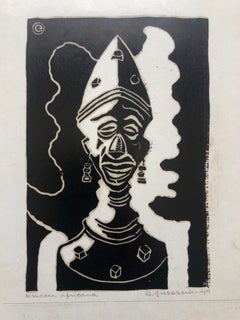
1945 Brazilian Master, Art Deco Nudes Serigraph Woodcut Carnaval Bahia
By Odetto Guersoni
Located in Surfside, FL
Genre: Brazilian Art Deco, African Diaspora
Bahian Carnival
Subject: Abstract
Medium: Print
Surface: Paper
Country: Brazil
Dimensions of overall paper are listed.
This is from a series of work he did in the 1940's, we sold one called Ritmo Negro, they are about Afro-Brazilian jazz, dance and music.
Odetto Guersoni was born in the city of Jaboticabal, State of São Paulo, in 1924. From 1936 to 1941 he attended the Liceu de Artes de Ofícios in São Paulo, beginning his artistic career in 1945, when he exhibited paintings in the Hall of the Plastic Artists Union . Two years later he was part of the collective group of 19, alongside Aldemir, Charoux, Otavio Araújo, Grassmann, Maria Leontina and several other artists that time would make famous. He then practiced a figurative painting of accentuated Expressionist lauds, characterized by deformation and coloring, raw and Satirical- as, moreover, so many of his fellow exhibitors at the time. As a French government scholar, Odette Guerzoni went to Paris in 1947 and the following year took part in the Peintres et Graveurs Etrangers and Art Libre exhibitions. Student of engraving by Renê Cottet, gradually transformed this expressive medium into his favorite, to the detriment of painting, which he practically abandoned soon after.
In 1947, he participated in the 19 Painters exhibition at the Prestes Maia Gallery together with Lothar Charoux, Maria Leontina,Grassmann, Aldemir Martins, Luiz Sacilotto and hiró. Guersoni was awarded a scholarship by the French government, and traveled to Paris, where he began work in engraving. Back in Brazil, in 1951, he founded the Art Workshop, in São Paulo. In 1954, he returned to Europe for a year, financed by the International Labor Organization (ILO). In Geneva, he studied engraving with René Cottet (1902 - 1992) and worked in Stanley william Hayter's studio, Atelier 17, in Paris (1901 - 1988). From 1956 to 1957, he became director of the Union of Plastic Artists of São Paulo. From 1960, he attended, as a trainee, some art schools in the United States and Japan such as The New York School of Printing and Osaka University. In 1971, also in Japan, he attended the workshop of I. Jokuriti. Two years later, he was voted Best Recorder of the Year by the Paulista Association of Art Critics - APCA. He took part in a special room at the Ibero-American Biennial in Montevideo in 1983. The Pinacoteca do Estado de São Paulo - Pesp presents a retrospective of his work in 1994.
Odetto Guersoni explores the wide spectrum of possibilities of the engraving. In addition to using techniques such as metal etching, lithograph, serigraph, linocut and, especially, woodcut he developed, in the 1950s, the philigraphy, in which the forms he developed gained points of embroidery made by Bonadei (1906 - 1974) . And, in the 1960s, the plastigraphy, in which he makes engravings on pasty surfaces, obtained from gypsum or other soft material. In the 1970s, technical investigations were associated with pictographic, ideographic, archaic symbol searches, Brazilian cave paintings and plant forms. The drawings are reduced to stylized, geometric shapes and transformed into abstract graphic elements. The artist works with few matrices, which, organized in rectangles, squares or circles, become modules to be combined. Guersoni juxtaposes them, adds, changes colors, and thereby composes colorful mandalas and structural geometries. Based on concise compositions, it produces color vibrations through optical illusions. In many of his woodcut works of the 1980s he uses smooth wood, knives, saws, gouges, punches, avoiding the natural textures of wood. In printing, it leaves the vibrant color and employs dosed inks with colorless masses, obtaining transparencies by superpositions. New journeys of study and specialization in engraving techniques took him in 1954 to Switzerland, 1960 to the United States, and in 1966 to Germany and Austria. Today, after having performed more than 40 individuals including 16 abroad and having participated in more than 50 collectives in several countries, Guersoni is considered one of the most notable Brazilian engravers. Conquered awards in several shows.
CHRONOLOGY
Individual exhibitions
1946 - Sao Paulo SP - 10th Salon of the Artists' Union, at the Prestes Maia Gallery
1947 - São Paulo SP - 19 Painters, at the Prestes Maia Gallery
1948 - Paris France - Peintres et Graveurs Etrangers at the École des Beaux-Arts
1949 - São Paulo SP - 13th Salon of the Artists' Union, at the Prestes Maia Gallery
1951 - São Paulo SP - 1st Paulista Salon of Modern Art, at Prestes Maia Gallery - silver medal
1953 - São Paulo SP - 2nd International Biennial of São Paulo, at MAM / SP
1954 - São Paulo SP - 3rd Paulista Salon of Modern Art, in the Prestes Maia Gallery
1955 - Rio de Janeiro RJ - 4th National Salon of Modern Art
1955 - Salvador BA - 5th Baiano Salon of Fine Arts, in Belvedere da Sé - honorable mention
1962 - São Paulo SP - Leirner Prize for Contemporary Art at the Folha Art Gallery - 1st printing award
1963 - Curitiba PR - 20th Salão Paranaense de Belas Artes, at the Public Library of Paraná
1963 - Rio de Janeiro RJ - Individual, no MAM / RJ
1968 - Bradford England - First International Print Biennale
1970 - São Paulo SP - Antonio Henrique Amaral, Odetto Guersoni, Tomie Ohtake, Pedro Tort and Gerda Brentani, in the Alberto Bonfiglioli Gallery
1971 - São Paulo SP - 11th International Biennial of São Paulo, at the Biennial Foundation - acquisition award
1973 - Punta del Este Uruguay - 1st Engraving Meeting of the Prata Basin Countries - International Prize
1977 - São Paulo SP - The Groups: the 40's, at the Lasar Segall Museum
1982 - São Paulo SP - Ismenia Coaracy, Odetto Guersoni and Alice Brill...
Category
1940s Art Deco Nude Prints
Materials
Woodcut
$600
H 5.75 in W 8.25 in D 0.1 in
More From This Seller
View AllMadman's Drum (Brothel) — 'Story Without Words' Graphic Modernism
By Lynd Ward
Located in Myrtle Beach, SC
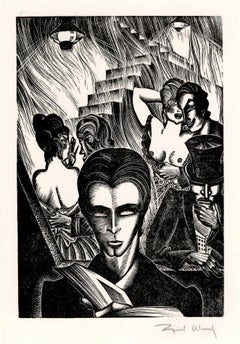
Lynd Ward, 'Madman's Drum, Plate 41', wood engraving, 1930, edition small. Signed in pencil. A fine, richly-inked impression, on off-white tissue-thin Japan paper; the full sheet with margins (1 5/8 to 2 1/2 inches); a small paper blemish in the upper right margin, away from the image, otherwise in excellent condition. A scarce, artist-printed, hand-signed proof impression before the published edition. Matted to museum standards, unframed.
Image size 5 1/2 x 3 3/4 inches (140 x 95 mm); sheet size 9 5/8 x 7 1/8 inches (244 x 181 mm).
From Lynd Ward’s book of illustrations without words, 'Madman’s Drum', Jonathan Cape and Harrison Smith, New York, 1930.
Reproduced in 'Storyteller Without Words, the Wood Engravings of Lynd Ward', Harry N. Abrams, New York, 1974.
ABOUT THE ARTIST
Lynd Ward is acknowledged as one of America’s foremost wood engravers and book illustrators of the first half of the twentieth century. His innovative use of narrative printmaking as a stand-alone storytelling vehicle was uniquely successful in reaching a broad audience. The powerful psychological intensity of his work, celebrated for its dynamic design, technical precision, and compelling dramatic content, finds resonance in the literature of Poe, Melville, and Hawthorne. Like these classic American writers, Ward was concerned with the themes of man’s inner struggles and the role of the subconscious in determining his destiny. An artist of social conscience during the Great Depression and World War II, he infused his graphic images with his unique brand of social realism, deftly portraying the problems that challenged the ideals of American society.
The son of a Methodist preacher, Lynd Ward, moved from Chicago to Massachusetts at an early age. He graduated from the Teachers College of Columbia University, New York, in 1926, where he studied illustration and graphic arts. He married May Yonge McNeer in 1936 and left for Europe for their honeymoon in Eastern Europe. After four months, they settled in Leipzig, where Ward studied at the National Academy of Graphic Arts and Bookmaking. Inspired by Belgian expressionist artist Frans Masereel's graphic novel ‘The Sun,’ and another graphic novel by the German artist Otto Nückel, ‘Destiny,’ he determined to create his own "wordless" novel. Upon his return to America, Ward completed his first book, ‘God's Man: A Novel in Woodcuts,’ published in 1929. ‘Gods’ Man’ was a great success for its author and publisher and was reprinted four times in 1930, including a British edition. This book and several which followed it, ‘Madman’s Drum,’ 1930, ‘Wild Pilgrimage...
Category
1930s American Modern Figurative Prints
Materials
Woodcut
Explorator
Located in Myrtle Beach, SC
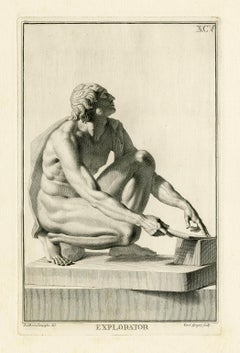
Giovanni Domenico Campiglia, 'Explorator', engraving, 1734, edition unknown, scarce. Signed 'Dom. Campiglia del.' in the matrix, lower left. A fine impression, on handmade antique, l...
Category
1730s Realist Nude Prints
Materials
Engraving
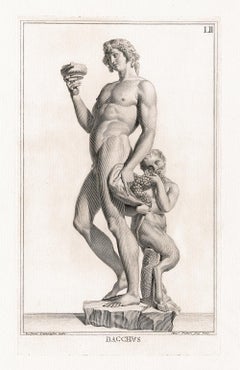
'Bacchus' — 18th Century Classical Italian Realism
Located in Myrtle Beach, SC
Giovanni Domenico Campiglia, 'Bacchus', engraving, 1734, edition unknown. Signed 'Dom. Campiglia del.' in the plate, lower left. Engraving by Gabbugiani, after the original by Giovan...
Category
1730s Realist Nude Prints
Materials
Engraving
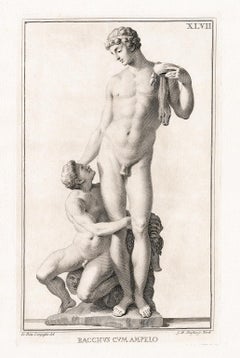
'Bacchus Cumampelo' — 18th Century Classical Italian Realism
Located in Myrtle Beach, SC
Giovanni Domenico Campiglia, 'Bacchus Cumampelo', engraving, 1734, edition unknown. Signed 'Dom. Campiglia del.' in the plate, lower left. Engraving by Gabbugiani, after the original...
Category
1730s Realist Nude Prints
Materials
Engraving
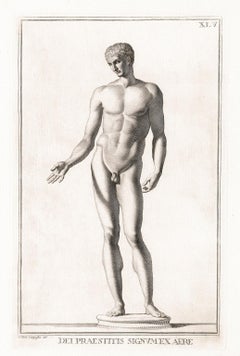
'Dei Praestitis Signumexaere' — 18th Century Classical Italian Realism
Located in Myrtle Beach, SC
Giovanni Domenico Campiglia, 'Dei Praestitis Signumexaere' (God's Providence Signumexaere), engraving, 1734, edition unknown. Signed 'Dom. Campiglia del.' in the plate, lower left. E...
Category
1730s Realist Nude Prints
Materials
Engraving
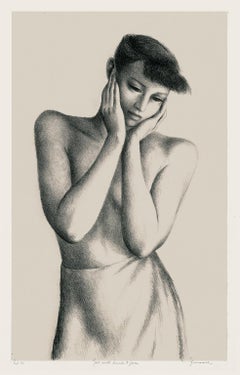
'Girl with Hands to Face' — Mid-century Modernism
By Benton Murdoch Spruance
Located in Myrtle Beach, SC
Benton Spruance, 'Girl with Hands to Face', two-color lithograph, 1940, edition 30, Fine and Looney 180. Signed, titled, and annotated 'Ed. 30' in pencil. A superb impression, on cr...
Category
1940s American Modern Figurative Prints
Materials
Lithograph
$960 Sale Price
20% Off