Items Similar to Page from "Spring View in Takanawa" Mid 18th Century Ukiyo-e Print
Want more images or videos?
Request additional images or videos from the seller
1 of 10
Utagawa Kunisada (Toyokuni III)Page from "Spring View in Takanawa" Mid 18th Century Ukiyo-e Printc. 1845
c. 1845
$950
£732.33
€832.39
CA$1,353.61
A$1,472.59
CHF 777.06
MX$17,710.41
NOK 9,802.34
SEK 9,122.63
DKK 6,216.59
About the Item
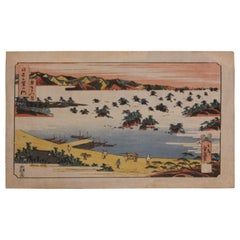
Page from "Spring View in Takanawa" Mid 18th Century Ukiyo-e Print
Left page from the triptych print "Spring View in Takanawa" by Utagawa Kunisada (Toyokuni III) (Japanese b. 1786 d. 1865.) A woman stands next to the shoreline, wearing stylish traveling clothes and walking shoes. A child stands next to her, holding a sign advertising the “opening” (kaichô) day for the temple at Takanawa. In the background the colors of sunset are seen on the horizon and three small ships sail in the distance. The red lantern hanging above the woman also advertise the kaichô day. Kaichô days occur in Buddhist cultures when the temple opens the inner portions, where the holy statues are enshrined, to the public. This would have happened for a short time around once a year, making it an occasion which attracted tourists and other travelers.
Mat size: 19" H x 13" W
Paper size: 14.38" H x 9.82" W
Image size: 13.92" H x 9.69" W
Signed in right corner: 豊国画 (Toyokuni ga) 国貞 (Kunisada) 二代目 (nidaime)
Utagawa Kunisada took the title of "Toyokuni" in 1844 and in the years 1844 and 1845 often signed his work with the nidaime, meaning "second of the name," although he was in fact the third to hold the name.
Kunisada was born in 1786 near Edo (today Tokyo) as the son of an affluent merchant with a ferry boat license. At the age of fifteen he joined the famous art school of Utagawa Toyokuni and took the name Kunisada. In 1807 the young artist produced his first illustrated book. And in 1808 his first actor prints were published. His fame grew fast. While other artists like Kuniyoshi Utagawa or Hiroshige had to fight for recognition for years, he was successful from the beginning. He went on to become the most commercially successful of his contemporary woodblock print-makers, although his contributions were widely ignored by art historians until the late 20th century. Kunisada designed a wide spectrum of traditional ukiyo-e subjects like kabuki themes, beautiful women, historical events and quite a few shunga prints. He made few landscapes.
- Creator:Utagawa Kunisada (Toyokuni III) (1786-1864, Japanese)
- Creation Year:c. 1845
- Dimensions:Height: 19 in (48.26 cm)Width: 13 in (33.02 cm)Depth: 0.25 in (6.35 mm)
- Medium:
- Movement & Style:
- Period:
- Condition:Slight fading to color consistent with age. Paper has become softened and lightly creased with age, with the edges being especially delicate. Presence of ink staining on bottom portion of the woman's kimono. Mat is new.
- Gallery Location:Soquel, CA
- Reference Number:Seller: JMA 99901stDibs: LU54217306112
Utagawa Kunisada (Toyokuni III)
Born in the Honjo district of Edo as Kunisada Tsunoda, Kunisada’s family owned a small hereditary ferryboat service. Though his father, an amateur poet, died when Kunisada was a child, the family business provided some financial security. During his childhood, he showed considerable promise in painting and drawing. Due to strong familial ties with literary and theatrical circles, he spent time studying actor portraits. At age 14, he was admitted to study under Toyokuni, head of the Utagawa school. Kunisada's work embodies the characteristics of the Utagawa school, focusing on traditional subjects such as kabuki, bijin (beautiful women), shunga (erotic prints), and historical prints. His first known print dates to 1807, his first illustrated book to 1808. Kunisada’s career took off from the beginning. Many of his works became overnight successes and he was considered the “star attraction†of the Utagawa school. He signed his works “Kunisada,†sometimes with the studio names of Gototei and Kochoro affixed. In 1844, he adopted the name of his teacher and became Toyokuni III. Kunisada passed away in 1864 in the same neighborhood that he was born. He was 70 years old. Kunis
About the Seller
5.0
Platinum Seller
Premium sellers with a 4.7+ rating and 24-hour response times
Established in 1986
1stDibs seller since 2014
3,048 sales on 1stDibs
Typical response time: <1 hour
- ShippingRetrieving quote...Shipping from: Soquel, CA
- Return Policy
More From This Seller
View All"Enshoku Sanju-roku Kasen" (Thirty-six Enchanting Flowers) Woodblock on paper
By Toyohara Kunichika
Located in Soquel, CA
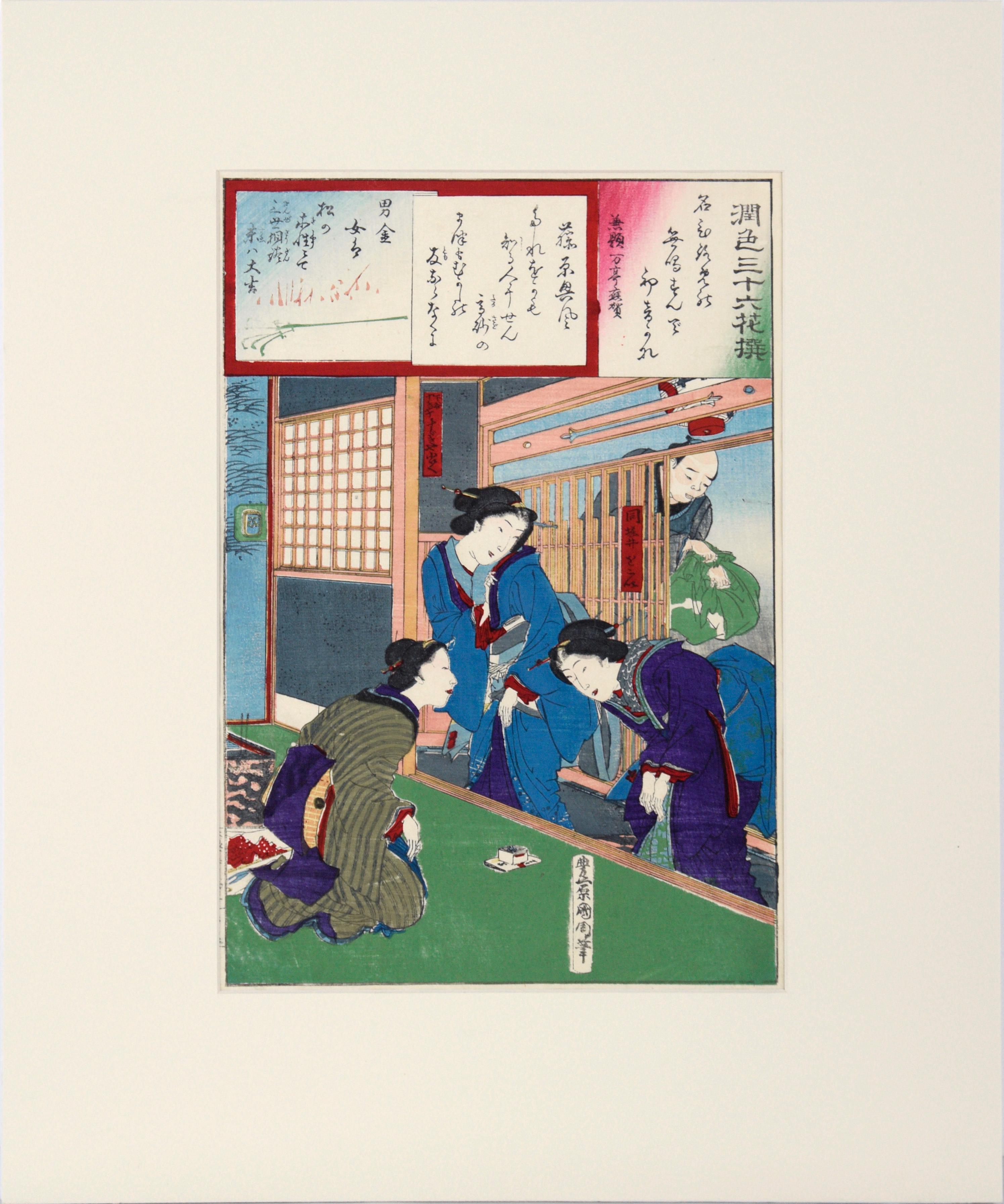
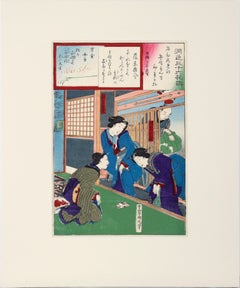
"Enshoku Sanju-roku Kasen" (Thirty-six Enchanting Flowers) Woodblock on paper
Elegant woodblock print by Toyohara Kunuchika (Japanese, 1835-1900). Three women are in talking with each other inside, while a man waits outside holding a bag of some kind. The colors in this piece are rich and saturated, primarily blues, greens, and purple.
Mat size: 16"H x 20"W
Paper size: 14.75"H x 9.88"W
Born in 1835, Toyohara Kunichika grew up in the Kyobashi district of Edo in the midst of merchants and artisans. In 1848, at age 13, he was accepted as an apprentice into the studio of Utagawa Kunisada I...
Category
1880s Edo Figurative Prints
Materials
Ink, Rice Paper, Woodcut
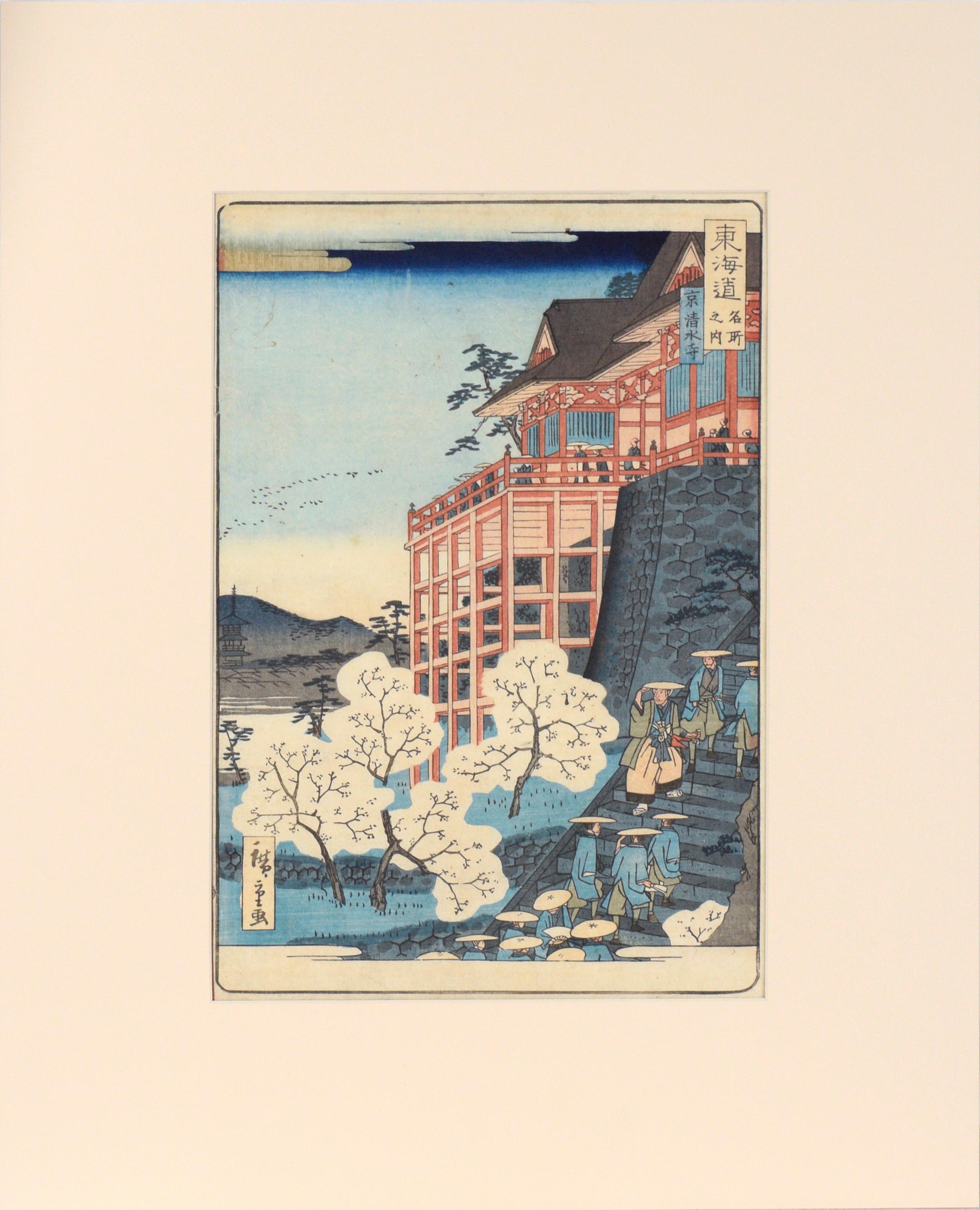
Kiyomizu Temple, Scenes of Famous Places along Tôkaidô Road - Woodblock on Paper
By Utagawa Hiroshige II
Located in Soquel, CA
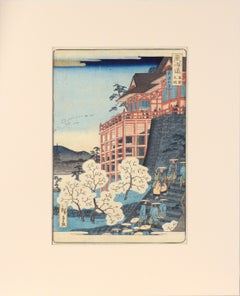
Kiyomizu Temple, Scenes of Famous Places along Tôkaidô Road - Woodblock on Paper
Full Title:
Kyoto: Kiyomizu Temple (Kyô Kiyomizudera), from the series Scenes of Famous Places along...
Category
1860s Edo Landscape Prints
Materials
Ink, Rice Paper, Woodcut
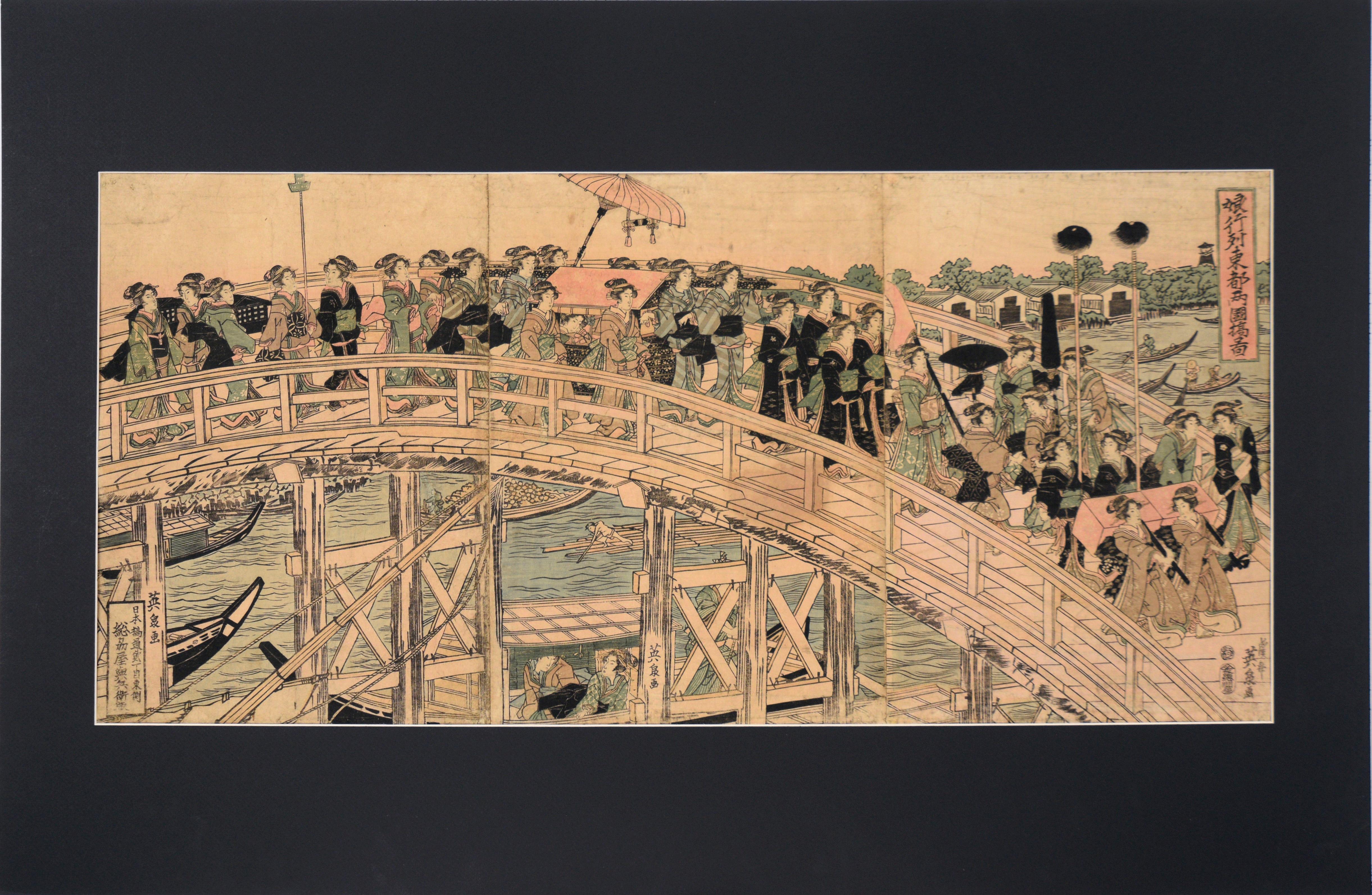
Mitate of a Daimyo's Procession Crossing Ryogoku Bridge - Woodblock Print
By Keisai Eisen
Located in Soquel, CA
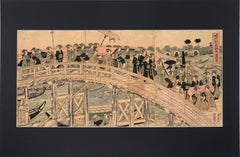
Mitate of a Daimyo's Procession Crossing Ryogoku Bridge - Woodblock Print
Woodblock print of a procession by Keisai Eisen (Japanese, 1790–1848). Terrific triptych of a procession of...
Category
Early 19th Century Edo Figurative Prints
Materials
Ink, Rice Paper, Woodcut
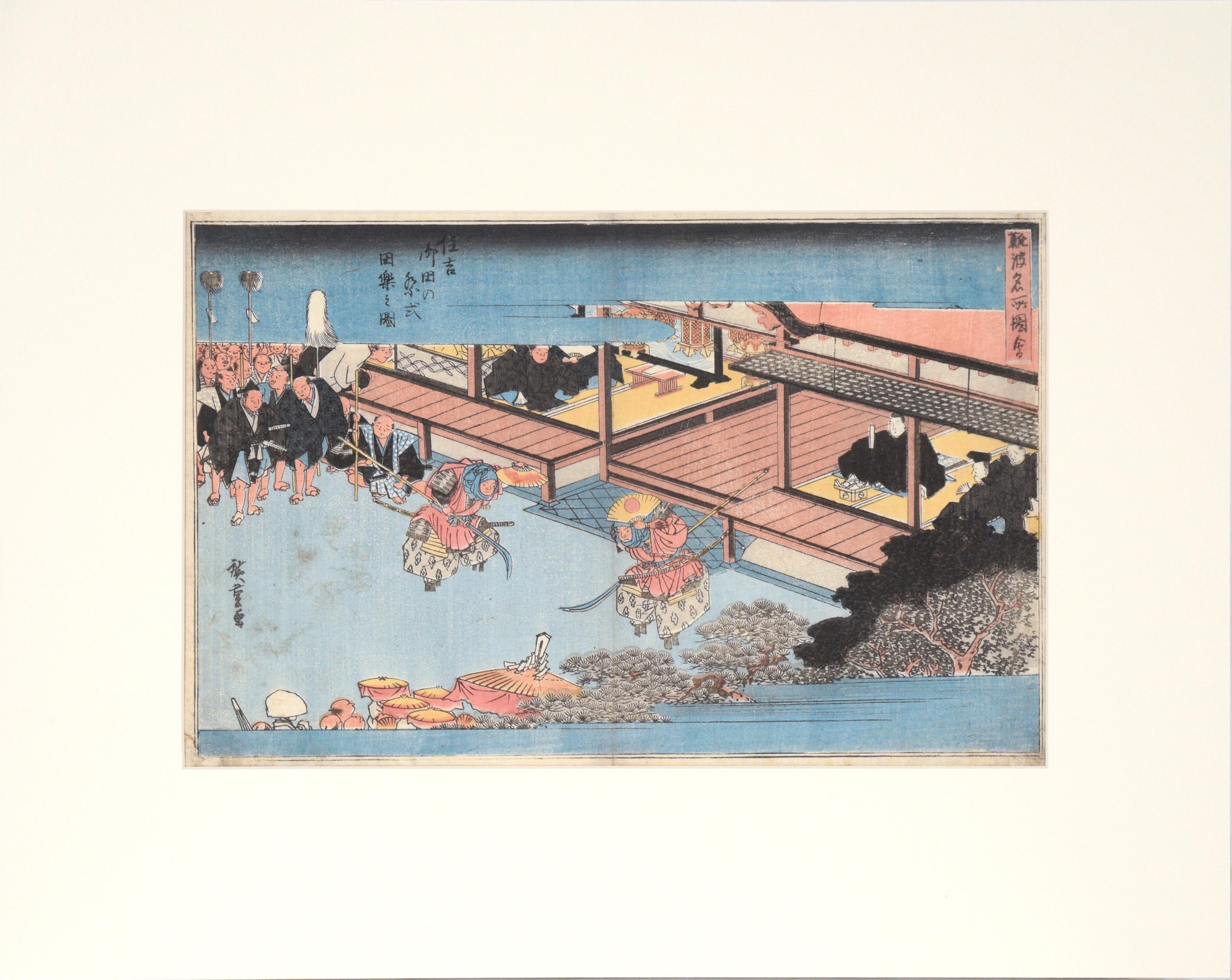
Sumiyoshi: Dengaku dance performed during an Onda ceremony - Woodblock Print
By Utagawa Hiroshige
Located in Soquel, CA
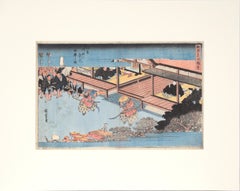
Sumiyoshi: Dengaku dance performed during an Onda ceremony - Woodblock Print
Bright woodblock print by Utagawa Hiroshige (Japanese, 1797-1858). In this scene, two dancers with swords and fans are facing each other, in the center of a courtyard. There are spectators surrounding them, including nobles in black clothing on a balcony.
Presented in a new off-white mat with foamcore backing.
Mat size: 16"H x 20"W
Paper size: 9.63"H x 14.5W"
Utagawa Hiroshige (1797-1858, sometimes called Ando Hiroshige) was the second of the two great masters of the Japanese landscape woodblock print...
Category
1830s Edo Figurative Prints
Materials
Ink, Rice Paper, Woodcut
"Various Himochi" Wagashi Festival Japanese Woodblock Print by Utagawa Toyokuni
By Utagawa Toyokuni
Located in Soquel, CA
"Various Himochi" Wagashi Festival Japanese Woodblock Print by Utagawa Toyokuni
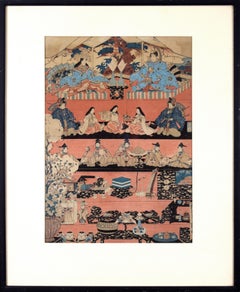
Rare oversized early 19th century 5-tiered woodblock by Utagawa Ichiyosai Toyokuni, (Japan, 1769-1825), a Japanese lord and wife oversee a sekku festival of food, music, and dolls or toys. '"oshi" is the first day of “Mi (Snake)” in the third month of the lunar calendar. This day, known in modern Japan as the Girls' Festival, originated in China as a form of purification ceremony in which water and drinking peach blossom wine were used to drive away evil. Many kinds of hishi-mochi appear in this picture of hina ningyo (dolls associated with Hinamatsuri, or the Girl’s Day) from Omochae.
The custom of eating special dishes at events throughout the year and at milestones in people's lives has existed since ancient times. This paragraph specifically focuses on the annual event called sekku, and life events that involve eating sweets. Joshi is the first day of “Mi (Snake)” in the third month of the lunar calendar. This day, known in modern Japan as the Girls' Festival, originated in China as a form of purification ceremony in which water and drinking peach blossom wine were used to drive away evil. According to the Keiso saijiki, in ancient China, on the third day of the third lunar month, people ate “ryuzetsuhan,” which is the juice of gogyo (Jersey cudweed) mixed with rice flour and nectar. In Japan, there is a record in the Heian period history book Nihon Montoku tenno jitsuroku [839-5] that it was an annual event to make kusamochi using gogyo on the third day of the third month of the lunar calendar, which may have been influenced by Chinese customs.
The tradition of eating kusamochi on the third day of the third month of the lunar calendar continued after that. By the Edo period, however, hishimochi had come to be used as a sweet to serve on the third day of the third month. A picture of a hishimochi is included in the Morisada manko , which we mentioned in Part 1. According to it, hishimochi in the Edo period were often three layers of green-white-green instead of the now common red-white-green. However, it is possible to see from our collection that not all hishimochi were made in this way. Omochae published in 1857, is a good example. Omochae is a type of ukiyoe print...
Category
1820s Edo Figurative Prints
Materials
Ink, Rice Paper, Woodcut
Actor as Samurai - 18th Century Japanese Woodblock Print
By Katsukawa Shunshō
Located in Soquel, CA
Actor as Samurai - 18th Century Japanese Woodblock Print
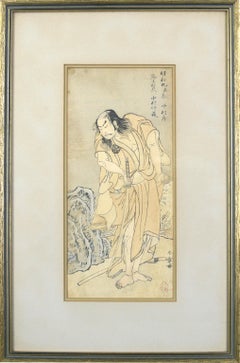
Woodblock print depicting an actor, possibly Nakamura Denkuro II, as a samurai. The actor stands with his sword unsheathed a...
Category
Late 18th Century Edo Figurative Prints
Materials
Woodcut, Rice Paper
You May Also Like
Beauties on the Beach with view of Mount Fuji
By Yoshu Chikanobu
Located in Burbank, CA
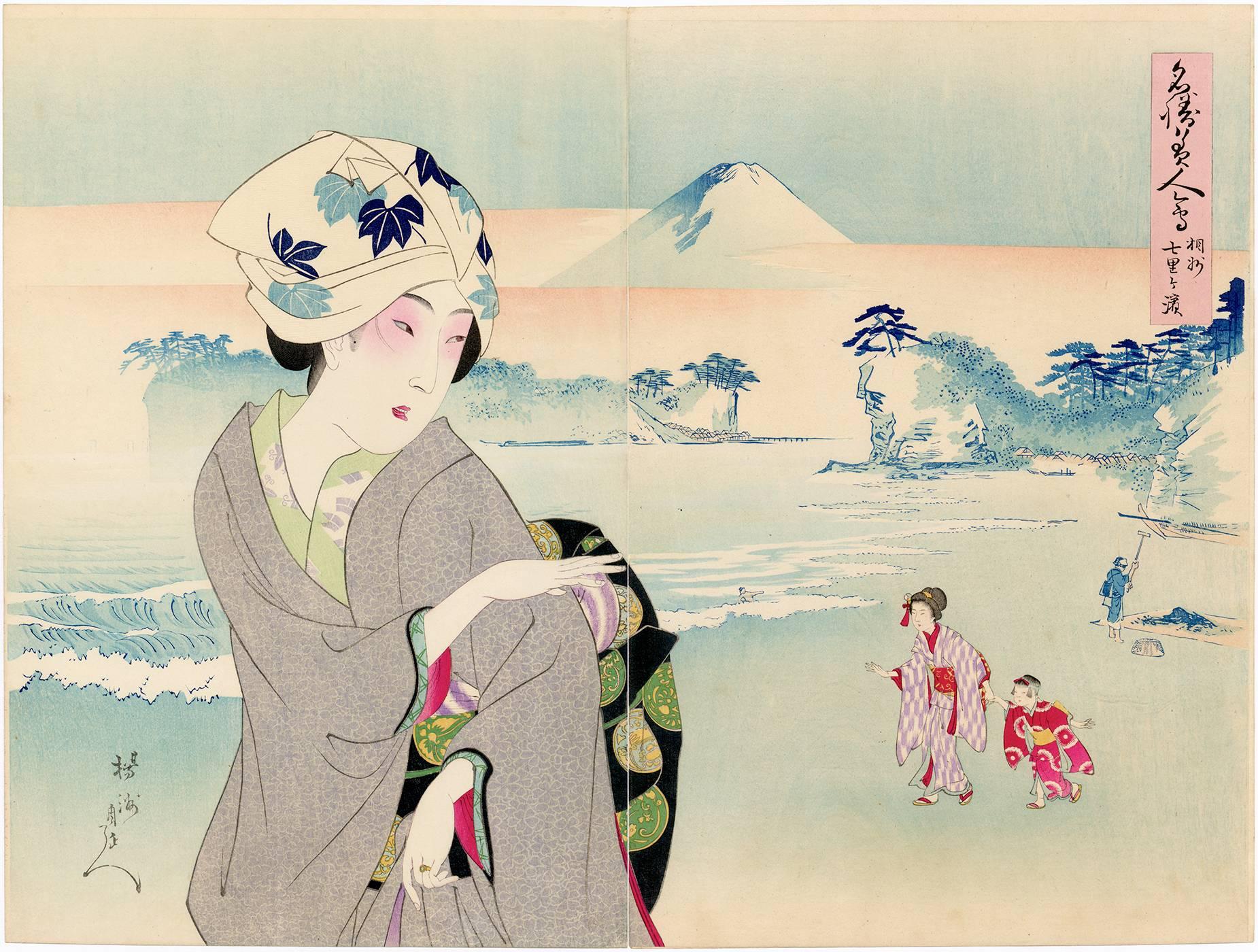
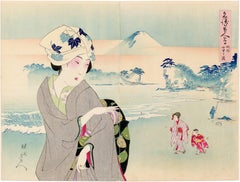
Shichirigahama, Sagami Province. A beauty in the foreground waves to her young companions, who run towards her on the beach. The beauty at left wears a western-style golden ring. We ...
Category
1890s Edo Landscape Prints
Materials
Handmade Paper, Mulberry Paper, Woodcut
Japanese Beauty Admiring Kirifuri Waterfall
By Yoshu Chikanobu
Located in Burbank, CA
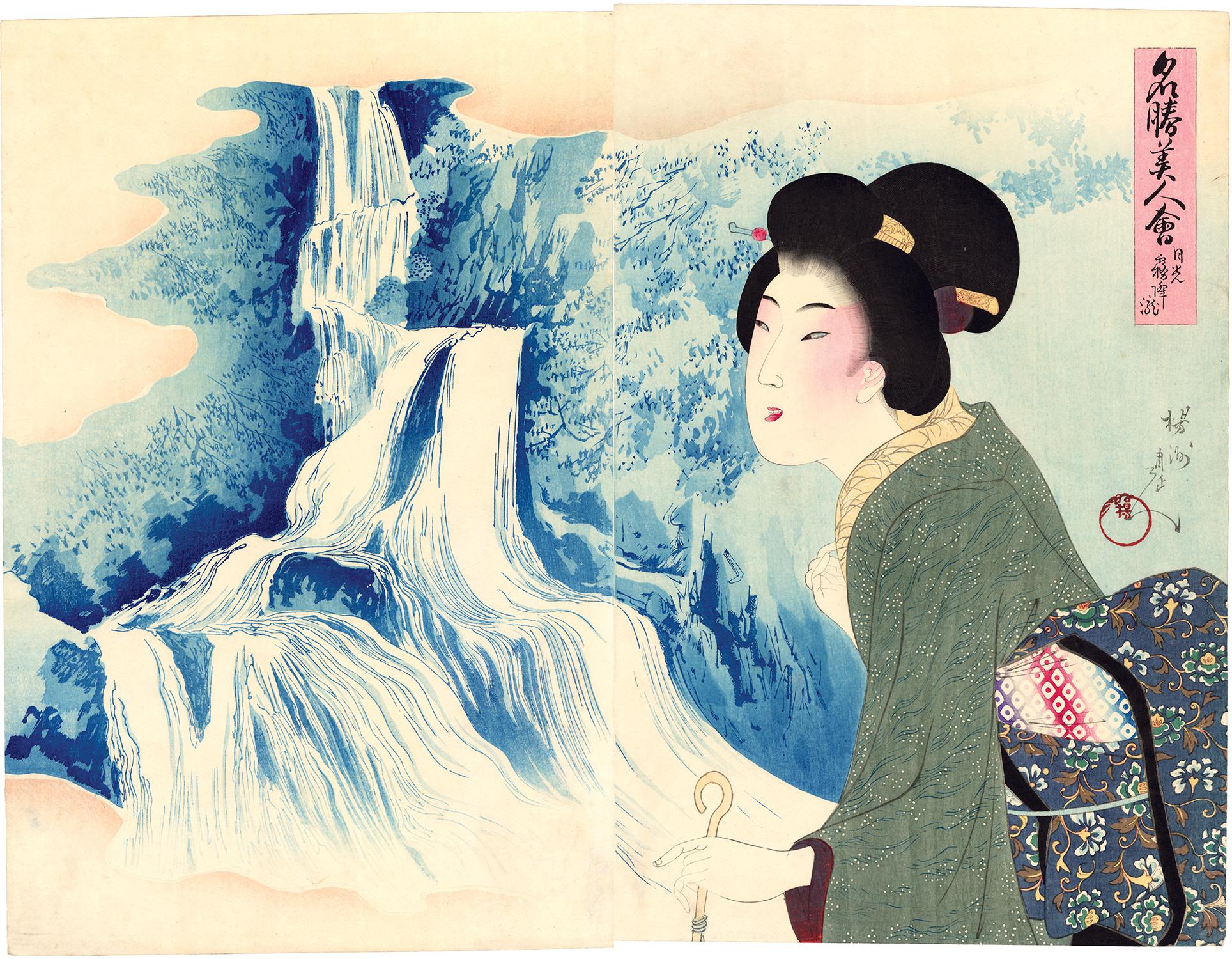
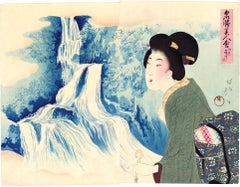
A beauty turns to admire the Kirifuri Waterfall in Nikko Province. She holds the handle of an umbrella and wears fashionable clothing that is beautifully printed. This series pairs f...
Category
1890s Edo Landscape Prints
Materials
Handmade Paper, Mulberry Paper, Woodcut
$940 Sale Price
20% Off
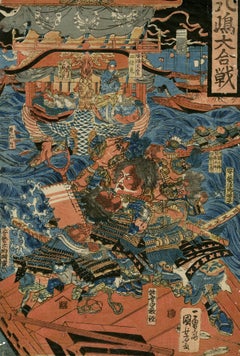
The Battle of Dan-no-ura in Yashima, Nagato Province in the First Year .....
By Utagawa Yoshitora
Located in Middletown, NY
The Battle of Dan-no-ura in Yashima, Nagato Province in the First Year of the Bunji Era (1185)
Tokyo c. 1830
Woodblock print (nishiki-e) with ink and hand-coloring in watercolor on handmade mulberry paper, 14 7/16 x 9 15/16 inches (367 x 252 mm), ōban tate-e, the full sheet. In good condition with some handling creases. Colors are fresh and extremely vibrant. The right panel from the triptych by Yoshitora depicting one of Japan's most storied naval battles. An impression of this work may be found in the permanent collection of the Honolulu Museum of Art.
The great naval battle of Dan-no-ura in 1185 was the final climax in a long series of bitter wars between two powerful families in feudal Japan...
Category
Early 19th Century Edo Figurative Prints
Materials
Watercolor, Handmade Paper, Woodcut
Toshogu Shrine
Located in Middletown, NY
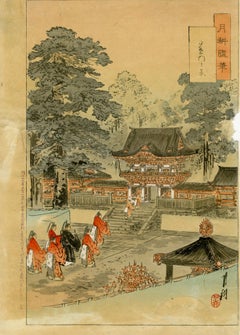
In image of the Tokugawa family paying homage to Tosho-gu Shrine in Nikko.
Tokyo: Matsuki Heikichi, 1896
Woodcut in ink with embossing and hand-coloring in watercolor on handmade m...
Category
Late 19th Century Edo Figurative Prints
Materials
Watercolor, Handmade Paper, Woodcut
Ôkubo Hikozaemon Protects the Hidden Shogun Triptych
By Taiso Yoshitoshi
Located in Burbank, CA
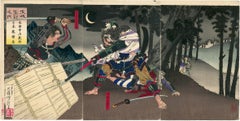
“War Chronicles of Osaka” (Osaka gunki no uchi). Okubo Hikozaemon, raising his sword, protects the hidden Tokugawa shogun from the spear of Gorô Matabei Mototsugu in a moonlit fores...
Category
1880s Other Art Style Figurative Prints
Materials
Mulberry Paper, Woodcut
Edo Landscape Japanese Woodblock Print
By Utagawa Hiroshige (Ando Hiroshige)
Located in Houston, TX
Edo Meisho woodblock print of a famous Japanese coastal dock. This woodblock is most likely apart of the series "One Hundred Famous Views of Edo." The woodblock print is printed on r...
Category
1850s Edo Landscape Prints
Materials
Woodcut