Blue Rider Art

to
5
4
1
2
Overall Width
to
Overall Height
to
11
1
3
5
1
1
1
113,422
62,259
57,386
26,674
14,629
9,306
6,467
5,496
4,206
3,048
2,397
2,355
2,227
606
8
4
5
5
4
2
2
1
1
1
1
1
1
1
1
1
1
1
1
1
1
1
5
3
2
1
1
5
2
1
1
1
5
2
6
6
Style: Blue Rider
On The Way to Havasu

On The Way to Havasu

By James Mannix

Located in East Hampton, NY

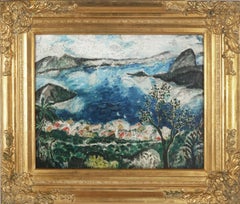
Color Photograph of Abandoned Gas Station Architecture Lake Havasu is a large reservoir formed by Parker Dam on the Colorado River, on the border between San Bernardino County, Cali...

Category

2010s Blue Rider Art

Materials

Mixed Media

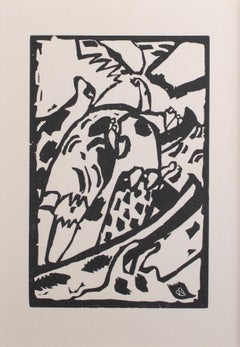
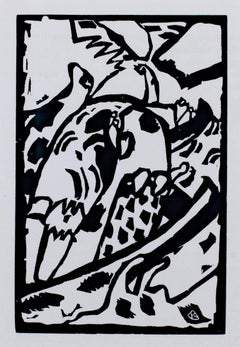
'Improvisation 7' second ed. woodcut from 'Klänge' by Wassily Kandinsky

'Improvisation 7' second ed. woodcut from 'Klänge' by Wassily Kandinsky

By Wassily Kandinsky

Located in Milwaukee, WI

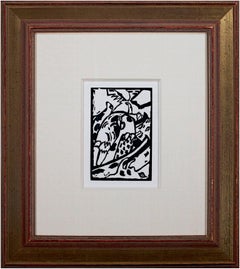
'Improvisation 7' second ed. woodcut from 'Klänge' is a woodcut print created by Wassily Kandinsky. The present woodcut print comes from the second edition of 'Klänge (Sounds),' a book of original graphics and poetry by Wassily Kandinsky. The title of the album and of this print, 'Improvisation,' demonstrated Kandinsky's interest in music and how abstract musical forms could be translated into images on a two-dimensional surface. This particular composition is difficult to read, but through the abstraction, one can make out various figures and a landscape beyond. Originally carved and printed in 1911, this second edition print was done ca. 1938. It is a woodcut in black ink on woven paper. Signed with encircled 'K' in the block, lower right (from the book, signed in ink, ed. 117/300) Image Size: 7 1/2" x 5 inches Frame Size: 22 1/4" x 18 3/4" Ref. Roethel 124 Artist Bio: The Museum of Modern Art described 'Klänge (Sounds)' as follows: Vasily Kandinsky's self-described "musical album," Klänge (Sounds), consists of thirty-eight prose-poems he wrote between 1909 and 1911 and fifty-six woodcuts he began in 1907. In the woodcuts Kandinsky veiled his subject matter, creating increasingly indecipherable images (though the horse and rider, his symbol for overcoming objective representation, runs through as a leitmotif). This process proved crucial for the development of abstraction in his art. Kandinsky said his choice of media sprang from an "inner necessity" for expression: the woodcuts were not merely illustrative, nor were the poems purely verbal descriptions. Kandinsky sought a synthesis of the arts, in which meaning was created through the interaction of, and space between, text and image, sound and meaning, mark and blank space. The experimental typography shows his interest in the physical aspects of the book. Klänge is one of three major publications by Kandinsky that appeared shortly before World War I, alongside Über die Geistige in der Kunst (Concerning the Spiritual in Art) and the Blaue Reiter almanac...

Category

1910s Blue Rider Art
Materials

Woodcut, Laid Paper

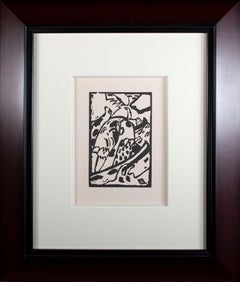
'Improvisation 7' original first ed. woodcut  from 'Klänge' by Wassily Kandinsky

'Improvisation 7' original first ed. woodcut from 'Klänge' by Wassily Kandinsky

By Wassily Kandinsky

Located in Milwaukee, WI

The present woodcut print comes from 'Klänge (Sounds),' a book of original graphics and poetry by Wassily Kandinsky. This first edition was released in an edition of 300, each book signed and numbered by the artist. The title of the album and this particular print, 'Improvisation,' demonstrated Kandinsky's interest in music and how abstract musical forms could be translated into images on a two-dimensional surface. This particular composition is difficult to read, but through the abstraction, one can make out various figures and a landscape beyond. 7.5 x 5 inches, image 22 x 19.5 inches, frame Woodcut in black ink on laid paper (watermark Van Gelder Zonen) Signed with encircled 'K' in the block, lower right Framed to conservation standards using 100 percent acid free archival materials including silk-lined matting with 1/4 inch bevel, museum glass, and a gold-gilded moulding Ref. Roethel 124 The Museum of Modern Art described 'Klänge (Sounds)' as follows: Vasily Kandinsky's self-described "musical album," Klänge (Sounds), consists of thirty-eight prose-poems he wrote between 1909 and 1911 and fifty-six woodcuts he began in 1907. In the woodcuts Kandinsky veiled his subject matter, creating increasingly indecipherable images (though the horse and rider, his symbol for overcoming objective representation, runs through as a leitmotif). This process proved crucial for the development of abstraction in his art. Kandinsky said his choice of media sprang from an "inner necessity" for expression: the woodcuts were not merely illustrative, nor were the poems purely verbal descriptions. Kandinsky sought a synthesis of the arts, in which meaning was created through the interaction of, and space between, text and image, sound and meaning, mark and blank space. The experimental typography shows his interest in the physical aspects of the book. Klänge is one of three major publications by Kandinsky that appeared shortly before World War I, alongside Über die Geistige in der Kunst (Concerning the Spiritual in Art) and the Blaue Reiter almanac...

Category

1910s Blue Rider Art
Materials

Woodcut

Related Items
Oil painting on board "Rough sea with steamer on the horizon" by S.A.Vinogradoff

Oil painting on board "Rough sea with steamer on the horizon" by S.A.Vinogradoff

Located in Gavere, BE

Sergey VINOGRADOV ( 1869 - 1938 ) Rough sea with steamer on the horizon Sergei Arsenievich Vinogradov ( Russian: 1869–1938 ) was a Russian-Soviet Impressionist painter; known for l...

Category

1920s Blue Rider Art

Materials

Gold Leaf

Trois femmes

Walter BeckerTrois femmes, mid 20th century

$560Sale Price|20% Off

H 19 in W 13.5 in

Trois femmes

Located in Belgrade, MT

Walter Becker was born in 1893 in Essen, Ruhr, Germany. Considered an important graphic artist of the "lost generation", Becker is well known for his depictions of figures and portraits in a style that combined elements of German Expressionism, Dada, and French modernism. He worked in a variety of print media, including color lincut, lithography, woodcut and etching. After a short military service, Becker studied under the German Sculptor Karl Albiker at the Dresden Academy of Fine Arts. He moved to southern France where he lived and worked from 1924-1935, and was in contact with George Braque, Thomas...

Category

Mid-20th Century Blue Rider Art

Materials

Lithograph

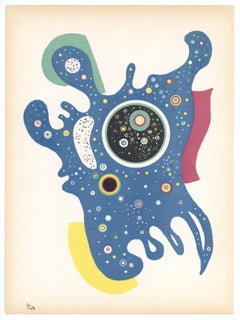
"Stars" original lithograph

"Stars" original lithograph

By Wassily Kandinsky

Located in Henderson, NV

Medium: original lithograph. Printed in 1938 and published in Paris by Teriade for the art revue Verve (volume 1, number 2). Kandinsky was invited to contribute an original compositi...

Category

1930s Blue Rider Art

Materials

Lithograph

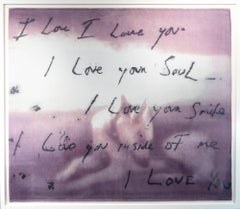
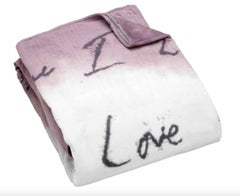
"I Love You" Limited Edition towel/wall hanging (LARGE: 60 inches x 70 inches)

"I Love You" Limited Edition towel/wall hanging (LARGE: 60 inches x 70 inches)

By Tracey Emin

Located in New York, NY

Tracey Emin I Love You/I Love Your Soul/I Love Your Smile, ca. 2010 100% Cotton Beach Towel 60 × 70 inches (folded it's 25 x 30 inches) Signed in plate, authorized printed...

Category

2010s Blue Rider Art

Materials

Cotton, Screen, Mixed Media, Laid Paper

"Avernus" Nude Photography 24" x 32" in Ed. 1/7 by Aaron Mcpolin

"Avernus" Nude Photography 24" x 32" in Ed. 1/7 by Aaron Mcpolin

By Aaron McPolin

Located in Culver City, CA

"Avernus" Nude Photography 24" x 32" in Ed. 1/7 by Aaron Mcpolin Archival Giclee Print Signed and numbered by the artist. Comes with COA issued by the artist NOT framed. Ships in a...

Category

21st Century and Contemporary Blue Rider Art

Materials

Archival Pigment

Headland IV - Etching by Gordon Cook on Japanese Paper

Headland IV - Etching by Gordon Cook on Japanese Paper

By Gordon Cook

Located in Soquel, CA

Headland IV by Gordon Cook (American, 1927-1985). 1963. Signed on verso "gordon cook/ Headland IV 1963." Detailed etching based on a natural shore scene by Gordon Cook. Printed on ...

Category

1960s Blue Rider Art

Materials

Laid Paper, Etching

Andrés Triptych. From the Series Guerreros. Photomontage

Andrés Triptych. From the Series Guerreros. Photomontage

By Celso José Castro Daza

Located in Miami Beach, FL

Andrés Triptych, 1999 by Celso José Castro Daza From the Series Guerreros One-of-a-kind Photomontage on archival paper Overall size: Sheet Size: 27.5 in. H x 58.5 in. W Individual si...

Category

Early 2000s Blue Rider Art

Materials

Archival Paper, Mixed Media, Color, Photographic Paper

Adoration of the Magi / - The Rider of the Sun -

Adoration of the Magi / - The Rider of the Sun -

Located in Berlin, DE

Walter Helbig (1878 Falkenstein - 1968 Ascona), Adoration of the Magi, 1918. Hand-colored linocut, 30 cm x 22.5 cm (depiction), 50 cm x 35 cm (sheet size), signed “W.[alter] Helbig” in pencil lower right, inscribed “Adoration of the Magi” lower left and dated “1918”. Below this a handwritten dedication “with heartfelt Christmas greetings”. - Paper somewhat darkened and with slight creases, thumbtack holes in the corners - The Rider of the Sun - The 'apocalypse' of World War I brought about a return to sacred art. Walter Helbig belonged to the circle of the 'Brücke' and the 'Blauer Reiter'. With his reinterpretation of religious themes in an expressionist formal language, Helbig shaped an avant-garde neo-sacred art. This is symbolically expressed in the silhouette of the rider against the sun-like yellow background. It refers to the awakening initiated by the Blue Riding, which is now linked back to the sacred. The rider and horse "look" at Mary and the Christ Child, who occupy the entire field. Opposite them are the three kings, the eldest of whom kneels before Christ and offers him a gold-filled casket. The expressionist lines give rise to a tower that rises into the "sun", so that the gift has become a Gothic church, expressing the hope that the fallen world will be resurrected in the name of Christ. This dimension of meaning is emphasized by the magical effect of the color scheme. About the artist In 1895, Walter Helbig began studying at the Dresden Academy of Art, where he became friends with the future Brücke artist Otto Müller, with whom he lived in Dresden from 1903 to 1905. While studying in Italy from 1897 to 1899, he met Arnold Böcklin and Adolf von Hildebrand. After completing his studies, he first worked for Otto Gussmann, painting churches. From 1905 to 1909 he worked as a freelance painter in Hamburg. In 1909, through the mediation of Otto Müller, Helbig made the acquaintance of artists from the 'Brücke'. In 1910 he exhibited at the founding exhibition of the Berlin 'Neue Sezession'. In the same year, he moved to Switzerland, where, together with Hans Arp and Oscar Lüthy, he founded the 'Moderne Bund' in Weggis, to which Cuno Amiet and Giovanni Giacometti also belonged. At the second exhibition of the 'Moderne Bund' in Zurich in 1911, Henri Matisse and Robert Delaunay were represented alongside artists from the 'Blauer Reiter'. In 1913, Helbig traveled to Paris with Arp and Lüthy. After the dissolution of the 'Moderne Bund', Helbig was represented at the first Dada exhibition in Zurich in 1914. In 1919, he joined the Berlin 'Novembergruppe'. After the devastation of World War I, Helbig turned increasingly to religious themes in his work. In 1924, like many other artists of his time, he moved to Ascona for financial reasons, where he became a naturalized citizen in 1938. There he founded the artists' association "The Great Bear", to which Marianne von Werefkin...

Category

1910s Blue Rider Art
Materials

Paper

Previously Available Items
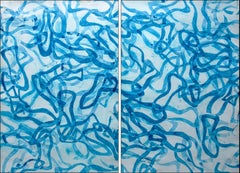
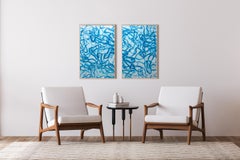
Blue of Blues, Abstract Fish Shapes Diptych, Overlapping Forms, Mediterranean

Blue of Blues, Abstract Fish Shapes Diptych, Overlapping Forms, Mediterranean

Located in Barcelona, ES

This series by Enric Servera explores the relationship of humans to salt and seawater. The intention of these works is to submerge us into the sea, a salty treasure that surrounds us and reminds us of its natural beauty and the importance of its preservation. Details: Title: Blue of Blues N12 Medium: Mixed Media on Paper Size: 90x 120 cm total (35.4 x 49.6 inches). Each panel measures 63 x 90 cm (24.8 x 35.4 inches). Year: 2023 * Frame is for illustrative purposes only. Artwork shipped carefully rolled and packaged in a tube. * Certificate of Authenticity provided. Enric Servera (Ciutadella de Menorca, 1970) lives and works between Barcelona and Menorca, Spain. His works explores the colors and forms of the ocean, inspired by the fauna and flora of the Mediterranean Sea. His work has shown in galleries across Spain, and is part of several public and private collections. Words that may describe this series of artworks are: Mediterranean-inspired art, abstract sea paintings...

Category

2010s Blue Rider Art

Materials

Acrylic, Watercolor, Paper

On The Way to Havasu

On The Way to Havasu

By James Mannix

Located in East Hampton, NY

Color Photograph of Abandoned Gas Station Architecture Lake Havasu is a large reservoir formed by Parker Dam on the Colorado River, on the border between San Bernardino County, Cali...

Category

2010s Blue Rider Art

Materials

Mixed Media

Felson,

Wassily KandinskyFelson,, 1909

Sold

H 6.05 in W 6.05 in

Felson,

By Wassily Kandinsky

Located in New York, NY

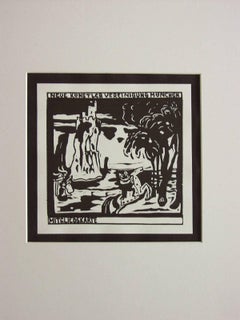
Black and White Woodcut. Published in 1909 in an edition of 100 to be used as a card member for the group of artists "Neu Kunstler-Vereingun Munchen". The impression is complete in ...

Category

1910s Blue Rider Art
Materials

Woodcut

Blue Rider art for sale on 1stDibs.
Find a wide variety of authentic Blue Rider art available for sale on 1stDibs. Works in this style were very popular during the 21st Century and Contemporary, but contemporary artists have continued to produce works inspired by this movement. Many Pop art paintings were created by popular artists on 1stDibs, including Wassily Kandinsky, Anastasia Kurakina, James Mannix, and (after) Wassily Kandinsky. Frequently made by artists working with Woodcut Print, and Paper and other materials, all of these pieces for sale are unique and have attracted attention over the years. Not every interior allows for large Blue Rider art, so small editions measuring 6.05 inches across are also available. Prices for art made by famous or emerging artists can differ depending on medium, time period and other attributes. On 1stDibs, the price for these items starts at $450 and tops out at $26,000, while the average work sells for $3,075.