Adaa Art Dealers Association Of America
Art Dealers Association of America (ADAA)
Founded in 1962, the Art Dealers Association of America is a vetted community of more than 180 top-tier galleries across the United States. Working with these member galleries, ADAA appraisers offer assessment services for artworks spanning from the Renaissance to the present day. The ADAA also arranges public forums on important art-related topics and hosts The Art Show, presented each year at New York’s Park Avenue Armory, which stands out among art fairs for its acclaimed selection of curated booths — many of which are one-artist exhibitions.to
37
3,623
1,849
1,051
895
479
326
268
206
163
137
130
118
113
98
87
86
81
74
53
40
34
34
30
27
27
19
18
14
9
9
8
6
5
5
5
5
4
4
3
3
3
3
2
2
1
1
1
1
1
1
1
76
72
68
65
60
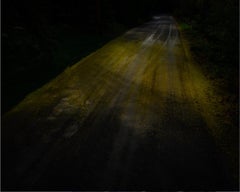
Gold Road (fallen pollen), 2022
By Cig Harvey
Located in Santa Monica, CA
Signed, titled and dated in ink on accompanying photographer's label
Archival pigment print
Image: 16" x 20", Paper: 17" x 21", Matted: 24" x 30"
Edition of 10
Category
2010s Adaa Art Dealers Association Of America
Materials
Archival Pigment
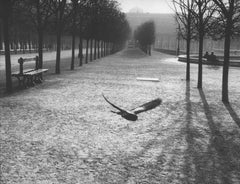
Palais Royal, Paris, 1989
By Edouard Boubat
Located in Santa Monica, CA
Palais Royal, Paris, 1989/Printed Later
Signed in ink on recto
Gelatin silver print
16 x 12 inches
Category
20th Century Adaa Art Dealers Association Of America
Materials
Silver Gelatin
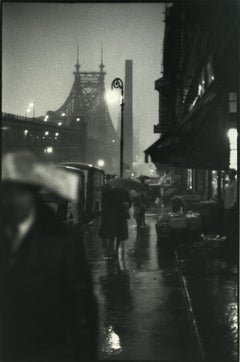
Queensborough Bridge, New York
By Louis Faurer
Located in New York, NY
Image size is 10 x 6.5 inches.
Signed, titled and dated by the artist on verso.
Category
1940s Adaa Art Dealers Association Of America
Materials
Silver Gelatin
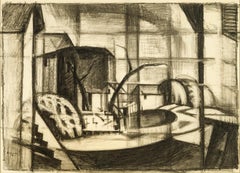
Study for Old Canal, Red and Blue (Rockaway, Morris Canal)
By Oscar Florianus Bluemner
Located in New York, NY
Oscar Bluemner was a German and an American, a trained architect who read voraciously in art theory, color theory, and philosophy, a writer of art criticism both in German and English, and, above all, a practicing artist. Bluemner was an intense man, who sought to express and share, through drawing and painting, universal emotional experience. Undergirded by theory, Bluemner chose color and line for his vehicles; but color especially became the focus of his passion. He was neither abstract artist nor realist, but employed the “expressional use of real phenomena” to pursue his ends. (Oscar Bluemner, from unpublished typescript on “Modern Art” for Camera Work, in Bluemner papers, Archives of American Art, Smithsonian Institution, as cited and quoted in Jeffrey R. Hayes, Oscar Bluemner [1991], p. 60. The Bluemner papers in the Archives [hereafter abbreviated as AAA] are the primary source for Bluemner scholars. Jeffrey Hayes read them thoroughly and translated key passages for his doctoral dissertation, Oscar Bluemner: Life, Art, and Theory [University of Maryland, 1982; UMI reprint, 1982], which remains the most comprehensive source on Bluemner. In 1991, Hayes published a monographic study of Bluemner digested from his dissertation and, in 2005, contributed a brief essay to the gallery show at Barbara Mathes, op. cit.. The most recent, accessible, and comprehensive view of Bluemner is the richly illustrated, Barbara Haskell, Oscar Bluemner: A Passion for Color, exhib. cat. [New York: Whitney Museum of American Art, 2005.])
Bluemner was born in the industrial city of Prenzlau, Prussia, the son and grandson of builders and artisans. He followed the family predilection and studied architecture, receiving a traditional and thorough German training. He was a prize-winning student and appeared to be on his way to a successful career when he decided, in 1892, to emigrate to America, drawn perhaps by the prospect of immediate architectural opportunities at the Chicago World’s Fair, but, more importantly, seeking a freedom of expression and an expansiveness that he believed he would find in the New World.
The course of Bluemner’s American career proved uneven. He did indeed work as an architect in Chicago, but left there distressed at the formulaic quality of what he was paid to do. Plagued by periods of unemployment, he lived variously in Chicago, New York, and Boston. At one especially low point, he pawned his coat and drafting tools and lived in a Bowery flophouse, selling calendars on the streets of New York and begging for stale bread. In Boston, he almost decided to return home to Germany, but was deterred partly because he could not afford the fare for passage. He changed plans and direction again, heading for Chicago, where he married Lina Schumm, a second-generation German-American from Wisconsin. Their first child, Paul Robert, was born in 1897. In 1899, Bluemner became an American citizen. They moved to New York City where, until 1912, Bluemner worked as an architect and draftsman to support his family, which also included a daughter, Ella Vera, born in 1903.
All the while, Oscar Bluemner was attracted to the freer possibilities of art. He spent weekends roaming Manhattan’s rural margins, visiting the Bronx, Brooklyn, Queens, and New Jersey, sketching landscapes in hundreds of small conté crayon drawings. Unlike so many city-based artists, Bluemner did not venture out in search of pristine countryside or unspoiled nature. As he wrote in 1932, in an unsuccessful application for a Guggenheim Fellowship, “I prefer the intimate landscape of our common surroundings, where town and country mingle. For we are in the habit to carry into them our feelings of pain and pleasure, our moods” (as quoted by Joyce E. Brodsky in “Oscar Bluemner in Black and White,” p. 4, in Bulletin 1977, I, no. 5, The William Benton Museum of Art, Storrs, Connecticut). By 1911, Bluemner had found a powerful muse in a series of old industrial towns, mostly in New Jersey, strung along the route of the Morris Canal.
While he educated himself at museums and art galleries, Bluemner entered numerous architectural competitions. In 1903, in partnership with Michael Garven, he designed a new courthouse for Bronx County. Garven, who had ties to Tammany Hall, attempted to exclude Bluemner from financial or artistic credit, but Bluemner promptly sued, and, finally, in 1911, after numerous appeals, won a $7,000 judgment.
Barbara Haskell’s recent catalogue reveals more details of Bluemner’s architectural career than have previously been known. Bluemner the architect was also married with a wife and two children. He took what work he could get and had little pride in what he produced, a galling situation for a passionate idealist, and the undoubted explanation for why he later destroyed the bulk of his records for these years. Beginning in 1907, Bluemner maintained a diary, his “Own Principles of Painting,” where he refined his ideas and incorporated insights from his extensive reading in philosophy and criticism both in English and German to create a theoretical basis for his art. Sometime between 1908 and 1910, Bluemner’s life as an artist was transformed by his encounter with the German-educated Alfred Stieglitz, proprietor of the Little Galleries of the Photo-Secession at 291 Fifth Avenue. The two men were kindred Teutonic souls. Bluemner met Stieglitz at about the time that Stieglitz was shifting his serious attention away from photography and toward contemporary art in a modernist idiom. Stieglitz encouraged and presided over Bluemner’s transition from architect to painter. During the same period elements of Bluemner’s study of art began to coalesce into a personal vision. A Van Gogh show in 1908 convinced Bluemner that color could be liberated from the constraints of naturalism. In 1911, Bluemner visited a Cézanne watercolor show at Stieglitz’s gallery and saw, in Cézanne’s formal experiments, a path for uniting Van Gogh’s expressionist use of color with a reality-based but non-objective language of form.
A definitive change of course in Bluemner’s professional life came in 1912. Ironically, it was the proceeds from his successful suit to gain credit for his architectural work that enabled Bluemner to commit to painting as a profession. Dividing the judgment money to provide for the adequate support of his wife and two children, he took what remained and financed a trip to Europe. Bluemner traveled across the Continent and England, seeing as much art as possible along the way, and always working at a feverish pace. He took some of his already-completed work with him on his European trip, and arranged his first-ever solo exhibitions in Berlin, Leipzig, and Elberfeld, Germany. After Bluemner returned from his study trip, he was a painter, and would henceforth return to drafting only as a last-ditch expedient to support his family when his art failed to generate sufficient income.
Bluemner became part of the circle of Stieglitz artists at “291,” a group which included Marsden Hartley, John Marin, and Arthur Dove. He returned to New York in time to show five paintings at the 1913 Armory Show and began, as well, to publish critical and theoretical essays in Stieglitz’s journal, Camera Work. In its pages he cogently defended the Armory Show against the onslaught of conservative attacks. In 1915, under Stieglitz’s auspices, Bluemner had his first American one-man show at “291.” Bluemner’s work offers an interesting contrast with that of another Stieglitz architect-turned-artist, John Marin, who also had New Jersey connections.
The years after 1914 were increasingly uncomfortable. Bluemner remained, all of his life, proud of his German cultural legacy, contributing regularly to German language journals and newspapers in this country. The anti-German sentiment, indeed mania, before and during World War I, made life difficult for the artist and his family. It is impossible to escape the political agenda in Charles Caffin’s critique of Bluemner’s 1915 show. Caffin found in Bluemner’s precise and earnest explorations of form, “drilled, regimented, coerced . . . formations . . . utterly alien to the American idea of democracy” (New York American, reprinted in Camera Work, no. 48 [Oct. 1916], as quoted in Hayes, 1991, p. 71).
In 1916, seeking a change of scene, more freedom to paint, and lower expenses, Bluemner moved his family to New Jersey, familiar terrain from his earlier sketching and painting. During the ten years they lived in New Jersey, the Bluemner family moved around the state, usually, but not always, one step ahead of the rent collector. In 1917, Stieglitz closed “291” and did not reestablish a Manhattan gallery until 1925. In the interim, Bluemner developed relationships with other dealers and with patrons. Throughout his career he drew support and encouragement from art cognoscenti who recognized his talent and the high quality of his work. Unfortunately, that did not pay the bills. Chronic shortfalls were aggravated by Bluemner’s inability to sustain supportive relationships. He was a difficult man, eternally bitter at the gap between the ideal and the real. Hard on himself and hard on those around him, he ultimately always found a reason to bite the hand that fed him.
Bluemner never achieved financial stability. He left New Jersey in 1926, after the death of his beloved wife, and settled in South Braintree, Massachusetts, outside of Boston, where he continued to paint until his own death in 1938. As late as 1934 and again in 1936, he worked for New Deal art programs designed to support struggling artists. Bluemner held popular taste and mass culture in contempt, and there was certainly no room in his quasi-religious approach to art for accommodation to any perceived commercial advantage. His German background was also problematic, not only for its political disadvantages, but because, in a world where art is understood in terms of national styles, Bluemner was sui generis, and, to this day, lacks a comfortable context.
In 1933, Bluemner adopted Florianus (definitively revising his birth names, Friedrich Julius Oskar) as his middle name and incorporated it into his signature, to present “a Latin version of his own surname that he believed reinforced his career-long effort to translate ordinary perceptions into the more timeless and universal languages of art” (Hayes 1982, p. 189 n. 1). In 1939, critic Paul Rosenfeld, a friend and member of the Stieglitz circle, responding to the difficulty in categorizing Bluemner, perceptively located him among “the ranks of the pre-Nazi German moderns” (Hayes 1991, p. 41). Bluemner was powerfully influenced in his career by the intellectual heritage of two towering figures of nineteenth-century German culture, Johann Wolfgang von Goethe and Georg Wilhelm Friedrich Hegel. A keen student of color theory, Bluemner gave pride of place to the formulations of Goethe, who equated specific colors with emotional properties. In a November 19, 1915, interview in the German-language newspaper, New Yorker Staats-Zeitung (Abendblatt), he stated:
I comprehend the visible world . . . abstract the primary-artistic . . . and after these elements of realty are extracted and analyzed, I reconstruct a new free creation that still resembles the original, but also . . . becomes an objectification of the abstract idea of beauty.
The first—and most conspicuous mark of this creation is . . . colors which accord with the character of things, the locality . . . [and which] like the colors of Cranach, van der Weyden, or Durer, are of absolute purity, breadth, and luminosity. . . . I proceed from the psychological use of color by the Old Masters . . . [in which] we immediately recognize colors as carriers of “sorrow and joy” in Goethe’s sense, or as signs of human relationship. . . . Upon this color symbolism rests the beauty as well as the expressiveness, of earlier sacred paintings. Above all, I recognize myself as a contributor to the new German theory of light and color, which expands Goethe’s law of color through modern scientific means (as quoted in Hayes 1991, p. 71).
Hayes has traced the global extent of Bluemner’s intellectual indebtedness to Hegel (1991, pp. 36–37). More specifically, Bluemner made visual, in his art, the Hegelian world view, in the thesis and antithesis of the straight line and the curve, the red and the green, the vertical and the horizontal, the agitation and the calm. Bluemner respected all of these elements equally, painting and drawing the tension and dynamic of the dialectic and seeking ultimate reconciliation in a final visual synthesis. Bluemner was a keen student of art, past and present, looking, dissecting, and digesting all that he saw. He found precedents for his non-naturalist use of brilliant-hued color not only in the work Van Gogh and Cezanne, but also in Gauguin, the Nabis, and the Symbolists, as well as among his contemporaries, the young Germans of Der Blaue Reiter.
Bluemner was accustomed to working to the absolute standard of precision required of the architectural draftsman, who adjusts a design many times until its reality incorporates both practical imperatives and aesthetic intentions. Hayes describes Bluemner’s working method, explaining how the artist produced multiple images playing on the same theme—in sketch form, in charcoal, and in watercolor, leading to the oil works that express the ultimate completion of his process (Hayes, 1982, pp. 156–61, including relevant footnotes). Because of Bluemner’s working method, driven not only by visual considerations but also by theoretical constructs, his watercolor and charcoal studies have a unique integrity. They are not, as is sometimes the case with other artists, rough preparatory sketches. They stand on their own, unfinished only in the sense of not finally achieving Bluemner’s carefully considered purpose.
The present charcoal drawing is one of a series of images that take as their starting point the Morris Canal as it passed through Rockaway, New Jersey. The Morris Canal industrial towns that Bluemner chose as the points of departure for his early artistic explorations in oil included Paterson with its silk mills (which recalled the mills in the artist’s childhood home in Elberfeld), the port city of Hoboken, Newark, and, more curiously, a series of iron ore mining and refining towns, in the north central part of the state that pre-dated the Canal, harkening back to the era of the Revolutionary War. The Rockaway theme was among the original group of oil paintings that Bluemner painted in six productive months from July through December 1911 and took with him to Europe in 1912. In his painting journal, Bluemner called this work Morris Canal at Rockaway N.J. (AAA, reel 339, frames 150 and 667, Hayes, 1982, pp. 116–17), and exhibited it at the Galerie Fritz Gurlitt in Berlin in 1912 as Rockaway N. J. Alter Kanal. After his return, Bluemner scraped down and reworked these canvases. The Rockaway picture survives today, revised between 1914 and 1922, as Old Canal, Red and Blue (Rockaway River) in the collection of the Hirshhorn Museum and Sculpture Garden, Smithsonian Institution, Washington D. C. (color illus. in Haskell, fig. 48, p. 65).
For Bluemner, the charcoal expression of his artistic vision was a critical step in composition. It represented his own adaptation of Arthur Wesley’s Dow’s (1857–1922) description of a Japanese...
Category
20th Century American Modern Adaa Art Dealers Association Of America
Materials
Paper, Charcoal
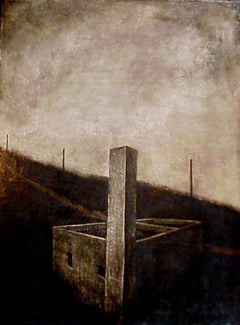
Untitled
By Joan Nelson
Located in New York, NY
JOAN NELSON
UNTITLED, 1984
egg tempera on masonite
24 x 18 in. 61 x 45.7 cm.
signed and dated on verso
landscape
castle
Category
1980s Contemporary Adaa Art Dealers Association Of America
Materials
Masonite, Egg Tempera
$18,000
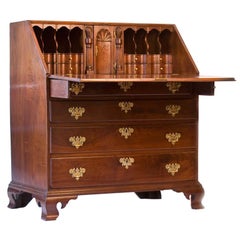
Walnut Chippendale Slant-Front Desk
Located in West Chester, PA
Desk with bold serpentine interior, document drawers with turnings and flames, and block-and-shell prospect door with carved tulip. Case with four gra...
Category
18th Century Antique Adaa Art Dealers Association Of America
Materials
Tulipwood
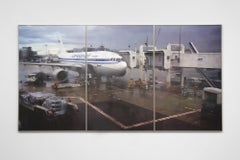
Untitled (Airport Paris)
By Peter Fischli & David Weiss
Located in New York, NY
Peter Fischli / David Weiss
Untitled (Airport Paris)
2008
Offset lithograph on three sheets
Each sheet: 51 1/4 x 32 5/8 inches; 130 x 83 cm
Edition of 100
Signed and numbered in ink ...
Category
Early 2000s Contemporary Adaa Art Dealers Association Of America
Materials
Lithograph
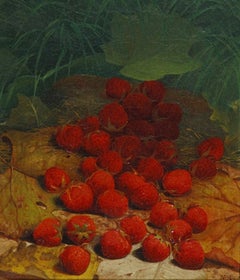
Strawberries Strewn on a Forest Floor
By William Mason Brown
Located in New York, NY
William Mason Brown was born in Troy, New York, where he studied for several years with local artists, including the leading portraitist there, Abel Buel Moore. In 1850, he moved to ...
Category
19th Century American Realist Adaa Art Dealers Association Of America
Materials
Canvas, Oil
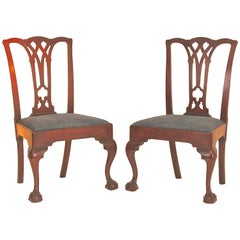
Pair of Mahogany Chippendale Side Chairs
Located in West Chester, PA
Gothic splats, slip seats, cabriole legs terminating in claw and ball feet. Philadelphia. 1775.
Category
18th Century American Chippendale Antique Adaa Art Dealers Association Of America
Materials
Mahogany

$10,000 / set
Haru, 2023
By Paul Cupido
Located in Santa Monica, CA
Signed, titled, dated in ink on photographer's label.
Archival pigment print on Kozo Paper
Image/Paper: 12" x 8"
AP 1
Category
2010s Adaa Art Dealers Association Of America
Materials
Archival Pigment
$4,750
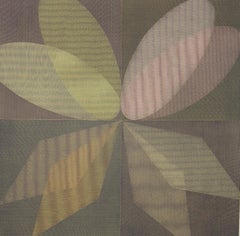
UNTITLED (from the KINETIC PORTFOLIO)
By Eusebio Sempere
Located in New York, NY
serigraph, Edition of 100
image of abstract flower
from KINETIC PORTFOLIO
Category
1970s Abstract Adaa Art Dealers Association Of America
Materials
Screen
$1,056 Sale Price
20% Off
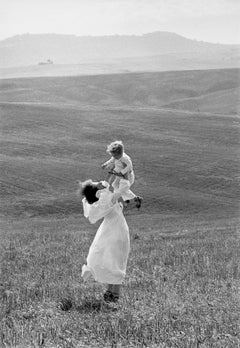
Tuscany, Italy, 1956/Printed Later
By Edouard Boubat
Located in Santa Monica, CA
Signed in ink on recto; signed, titled & dated in pencil on verso
Image 13-3/4" x 9-1/4", Paper 16" x 12", Matted 20" x 16"
Category
1950s Adaa Art Dealers Association Of America
Materials
Silver Gelatin
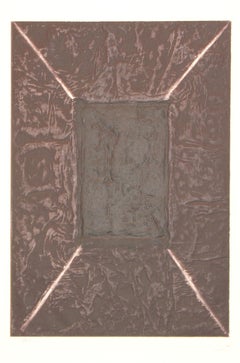
LA PORTE (THE DOOR)
By Antoni Tàpies
Located in New York, NY
aquatint and embossing on paper.
plate 19 3/4 x 13 3/4 in.
paper 30 3/4 x 23 in.
Category
Late 20th Century Abstract Adaa Art Dealers Association Of America
Materials
Aquatint
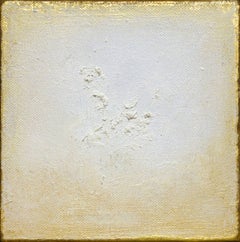
ODYSEUSS TOUCHED BY ATHENA'S WAND
By Julie Hedrick
Located in New York, NY
small oil painting on canvas
Category
21st Century and Contemporary Contemporary Adaa Art Dealers Association Of America
Materials
Oil, Canvas
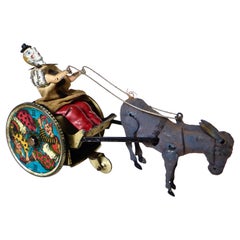
German Tinplate Clockwork Wind Up Toy by the Lehman Co. "Balky Mule" Circa 1909
By E.P. Lehman Co.
Located in Incline Village, NV
Perhaps the wildest action of all the Lehman toys, said to resemble Ernest Paul Lehman's temperament (founder of the company), "Balky Mule" was first manufactured in 1897 in Berlin (Brandenburg), and had a multi decade run; this example is from around 1909 (see image with markings to the rear of the carriage). The toy is catalogued as "EPL #425" and documented on page 59 and 60 of the book "Lehman Toys" by Jurgen & Marianne Cieslik, published in 1982.
To operate the toy; wind up the attached clockwork key on the underneath of the carriage and place the toy on the floor. Do not over-wind and be gentle, as the toy is aggressive and over 100 years old. The toy will go backwards and forward, and the clown will pop up and down as the cart goes in several different directions across the floor until it winds down (see video accompanying the listing for guidance).
The toy is found broken and/or inoperable, more often than not, because of the rough action, and typical abuse by children (after all, it was a toy).
This example is in very nice original condition and works well. The lithography and hand paint is bright and original with no touch up or repaint. The hand paint is; flesh tones to the face of the clown, red trousers, orange hair, and grey paint to the seat of the carriage. The clothing to the clown figure is still intact and all original. The lithography to the wheels features brightly colored clowns and a German marking logo. What is really unusual is the fact that the donkey still has all four of its loosely attached original legs, considering the aggressive action of the toy. The metal on the donkey is actually treated with "fabric like" paint, to simulate fur.
All in all this is a really cool toy and a "must have" for the collector of tin toys, or someone who simply wants a wonderful example of an early, "turn of the century" iconic wind up toy.
Provenance: Recently acquired from a prominent toy collection in Los Angeles, California
Dimensions: 7 1/2" long x 3" wide x 5" high
Note: After 40 plus years of dealing and collecting toys, I am justly qualified to guarantee and present the authenticity of antique and vintage toys and children's playthings; important considering the fakes and reproductions in the marketplace
it would behoove an enterprising collector, dealer, or decorator to take advantage of the opportunity to buy as many of the vintage tin...
Category
Early 1900s German Folk Art Antique Adaa Art Dealers Association Of America
Materials
Tin
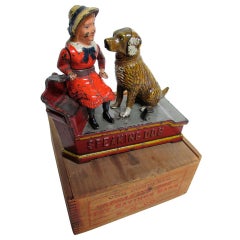
Mechanical Bank Speaking Dog By The Shepard Co Ca 1885; with Original Wooden Box
By Shepard Hardware Company
Located in Incline Village, NV
Manufactured in 1884 by the Shepard Hardware Company in Buffalo, New York, this cast iron mechanical bank measures 7 1/8" long and is in excellent all original condition and paint, especially considering that the Shepard Company did not use a primer rendering their surface more vulnerable than say, the Steven's Company. There is no touch up or repaint, and no restoration of any kind. Colors of bright red on the dress, flesh tones, tan colored dog, and maroon base are all very bright and crisp. The bank is accompanied by the original wooden box in which it was originally shipped; a very special find and charming piece of Americana. Rare to find the original box. The bank and box came directly from an estate and the original owner, and I have owned it since then for over 35 years. The theme of the bank depicts a young Victorian girl playing with her golden retriever. It is one of only four antique mechanical banks...
Category
19th Century American Folk Art Antique Adaa Art Dealers Association Of America
Materials
Iron
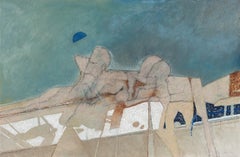
Reclining Figures
By Otis Huband
Located in Dallas, TX
Born in 1933, Otis Huband declared his intention to be an artist at age 6. He earned his BFA and MFA at Richmond Professional Institute of the College of William & Mary, now Virginia...
Category
2010s American Modern Adaa Art Dealers Association Of America
Materials
Canvas, Oil
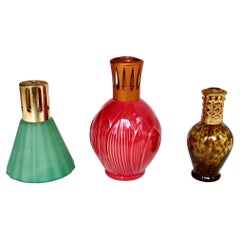
(3) French Post-War Glass Fragrance Diffusers "Lamp Berger Luneville" Ca. 1950's
By Luneville
Located in Incline Village, NV
Offered here are three nice quality authentic glass, post-war French fragrance diffusers used to freshen up and make a room or area smell nicely. Sometimes called aroma oil lamps, th...
Category
1950s French Mid-Century Modern Vintage Adaa Art Dealers Association Of America
Materials
Glass
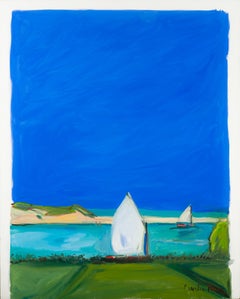
Two Sailboats
By Cornelia Foss
Located in New York, NY
Cornelia Foss is renowned for her expressive landscapes, intimate portraits, and still lifes. Born in Berlin in 1931, she spent her early years in Rome before emigrating to the Unite...
Category
2010s Contemporary Adaa Art Dealers Association Of America
Materials
Canvas, Oil
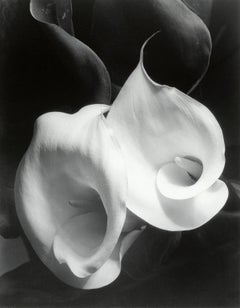
Two Callas
By Imogen Cunningham
Located in New York, NY
This supremely elegant photograph illustrates why Imogen Cunningham’s botanical pictures are a keystone of modernist photography. In the 1920s, Cunnin...
Category
1920s Adaa Art Dealers Association Of America
Materials
Silver Gelatin
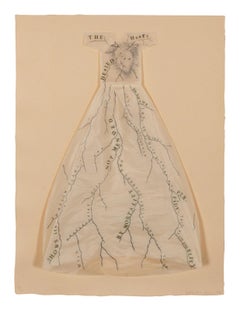
WHITE HINGED POEM DRESS (#3)
By Lesley Dill
Located in New York, NY
LESLEY DILL
WHITE HINGED POEM DRESS (#3), 1993
mixed media paper construction
Framed: 22 1/2 x 17 1/2 in
Edition of 20
signed, dated and numbered 12...
Category
1990s Contemporary Adaa Art Dealers Association Of America
Materials
Paper
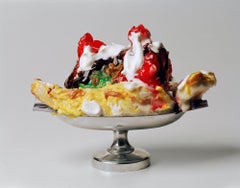
Banana Split
By Sharon Core
Located in New York, NY
From Sharon Core's series Oldenburgs, which playfully explores the sculptural work of Claes Oldenburg.
Category
2010s Adaa Art Dealers Association Of America
Materials
Archival Pigment
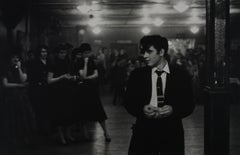
Irish Dancehall, The Bronx, 1954 (printed 2006)
By George S. Zimbel
Located in Santa Monica, CA
Signed in ink on recto; Signed, titled and dated in pencil on verso
Image: 7-3/4 x 12"; Paper: 10-3/4 x 13-3/4"; Mat 16 x 20"
Category
1950s Adaa Art Dealers Association Of America
Materials
Silver Gelatin
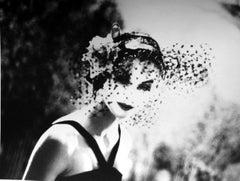
Anne Saint-Marie, New York, Chanel Advertising Campaign
By Lillian Bassman
Located in Santa Monica, CA
signed and number in pencil on verso
Category
Mid-20th Century Adaa Art Dealers Association Of America
Materials
Silver Gelatin
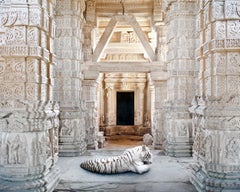
Becoming Arihanta, Sahastrabahu Temple, Gwailor
By Karen Knorr
Located in New York, NY
Listing includes framing with UV Plexi, free shipping, and a 14 day return policy.
Becoming Arihanta, Sahastrabahu Temple, Gwailor (2012) by Karen Knorr
24 x 30 inches (27 x 33 inches framed)
Archival pigment print
Edition 3 of 5 - Last edition available at this price
Signed on artist certificate and acquired directly from the artist.
Karen Knorr Artist Biography
While Knorr’s images take some of their inspiration from the Indian tradition of personifying animals in literature and art, there is another almost subconscious strain to her work. Going back to the time of cave painting we see that these early visual artists not only recorded their lives and surroundings, but used art to express themselves. The depiction of animals in symbolic and powerful ways and the urge to create these images with the best tools at hand is a line stretching from these unnamed cave painters to Karen Knorr.
Playfully combining technologies and genres, Knorr mixes digital...
Category
2010s Adaa Art Dealers Association Of America
Materials
Photographic Paper, Color, Pigment, Archival Pigment
GRAND PALEIA
By Hugo Bastidas
Located in New York, NY
Oil painting on linen of chandelier in overgrown forest.
nature
trees
landscape
surreal
Category
21st Century and Contemporary Contemporary Adaa Art Dealers Association Of America
Materials
Linen, Oil
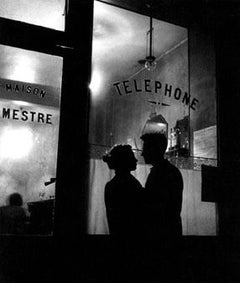
Menilmontant (Devant chez Mestre)
By Willy Ronis
Located in Santa Monica, CA
Ménilmontant [Devant Chez Mestre], 1957/Printed Later
Titled & dated in pencil with the photographer's stamp on verso; Signed in ink on recto
Gelatin silver print
Image 12-1/2" x 10-...
Category
1950s Adaa Art Dealers Association Of America
Materials
Silver Gelatin
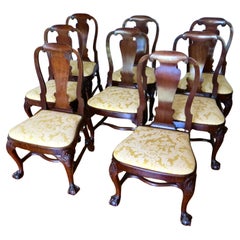
Fine Quality Set of (8) George I Dining Chairs. English Circa 1715
Located in Incline Village, NV
From my own private collection of outstandinq quality antique furniture items is being offered this "Magnificent Set of Eight George I Walnut Chairs" in impeccable original conditio...
Category
1710s English George I Antique Adaa Art Dealers Association Of America
Materials
Walnut
"Four Wheels No Brakes" Antique Tin Wind-Up Toy by Louis Marx Co. N.Y.C. C.1928
By Louis Marx and Company
Located in Incline Village, NV
The theme of this "crazy car" by the Louis Marx Toy Company located in New York City, is that of a jalopy, often referred to as a "flivver" car (a car that fails) "Funny Flivver top ...
Category
1920s American Folk Art Vintage Adaa Art Dealers Association Of America
Materials
Tin

Rinsing the Eye
By Terrell James
Located in Houston, TX
Terrell James
"Rinsing the Eye" 2019
Oil on linen
64 x 78 inches
Category
21st Century and Contemporary Abstract Expressionist Adaa Art Dealers Association Of America
Materials
Linen, Oil
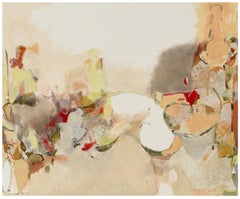
In the Studio
By Cornelia Foss
Located in New York, NY
Cornelia Foss is renowned for her expressive landscapes, intimate portraits, and still lifes. Born in Berlin in 1931, she spent her early years in Rome before emigrating to the Unite...
Category
2010s Contemporary Adaa Art Dealers Association Of America
Materials
Canvas, Oil
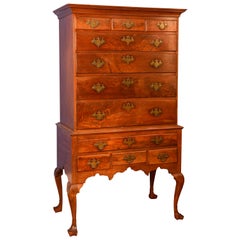
Queen Anne Walnut Flat Top High Boy
Located in West Chester, PA
Walnut Queen Anne highboy with lovely figured wood drawer fronts. Nicely scalloped aprons and cabriole legs terminating in trifid feet.
Category
18th Century American Queen Anne Antique Adaa Art Dealers Association Of America
Materials
Walnut
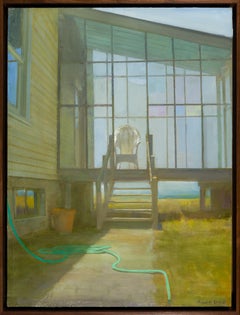
September
By Randall Exon
Located in New York, NY
Oil on panel
Category
2010s Contemporary Adaa Art Dealers Association Of America
Materials
Oil, Panel
$18,000
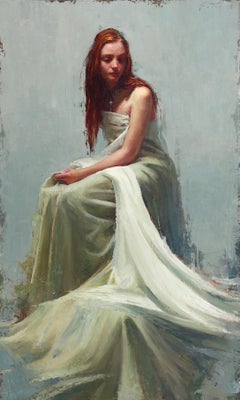
"Des Artes Graphicas No. 1"
By Tim Rees
Located in Scottsdale, AZ
Timothy Rees was fascinated with drawing throughout his youth and after high school pursued a degree in animation. The pull to painting portraits and figures was strong, however, le...
Category
2010s Contemporary Adaa Art Dealers Association Of America
Materials
Linen, Oil, Panel
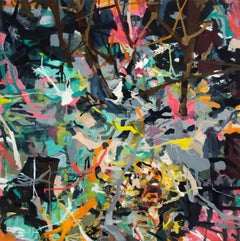
Slippery Pink
By Allison Gildersleeve
Located in Dallas, TX
Allison Gildersleeve addresses the theme of memory, exploring the phenomenon of past and present becoming collapsed or entwined by the emotional experience. Gildersleeve states: “In ...
Category
2010s Contemporary Adaa Art Dealers Association Of America
Materials
Canvas, Oil
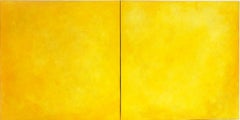
JULIE HEDRICK RA (Egypt) Sun God
By Julie Hedrick
Located in New York, NY
JULIE HEDRICK
RA (Egypt) Sun God, 2021
oil on canvas (diptych)
60 x 120 in. 152.4 x 304.8 cm.
Category
2010s Contemporary Adaa Art Dealers Association Of America
Materials
Canvas, Oil
$52,800 Sale Price
20% Off
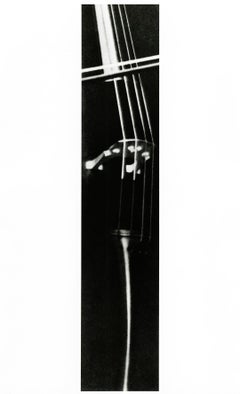
Cello Study
By Andre Kertesz
Located in New York, NY
This image measures 9 3/4 x 2 inches, on a 10 x 8 inch sheet. It is signed and date by the artist on verso, and notated "Paris." The print was made no later than 1971.
This elegant ...
Category
1920s Adaa Art Dealers Association Of America
Materials
Silver Gelatin
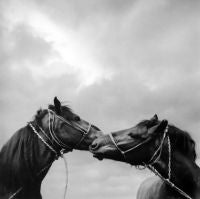
Untitled (Horses Kissing)
By Pentti Sammallahti
Located in Santa Monica, CA
Pentti Sammallahti
Untitled (Horses Kissing)
1979
Gelatin Silver print
Category
20th Century Adaa Art Dealers Association Of America
Materials
Silver Gelatin
Lily and Bird
By Joseph Stella
Located in New York, NY
Silverpoint and colored pencil on paper, 29 x 23 in.
Signed (at lower right): Joseph Stella
Executed about 1919
EXHIBITED: Hirschl & Adler Galleries, New York, November 23, 1985–January 4, 1986, American Masterworks on Paper: Drawings, Watercolors, and Prints, pp. 6, 46 no. 47 illus. // (probably) Richard York Gallery, New York, October 5–November 17, 1990, Joseph Stella: 100 Works on Paper, no. 36
EX COLL.: [Dudensing Galleries, New York]; sale, Christie’s, New York, December 7, 1984, lot 324; [Hirschl & Adler Galleries, New York, 1984]; to private collection, 2006 until the present
An independent-minded artist who adhered to the credo “Rules don’t exist,” Joseph Stella explored a range of styles, media, and themes, willfully ignoring the “barricades erected by ... [the] self-appointed dictators” of the art establishment (Joseph Stella, “On Painting,” Broom 11 [December 1921], pp. 122–23; Joseph Stella, “Discovery of America: Autobiographical Notes,” Art News 59
[November 1960], p. 41). By doing so, he produced a diverse and highly eclectic body of work, ranging from realist figure subjects, pulsating Futurist cityscapes, and modernist religious...
Category
Early 20th Century American Modern Adaa Art Dealers Association Of America
Materials
Paper, Color Pencil
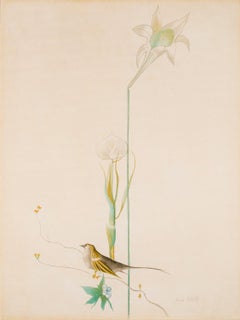
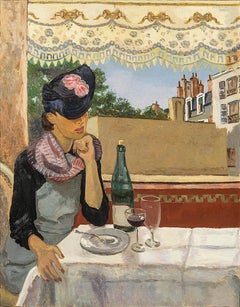
Table by the Window
By Edmund Quincy
Located in New York, NY
Estate stamp (on back, on original stretcher): Estate of/ Edmund Quincy/ 1903-1997 ///
Category
20th Century American Realist Adaa Art Dealers Association Of America
Materials
Canvas, Oil
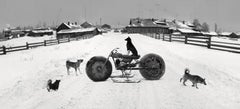
Solovki, White Sea, Russia (Dog on Motorbike)
By Pentti Sammallahti
Located in Santa Monica, CA
Pentti Sammallahti
Solovki, White Sea, Russia (Dog on Motorbike)
1992
Gelatin Silver print
Category
20th Century Adaa Art Dealers Association Of America
Materials
Silver Gelatin
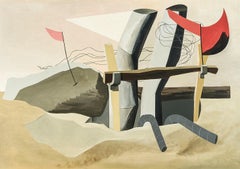
Excavation
By Charles Houghton Howard
Located in New York, NY
Charles Houghton Howard was born in Montclair, New Jersey, the third of five children in a cultured and educated family with roots going back to the Massachusetts Bay colony. His father, John Galen Howard, was an architect who had trained at M.I.T. and the École des Beaux Arts in Paris, and apprenticed in Boston with H. H. Richardson. In New York, the elder Howard worked for McKim, Mead and White before establishing a successful private practice. Mary Robertson Bradbury, Charles’s mother, had studied art before her marriage. John Galen Howard moved his household to California in 1902 to assume the position of supervising architect of the new University of California campus at Berkeley and to serve as Professor of Architecture and the first Dean of the School of Architecture (established in 1903). The four Howard boys grew up to be artists and all married artists, leaving a combined family legacy of art making in the San Francisco Bay area that endures to this day, most notably in design, murals and reliefs at the Coit Tower and in buildings on the Berkeley campus.
Charles Howard graduated from the University of California at Berkeley in 1921 as a journalism major, and pursued graduate studies in English at Harvard and Columbia Universities before embarking on a two-year trip to Europe. Howard went to Europe as a would-be writer. But a near-religious experience, seeing a picture by Giorgione in a remote town outside of Venice, proved a life-altering epiphany. In his own words, “I cut the tour at once and hurried immediately back to Paris, to begin painting. I have been painting whenever I could ever since” (Charles Howard, “What Concerns Me,” Magazine of Art 39, no. 2 [February 1946], p. 63). Giorgione’s achievement, in utilizing a structured and rational visual language of art to convey high emotion on canvas, instantly convinced Howard that painting, and not literature, offered the best vehicle to express what he wanted to say. Howard returned to the United States in 1925, confirmed in his intent to become an artist.
Howard settled in New York and supported himself as a painter in the decorating workshop of Louis Bouché and Rudolph Guertler, where he specialized in mural painting. Devoting spare time to his own work, he lived in Greenwich Village and immersed himself in the downtown avant-garde cultural milieu. The late 1920s and early 1930s were the years of Howard’s art apprenticeship. He never pursued formal art instruction, but his keen eye, depth of feeling, and intense commitment to the process of art making, allowed him to assimilate elements of painting intuitively from the wide variety of art that interested him. He found inspiration in the modernist movements of the day, both for their adherence to abstract formal qualities and for the cosmopolitan, international nature of the movements themselves. Influenced deeply by Surrealism, Howard was part of a group of American and European Surrealists clustered around Julien Levy. Levy opened his eponymously-named gallery in 1931, and rose to fame in January 1932, when he organized and hosted Surrealisme, the first ever exhibition of Surrealism in America, which included one work by Howard. Levy remained the preeminent force in advocating for Surrealism in America until he closed his gallery in 1949. Howard’s association with Levy in the early 1930s confirms the artist’s place among the avant-garde community in New York at that time.
In 1933, Howard left New York for London. It is likely that among the factors that led to the move were Howard’s desire to be a part of an international art community, as well as his marriage to English artist, Madge Knight...
Category
20th Century American Modern Adaa Art Dealers Association Of America
Materials
Canvas, Oil
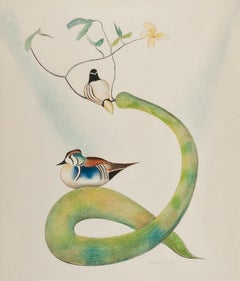
Two Wood Ducks on a Flowering Branch
By Joseph Stella
Located in New York, NY
Joseph Stella was a visionary artist who painted what he saw, an idiosyncratic and individual experience of his time and place. Stella arrived in New York in 1896, part of a wave of Italian immigrants from poverty-stricken Southern Italy. But Stella was not a child of poverty. His father was a notary and respected citizen in Muro Locano, a small town in the southern Appenines. The five Stella brothers were all properly educated in Naples. Stella’s older brother, Antonio, was the first of the family to come to America. Antonio Stella trained as a physician in Italy, and was a successful and respected doctor in the Italian community centered in Greenwich Village. He sponsored and supported his younger brother, Joseph, first sending him to medical school in New York, then to study pharmacology, and then sustaining him through the early days of his artistic career. Antonio Stella specialized in the treatment of tuberculosis and was active in social reform circles. His connections were instrumental in Joseph Stella’s early commissions for illustrations in reform journals.
Joseph Stella, from the beginning, was an outsider. He was of the Italian-American community, but did not share its overwhelming poverty and general lack of education. He went back to Italy on several occasions, but was no longer an Italian. His art incorporated many influences. At various times his work echoed the concerns and techniques of the so-called Ashcan School, of New York Dada, of Futurism and, of Cubism, among others. These are all legitimate influences, but Stella never totally committed himself to any group. He was a convivial, but ultimately solitary figure, with a lifelong mistrust of any authority external to his own personal mandate. He was in Europe during the time that Alfred Stieglitz established his 291 Gallery. When Stella returned he joined the international coterie of artists who gathered at the West Side apartment of the art patron Conrad Arensberg. It was here that Stella became close friends with Marcel Duchamp.
Stella was nineteen when he arrived in America and studied in the early years of the century at the Art Students League, and with William Merritt Chase, under whose tutelage he received rigorous training as a draftsman. His love of line, and his mastery of its techniques, is apparent early in his career in the illustrations he made for various social reform journals. Stella, whose later work as a colorist is breathtakingly lush, never felt obliged to choose between line and color. He drew throughout his career, and unlike other modernists, whose work evolved inexorably to more and more abstract form, Stella freely reverted to earlier realist modes of representation whenever it suited him. This was because, in fact, his “realist” work was not “true to nature,” but true to Stella’s own unique interpretation.
Stella began to draw flowers, vegetables, butterflies, and birds in 1919, after he had finished the Brooklyn Bridge series of paintings, which are probably his best-known works. These drawings of flora and fauna were initially coincidental with his fantastical, nostalgic and spiritual vision of his native Italy which he called Tree of My Life (Mr. and Mrs. Barney A. Ebsworth Foundation and Windsor, Inc., St. Louis, illus. in Barbara Haskell, Joseph Stella, exh. cat. [New York: Whitney Museum of American Art, 1994], p. 111 no. 133).
Two Wood Ducks...
Category
20th Century American Modern Adaa Art Dealers Association Of America
Materials
Color Pencil
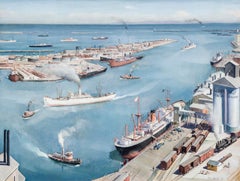
San Pedro Harbor
By Paul Sample
Located in New York, NY
It is infrequent, to say the least, that a diagnosis of tuberculosis proves fortuitous, but that was the event, in 1921, that set Paul Starrett Sample on the road to becoming a professional artist. (The best source for an overview of Sample’s life and oeuvre remains Paul Sample: Painter of the American Scene, exhib. cat., [Hanover, New Hampshire: Hood Museum of Art, 1988] with a detailed and definitive chronology by Sample scholar, Paula F. Glick, and an essay by Robert L. McGrath. It is the source for this essay unless otherwise indicated.) Sample, born in Louisville, Kentucky, in 1896 to a construction engineer and his wife, spent his childhood moving with his family to the various locations that his father’s work took them. By 1911, the family had landed in Glencoe, Illinois, settling long enough for Paul to graduate from New Trier High School in 1916. Sample enrolled at Dartmouth College, in Hanover, New Hampshire, where his interests were anything but academic. His enthusiasms included the football and basketball teams, boxing, pledging at a fraternity, and learning to play the saxophone. After the United States entered World War I, Sample, to his family’s dismay, signed on for the Naval Reserve, leading directly to a hiatus from Dartmouth. In 1918 and 1919, Sample served in the U.S. Merchant Marine where he earned a third mate’s license and seriously contemplated life as a sailor. Acceding to parental pressure, he returned to Dartmouth, graduating in 1921. Sample’s undergraduate life revolved around sports and a jazz band he formed with his brother, Donald, two years younger and also a Dartmouth student. In November 1933, Sample summarized his life in a letter he wrote introducing himself to Frederick Newlin Price, founder of Ferargil Galleries, who would become his New York art dealer. The artist characterized his undergraduate years as spent “wasting my time intensively.” He told Price that that “I took an art appreciation course and slept thru it every day” (Ferargil Galleries Records, circa 1900–63, Archives of American Art, Smithsonian Institution, available on line).
In 1920, Donald Sample contracted tuberculosis. He went for treatment to the world-famous Trudeau Sanitorium at Saranac Lake, in New York State’s Adirondack Mountains for the prescribed regimen of rest, healthful food, and fresh air. Visiting his brother in 1921, Paul also contracted the disease. Tuberculosis is highly contagious, and had no certain cure before the development of streptomycin in 1946. Even for patients who appeared to have recovered, there was a significant rate of recurrence. Thus, in his letter to Price, Sample avoided the stigma conjured by naming the disease, but wrote “I had a relapse with a bad lung and spent the next four years hospitalized in Saranac Lake.” The stringent physical restrictions imposed by adherence to “the cure” required Sample to cultivate an alternate set of interests. He read voraciously and, at the suggestion of his physician, contacted the husband of a fellow patient for instruction in art. That artist, then living in Saranac, was Jonas Lie (1880–1940), a prominent Norwegian-American painter and an associate academician at the National Academy of Design. Lie had gained renown for his dramatic 1913 series of paintings documenting the construction of the Panama Canal (The Metropolitan Museum of Art, New York; United States Military Academy, West Point, New York). Primarily a landscape artist, Lie had a particular affinity for scenes with water. His paintings, impressionistic, atmospheric, and brushy, never strayed from a realistic rendering of his subject. Sample regarded Lie as a mentor and retained a lifelong reverence for his teacher. Sample’s early paintings very much reflect Lie’s influence.
`
In 1925, “cured,” Sample left Saranac Lake for what proved to be a brief stay in New York City, where his veteran’s benefits financed a commercial art course. The family, however, had moved to California, in the futile hope that the climate would benefit Donald. Sample joined them and after Donald’s death, remained in California, taking classes at the Otis Art Institute in Los Angeles. In Sample’s account to Price, “I couldn’t stomach the practice of painting a lot of High Sierras and desert flowers which seemed to be the only kind of pictures that were sold here so I got a job teaching drawing and painting at the art school of the University of Southern California.” Initially hired as a part-time instructor, Sample progressed to full-time status and ultimately, by the mid-1930s, to the post of Chairman of the Fine Art Department. Sample, however, did not want to wind up as a professor. “Teaching is all right in small doses,” he wrote, “but I have a horror of drifting into being a college professor and nothing more.” At the same time as he taught, Sample began to exhibit his work in a variety of venues at first locally, then nationally. Though he confessed himself “a terrible salesman,” and though occupied with continued learning and teaching, Sample was nonetheless, ambitious. In 1927, he wrote in his diary, “I am eventually going to be a painter and a damned good one. And what is more, I am going to make money at it” (as quoted by Glick, p. 15). In 1928, Sample felt sufficiently solvent to marry his long-time love, Sylvia Howland, who had also been a patient at Saranac Lake. The Howland family were rooted New Englanders and in summertime the Samples regularly traveled East for family reunion vacations.
While the 1930s brought serious hardship to many artists, for Paul Sample it was a decade of success. Buttressed by the financial safety net of his teacher’s salary, he painted realist depictions of the American scene. While his work addressed depression-era conditions with a sympathetic eye, Sample avoided the anger and tinge of bitterness that characterized much contemporary realist art. Beginning in 1930, Sample began to exhibit regularly in juried exhibitions at important national venues, garnering prizes along the way. In 1930, Inner Harbor won an honorable mention in the Annual Exhibition of the Art Institute of Chicago. That same year Sample was also represented in a show at the Albright-Knox Gallery in Buffalo and at the Biennial Exhibition of the Corcoran Gallery of Art, Washington, D.C. In 1931, Dairy Ranch won the second Hallgarten Prize at the Annual Exhibition of the National Academy of Design, in New York. Sample also made his first appearances at the Carnegie Institute, Pittsburgh, and The Pennsylvania Academy of the Fine Arts, Philadelphia. In 1936, Miner’s Resting won the Temple Gold Medal at the Pennsylvania Academy’s Annual Exhibition. Always interested in watercolor, in 1936, Sample began to send works on paper to exhibitions at the Whitney Museum, New York.
While participating in juried exhibitions, Sample also cultivated commercial possibilities. His first New York art dealer was the prestigious Macbeth Gallery in New York, which included his work in a November 1931 exhibition. In 1934, Sample joined the Ferargil Galleries in New York, after Fred Price arranged the sale of Sample’s Church Supper to the Michele and Donald D’Amour Museum of Fine Arts in Springfield, Massachusetts. In 1937, The Metropolitan Museum of Art purchased Sample’s Janitor’s Holiday from the annual exhibition of the National Academy of Design, a notable honor.
As prestigious as this exhibition schedule may have been, by far Sample’s most visible presence in the 1930s and 1940s was the result of his relationship with Henry Luce’s burgeoning publishing empire, Time, Inc. Sample’s first contribution to a Luce publication appears to have been another San Pedro...
Category
20th Century American Modern Adaa Art Dealers Association Of America
Materials
Canvas, Oil
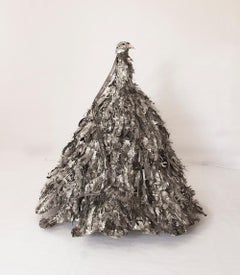
SILVER GOWN OF ASCENSION
By Lesley Dill
Located in New York, NY
The language featured on this work of art reads "highest moment of impulse... high collateral glory." John Milton
Category
2010s Contemporary Adaa Art Dealers Association Of America
Materials
Metal, Wire
$80,000 Sale Price
20% Off
Ford Model V, New York
By Len Prince
Located in Santa Monica, CA
signed by artist
Category
Adaa Art Dealers Association Of America
Woman at The Bar, Bourbon Street, New Orleans , 1955 (printed 2008)
By George S. Zimbel
Located in Santa Monica, CA
Signed and dated in ink on recto; Signed, titled and dated in pencil on verso
Image: 8 x 12-1/2"; Paper 10-3/4" x 13-3/4"; Mat 16 x 20"
Category
1950s Adaa Art Dealers Association Of America
Materials
Silver Gelatin
Untitled
By Michael Gregory
Located in San Francisco, CA
Michael Gregory was born in 1955 in Los Angeles, CA and received his BFA from the San Francisco Art Institute in 1980. Previously living and working in Bolinas, California, Gregory h...
Category
2010s Adaa Art Dealers Association Of America
Materials
Oil, Panel
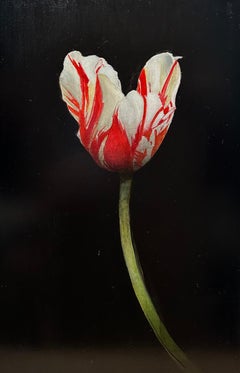
RENDEZVOUS PLATINUM
By Adriana Marmorek
Located in New York, NY
Adriana Marmorek
RENDEZVOUS PLATINUM, 2020
blown glass, porcelain painted platinum
1.97 x 10.24 x 8.27 in. 5 x 26 x 21 cm.
Category
2010s Contemporary Adaa Art Dealers Association Of America
Materials
Porcelain, Blown Glass, Paint
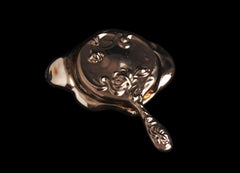
Camellia
Located in Santa Monica, CA
Vintage Hand Colored Albumen print
Category
Late 19th Century Adaa Art Dealers Association Of America
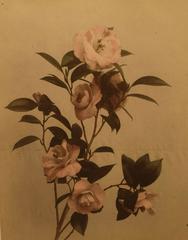
$2,500
Chrysanthemum (1 Washigamine 2 Riukonoisami)
Located in Santa Monica, CA
Vintage Hand Colored Albumen print
Category
Late 19th Century Adaa Art Dealers Association Of America
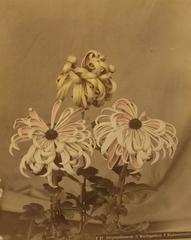
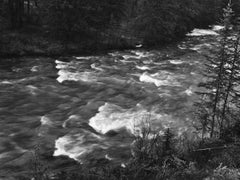
Alberta, Canada, 1978
By Paul Caponigro
Located in Santa Monica, CA
Alberta, Canada, 1978
Signed in pencil on mount recto
Gelatin Silver Print
Image: 9 x 12.5 in. Paper: 11 x 14 in
Category
1970s Adaa Art Dealers Association Of America
Materials
Silver Gelatin
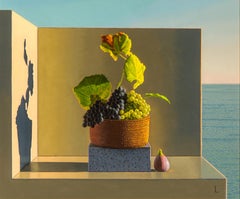
Offering: Grapes & Fig
By David Ligare
Located in New York, NY
David Ligare (b. 1945)
Contemporary American Painter
"Offering: Grapes & Fig," 2023
Oil on canvas, 20 x 24 in.
Signed and dated (at lower right): L; (on verso): Ligare / 2023
Category
21st Century and Contemporary Contemporary Adaa Art Dealers Association Of America
Materials
Canvas, Oil
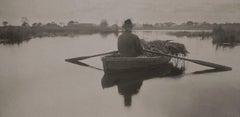
Rowing Home the Schoof-Stuff, Life and Landscape on the Norfolk Broads
By P.H. Emerson
Located in Santa Monica, CA
Vintage platinum/palladium print
66NNF
Titled in pencil on recto
Variously numbered in pencil with plate number printed on verso.
The English photographer, Peter Henry Emerson, promoted photography as an independent art form and created an aesthetic theory called “naturalistic photography.” Trained as a physician, Emerson first began to photograph as part of an anthropological study of the peasants and fishermen of East Anglia. These black-and-white photographs, published in books such as Life and Landscape on the Norfolk Broads...
Category
Late 19th Century Adaa Art Dealers Association Of America
Materials
Platinum
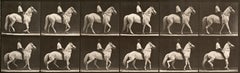
Human and Animal Locomotion. Plate 577.
By Eadweard Muybridge
Located in New York, NY
Human and Animal Locomotion. Plate 577.
Walking; saddle; irregular; white horse Clinton.
14 x 20 inch original vintage collotype print from 1887
Image size 5 1/2 x 18 1/8 inches
Muy...
Category
1880s Adaa Art Dealers Association Of America
Materials
Photographic Paper
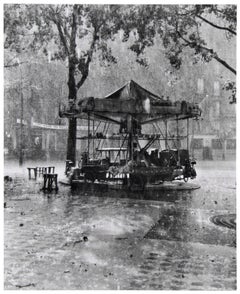
Le Manege De Mr. Barre, 1955
Located in Santa Monica, CA
Signed in ink on recto; titled and dated in pencil on verso
Gelatin Silver Print
Paper Size: 16 x 12 inches; Image Size: 11 3/4 x 9 12
Category
1950s Adaa Art Dealers Association Of America
Materials
Silver Gelatin
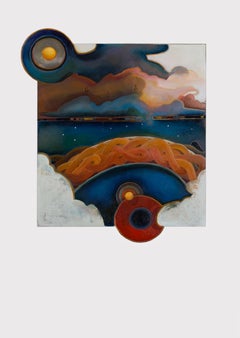
BREAK IN THE HORIZON
By Valerie B Hird
Located in New York, NY
VALERIE HIRD
BREAK IN THE HORIZON, 2019
oil, monotypes, gesso, Arches paper, silver leaf, silver amulet
23 1/2 x 22 in. 59.7 x 55.9 cm.
mythology
Category
2010s Contemporary Adaa Art Dealers Association Of America
Materials
Silver
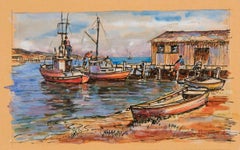
Boats at the Dock
By Stephen Seymour Thomas
Located in Dallas, TX
gouache with pen and ink
signed "Seymour Thomas" at lower right
Category
20th Century Academic Adaa Art Dealers Association Of America
Materials
Ink, Gouache, Pen
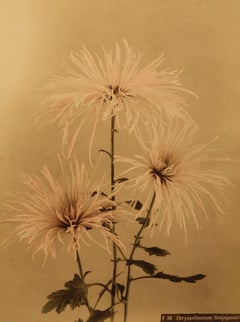
Chrysanthemum (Senjogataki), c. 1880's
Located in Santa Monica, CA
Inscribed "Chrysanthemum (Senjogataki)" on recto
Vintage Hand Colored Albumen Print
Paper is 11 5/8 x 9 1/4 inches, Matted to 20 x 16 inches
Category
1880s Adaa Art Dealers Association Of America
Materials
Photographic Paper
Woman Picking Flowers, 1900
Located in Santa Monica, CA
vintage platinum print
9.5" x 7.5" print; 18" x 13.75" mount, mat 20" x 16"
Category
Early 1900s Adaa Art Dealers Association Of America
Materials
Platinum