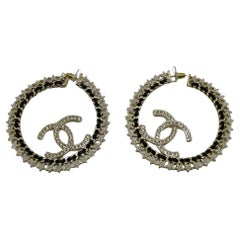
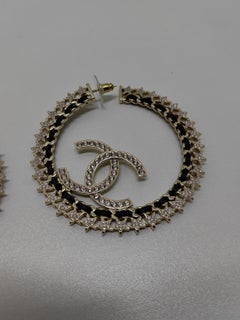
Chanel Rhinestone Star Hoop B23 Earrings
By Chanel
Located in PUTNEY, NSW
These dazzling Chanel hoop earrings combine modern elegance with the brand's iconic design
Category
Chanel Rhinestone Star Hoop B23 Earrings
By Chanel
Located in PUTNEY, NSW
These dazzling Chanel hoop earrings combine modern elegance with the brand's iconic design
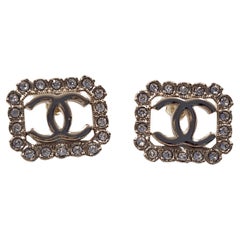
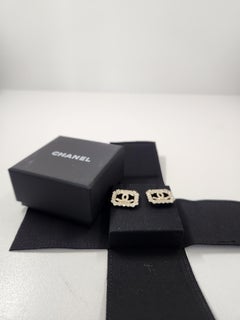
Chanel Small Rhinestone CC Rectangular Stud Earrings B23
By Chanel
Located in PUTNEY, NSW
Elevate your elegance with the Chanel Small Rhinestone CC Rectangular Stud Earrings B23. These
In the years following the opening of her modest millinery shop, Gabrielle "Coco" Chanel became a pivotal designer of both fashionable casual wear and Paris haute couture as well as an icon and arbiter of 20th-century style with her bob haircut and pearls. Today vintage Chanel handbags, jackets and evening dresses are among the most sought-after clothing and accessories for fashion lovers all over the world.
The first Chanel shop was established in 1910 in Paris on rue Cambon by the young milliner Gabrielle Chanel (1883–1971), who had picked up the nickname “Coco” while working as a club singer. The boutique drew the attention of the Parisian fashion elite who popularized her wide-brimmed Chanel Modes hats. Soon she added a sportswear store in the Normandy resort town of Deauville, where Coco set the tone for her defining sense of style — traditionally masculine garments reimagined for feminine shapes, made from simple jersey fabric.
Effortless and elegant, Chanel's designs promoted comfort and grace in women’s wear that had been dominated in the previous century by complicated layers of fabric and cumbersome corsets. She followed this success with a couture house, opened in 1915 in Biarritz.
But Chanel was not born into a life of glamour. Following the death of her mother, her father left her in an orphanage where she lived until the age of 18. It was there that she learned to sew as well as appreciate the classic pairing of black and white as worn by the nuns.
In 1926, Chanel introduced her first little black dress, reclaiming a color that had once been reserved for mourning and working-class women. That same decade, she debuted her perfume, Chanel No. 5, as well as the Chanel suit with a fitted skirt, inspired by the boxy lines of men’s clothing and employing a sporty tweed.
Chanel closed her fashion operations during World War II, then returned to the industry in 1954 to design for the functional needs of modern women.
Structure and wearability endured in all of Chanel’s clothing and accessories, like the quilted leather 2.55 handbag — a 1955 update of a 1920s-era design — with its gold-chain shoulder strap that freed up a woman’s hands. The 1957 two-tone slingback pumps had a practical heel height while offering a bold statement in the black tip of the shoes. Her collarless jacket reacted against the constricting styles of Christian Dior's New Look, replacing them with a design that was timeless, an instant classic.
After Coco Chanel died in 1971, the brand underwent several changes in leadership, including fashion designer Karl Lagerfeld, who took over as artistic director in 1983. His collections for Chanel displayed his knack for synthesizing old and new, high and low. Lagerfeld revived Chanel ballet flats and thoroughly embraced the classic logo's interlocking CCs, which took the form of a clasp featured on so many of the rare Chanel bags that are much sought after today.
Vintage Karl Lagerfeld designs for Chanel dresses, coats and other clothing of the 1980s, '90s and 2000s riffed on its iconography, accenting a lexicon of Chanel-isms with tastes of the moment. And as the 1990s have become associated with styles adopted by today’s supermodels and influencers, vintage Chanel bags of the 1990s are among the most prized of the brand’s offerings.
Over the years, the company has continued to innovate, such as expanding into ready-to-wear fashion in 1978 and, in 2002, establishing a subsidiary company — Paraffection — dedicated to preserving the heritage skills of fashion artisan workshops. The House of Chanel still operates its flagship on rue Cambon in Paris, where it all began.
Browse vintage Chanel bags, evening dresses, shoes, jewelry and other clothing and accessories on 1stDibs.
Contemporary jewelry is inextricably linked with the moment in which it is created, frequently reflecting current social, cultural and political issues such as environmental consciousness, identity and sustainability. It’s informed by fashion trends, from the chokers of the 1990s to the large chain necklaces of the early 2000s.
Jewelry is one of the oldest forms of adornment. Lockets made of silver or gold have been treasured gifts for hundreds of years, for example, and charm bracelets, which have existed since prehistoric times, didn’t become especially popular until the 19th-century reign of Queen Victoria. For many centuries, fine jewelry was used primarily to express wealth or status through lavish materials. Then, in the 1960s, a concept known as the “critique of preciousness” emerged, with jewelers creating pieces that did not get their value from gemstones or precious metals. Instead, it was the jeweler’s artistic vision that was prized and elevated.
This shift still informs Contemporary jewelry being made by artists today. Whether they are using cheap, found materials and working with provocative geometric shapes or seeking out the rarest stones, they are imbuing their work with meaning through their skills, techniques and ideas. Innovative designers such as Elsa Peretti, who popularized sculptural sterling-silver jewelry for Tiffany & Co., and David Yurman, who twisted metal into the simple yet striking Cable bracelet, have also influenced the direction of Contemporary jewelry’s forms and aesthetics.
Meanwhile, technological advancements like metal alloys and laser engraving have led to new possibilities in jewelry design. Now, edgy makers and brands as well as minimalist designers are pushing Contemporary jewelry forward into the 21st century.
Find a collection of Contemporary rings, earrings, necklaces and other jewelry on 1stDibs.
It is almost impossible to overstate how popular hoop earrings are today. They are routinely seen adorning the ears of high-profile women, ranging from Michelle Obama and Alexandria Ocasio-Cortez to Jennifer Lopez and Cardi B.
The roots of the hoop-earring phenomenon literally stretch back to the dawn of civilization. On view in the Metropolitan Museum of Art’s Ancient Near Eastern Art gallery is a pair of simple gold hoops from Mesopotamia dating to 2,600–2,500 B.C. that experts agree is among the oldest known examples. Hoop earrings can also be found in the Met’s Egyptian art gallery as well as in the museum’s displays of Greek and Roman art.
What inspired the original hoop design and why it was adopted by so many jewelers in the ancient world are unknown. It doesn’t have an origin story, feeling rather like the jewelry equivalent of the wheel. There just seems to be a logic to a circle that goes from the front to the back of the lobe.
“Hoops have been worn for millennia because they are unfathomably chic,” says Annabel Davidson, the editor of Vanity Fair UK’s special jewelry edition. “The way they accentuate the jawline, elongate the face and add a touch of flamboyance to a look is clearly a timeless expression of confidence, femininity and sartorial savvy.”
Throughout the ages, there have been countless decorative variations of hoop earrings. While the style can be found in just about every era, it was far more popular in some periods than others. Certain looks from yesteryear reflect cultural interests, while others are purely glamourous.
On 1stDibs, shop vintage diamond hoop earrings, gold hoop earrings, contemporary hoops and many more varieties of this wildly popular accessory.