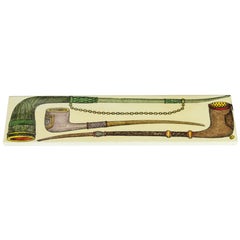
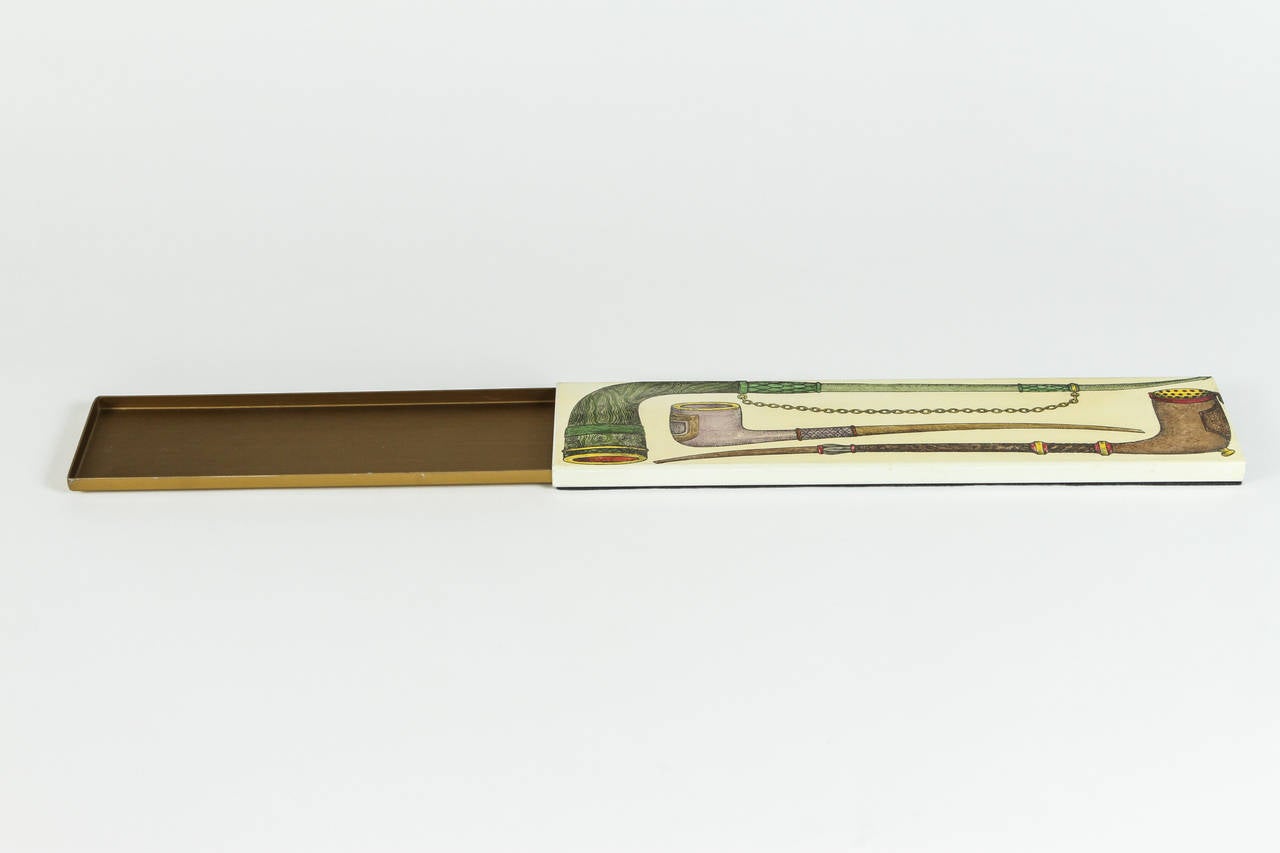
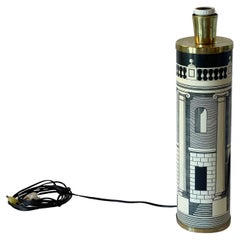
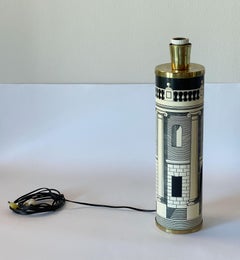
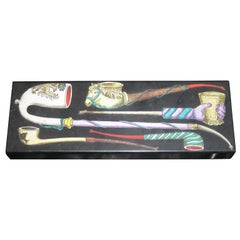
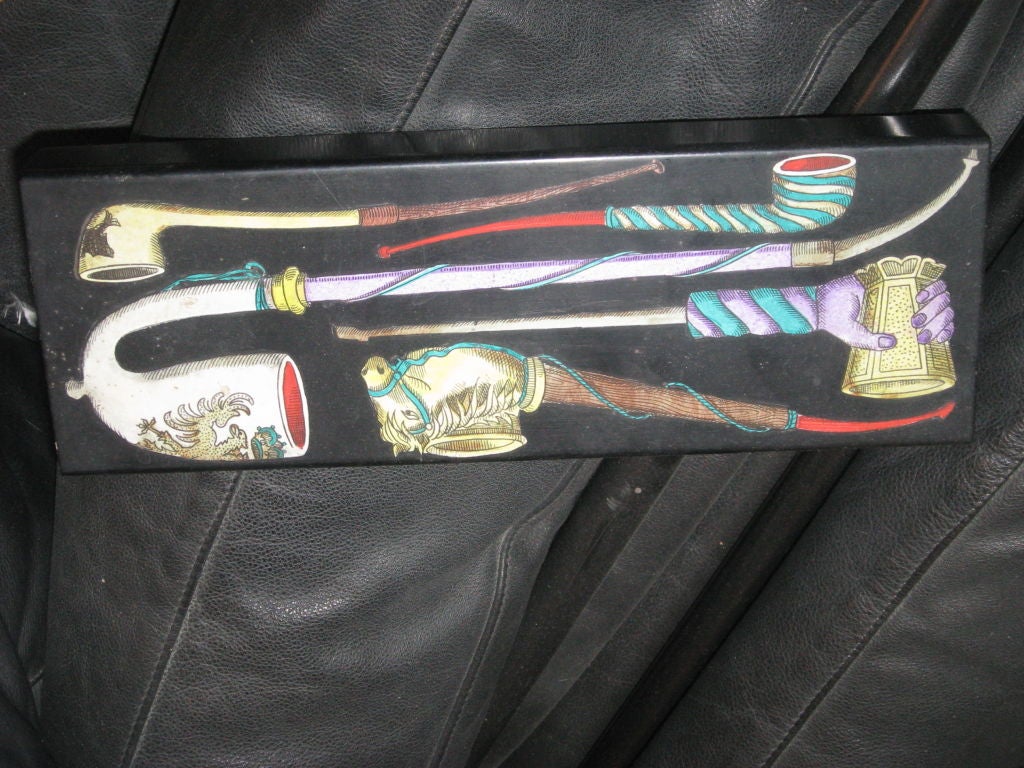
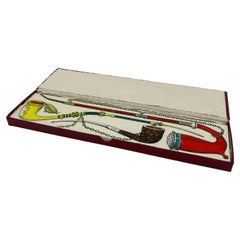
The Italian artist, illustrator and furniture maker Piero Fornasetti was one of the wittiest and most imaginative design talents of the 20th century. He crafted an inimitable decorative style from a personal vocabulary of images that included birds, butterflies, hot-air balloons, architecture and — most frequently, and in some 500 variations — an enigmatic woman’s face based on that of the 19th-century opera singer Lina Cavalieri. Fornasetti used transfer prints of these images, rendered in the style of engravings, to decorate an endless variety of furnishings and housewares that ranged from chairs, tables and desks to dinner plates, lamps and umbrella stands. His work is archly clever, often surreal and always fun.
Fornasetti was born in Milan, the son of an accountant, and he lived his entire life in the city. He showed artistic talent as a child and enrolled at Milan’s Brera Academy of Fine Art in 1930, but was expelled after two years for consistently failing to follow his professors’ orders. A group of his hand-painted silk scarves, displayed in the 1933 Triennale di Milano, caught the eye of the architect and designer Gio Ponti, who, in the 1940s, became Fornasetti’s collaborator and patron. Beginning in the early 1950s, they created a striking a series of desks, bureaus and secretaries that pair Ponti’s signature angular forms with Fornasetti’s decorative motifs — lighthearted arrangements of flowers and birds on some pieces, austere architectural imagery on others. The two worked together on numerous commissions for interiors, though their greatest project has been lost: the first-class lounges and restaurants of the luxury ocean liner Andrea Doria, which sank in 1956.
Fornasetti furnishings occupy an unusual and compelling niche in the decorative arts: they are odd yet pack a serious punch. They act, essentially, as functional sculpture. A large Fornasetti piece such as a cabinet or a desk can change the character of an entire room; his smaller works have the aesthetic power of a vase of flowers, providing a bright and alluring decorative note. The chimerical, fish-nor-fowl nature of Fornasetti’s work may be its greatest strength. It stands on its own. Bringing the Fornasetti look into the future is Barnaba Fornasetti, who took the reins of the company after his father's death.
Organically shaped, clean-lined and elegantly simple are three terms that well describe vintage mid-century modern furniture. The style, which emerged primarily in the years following World War II, is characterized by pieces that were conceived and made in an energetic, optimistic spirit by creators who believed that good design was an essential part of good living.
ORIGINS OF MID-CENTURY MODERN FURNITURE DESIGN
CHARACTERISTICS OF MID-CENTURY MODERN FURNITURE DESIGN
MID-CENTURY MODERN FURNITURE DESIGNERS TO KNOW
ICONIC MID-CENTURY MODERN FURNITURE DESIGNS
VINTAGE MID-CENTURY MODERN FURNITURE ON 1STDIBS
The mid-century modern era saw leagues of postwar American architects and designers animated by new ideas and new technology. The lean, functionalist International-style architecture of Le Corbusier and Bauhaus eminences Ludwig Mies van der Rohe and Walter Gropius had been promoted in the United States during the 1930s by Philip Johnson and others. New building techniques, such as “post-and-beam” construction, allowed the International-style schemes to be realized on a small scale in open-plan houses with long walls of glass.
Materials developed for wartime use became available for domestic goods and were incorporated into mid-century modern furniture designs. Charles and Ray Eames and Eero Saarinen, who had experimented extensively with molded plywood, eagerly embraced fiberglass for pieces such as the La Chaise and the Womb chair, respectively.
Architect, writer and designer George Nelson created with his team shades for the Bubble lamp using a new translucent polymer skin and, as design director at Herman Miller, recruited the Eameses, Alexander Girard and others for projects at the legendary Michigan furniture manufacturer.
Harry Bertoia and Isamu Noguchi devised chairs and tables built of wire mesh and wire struts. Materials were repurposed too: The Danish-born designer Jens Risom created a line of chairs using surplus parachute straps for webbed seats and backrests.
The Risom lounge chair was among the first pieces of furniture commissioned and produced by celebrated manufacturer Knoll, a chief influencer in the rise of modern design in the United States, thanks to the work of Florence Knoll, the pioneering architect and designer who made the firm a leader in its field. The seating that Knoll created for office spaces — as well as pieces designed by Florence initially for commercial clients — soon became desirable for the home.
As the demand for casual, uncluttered furnishings grew, more mid-century furniture designers caught the spirit.
Classically oriented creators such as Edward Wormley, house designer for Dunbar Inc., offered such pieces as the sinuous Listen to Me chaise; the British expatriate T.H. Robsjohn-Gibbings switched gears, creating items such as the tiered, biomorphic Mesa table. There were Young Turks such as Paul McCobb, who designed holistic groups of sleek, blond wood furniture, and Milo Baughman, who espoused a West Coast aesthetic in minimalist teak dining tables and lushly upholstered chairs and sofas with angular steel frames.
Generations turn over, and mid-century modern remains arguably the most popular style going. As the collection of vintage mid-century modern chairs, dressers, coffee tables and other furniture for the living room, dining room, bedroom and elsewhere on 1stDibs demonstrates, this period saw one of the most delightful and dramatic flowerings of creativity in design history.
Antique, vintage and new decorative boxes will safely store items while adding a splash of color or texture to a corner in any room. They have had a range of purposes over the years — from trinkets to serving as useful receptacles, such as snuff boxes, jewelry boxes and more. Boxes have also been designed in a range of forms and styles.
Box making is a craft dating back thousands of years. Early boxes as decorative objects were regularly designed and decorated both inside and out, ranging from minimal looks to more flashy styles. Decorative boxes have been constructed from different materials, with wood and metal being the most common. Wood is widely available and versatile, with woodworkers able to carve complex designs or showcase its natural grain.
Some antique jewelry boxes were made with tortoiseshell, mother-of-pearl, ivory and even porcupine quills, such as those created by the Anishinabe in Canada and the United States. In Sri Lanka, well-crafted boxes were inlaid with porcupine quills and ivory discs between ebony bands. Chinese sewing boxes and tea boxes made of black lacquer were popular in Europe during the late 18th and early 19th centuries. These often featured gold-painted designs or landscape scenes. Silk, paper and velvet frequently enhanced these boxes’ interiors.
Any style of decorative box can be a nice tabletop or desktop decor, whether to hold candy or tea in the living room or paper, pencils and other business supplies in the office. They can also act as jewelry boxes. Sewing boxes can be a lovely touch to any space while storing magazines or other trinkets.
You can find metal, wood and silver antique boxes on 1stDibs. The collection includes mid-century modern, Victorian and Art Deco styles that can add elegance to any home.