Located in San Francisco, CA
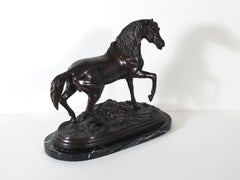
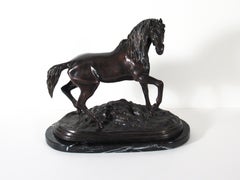
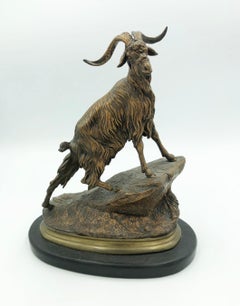
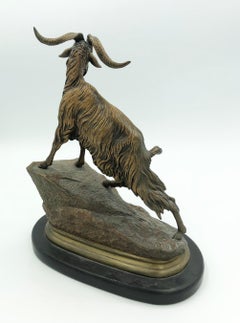
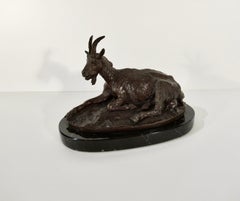
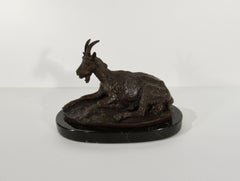
This artwork "Chevre Allongee (Reclining Goat)" c. 1860, is bronze sculpture after renown French artist Antoine Louis Barye, 1796-1875. Signature is impressed in the bronze. The subject size is 4.25 x 7 x 3.35 inches, including marble base is 5.25 x 4 x 7.75 inches. It is in excellent condition.
About the artist:
Antoine-Louis Barye lived his entire life in Paris and may never have left France. He was born in 1795 (a date revised in the 1990s from 1796 as a result of Martin Sonnabend's recalculation of the Revolutionary calendar). He is reported to have had minimal formal schooling even in reading, and to have acquired his extensive liberal-arts education on his own. His initial professional training was in metalwork: first with his father, a goldsmith from Lyons, then with a metal engraver in military equipment, and finally with Martin-Guillaume Biennais (active 1800-1832), then master goldsmith to Napoleon. After serving in the army from 1812 to 1814, Barye trained in the fine arts with sculptor François-Joseph Bosio (1768-1845) and painter Baron Gros (1771-1835). He then studied at the Ecole des Beaux-Arts from 1818 to 1823. His miniature medallion, Milo of Crotona Devoured by a Lion, won an honorable mention in metal engraving in 1819, but he failed to win the Prix de Rome. He worked as a craftsman for the goldsmith Jacques-Henri Fauconnier (1779-1839) from 1823 to 1831 and made his Salon debut in 1827 with a selection of busts.
Barye made his critical and public mark as a sculptor four years later, in the Salon of 1831, with groups representing predatory violence in the wild. His first government commission came soon after, precisely for such a subject. The Minister of the Interior purchased Barye's monumental plaster Lion (since called Lion Crushing a Serpent), shown in 1833, and had it cast in bronze by Honoré Gonon and shown in 1836, before placing it in the public Tuileries Gardens (now Musée du Louvre, Paris). In 1834 Barye was chosen for a project that was never executed, the colossal eagle as the crowning element of the triumphal arch at the Etoile. Around 1836 the government commissioned him to execute the emblematic animal decoration on the July Column at the place de la Bastille, inaugurated in 1840. He produced a monumental effigy of Saint Clotilde for the Church of the Madeleine, Paris, in the early 1840s. In 1846 the government commissioned a pendant Seated Lion for the Tuileries Lion Crushing a Serpent (1847, bronze, Portal, Pavillon de Flore, Palais du Louvre, Paris). During these same years the royal family began buying and commissioning small-scale works from Barye for their private collections. Around 1834, the duc d'Orléans commissioned a highly publicized surtout de table representing hunts of different regions and historical periods, possibly one of several tabletop projects that he ordered from Barye. The duc's sister Marie d'Orléans allegedly commissioned a lost-wax bronze of Barye's Charles VI Surprised in the Forest of Le Mans (location unknown; later serial variants), a model first shown in the Salon of 1833; his brother, the duc de Montpensier, apparently commissioned a pair of figurative...
Category
Mid-19th Century Realist Alfred Dubucand Art