Ben Schonzeit Figurative Prints

American, b. 1942

Ben Schonzeit was born in Brooklyn, New York in 1942. He is a graduate of The Cooper Union. He has exhibited widely both here and abroad since 1969. Schonzeit is a leading representative of the so-called Photo-Realists, who use photographs rather than reality as a basis for their paintings. He has also created works on paper from life and his imagination using a variety of mediums such as pen & ink, brush and watercolor. Schonzeit is internationally recognized as a pioneer of the Photorealist Movement (1970's) along with artists such as Richard Estes, Chuck Close, Robert Bechtle and Malcolm Morley. However, Schonzeit sets himself apart from this movement by choice and depiction of the subject matter. Schonzeit’s canvases were filled with highly magnified fruits, vegetables and flowers sometimes reproduced in a deliberately skewed, out of focus manner. His aesthetic is informed by the concurrent movements of Pop, that of color field painting, whose concerns were more formal. Schonzeit uses familiar objects as a vehicle to explore issues of color, form, content and abstraction. He is a prolific artist who embraces imagination as opposed to observation; invented rather than the depicted. Schonzeit is concerned with narrative color, abstraction, intellectual experience, drama and beauty. His work speaks of sensation, nostalgia, memory, relationships and associations unique to each viewer and each viewing. His paintings, drawings and photographs are included in the collections of many important museums around the world including the Solomon R. Guggenheim Museum, The Metropolitan Museum of Art, the Neue Nationalgalerie, Berlin, the Kunstmuseum Basel, the Denver Art Museum, and the Brooklyn Museum.

to
1
3
1
1
Overall Width
to
Overall Height
to
3
1
1
8
871
383
364
310
5
4
1
4
1
1
1
1
1
1
1
1
3
1
1
1
2
1
5
Artist: Ben Schonzeit
Yankee Flame Pop Art photorealist Lt Ed Signed/N. Statue of Liberty US President
By Ben Schonzeit
Located in New York, NY
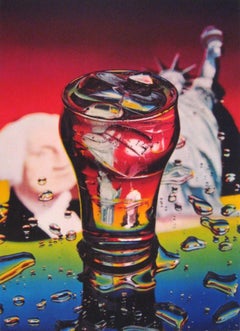
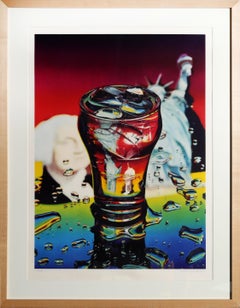
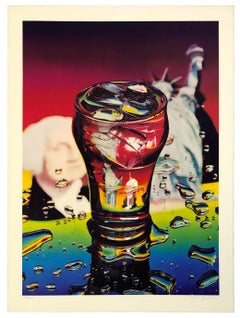
Ben Schonzeit Yankee Flame, from the portfolio: America: the Third Century, 1975 Collotype on wove paper Pencil signed and numbered 50/200 on the front Publisher: APC Editions, Chermayeff & Geismar Associates, Inc Printer: Triton Press 27 × 19 3/10 inches Unframed Note: this is the original hand signed and numbered collotype; not to be confused with the separate (unsigned) poster edition. This hand-signed, numbered and dated collotype in colors by photorealist pioneer artist Ben Schonzeit was created in 1975 for the portfolio America: the Third Century, commissioned by Mobil Oil Corporation in which 13 American artists, including Roy Lichtenstein, Ed Ruscha, Robert Rauschenberg, James Rosenquist and others created works celebrating America's bicentennial. Yankee Flame combines the iconic images of George Washington, Coca-Cola and the Statue of Liberty into a collaged interpretation of contemporary American life and the meaning of freedom. "Yankee Flame" is in excellent condition and never framed. It was acquired as part of the America: The Third Century full portfolio. Ben Schonzeit (b. 1942, Brooklyn, New York) is one of the original Photorealist painters and is considered to have pioneered the airbrush technique. His works often depict still life arrangements that are intentionally out of focus. He received his B.F.A. from The Cooper Union in 1964 and has since had over 50 solo exhibitions both in the United States and abroad. His paintings are held in numerous museum collections including the Solomon R. Guggenheim Museum in New York, Virginia Museum of Fine Arts in Richmond, Virginia, and the Metropolitan Museum of Art in New York. In 1973 Nancy Hoffman introduced me to Ben Schonzeit in the backroom of her gallery on West Broadway. She had been open less than a year, and Ben was one of the artists in her original stable. His large Crab Blue It had arrived from his studio a few days earlier and was leaning against the wall. I thought at the time it was one of the most impressive, virtuosic Photorealist works I had seen. That first encounter was more than a quarter of a century ago and I have always considered it to be one of the quintessential, tour de force paintings of American Photorealism. In the early seventies one could stand on West Broadway on any pleasant, sunny weekday and see less than a dozen people on the street between the Nancy Hoffman Gallery and OK Harris Works of Art. Almost all of the SoHo galleries, such as Leo Castelli, Paula Cooper, Ward-Nasse, and Ivan Karp’s Hundred Acres, could be visited in an afternoon. At night the streets were almost deserted. With the exception of Andy Warhol, there were no art world superstars. More importantly, none of the artists expected to achieve celebrity status. That was a phenomenon of the eighties and nineties. There were a only a handful of restaurants and watering holes, such Elephant and Castle, Fanelli’s, the Spring Street Bar and Prince Street Bar. Fanelli’s closed on weekends, which was a holdover from their sweatshop clientele during lunch and ragtag group of artists in the evenings. In those early days of SoHo, the drafty, raw sweatshop spaces with their large windows, rough floors, and service elevators provided large, inexpensive living quarters and studios for many artists. Unlike today, there were no boutiques. The area was not chic and with the exception of Lowell Nesbett’s showplace, the lofts were not glamorous. Schonzeit was in the same living and working space the he now occupies when I first visited him, but SoHo was a very different time and place. When the National Endowment of the Arts recommended me to curate America 1976, which turned into one of the major visual arts projects for the Bicentennial, Ben Schonzeit was on the first list of participants I made up for the U.S. Department of the Interior. His large diptych, Continental Divide, was one of the most memorable works produced for the exhibit. I stopped by his studio four or five times while it was in progress and have visited him many times over the years. We have maintained a very cordial working relationship and friendship over the past three decades. I saw The Music Room exhibit in 1978 and realized at the time that the vigorously rendered mural sized canvases and mirror and related works represented a major catharsis in his painting. In many ways, it and the other paintings and drawings based on the same image represented a sharp, decisive break with the tenets of Photorealism, or at least the photo-replicative aspects that had been so widely heralded in America and abroad in the mid-seventies. Over the years we have continued to work together. He has been in almost all of the major exhibitions I have curated here and abroad and in almost all of the books I have written. I am familiar with his studio habits, his quiet, internalized restlessness that manifests itself in the hundreds of small, unknown drawings and watercolors, doodles on napkins during lunch, and imaginary landscapes. I also know that he would rather do a painting than think or talk about it. Over the years I have followed the shifts in his studio procedure from the monumental airbrushed fruit and vegetable paintings to the most recent bouquets of flowers and decorative paintings. Our discussions of these matters tends to lapse into a verbal shorthand at this point. The following essay is based on both my longstanding familiarity and admiration for his work and involvement with contemporary realism and figurative painting. A booklet of color xeroxes with notes made up by Schonzeit was extremely helpful. In addition to several interviews, much of the information unfolded through a lengthy series of Emails. Due to our different working habits these were composed and sent out very late at night and answered by Ben the following morning. They dealt with the specifics of many of the paintings, generalities, his background and childhood in Brooklyn, and occasional bits of art world gossip. And there were odd discoveries. Prior to discussing his witty, tongue in cheek painting of Buffalo Bill, I did not know or had long forgotten that William Cody...
Category

1970s Pop Art Ben Schonzeit Figurative Prints

Materials

Other Medium, Lithograph, Pencil

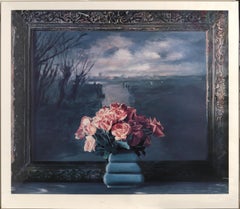
Roses with Dutch Landscape, Photorealist Lithograph by Ben Schonzeit
By Ben Schonzeit
Located in Long Island City, NY
Artist: Ben Schonzeit, American (1942 - ) Title: Roses with Dutch Landscape Year: 1990 Medium: Lithograph, signed, dated, and numbered in pencil Edition: 66/72 Image Size: 38 x 44 ...
Category

1990s Contemporary Ben Schonzeit Figurative Prints

Materials

Lithograph

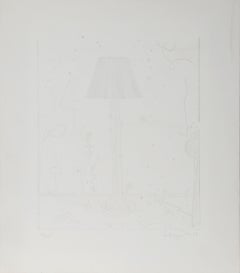
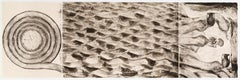
"Lamps (White)", 1979, Intaglio by Ben Schonzeit
By Ben Schonzeit
Located in Long Island City, NY
Artist: Ben Schonzeit, American (1942 - ) Title: Lamps (White) Year: 1979 Medium: Intaglio, signed and numbered in pencil Edition: 14/125 Size: 28.5 x 25 in. (72.39 x 63.5 cm)
Category

1970s Contemporary Ben Schonzeit Figurative Prints

Materials

Intaglio

Yankee Flame, Colorful Pop Art Collotype by Ben Schonzeit
By Ben Schonzeit
Located in Long Island City, NY
Artist: Ben Schonzeit, American (1942 - ) Title: Yankee Flame from the Portfolio, America: The Third Century Year: 1976 Medium: Collotype, signed and numbered in pencil Edition: 200 ...
Category

1970s Surrealist Ben Schonzeit Figurative Prints

Materials

Lithograph

Yankee Flame
By Ben Schonzeit
Located in Aventura, FL
Collotype on paper. Hand signed and dated on front by Ben Schonzeit. Hand numbered 147/200. Artwork size 30 x 22.25 inches. From America: The Third Century portfolio. Published...
Category

1970s Contemporary Ben Schonzeit Figurative Prints

Materials

Paper

Yankee Flame
Yankee Flame
$1,125 Sale Price
25% Off
Related Items
Clemente Untitled B: surreal mythical landscape, voyage with ocean, Venus, snake
By Francesco Clemente
Located in New York, NY
A black and white, large-scale surreal mythical landscape of an ocean voyage, with a snake wrapped around a clock, a ship, Venus sculpture, greek urns, and snakes, printed in black o...
Category

1980s Contemporary Ben Schonzeit Figurative Prints

Materials

Lithograph

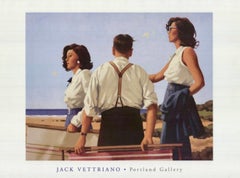
Young Hearts, Portland Gallery London offset lithograph
By Jack Vettriano
Located in Hillsborough, NC
Jack Vettriano (1951-) is renowned for his film noir oil paintings and 1930s glam style. Uniquely Vettriano, ‘Young Hearts’ is set by the seaside inviting narratives about the figures in his work: relationships, anticipation, power and suggestion. Vettriano grew up by the Fife Scottish coast. He began painting beach scenes as a young adult, later developing his particular recognizable style and thematic imagery. His work was embraced by celebrities such as Madonna and Jack Nicholson and he has become hugely successful. His most famous painting, ‘The Singing Butler...
Category

Early 2000s Contemporary Ben Schonzeit Figurative Prints

Materials

Lithograph, Offset

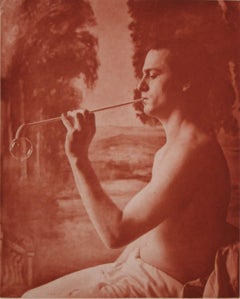
The Bubble Blower
By McDermott & McGough
Located in New York, NY
Known for their work in painting, photography, sculpture, and film, McDermott & McGough comprises visual artists David McDermott and Peter McGough, who formed their partnership on th...
Category

21st Century and Contemporary Contemporary Ben Schonzeit Figurative Prints

Materials

Photogravure

The Bubble Blower
$1,600 Sale Price
46% Off
H 25 in W 20 in
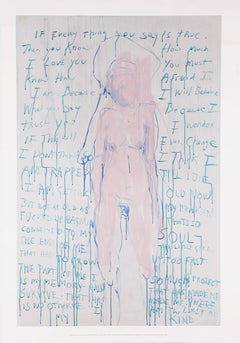
I Am The Last Of My Kind
By Tracey Emin
Located in London, GB
Published by the Royal Academy
Category

2010s Contemporary Ben Schonzeit Figurative Prints

Materials

Lithograph, Offset

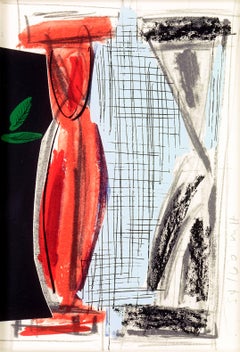
Two Columns (framed): colorful pop art abstracted Greek pillars Micheal Hurson
By Michael Hurson
Located in New York, NY
Pop art scene of abstracted Greek pillars and green leaves. Drawings in black and white, pale blue, red and grey compose this colorful print. Layers of p...
Category

1980s Contemporary Ben Schonzeit Figurative Prints

Materials

Lithograph, Screen

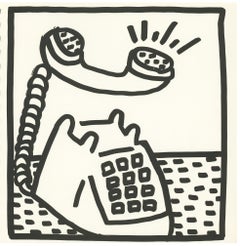
Keith Haring lithographic insert 1982 (Keith Haring Tony Shafrazi 1982)
By Keith Haring
Located in NEW YORK, NY
Keith Haring Lithograph 1982: Double-sided lithographic insert from the seminal spiral bound, 1982 Tony Shafrazi catalog published on the occasion of Haring's first gallery solo exhi...
Category

1980s Pop Art Ben Schonzeit Figurative Prints

Materials

Lithograph, Offset

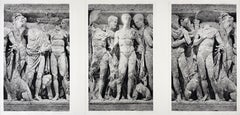
Los Romanos en Tarquena — Photogravure Triptych of Ancient Male Nude Reliefs
By David Smith-Harrison
Located in Palm Springs, CA
Los Romanos en Tarquena is a powerful photogravure by David Smith-Harrison, depicting a frieze of ancient Roman male figures rendered in striking sculptural detail. Presented as a tr...
Category

2010s Contemporary Ben Schonzeit Figurative Prints

Materials

Intaglio, Photogravure, Monoprint

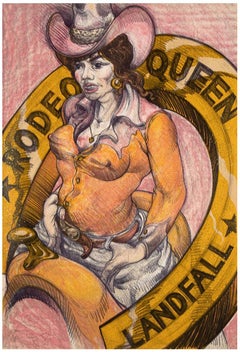
Rodeo Queen by Luis Jimenez
Located in Phoenix, AZ
Rodeo Queen, 1981 Edition 36/50 Signed lower left, Inscribed: for the "Rose" 82. Provenance: Print was a gift to Rozanne Charington, companion and model for "Rodeo Queen", "Rose Tattoo" and "Jimenez at Adeliza's Candy Store". Lithograph on paper 42 ½ × 29 in. (107.3 × 73.7 cm) Luis Alfonso Jimenez Born, 1940, El Paso, Texas, died 2006, Hondo, New Mexico. Statement: Luis Jimenez, in his work, celebrates the vitality of life. . . . Jimenez es un hijo de la frontera; he knows its people and the landscape. It is the transformation of these people into art that is his most important contribution to the art of this vast region which stretches between Mexico and the United States. His subject matter utilizes the popular images of the cultura del norte, and a large part of it is depicted and transformed in the rough and tumble world of la frontera. He is also a son of el norte, and so he uses its materials and explores its emerging, popular myths. The tension and attraction of Jimnez’s work is that he always creates within the space of his two worlds, the Mexicano and the Americano. He constantly shows us the irony of the two forces which repel, while showing us glimpses of the synthesis he seeks. What a gift it has been to us for this talented artist to reflect on the soul of our region. He gives meaning to our existence and history. Rudolfo Anaya (passage chosen by the artist), A View from La Frontera, Man on Fire: Luis Jimenez, pp. 1, 3, 6Biography: Luis Jimenez was born in Texas to parents who had emigrated from Mexico to the United States; he would later dedicate his 1989 sculpture Border Crossing to his father, who had entered the country illegally. The elder Jimenez was a neon sign designer in El Paso, and Luis worked with him as a youth. His experience working in the neon shop and his fascination with U.S. car culture would both become major influences on his art career. Jimenez studied architecture at the University of Texas, Austin (UTA), and also took art courses in which he first created sculptures with wood, steel, and fiberglass, choosing the latter because of its association with U.S. popular culture. He subsequently became one of the artists who made fiberglass an acceptable medium in the 1960s. In 1964 Jimenez received his B.S. in art from UTA, and he continued his studies at the Universidad Nacional Autonoma de Mexico in Mexico City. In 1966 he moved to New York City and worked as an assistant to sculptor Seymour Lipton. Jimenez began to exhibit his art while in New York and in 1972 moved to New Mexico to focus on creating public sculptures, even as he maintained his diverse output of drawings, prints, and lithographs. Drawing on his early experiences, Jimenez creates works that come from a border perspective, one that draws upon the hybridity bred by culture clashes. Often socially and politically informed, his works speak not only in regional terms, those germane to the southwestern United States, but to broader, more global issues as well. They exhibit a profoundly Chicano aesthetic and sensibility, one that is informed by Mexican and Mexican American traditions, North American popular culture, Chicano cultural icons, and images and themes unique to the Southwest. Death, sexuality, and the struggle of the common people are frequent themes. Inspired by authors who write in an autobiographical style, Jimenez creates works that function as personal narrative yet are also able to make statements about culture in more global terms. His use of bold colors and lines, a legacy from his fathers work as a neon sign maker, lends a dynamic sensuality to his work, one that is particularly evident in his monumental fiberglass and acrylic urethane sculptural works Many of Jimenez's works correspond to scholar Toms Ybarra-Fraustos definition of the Chicano aesthetic of rasquachismo, a lowbrow sensibility that appeals to the working class in that it applies to objects that subvert expressions of the mainstream or dominant culture. Creating art that speaks to the people, Jimenez is able to transform regional and culturally specific myths and symbols into globally recognized and relevant icons. Exhibitions: In addition to his personal work, Jimenez has been commissioned for numerous public art projects. In 1999 his sculpture Southwest Piet was designated a National Treasure by First Lady Hillary Clinton. The many exhibitions featuring his work have included Human Concern/Personal Torment (Whitney Museum of American Art, New York, 1969). The First International Motorcycle Art Show (Phoenix Art Museum, Phoenix, AZ, 1973). Three Texas Artists (Centre Cultural Americaine, USIS, Paris, 1977), Recent Trends in Collecting (Smithsonian Institution, Washington, DC, 1982). Committed to Print (Museum of Modern Art, New York, 1989) Printmaking in Texas: The 1980s (Modern Art Museum, Fort Worth, TX. Laguna Gloria Art Museum, Austin, 1990. The Whitney Biennial (Whitney Museum of American Art, New York, 1991) Man On Fire: Luis Jimnez (Albuquerque Museum of Art, NM, 1994-95). 47th Annual Purchase Exhibition (American Academy of Arts and Letters, New York, 1995). Traveling solo exhibition, Working Class Heroes: Images from the Popular Culture (1997-2000). Jiménez Collier Gallery has been in continuous operation for over 40 years. Originally located just off Main Street in downtown Scottsdale, Arizona, we have moved to Phoenix to accommodate and showcase our large inventory including: • Original works by Maynard Dixon, Lon Megargee, Ed Mell, Fritz Scholder, Bill Schenck, Bill Lesch, Luis Jimenez, Greg Singley, Dan Budnik, and other 20th century Western, WPA and Contemporary Southwestern artists. • The Fine Art Estate of Lon Megargee • Vintage rodeo...
Category

1980s Contemporary Ben Schonzeit Figurative Prints

Materials

Lithograph

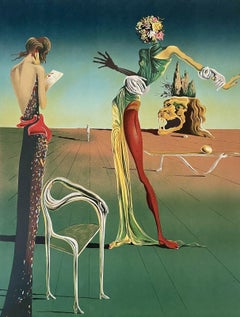
Dali, Femme à tete de Roses (after)
By Salvador Dalí­
Located in Fairfield, CT
Artist: Salvador Dali (1904-1989) Title: Femme à tete de Roses Year: 2004 Medium: Lithograph on wove paper Size: 30.25 x 22 inches Condition: Excellent Inscription: Unsigned and unnu...
Category

Early 2000s Surrealist Ben Schonzeit Figurative Prints

Materials

Lithograph

Dali, Femme à tete de Roses (after)
$2,360 Sale Price
20% Off
H 30.25 in W 22 in
Hand of Africa - Mandela, Former South African President, Signed Artwork, Hand
By Nelson Mandela
Located in Knowle Lane, Cranleigh
Nelson Mandela, Hand of Africa, Signed Limited Edition Lithograph Many people are unaware that Nelson Mandela turned his hand to art in his 80's as a way of leaving a legacy for his ...
Category

Early 2000s Contemporary Ben Schonzeit Figurative Prints

Materials

Lithograph

"Memory Exercise" 2020
By Justin Pollmann
Located in New York, NY
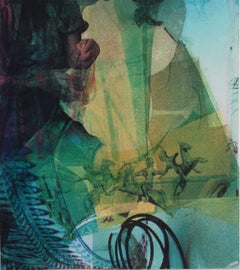
Justin Pollmann "Memory Exercise" 2020 Inkjet Transfer Collage, Monotype 19.5"x17.5" inches The inkjet transfer images are made by collaging transfers of inkjet prints to the pape...
Category

2010s Contemporary Ben Schonzeit Figurative Prints

Materials

Paper, Inkjet

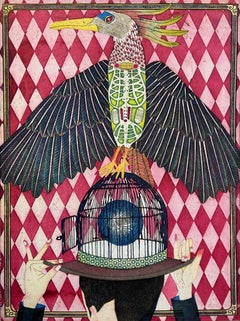
Feathered Bot, by Yuji Hiratsuka
By Yuji Hiratsuka
Located in Palm Springs, CA
Medium: Intaglio and Chine Colle Year: 2025 Image Size: 24" H x 18" W Edition of 10 Yuji Hiratsuka’s Feathered Bot transforms human perception into surreal allegory. A monumental bi...
Category

2010s Contemporary Ben Schonzeit Figurative Prints

Materials

Intaglio

Ben Schonzeit figurative prints for sale on 1stDibs.

Find a wide variety of authentic Ben Schonzeit figurative prints available for sale on 1stDibs. You can also browse by medium to find art by Ben Schonzeit in lithograph, intaglio and more. Much of the original work by this artist or collective was created during the 20th century and is mostly associated with the contemporary style. Not every interior allows for large Ben Schonzeit figurative prints, so small editions measuring 20 inches across are available. Customers who are interested in this artist might also find the work of Frank Romero, Michael Hurson, and Francisco Corzas. Ben Schonzeit figurative prints prices can differ depending upon medium, time period and other attributes. On 1stDibs, the price for these items starts at $500 and tops out at $2,400, while the average work can sell for $1,400.

Still Thinking About These?

All Recently Viewed