Charles John Watson Art

to
1
1
1
Overall Width
to
Overall Height
to
2
1
1
1
1
1
1
1
1
1
1
1
1
1
1
2
10,733
2,827
2,495
1,414
2
1
1
Artist: Charles John Watson
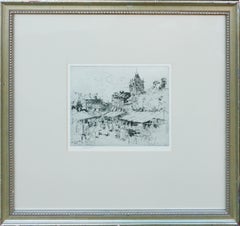
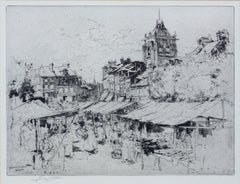
Late 19th Century Normandy French Market Engraving

Late 19th Century Normandy French Market Engraving

By Charles John Watson

Located in Soquel, CA

Charming engraving of the market in Aumale, France in Normandy by Charles John Watson (British, 1846-1927), circa 1880. Signed within engraving and below by artist. Presented under g...

Category

1880s Impressionist Charles John Watson Art

Materials

Paper, India Ink

Related Items
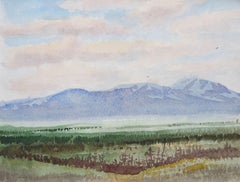
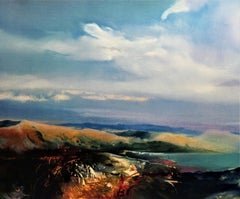
Blue mountain. 1975. Watercolor on paper, 14x19 cm

Blue mountain. 1975. Watercolor on paper, 14x19 cm

Located in Riga, LV

Blue mountain. 1975. Watercolor on paper, 14x19 cm Herberts Mangolds (1901-1978) Graphic, army officer. In 1920 he graduated from the Artillery Cadet School of Latvian and many mili...

Category

1970s Realist Charles John Watson Art

Materials

Watercolor, Paper

Dust Time, large lithograph

John MaxonDust Time, large lithograph, 1993

$1,020

H 31.5 in W 44 in D 0.01 in

Dust Time, large lithograph

By John Maxon

Located in San Francisco, CA

Artist: John Maxon (American, born 1947) Title: Dust Time Year: 1993 Medium: Color lithograph Edition: Numbered 146/210 Paper: Arches Image size: 26.5 x 39.75 inches Paper size: 31.5 x 44 inches Signature: Hand signed in pencil by the artist Condition: Excellent, has never been framed About the artist. Coming from a very western tradition in Wyoming, John Maxon developed an expansive view of nature . Moving eventually to the San Francisco Bay area, John's delight in the effects of light and color led him to the decision to become an artist at the young age of 15. His natural ability was encouraged, and at 16 he began figurative art classes with Howard Brodie, the artist well known for his WWII correspondence, drawings and the Watergate trial drawings. Education San Francisco Art Institute B.A., Painting, San Jose State University M.F.A., Painting, University of California, Davis Stanford University, Palo Alto, California Cabrillo College, Aptos, California Selected Solo Exhibitions 2018 Gallery Panza Verde – Antigua Guatemala, Guatemala 2015 Desert Art Collection - Palm Desert California 2015 Galeria Antigua – Antigua, Guatemala 2014 Galeria Panza Verde – Antigua, Guatemala 2008 Linda Durnell Gallery – Los Gatos, California 2006 Linda Durnell Gallery – Los Gatos, California 2005 Robert Allen Fine Art Gallery – Sausalito, California 2004 Ellis West Gallery – Durango, Colorado 2002 Ellis West Gallery – Durango, Colorado 2001 Robert Allen Fine Art Gallery – Sausalito, California 1997 Stanford University Faculty Club – Stanford, California Selected Group Exhibitions 2018 Chemers Art Gallery – Los Angeles, California 2009, 2010, 2016, 2017 & 2018 Robert Allen Fine Art – Sausalito, California 2017 Christopher Hill Gallery - St Helena, California 2013 / 19 Gallery North - Carmel, California 2015 Desert Art Collection - Palm Desert, California 2014 Paul Scott Gallery - Bend, Oregon 2014 Christopher Hill Gallery Healdsberg, California 2013 Firehouse Art Center - Pleasanton, Ca. 2013 2011 - 2013 Robert Allen Fine Art – Sausalito, California 2010 - 2012 Susan Street Gallery – Solano Beach, California 2010 (Awarded 1st place) and 2012 “Contemporary Landscape Painters of California” – Awarded 1st Place 2011 - 2012 Salisbury Fine Art – Avila Beach, California 2010 Bryant Street Gallery – Palo Alto, California 2009 Museum Art and History – Santa Cruz, California 2008 Cabrillo College – Aptos, California 2006 Christopher Hill Gallery – St. Helena, California 2005 Fort Lewis College – Durango, Colorado 2001 St. Supery Winery & Fine Art Gallery, Napa California 2001 Napa Valley Wine Auction – St. Helena, California 1997 West Coast Painting and Sculpture – Ocean Side, California 1997 Wolk Gallery – St. Helena, California Selected Museum Collections Interior Museum, Department of the Interior, Washington D. C. Santa Cruz County Art Museum – Santa Cruz, California University of California – Berkeley, California University of California – Davis, California Napa Valley Art...

Category

Late 20th Century American Impressionist Charles John Watson Art

Materials

Lithograph

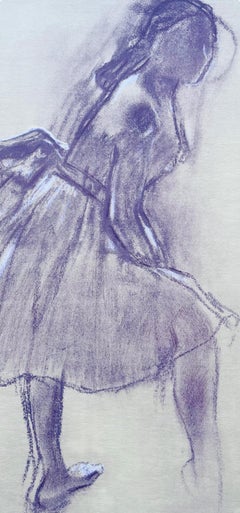
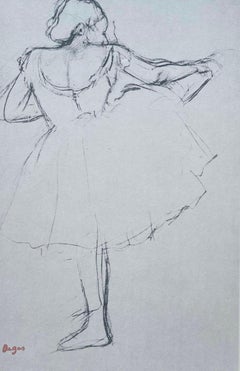
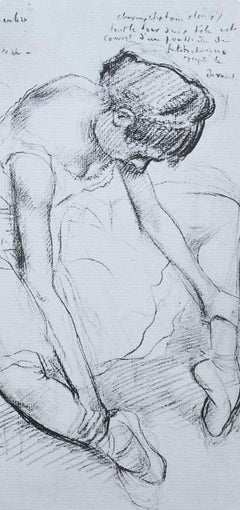
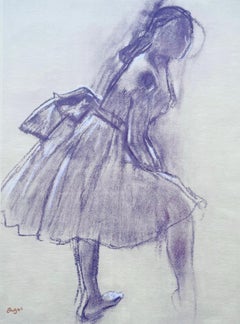
Edgar Degas, Dancer Standing in Profile, 1945 (after)

Edgar Degas, Dancer Standing in Profile, 1945 (after)

By Edgar Degas

Located in Southampton, NY

This exquisite lithograph after Edgar Degas (1834–1917), titled Danseur debout de profil (Dancer Standing in Profile), originates from the 1945 folio Degas, Ten Ballet Sketches. Published by The Studio Publications, Inc., New York, rendered and printed by Albert Carman, City Island, 1945, this work reflects Degas’s sensitive mastery of line, movement, and intimate observation, capturing the grace, poise, and psychological immediacy that define his iconic ballet imagery. In Danseur debout de profil (Dancer Standing in Profile), Degas reveals gesture and inner emotion through economical contour and lyrical nuance. Executed as a lithograph and pochoir on velin paper, this work measures 17 x 13 inches (43.18 x 33.02 cm). Signed in the plate and unnumbered as issued. Rendered and printed by Albert Carman, City Island, one of the notable American ateliers specializing in fine art lithography during the mid-20th century. Artwork Details: Artist: After Edgar Degas (1834–1917) Title: Danseur debout de profil (Dancer Standing in Profile), from Degas, Ten Ballet Sketches, 1945 Medium: Lithograph and pochoir on velin paper Dimensions: 17 x 13 inches (43.18 x 33.02 cm) Inscription: Signed in the plate and unnumbered as issued Date: 1945 Publisher: The Studio Publications, Inc., New York Printer: Albert Carman, City Island, 1945 Condition: Well preserved, consistent with age and medium Provenance: From the 1945 folio Degas, Ten Ballet Sketches, published by The Studio Publications, Inc., New York Notes: Excerpted from the album, Born in Paris in 1834, Edgar Degas lived, and surely loved the life of that city during most of his years. These continued somewhat sadly beyond those of most of his friends— into the debacle of the first World War, during which he died in 1917. Judging by the frequency with which he used them as models, he must have had an especial admiration for the ballet girls who followed a profession that at the time brought none of the glory and prosperity which attend it today. New aspects of the human body, revealed in movement, fascinated him. But his occupation with the simply anatomical side of his subjects never resulted in a cold interpretation. On the contrary there is a warmth and sympathy that pervades all of his work. The drawings here represent the painter in one important phase of his multi-sensitive view of life; and permit an insight which a more ambitious work might not do-into the operation of the creative process, the artist's transformation of reality as it passes through the mesh of his sensibilities. The Edition of this Portfolio is limited to MMMD examples. Rendered by Albert Carman. About the Publication: Degas, Ten Ballet Sketches, published in 1945 by The Studio Publications, Inc., New York, stands as one of the most elegant and scholarly mid-century American fine art folios devoted to the ballet imagery of Edgar Degas. Conceived as a high-quality interpretive portfolio, the album presents a series of lithograph-and-pochoir renderings based on Degas’s original drawings, executed with exceptional attention to tonal subtlety, contour fidelity, and the emotional interiority that defines the artist’s draftsmanship. Rendered and printed by Albert Carman on City Island, the publication embodies an American postwar effort to restore and celebrate European masterworks through meticulous handcraft and artisanal color application, honoring Degas’s distinctive line and the atmospheric delicacy of his studio-based studies. Produced in a substantial edition of MMMD examples, the portfolio offered audiences rare access to Degas’s private working drawings—images rarely seen outside institutional collections—while exemplifying the technical refinement and interpretive care characteristic of Carman’s workshop. Today, Degas, Ten Ballet Sketches remains a sought-after historical publication, valued for its craft, fidelity to Degas’s aesthetic, and its role in preserving and disseminating the artist’s intimate ballet imagery in a beautifully executed mid-century fine art format. About the Artist: Edgar Degas (1834–1917) was a French painter, draughtsman, printmaker, and sculptor whose groundbreaking fusion of classical draftsmanship, modern experimentation, and psychological depth helped define the trajectory of Western art, positioning him as one of the most influential figures of the nineteenth and early twentieth centuries; renowned for his depictions of ballet dancers, racehorses, theater scenes, cafe life, domestic interiors, milliners, laundresses, and women at their toilette, Degas reimagined observational realism through radical compositional innovation—employing extreme cropping, asymmetrical framing, oblique viewpoints, and dramatic lighting that anticipated photographic and cinematic language long before these technologies shaped visual culture, and although associated with Impressionism, he rejected plein-air spontaneity in favor of studio-based discipline rooted in the linear precision of Jean-Auguste-Dominique Ingres, the expressive chromaticism of Eugene Delacroix, and the modernity of Edouard Manet while also drawing inspiration from Japanese ukiyo-e prints, classical sculpture, and early photography; his independent artistic philosophy resonated with and helped shape the innovations of Pablo Picasso, Alexander Calder, Alberto Giacometti, Salvador Dali, Joan Miro, Wassily Kandinsky, Marcel Duchamp, and Man Ray, whose explorations of movement, form, dream logic, abstraction, and conceptualism all find antecedents in Degas’s investigations into seriality, temporality, and the fragmented figure, and his pioneering use of pastel, monotype, and wax sculpture fundamentally transformed each medium, influencing artists from Henri Matisse, Francis Bacon, Lucian Freud, and Giacomo Manzu to Paula Rego, contemporary realists, experimental photographers, and choreographers; his works are held in nearly every major museum collection worldwide—including the Musee dOrsay, the Louvre, the Metropolitan Museum of Art, the National Gallery of Art, the Art Institute of Chicago, the Courtauld Institute, and the National Gallery, London—affirming his central place in the history of art, and the highest auction record for Degas was achieved at Sothebys London on February 3, 2015, when Danseuses en Bleu sold for 37,033,000 GBP, cementing his status as one of the most sought-after and enduringly significant artists of the Western canon. Edgar Degas lithograph...

Category

1940s Impressionist Charles John Watson Art
Materials

Lithograph

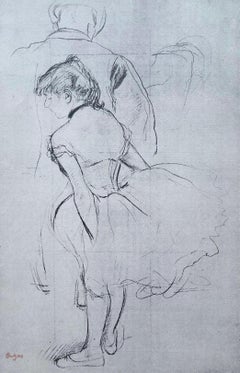
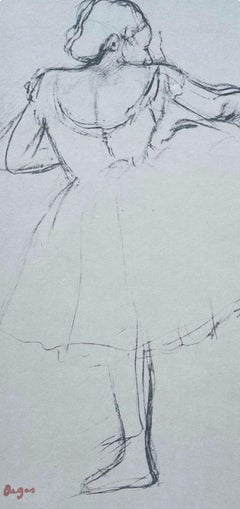
Edgar Degas, Dancer Arranging Her Dress, 1945 (after)

Edgar Degas, Dancer Arranging Her Dress, 1945 (after)

By Edgar Degas

Located in Southampton, NY

This exquisite lithograph after Edgar Degas (1834–1917), titled Danseuse arrangeant sa robe (Dancer Arranging Her Dress), originates from the 1945 folio Degas, Ten Ballet Sketches. Published by The Studio Publications, Inc., New York, rendered and printed by Albert Carman, City Island, 1945, this work reflects Degas’s sensitive mastery of line, movement, and intimate observation, capturing the grace, poise, and psychological immediacy that define his iconic ballet imagery. In Danseuse arrangeant sa robe (Dancer Arranging Her Dress), Degas reveals gesture and inner emotion through economical contour and lyrical nuance. Executed as a lithograph and pochoir on velin paper, this work measures 17 x 13 inches (43.18 x 33.02 cm). Signed in the plate and unnumbered as issued. Rendered and printed by Albert Carman, City Island, one of the notable American ateliers specializing in fine art lithography during the mid-20th century. Artwork Details: Artist: After Edgar Degas (1834–1917) Title: Danseuse arrangeant sa robe (Dancer Arranging Her Dress), from Degas, Ten Ballet Sketches, 1945 Medium: Lithograph and pochoir on velin paper Dimensions: 17 x 13 inches (43.18 x 33.02 cm) Inscription: Signed in the plate and unnumbered as issued Date: 1945 Publisher: The Studio Publications, Inc., New York Printer: Albert Carman, City Island, 1945 Condition: Well preserved, consistent with age and medium Provenance: From the 1945 folio Degas, Ten Ballet Sketches, published by The Studio Publications, Inc., New York Notes: Excerpted from the album, Born in Paris in 1834, Edgar Degas lived, and surely loved the life of that city during most of his years. These continued somewhat sadly beyond those of most of his friends— into the debacle of the first World War, during which he died in 1917. Judging by the frequency with which he used them as models, he must have had an especial admiration for the ballet girls who followed a profession that at the time brought none of the glory and prosperity which attend it today. New aspects of the human body, revealed in movement, fascinated him. But his occupation with the simply anatomical side of his subjects never resulted in a cold interpretation. On the contrary there is a warmth and sympathy that pervades all of his work. The drawings here represent the painter in one important phase of his multi-sensitive view of life; and permit an insight which a more ambitious work might not do-into the operation of the creative process, the artist's transformation of reality as it passes through the mesh of his sensibilities. The Edition of this Portfolio is limited to MMMD examples. Rendered by Albert Carman. About the Publication: Degas, Ten Ballet Sketches, published in 1945 by The Studio Publications, Inc., New York, stands as one of the most elegant and scholarly mid-century American fine art folios devoted to the ballet imagery of Edgar Degas. Conceived as a high-quality interpretive portfolio, the album presents a series of lithograph-and-pochoir renderings based on Degas’s original drawings, executed with exceptional attention to tonal subtlety, contour fidelity, and the emotional interiority that defines the artist’s draftsmanship. Rendered and printed by Albert Carman on City Island, the publication embodies an American postwar effort to restore and celebrate European masterworks through meticulous handcraft and artisanal color application, honoring Degas’s distinctive line and the atmospheric delicacy of his studio-based studies. Produced in a substantial edition of MMMD examples, the portfolio offered audiences rare access to Degas’s private working drawings—images rarely seen outside institutional collections—while exemplifying the technical refinement and interpretive care characteristic of Carman’s workshop. Today, Degas, Ten Ballet Sketches remains a sought-after historical publication, valued for its craft, fidelity to Degas’s aesthetic, and its role in preserving and disseminating the artist’s intimate ballet imagery in a beautifully executed mid-century fine art format. About the Artist: Edgar Degas (1834–1917) was a French painter, draughtsman, printmaker, and sculptor whose groundbreaking fusion of classical draftsmanship, modern experimentation, and psychological depth helped define the trajectory of Western art, positioning him as one of the most influential figures of the nineteenth and early twentieth centuries; renowned for his depictions of ballet dancers, racehorses, theater scenes, cafe life, domestic interiors, milliners, laundresses, and women at their toilette, Degas reimagined observational realism through radical compositional innovation—employing extreme cropping, asymmetrical framing, oblique viewpoints, and dramatic lighting that anticipated photographic and cinematic language long before these technologies shaped visual culture, and although associated with Impressionism, he rejected plein-air spontaneity in favor of studio-based discipline rooted in the linear precision of Jean-Auguste-Dominique Ingres, the expressive chromaticism of Eugene Delacroix, and the modernity of Edouard Manet while also drawing inspiration from Japanese ukiyo-e prints, classical sculpture, and early photography; his independent artistic philosophy resonated with and helped shape the innovations of Pablo Picasso, Alexander Calder, Alberto Giacometti, Salvador Dali, Joan Miro, Wassily Kandinsky, Marcel Duchamp, and Man Ray, whose explorations of movement, form, dream logic, abstraction, and conceptualism all find antecedents in Degas’s investigations into seriality, temporality, and the fragmented figure, and his pioneering use of pastel, monotype, and wax sculpture fundamentally transformed each medium, influencing artists from Henri Matisse, Francis Bacon, Lucian Freud, and Giacomo Manzu to Paula Rego, contemporary realists, experimental photographers, and choreographers; his works are held in nearly every major museum collection worldwide—including the Musee dOrsay, the Louvre, the Metropolitan Museum of Art, the National Gallery of Art, the Art Institute of Chicago, the Courtauld Institute, and the National Gallery, London—affirming his central place in the history of art, and the highest auction record for Degas was achieved at Sothebys London on February 3, 2015, when Danseuses en Bleu sold for 37,033,000 GBP, cementing his status as one of the most sought-after and enduringly significant artists of the Western canon. Edgar Degas lithograph...

Category

1940s Impressionist Charles John Watson Art
Materials

Lithograph

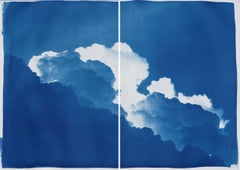
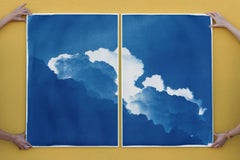
Azure Clouds Diptych, Handmade Cyanotype Print on Watercolor Paper, Skyscape

Azure Clouds Diptych, Handmade Cyanotype Print on Watercolor Paper, Skyscape

By Kind of Cyan

Located in Barcelona, ES

Exclusive limited edition cyanotype diptych. Details: + Title: Azure Clouds + Year: 2024 + Edition Size: 20 + Stamped and Certificate of Authenticity provided + Measurements : 100x21...

Category

2010s Realist Charles John Watson Art

Materials

Watercolor, Lithograph, Monotype

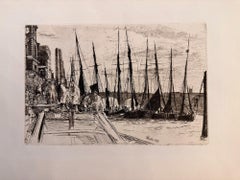
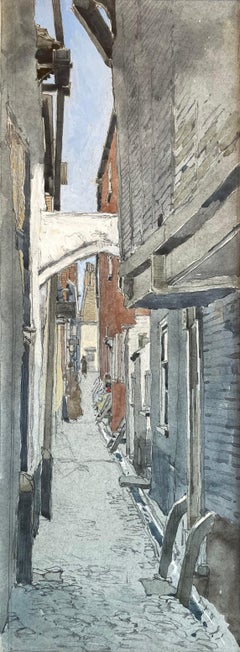
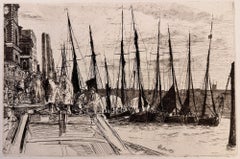
Billingsgate
Billingsgate

Billingsgate

By James Abbott McNeill Whistler

Located in Middletown, NY

Etching printed in dark brownish black ink on cream laid paper, 6 x 8 7/8 inches (152 x 226 mm); full margins. Extremely minor and unobtrusive band of toning along the top sheet edg...

Category

Mid-19th Century Impressionist Charles John Watson Art
Materials

Laid Paper, Drypoint, Etching

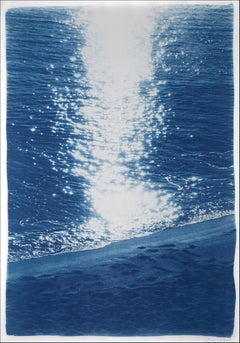
Dark Beach Sunrise, Blue Nautical Cyanotype, Watercolor Paper, Vertical Seascape

Dark Beach Sunrise, Blue Nautical Cyanotype, Watercolor Paper, Vertical Seascape

By Kind of Cyan

Located in Barcelona, ES

This is an exclusive handprinted limited edition cyanotype. "Dark Beach Sunrise" is a handmade cyanotype print portraying beautiful sunrise reflection on the beach. Details: + Titl...

Category

2010s Realist Charles John Watson Art

Materials

Emulsion, Watercolor, Lithograph, Paper

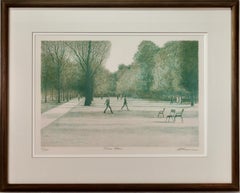
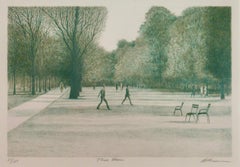
Three Chairs
Three Chairs

Harold AltmanThree Chairs, 1978

$900

H 22.25 in W 27.75 in D 1.35 in

Three Chairs

By Harold Altman

Located in San Francisco, CA

Artist: Harold Altman (American, 1924-2003) Title: Three Chairs Year: 1978 Medium: Original color lithograph Edition: Numbered 61/185 in pencil Paper: ...

Category

Late 20th Century American Impressionist Charles John Watson Art
Materials

Lithograph

Edgar Degas, Dancer at the Barre, 1945 (after)

Edgar Degas, Dancer at the Barre, 1945 (after)

By Edgar Degas

Located in Southampton, NY

This exquisite lithograph after Edgar Degas (1834–1917), titled Danseur au bar (Dancer at the Barre), originates from the 1945 folio Degas, Ten Ballet Sketches. Published by The Stud...

Category

1940s Impressionist Charles John Watson Art

Materials

Lithograph

Edgar Degas, Melina Darde, 1945 (after)

Edgar Degas, Melina Darde, 1945 (after)

By Edgar Degas

Located in Southampton, NY

This exquisite lithograph after Edgar Degas (1834–1917), titled Melina Darde, originates from the 1945 folio Degas, Ten Ballet Sketches. Published by The Studio Publications, Inc., New York, rendered and printed by Albert Carman, City Island, 1945, this work reflects Degas’s sensitive mastery of line, movement, and the intimate psychological nuances of the ballet studio. Executed as a lithograph and pochoir on velin paper, this work measures 17 x 13 inches (43.18 x 33.02 cm). Signed in the plate and unnumbered as issued. Rendered and printed by Albert Carman, City Island. Artwork Details: Artist: Edgar Degas (1834–1917) Title: Melina Darde, from Degas, Ten Ballet Sketches, 1945 Medium: Lithograph and pochoir on velin paper Dimensions: 17 x 13 inches (43.18 x 33.02 cm) Inscription: Signed in the plate and unnumbered as issued Date: 1945 Publisher: The Studio Publications, Inc., New York Printer: Albert Carman, City Island Condition: Well preserved, consistent with age and medium Provenance: From the 1945 folio Degas, Ten Ballet Sketches, published by The Studio Publications, Inc., New York Notes: Excerpted from the album, Born in Paris in 1834, Edgar Degas lived, and surely loved the life of that city during most of his years. These continued somewhat sadly beyond those of most of his friends— into the debacle of the first World War, during which he died in 1917. Judging by the frequency with which he used them as models, he must have had an especial admiration for the ballet girls who followed a profession that at the time brought none of the glory and prosperity which attend it today. New aspects of the human body, revealed in movement, fascinated him. But his occupation with the simply anatomical side of his subjects never resulted in a cold interpretation. On the contrary there is a warmth and sympathy that pervades all of his work. The drawings here represent the painter in one important phase of his multi-sensitive view of life; and permit an insight which a more ambitious work might not do-into the operation of the creative process, the artist's transformation of reality as it passes through the mesh of his sensibilities. The Edition of this Portfolio is limited to MMMD examples. Rendered by Albert Carman. About the Publication: Degas, Ten Ballet Sketches (1945) is one of the earliest and most significant American postwar fine art portfolios devoted to Edgar Degas’s intimate works on paper. Published by The Studio Publications, Inc., New York, and rendered and printed by Albert Carman at City Island, the album sought to faithfully reproduce a group of Degas’s ballet-related drawings through a combination of lithography and hand-applied pochoir coloring. This hybrid technique allowed the edition to preserve the immediacy, tonal subtlety, and gestural delicacy central to Degas’s draftsmanship. Conceived as a fine art publication rather than a commercial book, the portfolio provided American audiences unprecedented access to Degas’s private, spontaneous studies—images that reveal the artist’s fascination with movement, anatomy, and the psychological atmosphere of the rehearsal studio. The album exemplifies the mid-20th-century revival of pochoir as a means of recreating the texture and coloristic nuance of original works on paper, and it remains an important document of how Degas’s legacy was translated into high-quality printed form for collectors, museums, and connoisseurs. About the Artist: Edgar Degas (1834–1917) was a French painter, draughtsman, printmaker, and sculptor whose groundbreaking fusion of classical draftsmanship, modern experimentation, and psychological depth helped define the trajectory of Western art, positioning him as one of the most influential figures of the nineteenth and early twentieth centuries; renowned for his depictions of ballet dancers, racehorses, theater scenes, cafe life, domestic interiors, milliners, laundresses, and women at their toilette, Degas reimagined observational realism through radical compositional innovation—employing extreme cropping, asymmetrical framing, oblique viewpoints, and dramatic lighting that anticipated photographic and cinematic language long before these technologies shaped visual culture, and although associated with Impressionism, he rejected plein-air spontaneity in favor of studio-based discipline rooted in the linear precision of Jean-Auguste-Dominique Ingres, the expressive chromaticism of Eugene Delacroix, and the modernity of Edouard Manet while also drawing inspiration from Japanese ukiyo-e prints, classical sculpture, and early photography; his independent artistic philosophy resonated with and helped shape the innovations of Pablo Picasso, Alexander Calder, Alberto Giacometti, Salvador Dali, Joan Miro, Wassily Kandinsky, Marcel Duchamp, and Man Ray, whose explorations of movement, form, dream logic, abstraction, and conceptualism all find antecedents in Degas’s investigations into seriality, temporality, and the fragmented figure, and his pioneering use of pastel, monotype, and wax sculpture fundamentally transformed each medium, influencing artists from Henri Matisse, Francis Bacon, Lucian Freud, and Giacomo Manzu to Paula Rego, contemporary realists, experimental photographers, and choreographers; his works are held in nearly every major museum collection worldwide—including the Musee dOrsay, the Louvre, the Metropolitan Museum of Art, the National Gallery of Art, the Art Institute of Chicago, the Courtauld Institute, and the National Gallery, London—affirming his central place in the history of art, and the highest auction record for Degas was achieved at Sothebys London on February 3, 2015, when Danseuses en Bleu sold for 37,033,000 GBP, cementing his status as one of the most sought-after and enduringly significant artists of the Western canon. Degas pochoir, Degas lithograph...

Category

1940s Impressionist Charles John Watson Art
Materials

Lithograph

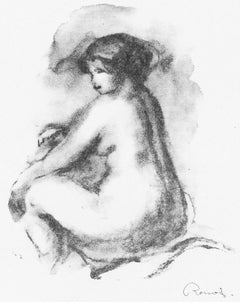
Pierre-Auguste Renoir, Seated Nude Woman, 1951 (after)

Pierre-Auguste Renoir, Seated Nude Woman, 1951 (after)

By Pierre-Auguste Renoir

Located in Southampton, NY

This exquisite lithograph after Pierre-Auguste Renoir (1841–1919), titled Femme nue assise (Seated Nude Woman), from the album Les Lithographies de Renoir (The Lithographs of Renoir)...

Category

1950s Impressionist Charles John Watson Art
Materials

Lithograph

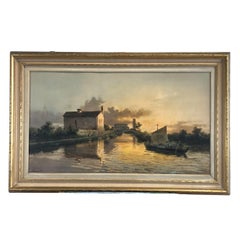
Watercolor "Island of Torcello with Devil's Bridge," Alberto Prosdocimi, '900

Watercolor "Island of Torcello with Devil's Bridge," Alberto Prosdocimi, '900

Located in Vicenza, VI

Artwork by Alberto Prosdocimi (1852-1925) "Island of Torcello with Devil's Bridge," from the early 1900s. Watercolor on cardboard, measuring 46 x 80 cm. The work is set in a coeval ...

Category

Early 1900s Realist Charles John Watson Art
Materials

Watercolor

Charles John Watson art for sale on 1stDibs.

Find a wide variety of authentic Charles John Watson art available for sale on 1stDibs. You can also browse by medium to find art by Charles John Watson in india ink, ink, paint and more. Much of the original work by this artist or collective was created during the 19th century and is mostly associated with the Impressionist style. Not every interior allows for large Charles John Watson art, so small editions measuring 4 inches across are available. Customers who are interested in this artist might also find the work of James March Phillips, Hercules Brabazon Brabazon, and Antoine Calbet. Charles John Watson art prices can differ depending upon medium, time period and other attributes. On 1stDibs, the price for these items starts at $1,177 and tops out at $1,480, while the average work can sell for $1,328.

Artists Similar to Charles John Watson