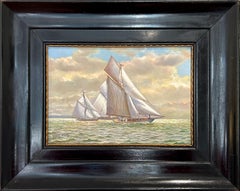
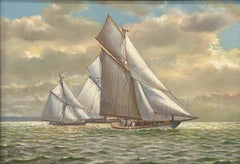
Charles Temple Dix Art

American, 1838-1873

Charles Temple Dix was born in Albany, New York, the youngest son of the distinguished statesman and soldier, General John Adams Dix. Having already visited Europe as a child, Dix returned with his family to Italy from 1853 to 1855. Dix’s decision to become an artist was enthusiastically supported by his father, and after graduation from Union College, Schenectady, New York, Dix continued his art studies in New York City in the late 1850s. Dix quickly immersed himself in the New York art world. He occupied a studio at the famous Tenth Street Studio building from 1860 to 1862, and he exhibited annually at the National Academy of Design, New York, from 1857 to 1861, the year in which he was elected an associate of that institution. He never submitted the diploma painting required for qualification as a full member.

Following the outbreak of the Civil War, Dix joined the Union army, serving as a major and acting as his father’s aide-de-camp. His creative output during this period was curtailed by his involvement in wartime activities. In March 1865, at the close of the war, Dix resumed his artistic career. He left for Europe, spending the winter in Rome and visiting England sometime thereafter. It appears that he remained for at least some time, for in 1867 he exhibited at the Royal Academy, London. In 1868, he married Camilla Ottilie Watson, niece of the art historian, Mrs. Anne Brownell Jameson, in London, and the married couple soon settled in Rome. In January 1873, Dix joined other American artists in Rome in signing a resolution mourning the death of the much-admired Hudson River School painter, John F. Kensett. Dix’s brief period in Rome ended two months later, when he died at the age of 35 of a sudden hemorrhage of the lungs.

In the course of his short and promising career, Dix had established himself as a popular and successful painter of marine subjects, and he was one of the few such painters to elicit praise regularly from contemporary critics. In his Book of the Artists (1867), Henry Tuckerman called Dix a painter “of rare promise and no inconsiderable performance in the sphere of marine landscape” (p. 552), an unfortunately ironic forecast of the artist’s brief career.

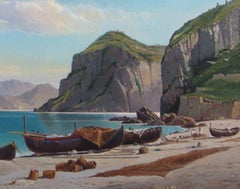
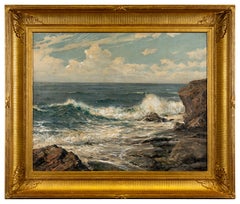
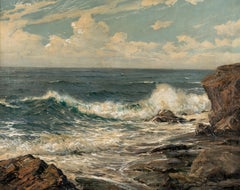
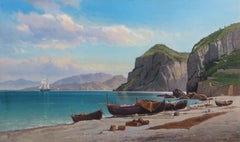
Beginning about 1866, when he first wintered in Rome, Dix painted a number of marine subjects of the island of Capri. Marina Grand, Capri dates from that winter, before Dix’s trip to England and his subsequent marriage and relocation to Rome. Dix evidently traveled to the island, returning to Rome with sketches of its coastal scenery. Located on the northern side of the island, the Marina Grande was the chief port on Capri. Dix frames the composition at right with the large, rocky cliffs characteristic of Capri’s coastline, while the sweep of the water opens to the left. Dix’s use of color is deep and clear, faithfully capturing the incomparable range of blues of the Mediterranean sea and sky. All of the elements of the picture—rocks, clouds, boats, and water—are treated with careful accuracy, reflecting a truth-to-nature aesthetic as espoused by the influential English critic, John Ruskin, and echoing similar concerns with the rocky coast landscape as fellow American marine artist, William Stanley Haseltine. Marina Grande, Capri is remarkable in that the artist was only 28 years old when he painted it, and it leads one to speculate as to what Dix might have accomplished had he enjoyed a longer life and career.

(Biography provided by Hirschl & Adler)
to
1
Overall Width
to
Overall Height
to
1
1
1
1
1
1
1
1
1
1
1
1
1
1
10,185
2,809
2,503
1,398
1
Artist: Charles Temple Dix
Marina Grande, Capri

Marina Grande, Capri

By Charles Temple Dix

Located in New York, NY

Charles Temple Dix was born in Albany, New York, the youngest son of the distinguished statesman and soldier, General John Adams Dix. Having already visited Europe as a child, Dix re...

Category

19th Century American Realist Charles Temple Dix Art

Materials

Canvas, Oil

Related Items
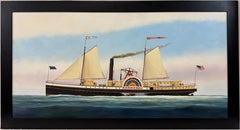
“Kennebec” Ship Portrait Sidewheeler Steamboat Paddle Steamer Oil on Canvas

“Kennebec” Ship Portrait Sidewheeler Steamboat Paddle Steamer Oil on Canvas

Located in Yardley, PA

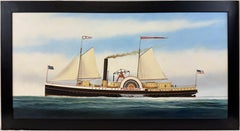
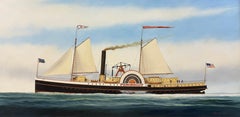
A striking and historically attentive portrait of the sidewheel steamer Kennebec, built in 1842. Rendered in crisp profile against a soft, painterly sky and calm Atlantic swells, Cameron’s portrait captures the stately elegance of early American steam navigation. The Kennebec, identified in bold red lettering on her paddle box, is shown under partial sail with twin smokestacks active - suggesting both the hybrid nature of early steam propulsion and the vessel’s readiness for sea. Flying period flags, including a U.S. ensign and company pennants, she presents as a proud representative of the Sanford Steamship Line, for whom she plied the route between Boston, Bangor, and the summer resorts of Maine. Her design, with a wood hull, 230-foot length, and distinctive “hogging truss,” speaks to mid-19th century innovation tailored to coastwise packets. Cameron’s style is reminiscent of 19th-century ship portraiture yet refined with contemporary technical precision. This is an excellent example of his work. This work is oil on canvas and is signed in the lower right. It is housed in its original black frame and retains the artist’s description of the ship on the reverse. Size: 22 inches tall by 44 inches wide (painting) 26 inches tall by 48 inches wide by 1 inch deep (frame) Provenance: Private collection; Acquired from the above About the artist: A Delaware artist, Scott Cameron paints the simple elegance of the America’s Cup races, serene coastal marsh scenes, timeless landscape vistas and historic steamboats in a style reminiscent of the era in which they reigned. An admirer of Andrew Wyeth and the Brandywine School of painters, Scott has combined the detail and quiet stillness of that School in his landscapes with the Luminist School’s sense of light glowing from within. A soft gentle atmosphere seems to fall over each scene adding to the peacefulness of the setting, and a sense of a time gone by. His America’s Cup scenes capture the action at a moment in time, allowing the beauty of the wind-filled sails to become the central design element of each painting. Scott Cameron has exhibited his oil paintings in numerous national and regional shows from the Mystic Seaport Museum to solo and group shows in some of the foremost galleries throughout the Northeast and Mid-Atlantic states. Favorite painting locations are the waterways and coastal inlets of Martha’s Vineyard and Maryland’s Eastern Shore and the gentle rolling landscapes of rural Pennsylvania, Delaware and Maryland. Meticulous research is behind every historic steamboat and America’s Cup painting...

Category

Late 20th Century American Realist Charles Temple Dix Art

Materials

Canvas, Oil

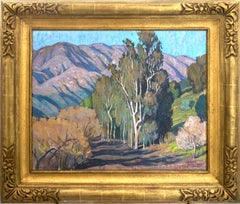
Pathway to the San Gabrielino Trail; Neglected and Protected

Pathway to the San Gabrielino Trail; Neglected and Protected

By Tim Solliday

Located in Pasadena, CA

Provenance Acquired by the gallery directly from the artist Painted en plein air in the San Gabriel Mountains near the artist's home in the early summer of 2013. Signed "T. Solliday...

Category

2010s American Realist Charles Temple Dix Art

Materials

Canvas, Oil

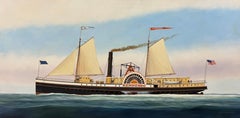
“Penobscot” Ship Portrait Sidewheeler Steamboat Paddle Steamer Oil on Canvas

“Penobscot” Ship Portrait Sidewheeler Steamboat Paddle Steamer Oil on Canvas

Located in Yardley, PA

A wonderful realistic portrait of the Penobscot, a mid-19th century coastal sidewheel steamer, rendered in Cameron’s hallmark marine portrait style - technically meticulous, historically informed, and visually serene. Executed with crisp linework and a soft, luminous palette, the ship is shown in profile navigating calm Atlantic waters under both steam and sail, her red paddle box emblazoned boldly with her name. Commissioned in 1843 by Menemon Sanford’s Steamship Line and constructed in New York, the Penobscot was a near twin to her sister ship, the Kennebec, but became especially prized for her seaworthiness. Measuring 228 feet in length with a 48-foot beam and twin 14-foot paddlewheels, she carried schooner rigging fore and aft, providing the added stability necessary for coastal and offshore passages. Initially assigned to the Maine coastal excursion routes, she would later be reassigned to the elite New York–Philadelphia line and eventually sold and renamed Norfolk for pre-Civil War service along the southern coast. This work is oil on canvas and is signed in the lower right. It is housed in its original black frame and retains the artist’s description of the ship on the reverse. Size: 22 inches tall by 44 inches wide (painting) 26 inches tall by 48 inches wide by 1 inch deep (frame) Provenance: Private collection; Acquired from the above About the artist: A Delaware artist, Scott Cameron paints the simple elegance of the America’s Cup races, serene coastal marsh scenes, timeless landscape vistas and historic steamboats in a style reminiscent of the era in which they reigned. An admirer of Andrew Wyeth and the Brandywine School of painters, Scott has combined the detail and quiet stillness of that School in his landscapes with the Luminist School’s sense of light glowing from within. A soft gentle atmosphere seems to fall over each scene adding to the peacefulness of the setting, and a sense of a time gone by. His America’s Cup scenes capture the action at a moment in time, allowing the beauty of the wind-filled sails to become the central design element of each painting. Scott Cameron has exhibited his oil paintings in numerous national and regional shows from the Mystic Seaport Museum to solo and group shows in some of the foremost galleries throughout the Northeast and Mid-Atlantic states. Favorite painting locations are the waterways and coastal inlets of Martha’s Vineyard and Maryland’s Eastern Shore and the gentle rolling landscapes of rural Pennsylvania, Delaware and Maryland. Meticulous research is behind every historic steamboat and America’s Cup painting...

Category

Late 20th Century American Realist Charles Temple Dix Art

Materials

Canvas, Oil

“All Hallows’ Eve” american realist, landscape oil painting of forest in autumn

“All Hallows’ Eve” american realist, landscape oil painting of forest in autumn

By Rachel Personett

Located in Sag Harbor, NY

An oil painting by American artist Rachel Personett (b. 1991, Hawaii) of a woodland scene in October. Yellow foliage adorns the trees and fallen brown leaves cover the ground in this...

Category

21st Century and Contemporary American Realist Charles Temple Dix Art

Materials

Canvas, Oil

“Eastern White Pines, c. 1910”, New England Landscape, Signed Oil Painting

“Eastern White Pines, c. 1910”, New England Landscape, Signed Oil Painting

By Charles Warren Eaton

Located in Yardley, PA

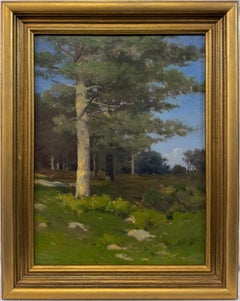
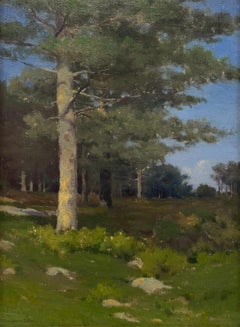
“Eastern White Pines, c. 1910” by Charles Warren Eaton (American, 1857-1937). A wonderful example of Eaton’s renowned compositions of Eastern white pine trees in his mature style. A...

Category

Early 20th Century American Realist Charles Temple Dix Art

Materials

Canvas, Oil, Board

Venetian Scene
Venetian Scene

Henry Pember SmithVenetian Scene, 1880's

$8,000

H 28 in W 36 in D 3 in

Venetian Scene

By Henry Pember Smith

Located in New York, NY

In the 1880’s Smith made a trip to Italy, which added a whole new dimension to his work. His tight style was highly suited to the depiction of the majestic architecture and complex c...

Category

1880s American Realist Charles Temple Dix Art

Materials

Oil, Canvas

North Atlantic Coast

North Atlantic Coast

Located in Sheffield, MA

Charles Bridgeman Vickery American, 1913-1998 North Atlantic Coast Oil on canvas 24 ¼ by 30 in, w/ frame 33 by 39 in Signed lower left Inventory Number: 01650 Charles Vickery, kno...

Category

Mid-20th Century American Realist Charles Temple Dix Art

Materials

Canvas, Oil

"Factory on the River" Modernist and Precisionist WPA Industrial New York Scene

"Factory on the River" Modernist and Precisionist WPA Industrial New York Scene

By William Sharp

Located in New York, NY

William Sharp (1900 - 1961) Factory on the River Oil on canvas 17 1/2 x 23 1/4 inches Initialed lower right: WS Provenance: Estate of the artist Private Collection, New York Swann Auction Galleries, American Art, June 13, 2019, Lot 178 William Sharp was born on June 13, 1900, in Lemberg, Austria, where he attended college and the Academy for Arts and Industry. He later studied in Kraków, Poland, and in Berlin and Munich, Germany. Sharp began his career as a designer of stained-glass windows and as a painter of murals. He served in the German army during World War I. After the war he became a newspaper artist in Berlin and a well-known etcher. Sharp drew political cartoons that were bitterly critical of the growing Nazi movement. As the influence of National Socialism intensified, he began to contribute drawings, under a pseudonym, to publications that were hostile to Hitler. After Hitler assumed power, Sharp was confronted with these drawings and told that he would be sent to a concentration camp. However, in 1934, he escaped to the United States. His first newspaper assignment in America was making courtroom sketches for The New York Mirror...

Category

Mid-20th Century American Realist Charles Temple Dix Art

Materials

Canvas, Paint, Oil

"Vrnik, Croatia" bright colorful plein air oil painting of island sea in Croatia

"Vrnik, Croatia" bright colorful plein air oil painting of island sea in Croatia

By Marc Dalessio

Located in Sag Harbor, NY

"Vrnik, Croatia" is a rich and colorful plein-air oil painting of the Vrnik island in Croatia. Dalessio captures the glowing shallow waters as it reaches the rocky shoreline, beneath...

Category

21st Century and Contemporary American Realist Charles Temple Dix Art

Materials

Canvas, Oil

“Walking Among the Trees” A Winter Scene in Blue, Gray & White

“Walking Among the Trees” A Winter Scene in Blue, Gray & White

Located in San Francisco, CA

Out for a breath of fresh air late on a wintery day, this adult and child are walking in a world of wonder in this painting. Crunching on the ice covering the shoveled pathway, the p...

Category

Mid-20th Century American Realist Charles Temple Dix Art

Materials

Canvas, Oil

Williamstown Landscape

Williamstown Landscape

Located in Sheffield, MA

Charles Foster American, 1850-1931 Cloudy Sky Over Pasture Oil on canvas 14 by 22 in, w/ frame 23 ½ by 31 ½ in Signed lower right, dated 1890 Inventory Number: 01900 Charles Foste...

Category

Late 19th Century American Realist Charles Temple Dix Art

Materials

Canvas, Oil

Charles Temple Dix art for sale on 1stDibs.

Find a wide variety of authentic Charles Temple Dix art available for sale on 1stDibs. You can also browse by medium to find art by Charles Temple Dix in canvas, fabric, oil paint and more. Not every interior allows for large Charles Temple Dix art, so small editions measuring 31 inches across are available. Customers who are interested in this artist might also find the work of James Edward Buttersworth, John Steuart Curry, and William Rickarby Miller. Charles Temple Dix art prices can differ depending upon medium, time period and other attributes. On 1stDibs, the price for these items starts at $150,000 and tops out at $150,000, while the average work can sell for $150,000.

Artists Similar to Charles Temple Dix