Cornelis Bega Art

to
9
Overall Width
to
Overall Height
to
11
11
8
1
10
6
5
4
4
4
3
1
1
1
11
3
2
2
11
10,113
2,803
2,503
1,389
5
11
Artist: Cornelis Bega
17th century etching black and white figures scene
By Cornelis Bega
Located in Milwaukee, WI
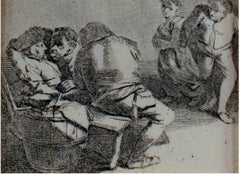
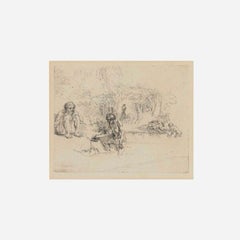
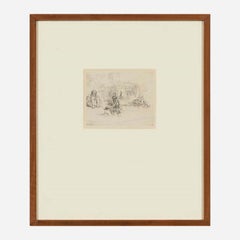
"The Singer" is an original etching by Cornelis-Pietersz Bega. It depicts a performer and onlookers. Publisher: Pearce #50. 4" x 3" art 16 1/2" x 13 1/2" frame Cornelis Pietersz Be...
Category

Mid-17th Century Old Masters Cornelis Bega Art

Materials

Etching

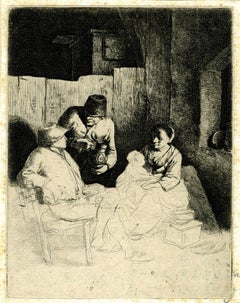
The Mother Seated in an Inn
By Cornelis Bega
Located in Middletown, NY
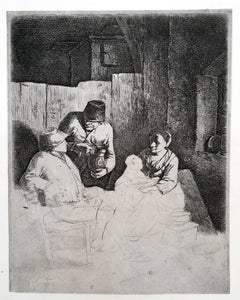
Etching on cream laid paper with an indiscernible horizontal watermark, 6 1/8 x 4 11/16 inches (154 x 120 mm). Thread margins. The first state (of two), before the additional work on...
Category

17th Century Old Masters Cornelis Bega Art

Materials

Handmade Paper, Laid Paper, Etching

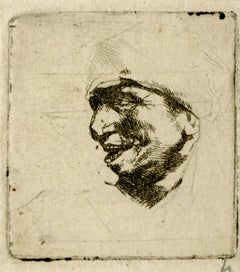
Head of a Laughing Peasant
By Cornelis Bega
Located in Middletown, NY
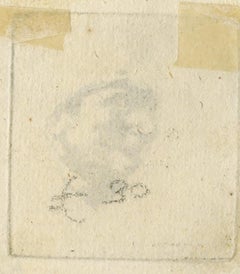
Etching on white laid paper, 1 5/8 x 1 1/2 inches (41 x 38 mm), thread margins. In excellent condition with a light pencil inscription on the verso. [Hollstein 6]
Category

17th Century Old Masters Cornelis Bega Art

Materials

Handmade Paper, Laid Paper, Etching

The Young Hostess
By Cornelis Bega
Located in New York, NY
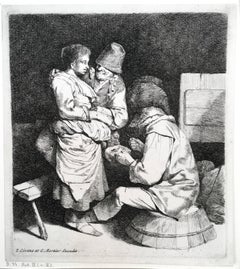
Cornelis Bega (active 1631/32-64), The Young Hostess, c. 1660-64, etching. Reference: Hollstein, Bartsch 33, third state (of 5). With the address of J. Covens and C Mortier bottom left - before the address was removed (in the fourth state) and the artist’s signature was added (in the fifth state). In excellent condition, printed in black/grey ink on an old laid paper, with a 3/16 inch margin outside the plate mark all around, archival matting. Provenance: Ex collection Graff (with stamp verso, Lugt 1092a), LRV (with stamp verso, Lugt 1761), an unidentified collector’s stamp verso, and Dr. Karl Herveg (his stamp verso, Lugt 3974). A very good impression, with the guidelines of the address strongly visible. Dr. Karl Herweg was a noted collector of 17th Century Dutch prints...
Category

1660s Old Masters Cornelis Bega Art

Materials

Etching

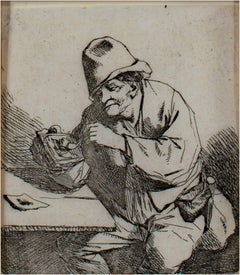
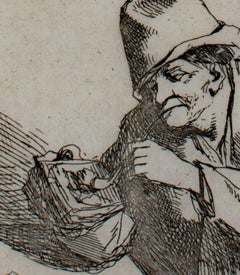
17th century etching black and white figure table tobacco pipe scene
By Cornelis Bega
Located in Milwaukee, WI
"The Pipe Smoker" is an original etching by Cornelis-Pietersz Bega. It depicts a man sitting at a table with his pipe. Publisher: Pearce #38. 3 1/2" x 3 1/4" art 13 5/8" x 11 3/4" f...
Category

Mid-17th Century Old Masters Cornelis Bega Art

Materials

Etching

17th century etching black and white indoors table figures scene
By Cornelis Bega
Located in Milwaukee, WI
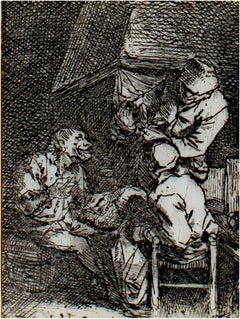
"The Conversation" is an original etching by Cornelis-Pietersz Bega. It depicts three men conversing in a dark interior. Publisher: Pearce #43. 3" x 2 1/4" art 12 3/4" x 11 5/8" fra...
Category

Mid-17th Century Old Masters Cornelis Bega Art

Materials

Etching

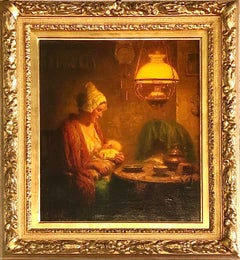
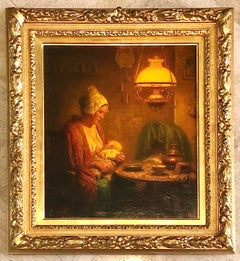
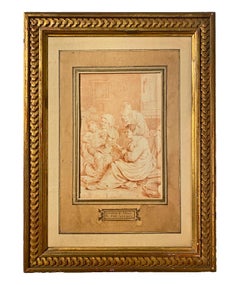
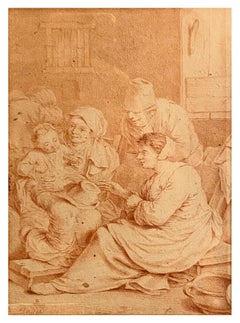
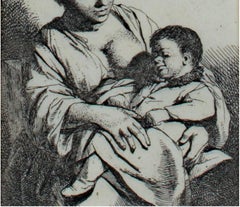
The Mother Seated in an Inn
By Cornelis Bega
Located in New York, NY
Cornelis Bega (1631/2-1664), The Mother Seated in an Inn, etching, circa 1660-64. Reference: Hollstein 31, a later impression, second state (of 2). In good condition, trimmed outside...
Category

1660s Old Masters Cornelis Bega Art

Materials

Etching

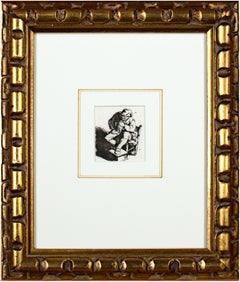
'The Smoker (Le Fumeur)' original etching by Cornelis-Pietersz Bega
By Cornelis Bega
Located in Milwaukee, WI
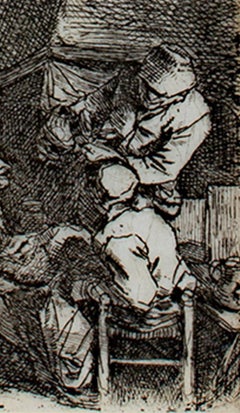
'The Smoker (Le Fumeur)' is an original etching by the celebrated Dutch painter and printmaker Cornelis-Pietersz Bega. It presents a genre scene of the type Bega was best known for: Bega's principal subjects were genre representations of taverns, domestic interiors and villages. He depicted nursing mothers, prostitutes, drunks, gamblers and fools such as quack doctors and alchemists. In this case, he shows a man seated on a chair with his foot on a flat stool and holding a smoking pipe. For Bega, this representation was more of a caricature than it was an image of a specific person, and such genre scenes would have held allegorical and symbolic meaning for the seventeenth-century viewer. During the seventeenth century, the Dutch of all levels of society consumed tobacco and alcohol, and these were an important part of the Dutch economy and a major source of wealth. At the same time, however, moralists and ministers sought to curb intoxication: they openly described drinking and smoking as sinful, immoral, and a general threat to one’s reputation. This paradox is reflected in prints such as this, which inherently carry the national pride of the Dutch economy alongside a moral warning in a print that could be just as easily consumed and collected. 2.5 x 2.25 inches, print 12.38 x 10.38 inches, frame Framed to conservation standards using archival materials including 100 percent rag matting and mounting materials. Housed in a gold finish Spanish-style wood moulding. Overall good and stable condition; margins cut to plate; some wrinkling in the corners from previous mounting; housed in a new custom frame. Cornelis Bega was born into prosperous circumstances. His mother, Maria Cornelis, inherited half the estate (gold, silver, paintings, drawings and prints) and all of the red chalk drawings of her father, Cornelis Cornelisz van Haarlem, a renowned Mannerist artist. Bega's father was Pieter Jansz Begijn (d 1648), a gold and silversmith. Like other family members, Bega was probably Catholic. Houbraken's claim that Bega studied with Adriaen van Ostade is likely to be correct; this was probably before 24 April 1653, when Bega joined Vincent Laurentsz. van der Vinne in Frankfurt for a journey through Germany, Switzerland and France. Bega had returned to Haarlem by 1 September 1654, at which time he joined the Guild of St Luke; he was already a competent draughtsman, as indicated by his first extant dated work, Interior with a Nursing Mother (1652; Frankfurt am Main, Städel. Kstinst.), and by a remarkable double portrait (Amsterdam, Rijksmuseum) drawn by him and Leendert van der Cooghen in 1654. Bega painted, drew, etched and made counterproofs in a wide variety of materials on different types of small-scale supports. He may have been the first Dutch artist to make monotypes, but this remains controversial. Approximately 160 paintings, 80 drawings and six monotypes by Bega have been catalogued, as well as around 34 etchings. Bega's principal subjects were genre representations of taverns, domestic interiors and villages. He depicted nursing mothers, prostitutes, drunks, smokers, gamblers and fools such as quack doctors and alchemists. Less common subjects include the ridiculed or pestered woman, as in Two Figures and Mother with a Spirits Bottle (c. 1662; Gouda, Stedel, Museum Catharina Gasthuis) and The Inn (etching), as well as witty satires on traditional scenes of middle-class music-makers, such as the Music Lesson (1663; Paris, Petit Palace). Bega's early paintings, such as the Weaver's Family (c. 1652; St Petersburg, Hermitage), are freely executed, dark and coarse, recalling the many-figured peasant subjects of van Ostade. Between c. 1660 and 1664 he began to paint genre scenes with fewer figures, which are finely articulated, colourful and psychologically expressive, for example Two Men Singing (1662; Dublin, N.G.). His exquisite, late fijnschilderen ('fine painting') manner, evident in The Alchemist (1663; Malibu, Getty Museum), compares well with that of Gerrit Dou. As a draughtsman Bega is noted for his single-figure studies, executed mainly in black and white chalk on blue paper or red chalk on white paper. None of the studies, which were drawn naer het leven (from life), seem to relate to a painting or etching. Bega traded drawings or shared models with other artists of the Haarlem school, including van der Cooghen, Gerrit Berckheyde, Dirck Helmbreker and Cornelis Visscher. These artists drew chalk figure studies in a very similar style, characterised by regular and precise parallel shading and well-defined forms; their drawings, especially those of Bega and Berckheyde, have been frequently confused. Unlike the realistic figure studies, Bega's etchings depict interiors with figures or single figures in the manner of van Ostade; the compositions, often with masterful chiaroscuro effects, reflect most closely the paintings of the 1650s. Bega is likely to have remained in Haarlem, where he paid dues to the Guild in 1661. He probably died from the plague; fees for his expensive funeral at St. Bavo's were paid on 30 August 1664. Among the artists he influenced were Thomas Wijck, Jan Steen, Richard Brakenburg (1650-1702) and Cornelis Dusart. Painters such as R. Oostrzaen ( fl ?1656) and Jacob Toorenvliet...
Category

17th Century Old Masters Cornelis Bega Art
Materials

Paper, Etching

17th century etching black and white indoor dramatic figures scene
By Cornelis Bega
Located in Milwaukee, WI
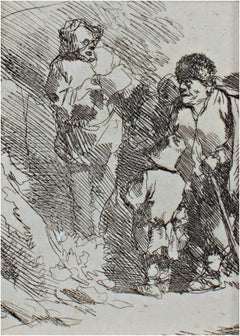
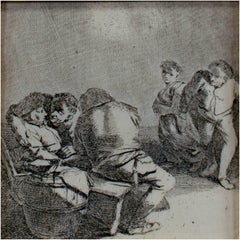
"The Meeting" is an original etching by Cornelis-Pietersz Bega. It depicts a confrontation between two groups of figures. Publisher: Pearce #48. 2 3/4" x 2 3/4" art 10 1/4" x 10 3/8...
Category

Mid-17th Century Old Masters Cornelis Bega Art
Materials

Etching

17th century etching black and white dramatic window figure scene
By Cornelis Bega
Located in Milwaukee, WI
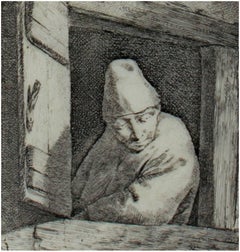
"Man Looking Through a Window" is an original etching by Cornelis-Pietersz Bega. It depicts a figure leaning through a window. Publisher: Pearce #37. 3 1/8" x 3" art 14 3/4" x 13 1/...
Category

Mid-17th Century Old Masters Cornelis Bega Art
Materials

Etching

17th century etching black and white mother and child figures scene
By Cornelis Bega
Located in Milwaukee, WI
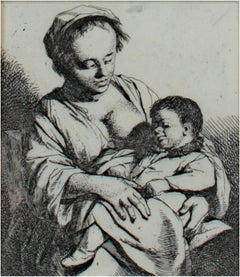
"Mother & Child" is an original etching by Cornelis-Pietersz Bega. It depicts a mother and her child. Publisher: Pearce #51. 3" x 3" art 13 3/4" x 11 3/4" frame Cornelis Pietersz B...
Category

Mid-17th Century Old Masters Cornelis Bega Art
Materials

Etching

Related Items
Hadrian's Mausoleum, Castel S. Angelo: A Framed 18th Century Etching by Piranesi
By Giovanni Battista Piranesi
Located in Alamo, CA
This large framed 18th century etching by Giovanni Battista Piranesi entitled "Veduta del Mausoleo d'Elio Adriana ora chiamato Castello S. Angelo nella parte opposta alla Facciata de...
Category

1750s Old Masters Cornelis Bega Art

Materials

Etching

The Roman Colosseum: A Framed 18th Century Etching of the Interior by Piranesi
By Giovanni Battista Piranesi
Located in Alamo, CA
This large framed 18th century etching by Giovanni Battista Piranesi entitled "Veduta dell'interno dell'Anfiteatro Flavio detto il Colosseo" (View of the interior of the Flavian Amph...
Category

1760s Old Masters Cornelis Bega Art

Materials

Etching

Church of St. Costanza, Rome: An 18th Century Piranesi Architectural Etching
By Giovanni Battista Piranesi
Located in Alamo, CA
This is a framed 18th century Giovanni Battista Piranesi etching entitled: "Veduta interna del Sepocro di Santa Costanza, fabbricat...
Category

1770s Old Masters Cornelis Bega Art

Materials

Etching

Ancient Roman Temple Architecture: An 18th Century Framed Etching by Piranesi
By Giovanni Battista Piranesi
Located in Alamo, CA
This is an 18th century etching by Giovanni Battista Piranesi entitled "Veduta del Tempio detto della Tosse su la Via Tiburtina, un miglio vicino a Tivoli" (View of the so-called Tem...
Category

1760s Old Masters Cornelis Bega Art

Materials

Etching

Crucifixion: 18th Century Etching by Conrad Metz after Daniele da Volterra
Located in Alamo, CA
"Crucifixion" is an etching and aquatint, printed in brown ink by Conrad M. Metz after a painting by Daniele da Volterra. It was published in London in 1789 in 'Imitations Of Ancient...
Category

Late 18th Century Old Masters Cornelis Bega Art
Materials

Etching, Aquatint

Column of Trajan in Rome: A Framed Original 19th C. Etching by Luigi Rossini
By Luigi Rossini
Located in Alamo, CA
This early 19th century etching entitled "Veduta dello scavo del Foro Trajano" was created by Luigi Rossini and included in his publication "Le Antichita Romane" (The Rome of Antiquity), published in Rome in 1823. It depicts the historical victory column of Trajan standing amidst the rubble of broken columns that remain around it. The etching is presented in a black wood frame with a light brown outer mat and a dark brown inner mat. There are several frame abrasions. The print and mats are in very good condition. The frame measures 27" high, 29.07" wide and 0.5" deep. The print is framed and matted in the identical style as the another etching of an ancient Roman landmark, the Piazza Navona, which is also listed on 1stdibs, see item # LU117326144172. The pair would make an attractive display grouping of Roman architecture. A discount is available for purchase of the pair of prints. Luigi Rossini (1790-1857) like his predecessors, Giovanni Piranesi (1720–1778) and Giuseppi Vasi (1710-1782), was an architect and artist. Like Piranesi and Vasi, he wanted to glorify the architecture of ancient Rome, which he felt was deteriorating and needed to be documented. Several of the ruins he illustrated have, in fact, since disappeared leaving only his images as a record of their appearance. His images of the grand edifices of the city dramatically depict the power and glory...
Category

1820s Old Masters Cornelis Bega Art

Materials

Etching

William Hogarth's "Analysis of Beauty": A Set of Two Framed 18th C. Engravings
By William Hogarth
Located in Alamo, CA
The two plates in this set were created utilizing both engraving and etching techniques by William Hogarth in 1753, originally as illustrations of his book on aesthetics, entitled "Analysis of Beauty". Due to their popularity, these plates were later published separately. The publication line in the lower right reads: "Designed, Engraved, and Publish'd by Wm. Hogarth, March 5th 1753, according to Act of Parliament." Hogarth's original copper plates were refurbished where needed by James Heath and engravings were republished in London in 1822 by Braddock, Cradock & Joy. This was the last time Hogarth's copper plates were used for printing. Most were melted during World War I for the construction of bombs. These large folio sized "Analysis of Beauty" engravings are presented in antiqued gold-colored frames with double mats; the outer silk mats are light brown-colored and the inner mats are dark brown. Each frame measures 27.38" x 31.25" x 1.13". There is one tiny spot in the right margin of plate 1 and another in the lower margin; the latter could be from the printing process. The prints are otherwise in excellent condition. The "Analysis of Beauty" series is in the collection of many major museums, including: The British Museum, The Metropolitan Museum of Art, The Tate Museum, The Chicago Art Institute and The Fine Arts Museums of San Francisco. The first engraving (Plate 1) depicts a courtyard of statues which is filled with some of the most famous works of classical sculpture. The most important sculptures are surrounded by less impressive works. The Medicean Venus (#13) is in the center with a statue of Julius Caesar (#19) to the right, elevated on a pulley with a short, overdressed Brutus stands over the falling Caesar. The Apollo Belvedere (#12) is next. A judge stands to the right with his foot on a cherub (#16). Another crying cherub holds a gallows and wipes his tears with the judge's robe. A sphinx (#21) and the drunken Silenus (#107) are below the Venus. Michaelangelo's torso (#54) and a statue of Antonius (#6) are seen in the foreground. The Farnese Hercules (#3) and a bust of another Hercules (#4) under two statuettes of Isis are also included in the scene. The key to these objects is included in the form of a serpentine line winding around a cone (#26), Hogarth's "Line of Beauty". For Hogarth the winding line is an essential element of beauty in art. Hogarth's theory of beauty is communicated in this plate. Plate 2 is thought to represent the Wanstead Assembly, with the Earl of Tynley and his household. It is an adaptation of a scene in the Happy Marriage series, which complements Hogarth's Marriage à la Mode...
Category

Mid-18th Century Old Masters Cornelis Bega Art
Materials

Engraving, Etching

Ancient Roman Marble Vase: 18th C. Piranesi Etching Vaso Cinerario di Gran Mole
By Giovanni Battista Piranesi
Located in Alamo, CA
"Vaso Cinerario di Gran Mole. Le Teste dei Giovenchi mostrano di reggere it pesante Festone composto di Frutti Fiori Grans ed use. Il tuto Necefsario all Vita Umana. Il Restante degl...
Category

1760s Old Masters Cornelis Bega Art

Materials

Etching

The Basilica of St. Paul in Rome, Early 19th Century Etching by Luigi Rossini
By Luigi Rossini
Located in Alamo, CA
"Rovina della gran Basilica di S. Paolo fueri le mura accaduta" (View of the Ruins of the Great Triumphal Arch of S. Paolo Fuori le Mura) from "Le Antichita Romane" (Ancient Rome), published in Rome in 1823. It depicts the destruction of the Basilica of St. Paul after the fire of 1823. People stand in the road and on the right observing the damage amid debris, which includes many fragments of columns. The etching is presented in a silver-color wood frame with an off-white double mat with a black inner mat. There are a few small spots, but it is otherwise in very good condition. See item # LU117324669722 for another Rossini etching...
Category

1820s Old Masters Cornelis Bega Art

Materials

Etching

St. Simon from Les Grands Apôtres Debout Original 17th Century Etching
By Jacques Callot
Located in Soquel, CA
St. Simon from "Les Grands Apôtres Debout, Représentant Le Sauveur, La Bienheureuse Marie et Les Saints Apôtres" Original 17th Century Etching by Jacques Callot. This portrait of St. Simon depicts him standing in a street, holding a book and leaning on a saw. The saw is typical of St. Simon's depictions as he was said to have been martyred by being sawed in half. Very good impression of this print, with bold lines and high contrast. This leaflet contains the words "Callot fec." in the bottom right, shorthand for the Latin fecit, meaning Callot made this. This edition contains no publishers mark or numbering on the piece, indicating that it is from the first printing state. Jacques Callot was born in the Duchy of Lorraine around 1592 to an important family in the court. He started an apprenticeship as a goldsmith at the age of 15, but later began learning etching. He is known for his technical skill in etching and for developing the echoppe style etching needle. Callot's etchings featured religious figures as well as soldiers, common people, beggars, and court individuals. His series "The Miseries and Misfortunes of War," published while Lorraine was invaded during the Thirty Years War, later influenced Goya's "Los Desastres de la Guerra...
Category

17th Century Old Masters Cornelis Bega Art
Materials

Ink, Laid Paper, Etching

Piazza Navona in Rome: A Framed Original 18th Century Etching by Barbault
Located in Alamo, CA
This early 19th century etching entitled "Veduta di Piazza Navona sopra le rovine del Circo" was created by Jean Barbault (1718-1762) after a painting by...
Category

Mid-18th Century Old Masters Cornelis Bega Art
Materials

Etching

"Gertrude" - Eleven Color Woodcut on Laid Rice Paper 2/45
Located in Soquel, CA
"Gertrude" - Eleven Color Woodcut on Laid Rice Paper 2/45 Portrait of a woman by artist, Dan Miller (American, b. 1928) made by layers of color in woodcuts in Miller's signature sty...
Category

1980s Contemporary Cornelis Bega Art
Materials

Rice Paper, Laid Paper, Woodcut

Cornelis Bega art for sale on 1stDibs.
Find a wide variety of authentic Cornelis Bega art available for sale on 1stDibs. You can also browse by medium to find art by Cornelis Bega in etching, paper and more. Much of the original work by this artist or collective was created during the 18th century and earlier and is mostly associated with the Old Masters style. Not every interior allows for large Cornelis Bega art, so small editions measuring 11 inches across are available. Customers who are interested in this artist might also find the work of Adriaen van Ostade, Wenceslaus Hollar, and Israel Silvestre. Cornelis Bega art prices can differ depending upon medium, time period and other attributes. On 1stDibs, the price for these items starts at $500 and tops out at $3,375, while the average work can sell for $2,295.
Artists Similar to Cornelis Bega